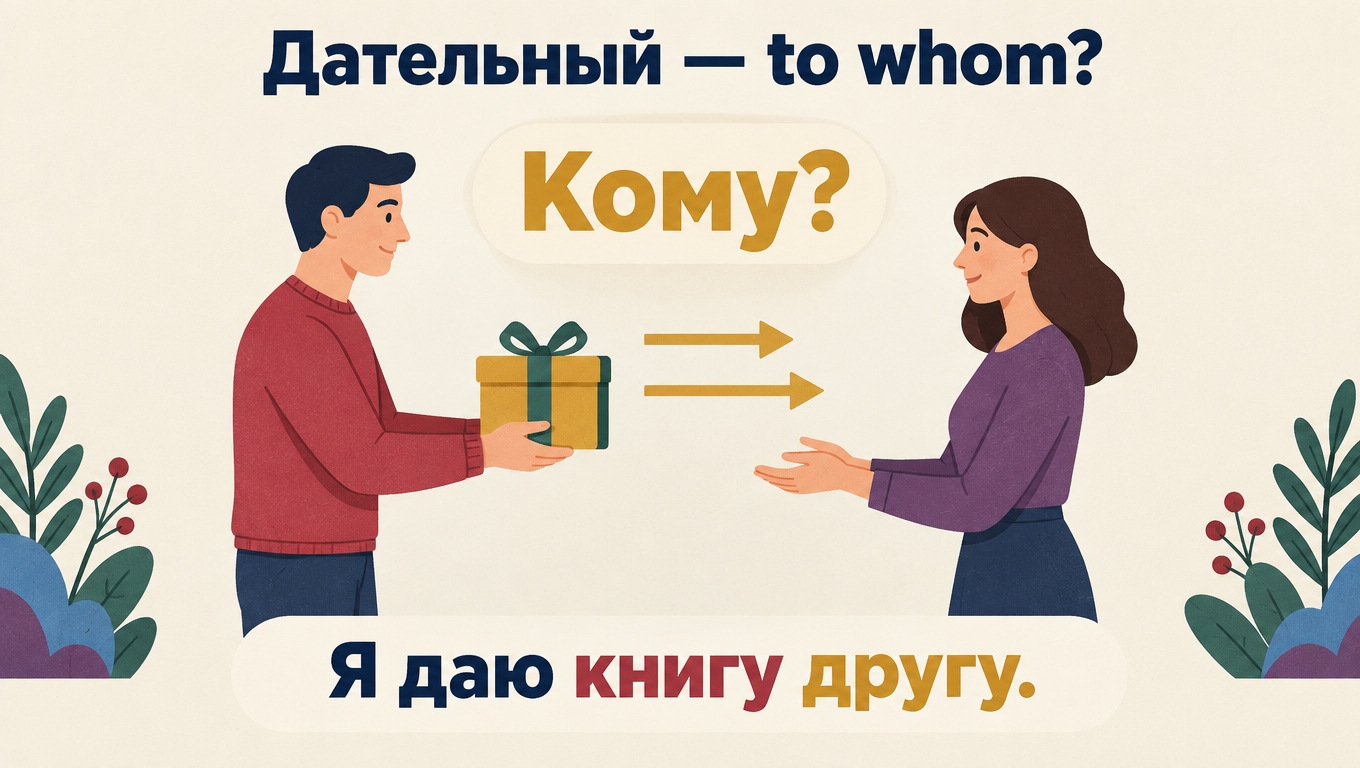
The dative is the friendliest of the Russian cases: three endings in the singular, two in the plural, and no animacy to worry about. It names the person everything is aimed at — the one you help, ring, give, show and explain to — and it is the case of «Мнехолодно», «Мненадо» and «Мнетридцатьлет», three sentences with no subject and no verb at all.
⏱ About 55 minutes26 phrases34 exercises
What you will learn
Recognise the dative as the case of the person an action is aimed at, and know the questions it answers: Кому? Чему?
Form the dative singular and plural of nouns — -у / -ю, -е, -ам / -ям — including the -и of России and of the third declension
Use the seven dative pronouns мне, тебе, ему, ей, нам, вам and им, and know what changes after a preposition: комне, кнему, кней
Say how you feel with мне plus a state word — холодно, жарко, скучно, интересно, плохо, хорошо, весело, грустно, трудно, легко — and put it in the past and future with было and будет
Use the verbs that demand the dative: помогать, звонить, давать, говорить, показывать, объяснять and нравиться
Use the two dative prepositions к and по — кврачу, погороду — say what you must, may and must not do, and ask and answer someone’s age
Quick review
Say these aloud before you start. They come from earlier lessons.
Я чита́ю кни́гу.I am reading a book. (accusative — Lesson 6)Listen in Russian:Slow in Russian:Я чита́ю кни́гу.
Я живу́ в Москве́.I live in Moscow. (prepositional — Lesson 5)Listen in Russian:Slow in Russian:Я живу́ в Москве́.
У меня́ нет вре́мени.I haven’t got any time. (genitive — Lesson 8)Listen in Russian:Slow in Russian:У меня́ нет вре́мени.
Он идёт на рабо́ту.He is going to work. (accusative of direction — Lesson 6)Listen in Russian:Slow in Russian:Он идёт на рабо́ту.
Мне нра́вится Москва́.I like Moscow. (the мне in it is already a dative — Lesson 4)Listen in Russian:Slow in Russian:Мне нра́вится Москва́.
Как дела́?How are things? (Lesson 3)Listen in Russian:Slow in Russian:Как дела́?
Theory
Кому? Чему? — the case of the person aimed at
The dative answers two questions, Кому? and Чему?, and it has one core idea: it names the person or thing an action is aimed at. English marks the same idea with "to" — or, more often, with nothing at all: "give me the book", "help him", "ring your mother". That is why the ending feels like an extra job. In Russian it is one ending and no preposition, and once you have it you have the recipient for every verb that needs one.
You have been using the dative since Lesson 4 without being told. The мне in «МненравитсяМосква» is the dative of я. So is the мне in «Мнехолодно» and «Мненадоработать». Each of those was taught as an unanalysed chunk, and each was quietly doing the same grammatical work: putting the person who feels, likes or must at the receiving end of the sentence. Today the chunks open up.
There is good news about difficulty. This course introduces the cases in the standard order — nominative, prepositional, accusative, genitive, dative — and the dative is the easiest of the five you now have. Three endings in the singular, two in the plural, no animacy split, no fleeting vowels, and no preposition needed for its central meaning. The only real work is remembering which verbs and which state words ask for it.
Я даю́ кни́гу ма́ме.I am giving the book to Mum. (книга is accusative — the thing given; мама is dative — the person it goes to)Listen in Russian:Slow in Russian:Я даю́ кни́гу ма́ме.
Помоги́те мне, пожа́луйста.Help me, please. (the person helped is in the dative, with no preposition at all)Listen in Russian:Slow in Russian:Помоги́те мне, пожа́луйста.
Мне хо́лодно.I am cold. (the person is in the dative; there is no verb)Listen in Russian:Slow in Russian:Мне хо́лодно.
Мы идём к врачу́.We are going to the doctor’s. (к + dative for movement towards a person)Listen in Russian:Slow in Russian:Мы идём к врачу́.
The endings: -у / -ю, -е, -ам / -ям
In the singular, masculine and neuter nouns add -у or -ю: -у after a hard consonant and after the hissing ж, ш, ч and щ — стол → столу, город → городу, письмо → письму, врач → врачу — and -ю after any other soft consonant and after -й: музей → музею, учитель → учителю. Feminine nouns in -а and -я add -е: мама → маме, книга → книге, работа → работе. That is the whole of it, and if you know the gender and the ending of the nominative you already know which shape applies.
Two exceptions are worth learning now rather than unlearning later. Nouns in -ия, -ий and -ие take -и instead of -е or -ю: Россия → России, Италия → Италии, здание → зданию. But музей ends in -й, not in -ий, so it takes the regular -ю: музею. Third-declension feminines in a soft sign also take -и: жизнь → жизни, вещь → вещи, ночь → ночи, площадь → площади.
The plural is the easy half. Every noun, whatever its gender, takes -ам after a hard consonant and after the hissing ж, ш, ч and щ, and -ям after any other soft consonant and after -й: столам, врачам, мамам, окнам, but музеям, жизням, Россиям. What you cannot predict is the stress. Some nouns keep it on the stem — ма́мам, кни́гам, жи́зням — and some move it onto the ending — стола́м, врача́м, города́м. The singular behaves the same way: го́роду but столу́, дру́гу but врачу́. Learn the stress with each noun, out loud, and this stops being a rule and becomes a habit.
стол — столу́ — стола́мtable — to the table — to the tablesListen in Russian:Slow in Russian:стол — столу́ — стола́м
врач — врачу́ — врача́мdoctor — to the doctor — to the doctorsListen in Russian:Slow in Russian:врач — врачу́ — врача́м
ма́ма — ма́ме — ма́мамmum — to mum — to the mumsListen in Russian:Slow in Russian:ма́ма — ма́ме — ма́мам
жизнь — жи́зни — жи́знямlife — to the life — to the lives (third declension takes -и)Listen in Russian:Slow in Russian:жизнь — жи́зни — жи́зням
Verbs that demand the dative
Some verbs simply insist on a particular case. That insistence is called government, and it has to be learnt with the verb rather than worked out from English. Six of the most useful Russian verbs take the dative for their person: помогать "to help", звонить "to ring", давать "to give", говорить "to tell", показывать "to show" and объяснять "to explain". Add нравиться from Lesson 4 and you have the whole core set.
They divide into two groups. помогать, звонить and нравиться put their person in the dative and take no accusative object, so the English and the Russian line up almost word for word — "I help Mum", «Япомогаюмаме» — minus the preposition that English does not use either. The other three carry two objects: the person in the dative and the thing in the accusative. «Ядаютебекнигу» — тебе is dative, книгу accusative. «Онаобъясняетмнеэто» — мне dative, это accusative.
The trap is that English hides the recipient. "I ring my mum" contains no "to", and neither does «Язвонюмаме» — but the Russian noun still changes its ending, and if it does not, the sentence is simply wrong. One more pattern is worth knowing while you are here: говорить takes the dative for its listener and о + prepositional for its topic, which you met in Lesson 5 (говоритьоработе). The "with someone" version, говоритьскем, needs the instrumental, and that is Lesson 10. One last thing, because the dialogues use it: a polite request is built on the perfective imperative — Помоги́темне, Объясни́темне — and not on the imperfective помога́йте and объясня́йте, which mean "keep on helping" and "keep on explaining". Perfective verbs arrive in Lesson 13; until then, learn those two request formulas whole.
Я помога́ю ма́ме.I am helping Mum.Listen in Russian:Slow in Russian:Я помога́ю ма́ме.
Она́ звони́т дру́гу.She is ringing her friend.Listen in Russian:Slow in Russian:Она́ звони́т дру́гу.
У́читель объясня́ет нам э́то.The teacher is explaining it to us.Listen in Russian:Slow in Russian:У́читель объясня́ет нам э́то.
Он пока́зывает мне письмо́.He is showing me the letter.Listen in Russian:Slow in Russian:Он пока́зывает мне письмо́.
Мне + a state: the sentence with no subject
Russian says "I am cold", "I am bored" and "I feel awful" with no verb and no subject at all. The person goes into the dative and the state is an invariable word ending in -о: Мнехолодно, Мнежарко, Мнескучно, Мнеинтересно, Мнеплохо, Мнехорошо, Мневесело, Мнегрустно, Мнетрудно, Мнелегко. Nothing conjugates and nothing agrees. It is the zero copula of Lesson 1 taken one step further — there the noun was missing, here the subject is too.
The dative person may be dropped when it is obvious, so «Холодно!» on its own already means "it is cold". And it may be anyone: Тебескучно? Емутрудно? Ейвесело? Намхорошо? The state word does not change for gender or number, which is why «Ейбылоскучно» and «Имбылоскучно» share one скучно between them. Tense is carried by the copula coming back: было in the past, будет in the future, both neuter singular because there is no subject for them to agree with.
The same frame does obligation and permission, and you already know four of its words from Lesson 4: Мненадоработать, Тебенужночитать, Намможноидти, Здесьнельзя. Add an infinitive and the sentence says what may or must happen; leave the infinitive out and it is a general verdict on the situation. нельзя is the negative of можно, and it is its own word — there is no *неможно, and ненадо means something gentler, "there is no need".
Мне хо́лодно.I am cold.Listen in Russian:Slow in Russian:Мне хо́лодно.
Тебе́ ску́чно?Are you bored?Listen in Russian:Slow in Russian:Тебе́ ску́чно?
Нам на́до идти́.We have to go.Listen in Russian:Slow in Russian:Нам на́до идти́.
Мне бы́ло тру́дно.I was finding it hard. (было carries the whole past tense)Listen in Russian:Slow in Russian:Мне бы́ло тру́дно.
к, по — and how old you are
к + dative is movement towards, and at this level almost always towards a person: Яидукврачу, Мыидёмкдругу, Ониидуткнам. Keep it apart from в + accusative, which is movement into a building or a town: Яидувбольницу but Яидукврачу, ЯедувМоскву but Яедуксестре. Two small things to remember — before мне and a few other consonant clusters к becomes ко, giving комне, and after any preposition the third-person pronouns grow an н: кнему, кней, кним.
по + dative is movement spread over an area rather than aimed at a point: гулятьпогороду, ездитьпоРоссии, ходитьпопарку. It is the preposition to reach for when the wandering matters more than the destination, and it survives in fixed chunks such as потелефону — звонитьпотелефону. по takes other cases with other meanings, "one each" and "after" among them; those come later, and the meaning taught here is always the dative.
Age uses the dative too, and it is worth learning whole rather than assembling. «Сколькотебелет?» is literally "how many years to you?" — the person in the dative, the number, and лет, the genitive plural of год. The answer keeps the frame: «Мнетридцатьлет». One word of honesty: which of год, года and лет a given number takes is the business of Lesson 11, where the numerals and their government arrive properly. Today, take the question and a couple of answers as fixed chunks and you will be right every time.
Мы идём к врачу́.We are going to the doctor’s.Listen in Russian:Slow in Russian:Мы идём к врачу́.
Они́ гуля́ют по го́роду.They are walking around the town.Listen in Russian:Slow in Russian:Они́ гуля́ют по го́роду.
Ско́лько тебе́ лет?How old are you?Listen in Russian:Slow in Russian:Ско́лько тебе́ лет?
Мне три́дцать лет.I am thirty. (literally "to me thirty years")Listen in Russian:Slow in Russian:Мне три́дцать лет.
Кому? Чему? — the dative endings
Form
стол (m, hard)
музе́й (m, -й)
ма́ма (f, -а)
Росси́я (f, -ия)
окно́ (n, -о)
Кто? Что? — Nominative
стол
музе́й
ма́ма
Росси́я
окно́
Кому? Чему? — Dative singular
столу́
музе́ю
ма́ме
Росси́и
окну́
The ending
-у
-ю
-е
-и
-у
Кому? — Dative plural
стола́м
музе́ям
ма́мам
Росси́ям
о́кнам
The plural ending
-ам
-ям
-ам
-ям
-ам
Three endings carry the whole case in the singular: -у after a hard consonant and after the hissing жшчщ, -ю after any other soft consonant and after -й, -е for feminines in -а and -я. Nouns in -ия, -ий and -ие take -и instead, hence России — but музею, because -й is not -ий. The plural is uniform: -ам after a hard consonant or a hissing one, -ям after any other soft consonant. Watch the stress: столу́ and окну́ put it on the ending, го́роду keeps it on the stem, and the plural is о́кнам but стола́м and врача́м.
The dative pronouns — семьслов
Form
я
ты
он
она́
мы
вы
они́
Nominative
я
ты
он
она́
мы
вы
они́
Dative — Кому?
мне
тебе́
ему́
ей
нам
вам
им
After к
комне
ктебе́
кнему́
кней
кнам
квам
кним
In a sentence
Мнехо́лодно.
Тебе́ску́чно?
Ему́тру́дно.
Ейве́село.
Намна́доидти́.
Ваммо́жно.
Имхорошо́.
Seven short words, and between them they cover most of what the dative is for at this level. Two things happen when a preposition is added: к becomes ко before мне, and the third-person forms grow an н — кнему, кней, кним. Everything else in the sentence stays exactly where it was: the state word, надо, можно and нельзя never agree with anything.
Verbs that demand the dative
Form
помога́ть
звони́ть
дава́ть
говори́ть
пока́зывать
объясня́ть
я-form
помога́ю
звоню́
даю́
говорю́
пока́зываю
объясня́ю
Government
+ dative
+ dative
+ dative + accusative
+ dative + accusative
+ dative + accusative
+ dative + accusative
In a sentence
Япомога́юма́ме.
Язвоню́дру́гу.
Ядаю́тебе́кни́гу.
Яговорю́врачу́. э́то.
Япока́зываюейписьмо́.
Яобъясня́ювамэ́то.
нравиться from Lesson 4 belongs in the same table: МненравитсяМосква. Learn each verb together with the case it demands, never the verb alone. говорить also takes о + prepositional for its topic — говоритьоработе, Lesson 5 — and the "with someone" version, говоритьскем, needs the instrumental, which is Lesson 10.
Мне + state, Мне + надо + infinitive
Form
state word
на́до / ну́жно + infinitive
мо́жно / нельзя́ + infinitive
present
Мнехо́лодно.
Мнена́дорабо́тать.
Мнемо́жночита́тьздесь?
past
Мнебы́лохо́лодно.
Мнена́добы́лорабо́тать.
Мнемо́жнобы́лочита́тьздесь?
future
Мнебу́детхо́лодно.
Мнена́добу́детрабо́тать.
Мнемо́жнобу́детчита́тьздесь?
The state word and the modal are invariable: the whole of the past and the future is carried by было and будет, exactly as the zero copula of Lesson 1 predicted. Both are neuter singular because there is no subject for them to agree with. The dative person may be dropped in every cell — Холодно, Надоработать, Здесьнельзя.
Vocabulary
Learn each word with its stress mark and its pronunciation. Nouns are given with their gender, animacy and their full six-case declension; verbs are given with their aspect and, where one exists, their partner verb.
Russian
English
Gender / aspect
Pronunciation
Audio
помога́тьimperfective
to help (someone — dative)
imperfective
/pəmɐˈɡatʲ/puh-muh-GYAT
Listen in Russian:Slow in Russian:помогать
звони́тьimperfective
to ring, to phone (someone — dative)
imperfective
/zvɐˈnʲitʲ/zvuh-NEET
Listen in Russian:Slow in Russian:звонить
пока́зыватьimperfective
to show (someone — dative, something — accusative)
imperfective
/pɐˈkazɨvətʲ/puh-KAH-zih-vyut
Listen in Russian:Slow in Russian:показывать
объясня́тьimperfective
to explain (to someone — dative)
imperfective
/əbjɪsʲˈnʲatʲ/ub-yih-SNYAT
Listen in Russian:Slow in Russian:объяснять
боле́тьimperfective
to be ill; to ache
imperfective
/bɐˈlʲetʲ/buh-LYET
Listen in Russian:Slow in Russian:болеть
голова́feminine · inanimate
head
feminine · inanimate
/ɡəlɐˈva/guh-luh-VAH
Listen in Russian:Slow in Russian:голова
го́рлоneuter · inanimate
throat
neuter · inanimate
/ˈɡorlə/GOH-rluh
Listen in Russian:Slow in Russian:горло
ве́селоadverb
fun, cheerful — мне весело = I am having a good time
adverb
/ˈvʲesʲɪlə/VYEH-sih-luh
Listen in Russian:Slow in Russian:весело
гру́стноadverb
sad — мне грустно = I feel sad
adverb
/ˈɡrusnə/GROO-snuh
Listen in Russian:Slow in Russian:грустно
тру́дноadverb
hard, difficult — мне трудно = I am finding it hard
adverb
/ˈtrudnə/TROOD-nuh
Listen in Russian:Slow in Russian:трудно
легко́adverb
easy, light — мне легко = I find it easy
adverb
/lʲɪxˈko/likh-KOH
Listen in Russian:Slow in Russian:легко
кpreposition
to, towards (a person or a thing) — takes the dative
preposition
/k/K
Listen in Russian:Slow in Russian:к
поpreposition
around, along (an area); by means of — takes the dative
preposition
/po/POH
Listen in Russian:Slow in Russian:по
хо́лодноadverb
cold — мне холодно = I am cold
adverb
/ˈxolədnə/KHOH-lud-nuh
Listen in Russian:Slow in Russian:холодно
жа́ркоadverb
hot — мне жарко = I am hot
adverb
/ˈʐarkə/ZHAHR-kuh
Listen in Russian:Slow in Russian:жарко
пло́хоadverb
bad, badly
adverb
/ˈploxə/PLOH-khuh
Listen in Russian:Slow in Russian:плохо
хорошо́adverb
good, well, OK
adverb
/xərɐˈʂo/khuh-ruh-SHOH
Listen in Russian:Slow in Russian:хорошо
интере́сноadverb
interesting — мне интересно = I find it interesting
adverb
/ɪntʲɪˈrʲesnə/in-tih-RYEH-snuh
Listen in Russian:Slow in Russian:интересно
ску́чноadverb
boring — мне скучно = I am bored
adverb
/ˈskuʂnə/SKOOSH-nuh
Listen in Russian:Slow in Russian:скучно
на́доadverb
must, have to, need to — мне надо + infinitive
adverb
/ˈnadə/NAH-duh
Listen in Russian:Slow in Russian:надо
ну́жноadverb
must, need to — a shade more formal than надо
adverb
/ˈnuʐnə/NOOZH-nuh
Listen in Russian:Slow in Russian:нужно
мо́жноadverb
may, it is allowed — можно? = may I?
adverb
/ˈmoʐnə/MOHZH-nuh
Listen in Russian:Slow in Russian:можно
нельзя́adverb
must not, it is forbidden, it is impossible
adverb
/nʲɪlʲˈzʲa/nil-ZYAH
Listen in Russian:Slow in Russian:нельзя
нра́витьсяimperfective
to be pleasing — мне нра́вится means "I like"
imperfective
/ˈnravʲɪt͜sə/NRAH-vih-tsyuh
Listen in Russian:Slow in Russian:нравиться
дава́тьimperfective
to give
imperfective
/dɐˈvatʲ/duh-VYAT
Listen in Russian:Slow in Russian:давать
говори́тьimperfective
to speak, to talk, to say
imperfective
/ɡəvɐˈrʲitʲ/guh-vuh-REET
Listen in Russian:Slow in Russian:говорить
яpronoun
I
pronoun
/ja/YAH
Listen in Russian:Slow in Russian:я
тыpronoun
you (informal, singular)
pronoun
/tɨ/TIH
Listen in Russian:Slow in Russian:ты
онpronoun
he
pronoun
/on/OHN
Listen in Russian:Slow in Russian:он
она́pronoun
she
pronoun
/ɐˈna/uh-NAH
Listen in Russian:Slow in Russian:она
врачmasculine · animate
doctor
masculine · animate
/vratɕ/VRAHCH
Listen in Russian:Slow in Russian:врач
другmasculine · animate
friend (male); plural друзья covers both sexes
masculine · animate
/druk/DROOKH
Listen in Russian:Slow in Russian:друг
го́родmasculine · inanimate
city, town
masculine · inanimate
/ˈɡorət/GOH-rut
Listen in Russian:Slow in Russian:город
годmasculine · inanimate
year
masculine · inanimate
/ɡot/GOHT
Listen in Russian:Slow in Russian:год
Full six-case declension of the 6 nouns in this lesson
Each case is listed with the question word that selects it. Find the question you are answering and the ending follows.
Singular
Form
голова́ (f)
го́рло (n)
врач (m)
друг (m)
го́род (m)
год (m)
nom · Кто? Что?
голова́
го́рло
врач
друг
город
год
gen · Кого? Чего?
го́ловы
го́рла
врача
дру́га
города
го́да
dat · Кому? Чему?
го́лове
го́рлу
врачу
дру́гу
городу
го́ду
acc · Кого? Что?
го́лову
го́рло
врача
дру́га
город
год
instr · Кем? Чем?
голо́вой
го́рлом
врачом
дру́гом
городом
го́дом
prep · Оком? Очём?
го́лове
го́рле
враче
дру́ге
городе
го́де
Plural
Form
голова́ (f)
го́рло (n)
врач (m)
друг (m)
го́род (m)
год (m)
nom · Кто? Что?
го́ловы
го́рла
врачи́
друзья́
города́
года́
gen · Кого? Чего?
голо́в
горл
враче́й
друзе́й
городо́в
лет
dat · Кому? Чему?
голова́м
го́рлам
врача́м
друзья́м
города́м
года́м
acc · Кого? Что?
го́ловы
го́рла
враче́й
друзе́й
города́
года́
instr · Кем? Чем?
голова́ми
го́рлами
врача́ми
друзья́ми
города́ми
года́ми
prep · Оком? Очём?
голова́х
го́рлах
врача́х
друзья́х
города́х
года́х
Ready-to-use phrases
Мне хо́лодно.
I am cold.
IPA/mnʲe ˈxolədnə/
Say itmuh-NYEH KHOH-lud-nuh.
The sentence of the lesson. There is no verb and no subject: the person who feels it is in the dative, and холодно is an invariable state word. Drop the Мне and «Холодно!» on its own still means "it is cold".
neutraldativeimpersonalfeelingsweather
Listen in Russian:Slow in Russian:Мне холодно.
Мне жа́рко.
I am hot.
IPA/mnʲe ˈʐarkə/
Say itmuh-NYEH ZHAHR-kuh.
The opposite of холодно, built the same way. Both are about how a person feels, not about the weather: for "it is cold outside" Russian uses the same word with no Мне, or the adjective — Наулицехолодно.
neutraldativeimpersonalfeelingsweather
Listen in Russian:Slow in Russian:Мне жарко.
Мне ску́чно.
I am bored.
IPA/mnʲe ˈskuʂnə/
Say itmuh-NYEH SKOOSH-nuh.
Remember the [шн] of скучно — the чн is pronounced [шн], so the word sounds like [ску́шно]. English "I am bored" has a subject and a participle; Russian has a person in the dative and one word that never changes.
neutraldativeimpersonalfeelings
Listen in Russian:Slow in Russian:Мне скучно.
Мне интере́сно.
I am interested; I find it interesting.
IPA/mnʲe ɪntʲɪˈrʲesnə/
Say itmuh-NYEH in-tih-RYEH-snuh.
One form covers both "I find it interesting" and "I am interested". Add an infinitive and it becomes a whole opinion: Мнеинтересночитатьобэтом.
neutraldativeimpersonalfeelingsstudy
Listen in Russian:Slow in Russian:Мне интересно.
Мне пло́хо.
I feel awful; I am not well.
IPA/mnʲe ˈploxə/
Say itmuh-NYEH PLOH-khuh.
The word you learnt in Lesson 1 as "badly" doing impersonal work: Мнеплохо covers feeling ill, feeling upset and feeling generally rotten. Its opposite is Мнехорошо.
neutraldativeimpersonalfeelingshealth
Listen in Russian:Slow in Russian:Мне плохо.
Мне хорошо́.
I feel fine; I am comfortable here.
IPA/mnʲe xərɐˈʂo/
Say itmuh-NYEH khuh-ruh-SHOH.
Three о, one stress, on the last: [xərɐˈʂo]. The first two reduce to [ə] and [ɐ]. Мнездесьхорошо is the natural way to say "I like it here".
neutraldativeimpersonalfeelings
Listen in Russian:Slow in Russian:Мне хорошо.
Мне ве́село.
I am having a good time.
IPA/mnʲe ˈvʲesʲɪlə/
Say itmuh-NYEH VYEH-sih-luh.
New in this lesson, and the cheerful end of the same paradigm. Намвесело, Имвесело, Ейвесело — the state word does not move an inch.
neutraldativeimpersonalfeelings
Listen in Russian:Slow in Russian:Мне весело.
Мне гру́стно.
I feel sad.
IPA/mnʲe ˈɡrusnə/
Say itmuh-NYEH GROO-snuh.
Say it [гру́сно]: the т of -стно disappears, exactly as in счастливо and чувство.
neutraldativeimpersonalfeelings
Listen in Russian:Slow in Russian:Мне грустно.
Мне тру́дно.
I am finding it hard.
IPA/mnʲe ˈtrudnə/
Say itmuh-NYEH TROOD-nuh.
Often followed by an infinitive: Мнетрудноговоритьпо-русски. Here the д is genuinely pronounced, unlike the т in грустно — do not generalise the silent letter.
neutraldativeimpersonalfeelingsstudy
Listen in Russian:Slow in Russian:Мне трудно.
Тебе́ легко́.
You find it easy.
IPA/tʲɪˈbʲe lʲɪxˈko/
Say ittih-BYEH likh-KOH.
Proof that the person is not fixed to мне: тебе, ему, ей, нам, вам, им all slot into the same frame. Note the two stress marks in one short sentence — тебе́ and легко́ are both stressed on their final vowel.
neutraldativeimpersonalfeelingsstudy
Listen in Russian:Slow in Russian:Тебе легко.
Нам на́до идти́.
We have to go.
IPA/nam ˈnadə ɪˈtʲtʲi/
Say itNAHM NAH-duh ih-TEE.
надо + infinitive, with the person who has to in the dative. The дative is optional — Надоидти means the same thing more bluntly. Past: Намнадобылоидти.
neutraldativeimpersonalmotion
Listen in Russian:Slow in Russian:Нам надо идти.
Мо́жно мне воды́?
May I have some water?
IPA/ˈmoʐnə mnʲe vɐˈdɨ/
Say itMOHZH-nuh muh-NYEH vuh-DIH?
можно + a dative person, and the thing asked for in the genitive you met in Lesson 8. воды is the ordinary genitive singular of вода doing partitive work — "some water", not "the water". This is the most useful polite request in the language: swap воды for кофе or чая and you have a whole toolkit.
politedativeimpersonalpolitenessfood
Listen in Russian:Slow in Russian:Можно мне воды?
Я помога́ю ма́ме.
I am helping Mum.
IPA/ja pəmɐˈɡaju ˈmamʲe/
Say itYAH puh-muh-GAH-yoo MAH-myuh.
помогать + dative, no preposition. маме is the dative of мама — the feminine -а becomes -е. Stress in помогает stays on the а of the suffix, as in every form of this verb.
neutraldativegovernmentfamily
Listen in Russian:Slow in Russian:Я помогаю маме.
Помоги́те мне, пожа́луйста.
Help me, please.
IPA/pəmɐˈɡʲitʲe mnʲe pəˈʐalujstə/
Say itpuh-muh-GEE-tyuh muh-NYEH, puh-ZHAH-luy-stuh.
The вы imperative, which is also how you address any adult you do not know; to one friend or child use the ты form, Помогимне. Note that Помогите is not built on помогать — that verb gives помогайте, "keep on helping". Помогите comes from the perfective помо́чь, because a request asks for one completed act. Aspect is Lesson 13; until then, take Помогите! whole. On its own it is a cry for help.
politedativegovernmentpolitenessemergency
Listen in Russian:Slow in Russian:Помогите мне, пожалуйста.
Он звони́т дру́гу по телефону́.
He is ringing his friend on the phone.
IPA/on zvɐˈnʲit ˈdruɡʊ pə tʲɪlʲɪˈfonu/
Say itOHN zvuh-NEET DROO-goo puh tih-lih-fuh-NOO.
Two datives in one sentence and neither has a preposition of its own: другу is the person rung, телефону is inside the fixed chunk потелефону. Stress the endings — звони́т, телефону́.
neutraldativegovernmentcommunication
Listen in Russian:Slow in Russian:Он звонит другу по телефону.
Она́ объясня́ет мне э́то.
She is explaining it to me.
IPA/ɐˈna əbjɪsʲˈnʲajet mnʲe ˈɛtə/
Say ituh-NAH ub-yih-SNYAH-yit muh-NYEH EH-tuh.
The person in the dative, the thing in the accusative: мне and это. Russian does not need "to" or "it to" — the endings carry the direction.
neutraldativegovernmentstudy
Listen in Russian:Slow in Russian:Она объясняет мне это.
Он пока́зывает нам письмо́.
He is showing us the letter.
IPA/on pɐˈkazɨvəjet nam pʲɪsʲˈmo/
Say itOHN puh-KAH-zih-vuh-yit NAHM pih-SMOH.
Same two-object pattern: нам is dative, письмо accusative. показывать keeps its stress on the first а through every form.
neutraldativegovernmentobjects
Listen in Russian:Slow in Russian:Он показывает нам письмо.
Я даю́ тебе́ кни́гу.
I am giving you the book.
IPA/ja dɐˈju tʲɪˈbʲe ˈknʲiɡʊ/
Say itYAH duh-YOO tih-BYEH kuh-NEE-goo.
давать was Lesson 6 with an accusative object; today you add the recipient. тебе is the dative of ты and книгу the accusative of книга — the two cases sitting side by side.
neutraldativegovernmentobjects
Listen in Russian:Slow in Russian:Я даю тебе книгу.
Я иду́ к врачу́.
I am going to the doctor’s.
IPA/ja ɪˈdu k vrɐˈtɕu/
Say itYAH ih-DOO k vruh-CHOO.
к + dative for movement towards a person, and the stress jumps onto the ending: врач, but врача́, врачу́, врачо́м. Compare Яидувбольницу — into the building, accusative.
neutraldativemotionhealth
Listen in Russian:Slow in Russian:Я иду к врачу.
Мы идём к ма́ме.
We are going to Mum’s.
IPA/mɨ ɪˈdʲom k ˈmamʲe/
Say itMIH ih-DYOHM k MAH-myuh.
идём needs no stress mark because ё is always stressed. ма́ме keeps the stress on the stem, unlike врачу́, which moves it onto the ending — Russian does not let you predict this by rule, only by learning each noun. The same sentence with a masculine noun gives «Мыидёмкдру́гу», also stem-stressed.
neutraldativemotionfamily
Listen in Russian:Slow in Russian:Мы идём к маме.
Они́ иду́т к нам.
They are coming to our place.
IPA/ɐˈnʲi ɪˈdut k nam/
Say ituh-NEE ih-DOOT k NAHM.
к + a dative pronoun: кнам, квам, кним, кнему, кней. The third person grows an н after any preposition; the first and second do not.
neutraldativemotionfamily
Listen in Russian:Slow in Russian:Они идут к нам.
Мы гуля́ем по го́роду.
We are walking around the town.
IPA/mɨ ɡʊˈlʲajɪm pə ˈɡorədʊ/
Say itMIH goo-LYAH-yim puh GOH-ruh-doo.
по + dative for movement spread over an area — the town is not a destination here, it is the space you wander through. городу keeps the stem stress of го́род; the plural, though, is города́.
neutraldativemotioncity
Listen in Russian:Slow in Russian:Мы гуляем по городу.
Ско́лько тебе́ лет?
How old are you?
IPA/ˈskolʲkə tʲɪˈbʲe lʲet/
Say itSKOHL-kuh tih-BYEH LYET?
Literally "how many years to you?" — the person is in the dative and there is no verb at all. To someone you address as вы: Скольковамлет? лет is the genitive plural of год.
informaldativequestionsnumbers
Listen in Russian:Slow in Russian:Сколько тебе лет?
Мне три́дцать лет.
I am thirty.
IPA/mnʲe ˈtrʲitsət lʲet/
Say itmuh-NYEH TREE-tsit LYET.
The answer is the same frame: person in the dative, number, лет. тридцать is pronounced [ˈtrʲitsət] — the дц collapses into a single [ц]. Which of год, года and лет a number takes is Lesson 11; today, learn the whole answer as one chunk.
neutraldativenumbersintroductions
Listen in Russian:Slow in Russian:Мне тридцать лет.
У меня́ боли́т голова́.
I have got a headache.
IPA/ʊ mʲɪˈna bɐˈlʲit ɡəlɐˈva/
Say itoo mih-NYAH buh-LEET guh-luh-VAH.
Two cases in four words: у + genitive for the owner, and голова in the nominative because the head is what does the aching. Say голова́, with the stress on the end.
neutraldativegenitivehealth
Listen in Russian:Slow in Russian:У меня болит голова.
У меня́ боли́т го́рло.
I have got a sore throat.
IPA/ʊ mʲɪˈna bɐˈlʲit ˈɡorlə/
Say itoo mih-NYAH buh-LEET GOH-rluh.
Exactly the same frame, and горло is neuter — which changes nothing, because болит agrees with a singular subject whatever its gender. For several things that ache use болят.
neutraldativegenitivehealth
Listen in Russian:Slow in Russian:У меня болит горло.
Dialogues
Tom is not well
Anna meets Tom in the street on a Monday morning. They are friends, so they use ты.
Anna
Привет, Том! Как дела?
Hi Tom! How are things?
Listen in Russian:Slow in Russian:Привет, Том! Как дела?
Tom
Плохо. Я болею.
Not good. I am ill.
Listen in Russian:Slow in Russian:Плохо. Я болею.
Anna
Что болит?
What aches?
Listen in Russian:Slow in Russian:Что болит?
Tom
У меня болит голова и болит горло.
I have got a headache and a sore throat.
Listen in Russian:Slow in Russian:У меня болит голова и болит горло.
Anna
Тебе надо идти к врачу.
You need to go to the doctor’s.
Listen in Russian:Slow in Russian:Тебе надо идти к врачу.
Tom
Да, я иду к врачу сейчас.
Yes, I am going to the doctor’s now.
Listen in Russian:Slow in Russian:Да, я иду к врачу сейчас.
Anna
Хорошо. Звони мне!
Good. Ring me!
Listen in Russian:Slow in Russian:Хорошо. Звони мне!
Tom
Хорошо. Спасибо!
I will. Thanks!
Listen in Russian:Slow in Russian:Хорошо. Спасибо!
A favour at the office
Ivan asks his colleague Marina for help with a letter. They are not close, so they use вы.
Ivan
Марина, помогите мне, пожалуйста.
Marina, help me, please.
Listen in Russian:Slow in Russian:Марина, помогите мне, пожалуйста.
Marina
Да, я помогаю вам. Что вам надо?
Yes, I am helping you. What do you need?
Listen in Russian:Slow in Russian:Да, я помогаю вам. Что вам надо?
Ivan
Объясните мне это письмо, пожалуйста.
Explain this letter to me, please.
Listen in Russian:Slow in Russian:Объясните мне это письмо, пожалуйста.
Marina
Хорошо. Я показываю вам письмо.
All right. I am showing you the letter.
Listen in Russian:Slow in Russian:Хорошо. Я показываю вам письмо.
Ivan
Спасибо! Вы очень хорошо объясняете.
Thank you! You explain very well.
Listen in Russian:Slow in Russian:Спасибо! Вы очень хорошо объясняете.
Marina
Пожалуйста! Вам трудно?
You are welcome! Are you finding it hard?
Listen in Russian:Slow in Russian:Пожалуйста! Вам трудно?
Ivan
Да, мне трудно. А вам?
Yes, I am finding it hard. And you?
Listen in Russian:Slow in Russian:Да, мне трудно. А вам?
Marina
Мне легко. И мне интересно.
I find it easy. And I find it interesting.
Listen in Russian:Slow in Russian:Мне легко. И мне интересно.
How old are you?
Marco and Nina have only just been introduced at a language club, so they use вы. Marco has not learnt the numbers yet — he uses the whole age sentence as a chunk.
Marco
Нина, сколько вам лет?
Nina, how old are you?
Listen in Russian:Slow in Russian:Нина, сколько вам лет?
Nina
Мне тридцать лет. А вам?
I am thirty. And you?
Listen in Russian:Slow in Russian:Мне тридцать лет. А вам?
Marco
Мне тридцать пять лет.
I am thirty-five.
Listen in Russian:Slow in Russian:Мне тридцать пять лет.
Nina
Вы из Италии?
Are you from Italy?
Listen in Russian:Slow in Russian:Вы из Италии?
Marco
Да, я из Италии. А вы?
Yes, I am from Italy. And you?
Listen in Russian:Slow in Russian:Да, я из Италии. А вы?
Nina
Я из России, из Москвы. Вы работаете здесь?
I am from Russia, from Moscow. Do you work here?
Listen in Russian:Slow in Russian:Я из России, из Москвы. Вы работаете здесь?
Marco
Да. И мне здесь очень хорошо.
Yes. And I feel very good here.
Listen in Russian:Slow in Russian:Да. И мне здесь очень хорошо.
Nina
И мне здесь хорошо. Очень приятно!
I feel good here too. Very nice to meet you!
Listen in Russian:Slow in Russian:И мне здесь хорошо. Очень приятно!
Exercises
Answer actively — try to recall the Russian before you look at any hint.
Case ChoiceExercise 1
Choose the correct form of мама.
Япомогаю ___ . (мама)
Case ChoiceExercise 2
Choose the correct form of врач.
Онидётк ___ . (врач)
Case ChoiceExercise 3
Choose the correct form of друг.
Оназвонит ___ . (друг)
Case ChoiceExercise 4
Choose the correct form of сестра.
Ядаюкнигу ___ . (сестра)
Case ChoiceExercise 5
Choose the correct form of город.
Мыгуляемпо ___ . (город)
Case ChoiceExercise 6
Choose the correct plural form of студент.
Учительницаговорит ___ . (студенты)
Ending ChoiceExercise 7
Choose the ending.
Dative singular of «письмо»: письм___
Ending ChoiceExercise 8
Choose the ending.
Dative singular of «Россия»: Росси___
Ending ChoiceExercise 9
Choose the ending.
Dative plural of «врач»: врач___
Ending ChoiceExercise 10
Choose the ending.
Dative singular of «жизнь»: жизн___
ConjugationExercise 11
Write the verb form.
«помогать» — the «мы» form of the present tense
ConjugationExercise 12
Write the verb form.
«звонить» — the «они» form of the present tense
ConjugationExercise 13
Write the verb form.
«болеть» — the «она» form of the past tense
Pronoun ChoiceExercise 14
Choose the correct form of я.
___ холодно.
Pronoun ChoiceExercise 15
Choose the correct form of она.
Язвоню ___ . (to her)
Fill GapExercise 16
Fill the gap.
Мне ___ работать. (must)
Fill GapExercise 17
Fill the gap with the right preposition.
Мыгуляем ___ городу. (around)
Fill GapExercise 18
Fill the gap with the state word.
Ему ___ говоритьпо-русски. (hard)
Translate To RussianExercise 19
Translate into Russian.
I am cold.
Translate To RussianExercise 20
Translate into Russian.
I am ringing Mum.
Translate To RussianExercise 21
Translate into Russian.
We are going to the doctor’s.
Translate To RussianExercise 22
Translate into Russian.
How old are you? (to one person you know well)
Translate To RussianExercise 23
Translate into Russian.
I have got a headache.
Translate To EnglishExercise 24
Translate into English.
Мнегру́стно.
Translate To EnglishExercise 25
Translate into English.
Она́пока́зываетнамписьмо́.
True FalseExercise 26
Answer true or false.
«Язвонюмама» is correct Russian.
Word OrderExercise 27
Put the words in order.
Build the sentence: "I am ringing Mum now."
Match PairsExercise 28
Pair the verbs.
Match each verb with what follows it.
Sentence TransformExercise 29
Keep the meaning, change the tense.
Rewrite this sentence in the past: «Мнехолодно.»
Sentence TransformExercise 30
Negate the sentence.
Make this sentence negative: «Язвонюмаме.»
Stress ChoiceExercise 31
Choose the correctly stressed form.
Where does the stress fall in «звонит»?
Stress ChoiceExercise 32
Choose the correctly stressed form.
Where does the stress fall in the dative singular of «врач»?
Listen And TypeExercise 33
Play the audio and type what you hear.
Listen and type the sentence.
Flashcard Self RatingExercise 34
Recall the meaning and the case, then rate how well you knew it.
к
Speak now
Say each sentence aloud three times: slowly, at normal speed, then from memory. Then change the person in the dative — мне, тебе, ему, ей, нам, вам, им — and say the whole frame again each time. The state word and the modal never change, so once you have the seven pronouns the whole lesson is yours.
Мне интере́сно.I find it interesting.Listen in Russian:Slow in Russian:Мне интере́сно.
Мне на́до рабо́тать.I have to work.Listen in Russian:Slow in Russian:Мне на́до рабо́тать.
Я помога́ю ма́ме.I am helping Mum.Listen in Russian:Slow in Russian:Я помога́ю ма́ме.
Я иду́ к врачу́.I am going to the doctor’s.Listen in Russian:Slow in Russian:Я иду́ к врачу́.
Мы гуля́ем по го́роду.We are walking around the town.Listen in Russian:Slow in Russian:Мы гуля́ем по го́роду.
Мне три́дцать лет.I am thirty. — now say your real ageListen in Russian:Slow in Russian:Мне три́дцать лет.
Lesson checkpoint
Before you move on, make sure you can do all of this without looking:
Give the dative singular of стол, врач, мама, письмо, музей and Россия, out loud, without looking
Give the dative plural of the same six, and say out loud which of them move the stress onto the ending
Say seven sentences about how you feel, each beginning with a different dative pronoun — Мнехолодно, Тебескучно?, Емутрудно, Ейвесело, Намхорошо, Ваминтересно, Имжарко
Take six verbs you know and say whether each governs the dative: помогать, звонить, давать, говорить, читать, смотреть
Ask someone how old they are, answer for yourself, and then say how old three people you know are — all in the dative
Say «Яидукврачу» and «Яидувбольницу», then explain out loud why the two prepositions differ
Remember this
The dative answers Кому? Чему? and names the person or thing an action is aimed at. It has three endings in the singular — -у after a hard consonant and after the hissing жшчщ, -ю after any other soft consonant and after -й, -е for feminines in -а and -я — and two in the plural, -ам and -ям, split the same way.
Nouns in -ия, -ий and -ие take -и in the dative singular — России, Италии — and so do third-declension feminines in a soft sign: жизни, вещи, ночи, площади. музей is not one of them, because -й is not -ий: музею.
помогать, звонить, давать, говорить, показывать, объяснять and нравиться all put their person in the dative, with no preposition. Three of them also take the thing in the accusative. Learn each verb together with the case it governs.
мне + a state word makes a sentence with no subject and no verb: Мнехолодно, Мнетрудно, Мневесело. The state word never changes for gender, number or person; only the dative pronoun and the copula move — было in the past, будет in the future.
надо, нужно, можно and нельзя take an infinitive and a dative person: Мненадоидти, Вамможночитать. нельзя is its own word, not a negation of можно, and ненадо means "there is no need" rather than "it is forbidden".
к + dative is movement towards a person — кврачу, кдругу, комне, кнему — while в + accusative is movement into a building or a town. по + dative spreads movement over an area: погороду, поРоссии. Age is a dative: Сколькотебелет? — Мнетридцатьлет.