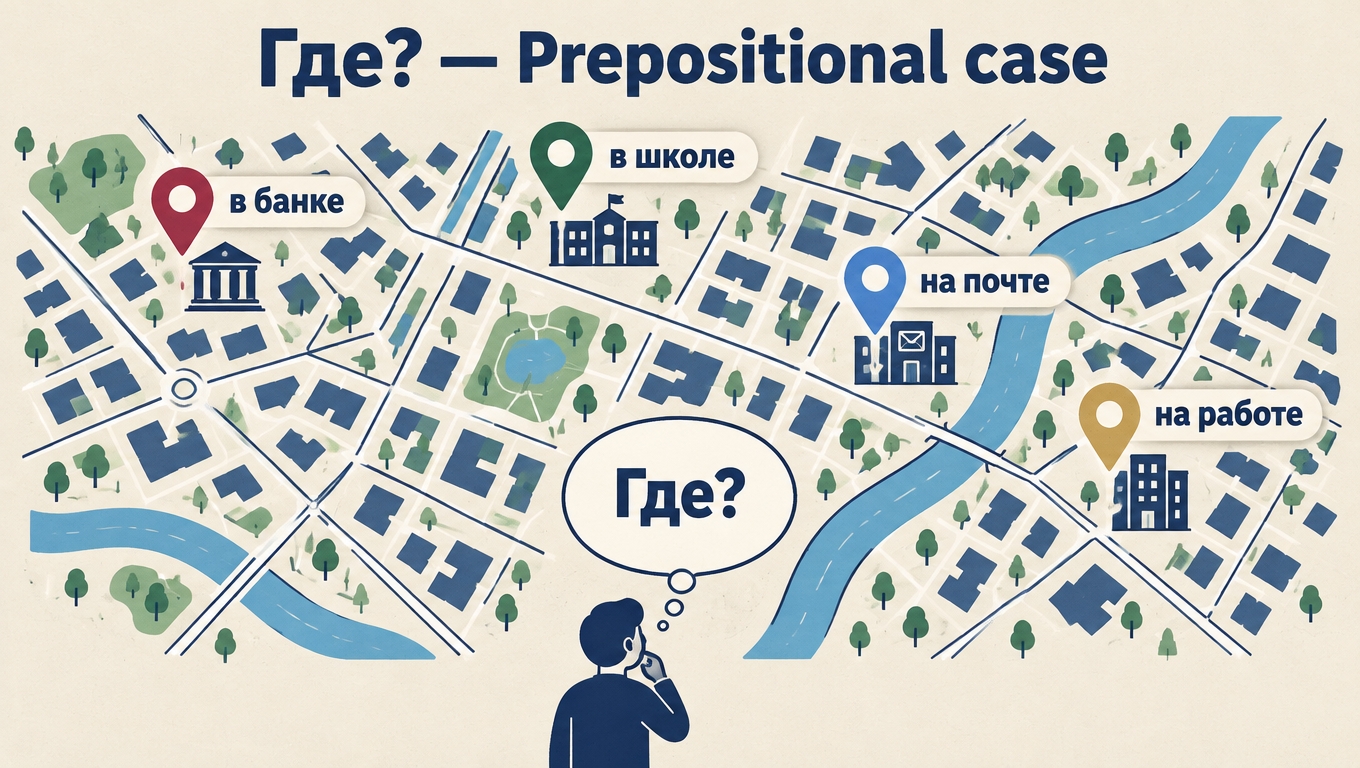
The first real case. Answer Где? with в or на plus a changed ending, sort places into the в-list and the на-list, and say where you live, where you work and where you study.
⏱ About 60 minutes26 phrases34 exercises
What you will learn
Ask where something or someone is with «Где?» and answer with a full prepositional phrase
Apply the prepositional endings -е, -и, -ах and -ях to masculine, feminine, neuter and plural nouns
Choose between в and на for any place by recalling the closed на-list rather than guessing
Use the three fixed locatives — дома, наработе, вшколе — as whole chunks
Put жить, работать, учиться and находиться in front of a place and keep the noun unchanged
Say what you are thinking or talking about with о plus the prepositional
Quick review
Say these aloud before you start. They come from earlier lessons.
Э́то Москва́.This is Moscow.Listen in Russian:Slow in Russian:Э́то Москва́.
Я студе́нт.I am a student.Listen in Russian:Slow in Russian:Я студе́нт.
Где ты живёшь?Where do you live?Listen in Russian:Slow in Russian:Где ты живёшь?
У меня́ есть кни́га.I have a book.Listen in Russian:Slow in Russian:У меня́ есть кни́га.
Мне нра́вится Москва́.I like Moscow.Listen in Russian:Slow in Russian:Мне нра́вится Москва́.
Я хочу́ ко́фе.I want a coffee.Listen in Russian:Slow in Russian:Я хочу́ ко́фе.
Theory
Где? — the question that opens the case system
Everything you have built until now has lived in a single case. «Ястуде́нт», «Э́тоМосква́», «Уменя́естькни́га» — in all of them the noun keeps the shape it has in the dictionary. From this lesson onwards Russian starts doing the thing it is famous for, and it starts in the gentlest possible place, with one question: Где? "Where?"
To say where something is, Russian keeps the preposition you would expect — в or на — and changes the END of the noun. «дом» becomes «вдо́ме». «шко́ла» becomes «вшко́ле». That changed ending is a case, and the case that answers Где? is the prepositional, «предло́жныйпаде́ж». It is the first of the six, and by a wide margin the easiest, because for the overwhelming majority of nouns the ending is simply -е.
Notice what has NOT changed: the word order. «Гдетыживёшь?» — «Яживу́вМоскве́». The question word goes first, the answer keeps subject, verb, place, in that order. Russian does its grammar in the endings, so it does not need to do it in the arrangement of the words. Everything you learnt about sentence shape in Lesson 2 still holds.
Я живу́ в Москве́.I live in Moscow.Listen in Russian:Slow in Russian:Я живу́ в Москве́.
Он рабо́тает в ба́нке.He works in a bank.Listen in Russian:Slow in Russian:Он рабо́тает в ба́нке.
Мы у́чимся в университе́те.We study at university.Listen in Russian:Slow in Russian:Мы у́чимся в университе́те.
А́нна сейча́с в метро́.Anna is on the metro now.Listen in Russian:Slow in Russian:А́нна сейча́с в метро́.
The endings: -е almost everywhere, -и in two groups, -ах and -ях in the plural
-е is the ending, and it does not care about gender. Masculine, feminine and neuter nouns all take it: «впа́рке», «вшко́ле», «втеа́тре», and — once you meet a neuter noun that actually declines — «вокне́». That is worth pausing on, because it is the opposite of what you had to do in Lesson 3, where an adjective ending depended entirely on the gender of its noun. Here one ending covers everything, which is why the prepositional singular is the cheapest case in the language to learn. The three neuter nouns you know so far — «метро́», «кино́», «кафе́» — are indeclinable borrowings and take no ending at all, so they look identical in every case.
Two groups take -и instead. The first is nouns whose nominative ends in -ия, -ий or -ие: «Росси́я» becomes «вРосси́и», «А́нглия» becomes «вА́нглии», «Ита́лия» becomes «вИта́лии». At this level that group is mostly countries, and you already know three of them. The second is the third declension — feminine nouns in -ь — which take -и in every oblique case: «пло́щадь» becomes «напло́щади». One small point of spelling to finish with: when the stem itself ends in a soft sign, the ending is written after it as ье, so «семья́» gives «всемье́».
In the plural the ending depends on one thing only — whether the consonant in front of it is hard or soft. Hard takes -ах: «вгорода́х», «вшко́лах», «вдома́х», «нау́лицах», since ц is always hard. Soft takes -ях: «вмузе́ях», «наплощадя́х», «всемья́х». If you are not sure whether a consonant is hard or soft, look at the nominative plural you already know: whatever letter stands before the -ы or the -и there also stands before the ending here.
One genuine exception, so that it does not ambush you later. A small set of masculine nouns has kept an older locative form in -у, used only after в or на and only for location: «влесу́», «всаду́», «вшкафу́», «ваэропорту́». For «аэропо́рт» both forms are correct, and «ваэропорту́» is at least as common in speech as the regular «ваэропо́рте». You are not expected to produce these today. Recognise them and move on.
в Москве́, в па́рке, в теа́треin Moscow, in the park, in the theatre — the default -еListen in Russian:Slow in Russian:в Москве́, в па́рке, в теа́тре
в Росси́и, в А́нглии, в Ита́лииin Russia, in England, in Italy — nouns in -ия take -иListen in Russian:Slow in Russian:в Росси́и, в А́нглии, в Ита́лии
на пло́щади, в библиоте́кеon the square, in the library — a third-declension -ь noun takes -иListen in Russian:Slow in Russian:на пло́щади, в библиоте́ке
в города́х, в шко́лах, в музе́яхin cities, in schools, in museums — -ах after a hard consonant, -ях after a soft oneListen in Russian:Slow in Russian:в города́х, в шко́лах, в музе́ях
в or на? Two lists, not a rule
The choice of preposition is the part of this lesson that English speakers find most infuriating, and the honest answer is that it is not derivable. Russian has two lists. Most enclosed spaces, buildings, institutions, towns and countries take в: «вго́роде», «вшко́ле», «вмагази́не», «вМоскве́», «вРосси́и». A much smaller and closed group takes на: «напо́чте», «навокза́ле», «назаво́де», «настадио́не», «нау́лице», «напло́щади», «нары́нке», «нарабо́те». That is the whole of the second list for today.
Learn the на-list as a set rather than trying to reason your way into it. Its historical logic is real — surfaces, events, open spaces, and places thought of as an activity rather than as a building — but it is not reliable enough to predict a word you have never met. The exception that proves the point sits in entertainment: you are «втеа́тре» and «вкино́», but a concert and an exhibition take на. A closed list of eight beats a rule that leaks.
Whichever preposition you choose, the case that follows is identical. в and на both govern the prepositional when the question is Где?, and both will govern the accusative when the question is Куда́?, which is the whole of Lesson 6. Learn them now as pairs — «вшко́ле / вшко́лу», «напо́чте / напо́чту» — and half of next lesson is already installed before you get there.
в шко́ле, в магази́не, в ба́нкеat school, in the shop, in the bank — the в-listListen in Russian:Slow in Russian:в шко́ле, в магази́не, в ба́нке
на по́чте, на вокза́ле, на заво́деat the post office, at the station, at the factory — the на-listListen in Russian:Slow in Russian:на по́чте, на вокза́ле, на заво́де
на у́лице, на пло́щади, на стадио́неin the street, on the square, at the stadium — open and public spacesListen in Russian:Slow in Russian:на у́лице, на пло́щади, на стадио́не
в теа́тре, но на конце́ртеin the theatre, but at a concert — the exception worth rememberingListen in Russian:Slow in Russian:в теа́тре, но на конце́рте
Three locatives that are not cases, and the verbs that carry a place
Before you build anything, memorise three whole chunks. «до́ма» means "at home" and is a single adverb with no preposition at all: «Ядо́ма». «нарабо́те» means "at work". «вшко́ле» means "at school". These arrive as frozen units; you do not need to be able to explain them to use them, and Russians do not think of them as grammar when they say them.
Four verbs do most of the work in this lesson, and all four take the same construction: verb, then в or на, then the prepositional. «житьвМоскве́», «рабо́татьвба́нке», «учи́тьсявуниверсите́те», «находи́тьсянапло́щади». Nothing about the place changes according to which verb introduces it, so learning «вшко́ле» once buys you four sentences.
Two of those verbs end in -ся: «учи́ться» and «находи́ться». Do not try to analyse that suffix today. -ся carries five different meanings and gets a lesson of its own, Lesson 18. For now they are fixed tools: «учи́ться» is "to study" and takes в plus the institution, and «находи́ться» is "to be situated". The second one is what you reach for when you are lost — «Гденаходи́тсяапте́ка?» is more precise and slightly more polite than a bare «Гдеапте́ка?», and it is the sentence that gets you an answer rather than a shrug. In practice you will only ever need its third person, «находи́тся».
Я живу́ в Москве́.I live in Moscow.Listen in Russian:Slow in Russian:Я живу́ в Москве́.
Она́ у́чится в университе́те.She studies at university.Listen in Russian:Slow in Russian:Она́ у́чится в университе́те.
Мы рабо́таем в рестора́не.We work in a restaurant.Listen in Russian:Slow in Russian:Мы рабо́таем в рестора́не.
Где находи́тся вокза́л?Where is the railway station?Listen in Russian:Slow in Russian:Где находи́тся вокза́л?
Sound focus
Sound focus: the ending is almost never where the stress is
Here is the phonetic point that makes this case easy to say and hard to hear. In nearly every prepositional form you will produce today, the stress sits somewhere in the middle of the word and the ending is unstressed: «вшко́ле», «вмагази́не», «напо́чте», «втеа́тре». An unstressed е in Russian is not [e] at all. It reduces to [ɪ], a short sound much closer to the i of English "kit". So «вшко́ле» is [f ˈʂkolʲɪ], and if you say it with a clear final -eh you will sound foreign even though every letter is right.
The preposition reduces too, and in two different ways. «на» is never [na] inside a phrase — it is [nə]: «напо́чте» is [nə pɐˈtɕtʲɪ]. And «в» devoices to [f] before a voiceless consonant, exactly as you saw with «вчера́» in Lesson 2: «впа́рке» is [f ˈparkʲɪ], «втеа́тре» is [f tʲɪˈatrʲɪ]. Before a vowel or a voiced consonant it stays [v]: «вМоскве́», «вго́роде».
The third thing to listen for is the softening. The -е of the ending palatalises the consonant in front of it, which is the same soft/hard contrast you met in Lesson 1. Compare the nominative «дом» [dom], where the м is hard, with «вдо́ме» [v ˈdomʲɪ], where it is not. Say the two out loud one after the other and you will hear the case ending doing its job — you will hear the case ending doing its job — not as a letter, but as a change in the consonant before it.
в шко́леat school — [f ˈʂkolʲɪ]: the ending is [ɪ], not [e]Listen in Russian:Slow in Russian:в шко́ле
на по́чтеat the post office — [nə pɐˈtɕtʲɪ]: на is never [na] in a phraseListen in Russian:Slow in Russian:на по́чте
в па́ркеin the park — [f ˈparkʲɪ]: в devoices to [f] before пListen in Russian:Slow in Russian:в па́рке
в до́меin the house — [v ˈdomʲɪ]: the -е softens the мListen in Russian:Slow in Russian:в до́ме
Где? — the prepositional singular: one ending for every gender
Form
парк (m)
шко́ла (f)
метро́ (n)
музе́й (m in -й)
пло́щадь (f in -ь)
Nominative (Кто? Что?)
парк
шко́ла
метро́
музе́й
пло́щадь
Где? — в / на + Prepositional
впа́рке
вшко́ле
вметро́
вмузе́е
напло́щади
Ending added
-е
-е
no change
-е
-и
Gender, which you had to know for the nominative, stops mattering here: the singular ending is -е for masculine, feminine and neuter alike. Only two groups break the pattern. Nouns in -ия, -ий and -ие take -и (вРосси́и, вА́нглии), and third-declension feminines in -ь also take -и (напло́щади). Indeclinable borrowings — метро́, кино́, кафе́ — simply do not change at all.
Two lists, not a rule: where в goes and where на goes
There is no rule to derive this from, and no amount of reasoning will produce it. What you can do is learn the на-list, because it is short and closed: напо́чте, навокза́ле, назаво́де, настадио́не, нау́лице, напло́щади, нары́нке, нарабо́те. Its historical logic — surfaces, events, open spaces, places thought of as an activity rather than a building — is real, but it will not predict a new word for you. Everything else in this lesson takes в. One word on the в-side has a spoken rival: alongside the regular ваэропо́рте you will constantly hear ваэропорту́, an older locative ending. Both are correct; produce the regular one and recognise the other.
Где? — the whole question-and-answer frame
Form
жить (to live)
рабо́тать (to work)
учи́ться (to study)
Question — Гдевы …?
Гдевыживёте?
Гдевырабо́таете?
Гдевыу́читесь?
Answer about yourself — Я …
Яживу́вМоскве́.
Ярабо́таювба́нке.
Яучу́сьвуниверсите́те.
Answer about her — Она …
Она́живётвИта́лии.
Она́рабо́таетнапо́чте.
Она́у́читсявшко́ле.
One frame, three verbs, and the place never changes shape whichever verb introduces it. That is the payoff of the case system: learn вшко́ле once and it serves жить, рабо́тать, учи́ться, находи́ться and ду́матьо. Swap the question word out for ты and the verb ending changes with it — Гдетыживёшь? — but the noun does not move at all.
The prepositional plural: -ах after a hard consonant, -ях after a soft one
Form
го́род (m, hard)
шко́ла (f, hard)
музе́й (m, soft)
пло́щадь (f, -ь)
Nominative plural
города́
шко́лы
музе́и
пло́щади
Prepositional plural — Где?
вгорода́х
вшко́лах
вмузе́ях
наплощадя́х
The plural ending depends on one thing only: whether the consonant before it is hard or soft. Hard takes -ах (вгорода́х, вшко́лах), soft takes -ях (вмузе́ях, наплощадя́х). Watch the stress too — it moves to the ending in города́х and площадя́х but stays put in шко́лах and музе́ях. The plural matters less than the singular at this level, because most talk about places is about one place.
Vocabulary
Learn each word with its stress mark and its pronunciation. Nouns are given with their gender, animacy and their full six-case declension; verbs are given with their aspect and, where one exists, their partner verb.
Russian
English
Gender / aspect
Pronunciation
Audio
шко́лаfeminine · inanimate
school
feminine · inanimate
/ˈʂkolə/SHKOH-luh
Listen in Russian:Slow in Russian:школа
университе́тmasculine · inanimate
university
masculine · inanimate
/ʊnʲɪvʲɪrsʲɪˈtʲet/oo-nih-vihr-sih-TYET
Listen in Russian:Slow in Russian:университет
магази́нmasculine · inanimate
shop, store
masculine · inanimate
/məɡɐˈzʲin/muh-guh-ZEEN
Listen in Russian:Slow in Russian:магазин
апте́каfeminine · inanimate
pharmacy, chemist's
feminine · inanimate
/ɐpˈtʲekə/up-TYEH-kuh
Listen in Russian:Slow in Russian:аптека
больни́цаfeminine · inanimate
hospital
feminine · inanimate
/bɐlʲˈnʲitsə/bul-NEE-tsih
Listen in Russian:Slow in Russian:больница
библиоте́каfeminine · inanimate
library
feminine · inanimate
/bʲɪblʲɪəˈtʲekə/bih-blih-uh-TYEH-kuh
Listen in Russian:Slow in Russian:библиотека
музе́йmasculine · inanimate
museum
masculine · inanimate
/mʊˈzʲej/moo-ZEY
Listen in Russian:Slow in Russian:музей
теа́трmasculine · inanimate
theatre
masculine · inanimate
/tʲɪˈatr/tih-AHTR
Listen in Russian:Slow in Russian:театр
кино́neuter · inanimate
cinema; film
neuter · inanimate
/kʲɪˈno/kih-NOH
Listen in Russian:Slow in Russian:кино
вокза́лmasculine · inanimate
railway station
masculine · inanimate
/vɐɡˈzal/vug-ZAHL
Listen in Russian:Slow in Russian:вокзал
аэропо́ртmasculine · inanimate
airport
masculine · inanimate
/ɐɛrɐˈport/uh-ih-ruh-POHRT
Listen in Russian:Slow in Russian:аэропорт
по́чтаfeminine · inanimate
post office; post, mail
feminine · inanimate
/ˈpotɕtə/POH-chtuh
Listen in Russian:Slow in Russian:почта
банкmasculine · inanimate
bank
masculine · inanimate
/bank/BAHNK
Listen in Russian:Slow in Russian:банк
рестора́нmasculine · inanimate
restaurant
masculine · inanimate
/rʲɪstɐˈran/rih-stuh-RAHN
Listen in Russian:Slow in Russian:ресторан
кафе́neuter · inanimate
café, coffee shop
neuter · inanimate
/kɐˈfɛ/kuh-FYEH
Listen in Russian:Slow in Russian:кафе
паркmasculine · inanimate
park
masculine · inanimate
/park/PAHRK
Listen in Russian:Slow in Russian:парк
у́лицаfeminine · inanimate
street
feminine · inanimate
/ˈulʲitsə/OO-lih-tsih
Listen in Russian:Slow in Russian:улица
пло́щадьfeminine · inanimate
square
feminine · inanimate
/ˈploɕːɪtʲ/PLOH-shchut
Listen in Russian:Slow in Russian:площадь
ры́нокmasculine · inanimate
market
masculine · inanimate
/ˈrɨnək/RIH-nuk
Listen in Russian:Slow in Russian:рынок
гости́ницаfeminine · inanimate
hotel
feminine · inanimate
/ɡɐˈsʲtʲinʲitsə/guh-STEE-nih-tsih
Listen in Russian:Slow in Russian:гостиница
о́фисmasculine · inanimate
office
masculine · inanimate
/ˈofʲɪs/OH-fis
Listen in Russian:Slow in Russian:офис
заво́дmasculine · inanimate
factory, works
masculine · inanimate
/zɐˈvot/zuh-VOHT
Listen in Russian:Slow in Russian:завод
стадио́нmasculine · inanimate
stadium
masculine · inanimate
/stədʲɪˈon/stuh-dih-OHN
Listen in Russian:Slow in Russian:стадион
метро́neuter · inanimate
metro, underground
neuter · inanimate
/mʲɪˈtro/mih-TROH
Listen in Russian:Slow in Russian:метро
Ло́ндонmasculine · inanimate
London
masculine · inanimate
/ˈlondən/LOHN-dun
Listen in Russian:Slow in Russian:Лондон
учи́тьсяimperfective
to study, to learn (to be a student)
imperfective
/ʊˈtɕitsə/oo-CHIH-tsyuh
Listen in Russian:Slow in Russian:учиться
находи́тьсяimperfective
to be situated, to be located
imperfective
/nəxɐˈdʲitsə/nuh-khuh-DEE-tsyuh
Listen in Russian:Slow in Russian:находиться
до́маadverb
at home
adverb
/ˈdomə/DOH-muh
Listen in Russian:Slow in Russian:дома
на рабо́теphrase
at work
phrase
/nə rɐˈbotʲɪ/nuh ruh-BOH-tyuh
Listen in Russian:Slow in Russian:на работе
вpreposition
in, at (of a place); into, to (of a direction)
preposition
/v/F
Listen in Russian:Slow in Russian:в
наpreposition
on, at (of a place); onto, on to (of a direction)
preposition
/na/NAH
Listen in Russian:Slow in Russian:на
оpreposition
about (with the Prepositional)
preposition
/o/OH
Listen in Russian:Slow in Russian:о
гдеadverb
where (location)
adverb
/ɡdʲe/guh-DYEH
Listen in Russian:Slow in Russian:где
го́родmasculine · inanimate
city, town
masculine · inanimate
/ˈɡorət/GOH-rut
Listen in Russian:Slow in Russian:город
Full six-case declension of the 26 nouns in this lesson
Each case is listed with the question word that selects it. Find the question you are answering and the ending follows.
Singular
Form
шко́ла (f)
университе́т (m)
магази́н (m)
апте́ка (f)
больни́ца (f)
библиоте́ка (f)
музе́й (m)
теа́тр (m)
кино́ (n)
вокза́л (m)
аэропо́рт (m)
по́чта (f)
банк (m)
рестора́н (m)
кафе́ (n)
парк (m)
у́лица (f)
пло́щадь (f)
ры́нок (m)
гости́ница (f)
о́фис (m)
заво́д (m)
стадио́н (m)
метро́ (n)
Ло́ндон (m)
го́род (m)
nom · Кто? Что?
школа
университет
магазин
аптека
больница
библиотека
музей
театр
кино
вокзал
аэропорт
почта
банк
ресторан
кафе
парк
улица
площадь
рынок
гостиница
офис
завод
стадион
метро
Лондон
город
gen · Кого? Чего?
школы
университета
магазина
аптеки
больницы
библиотеки
музея
театра
кино
вокзала
аэропорта
почты
ба́нка
ресторана
кафе
па́рка
улицы
площади
рынка
гостиницы
офиса
завода
стадиона
метро
Лондона
города
dat · Кому? Чему?
школе
университету
магазину
аптеке
больнице
библиотеке
музею
театру
кино
вокзалу
аэропорту
почте
ба́нку
ресторану
кафе
па́рку
улице
площади
рынку
гостинице
офису
заводу
стадиону
метро
Лондону
городу
acc · Кого? Что?
школу
университет
магазин
аптеку
больницу
библиотеку
музей
театр
кино
вокзал
аэропорт
почту
банк
ресторан
кафе
парк
улицу
площадь
рынок
гостиницу
офис
завод
стадион
метро
Лондон
город
instr · Кем? Чем?
школой
университетом
магазином
аптекой
больницой
библиотекой
музеем
театром
кино
вокзалом
аэропортом
почтой
ба́нком
рестораном
кафе
па́рком
улицой
площадью
рынком
гостиницой
офисом
заводом
стадионом
метро
Лондоном
городом
prep · Оком? Очём?
школе
университете
магазине
аптеке
больнице
библиотеке
музее
театре
кино
вокзале
аэропорте
почте
ба́нке
ресторане
кафе
па́рке
улице
площади
рынке
гостинице
офисе
заводе
стадионе
метро
Лондоне
городе
Plural
Form
шко́ла (f)
университе́т (m)
магази́н (m)
апте́ка (f)
больни́ца (f)
библиоте́ка (f)
музе́й (m)
теа́тр (m)
кино́ (n)
вокза́л (m)
аэропо́рт (m)
по́чта (f)
банк (m)
рестора́н (m)
кафе́ (n)
парк (m)
у́лица (f)
пло́щадь (f)
ры́нок (m)
гости́ница (f)
о́фис (m)
заво́д (m)
стадио́н (m)
метро́ (n)
Ло́ндон (m)
го́род (m)
nom · Кто? Что?
школы
университеты
магазины
аптеки
больницы
библиотеки
музеи
театры
—
вокзалы
аэропорты
почты
ба́нки
рестораны
—
па́рки
улицы
площади
рынки
гостиницы
офисы
заводы
стадионы
—
—
города́
gen · Кого? Чего?
школ
университетов
магазинов
аптек
больниц
библиотек
музеев
театров
—
вокзалов
аэропортов
почт
ба́нков
ресторанов
—
па́рков
улиц
площаде́й
рынков
гостиниц
офисов
заводов
стадионов
—
—
городо́в
dat · Кому? Чему?
школам
университетам
магазинам
аптекам
больницам
библиотекам
музеям
театрам
—
вокзалам
аэропортам
почтам
ба́нким
ресторанам
—
па́рким
улицам
площадя́м
рынкам
гостиницам
офисам
заводам
стадионам
—
—
города́м
acc · Кого? Что?
школы
университеты
магазины
аптеки
больницы
библиотеки
музеи
театры
—
вокзалы
аэропорты
почты
ба́нки
рестораны
—
па́рки
улицы
площади
рынки
гостиницы
офисы
заводы
стадионы
—
—
города́
instr · Кем? Чем?
школами
университетами
магазинами
аптеками
больницами
библиотеками
музеями
театрами
—
вокзалами
аэропортами
почтами
ба́нкими
ресторанами
—
па́ркими
улицами
площадя́ми
рынками
гостиницами
офисами
заводами
стадионами
—
—
города́ми
prep · Оком? Очём?
школах
университетах
магазинах
аптеках
больницах
библиотеках
музеях
театрах
—
вокзалах
аэропортах
почтах
ба́нких
ресторанах
—
па́рких
улицах
площадя́х
рынках
гостиницах
офисах
заводах
стадионах
—
—
города́х
A dash means the form does not exist. Plural-only nouns such as де́ньги and су́тки have no singular, and indeclinable nouns such as ко́фе and метро́ keep one form in all six cases.
Ready-to-use phrases
Где ты живёшь?
Where do you live?
IPA/ɡdʲe tɨ ʐɨˈvʲoʂ/
Say itguh-DYEH TIH zhih-VYOHSH?
The verb ending already says "you", and the question is the statement with a rising voice. живёшь keeps its ё, which is always stressed.
informalquestionsplace
Listen in Russian:Slow in Russian:Где ты живёшь?
Я живу́ в Москве́.
I live in Moscow.
IPA/ja ʐɨˈvu v mɐˈskvʲe/
Say itYAH zhih-VOO v muh-SKVYEH.
The template of the whole lesson: subject, verb, в or на, noun with a changed ending. Москве́ is the prepositional of Москва́.
neutralplacecity
Listen in Russian:Slow in Russian:Я живу в Москве.
Она́ живёт в Ита́лии.
She lives in Italy.
IPA/ɐˈna ʐɨˈvʲot v ɪˈtalʲɪɪ/
Say ituh-NAH zhih-VYOHT v ih-TAH-lih-ih.
Nouns in -ия take -и in the prepositional, not -е: Ита́лия → вИта́лии, Росси́я → вРосси́и, А́нглия → вА́нглии.
neutralplacecity
Listen in Russian:Slow in Russian:Она живёт в Италии.
Мы живём в го́роде.
We live in town.
IPA/mɨ ʐɨˈvʲom ˈɡorədʲɪ/
Say itMIH zhih-VYOHM v GOH-ruh-dyuh.
вго́роде is one of the curriculum's own examples of the в-class, and the ending -е is unstressed, so it sounds like [ɪ].
neutralplacecity
Listen in Russian:Slow in Russian:Мы живём в городе.
Где вы рабо́таете?
Where do you work?
IPA/ɡdʲe vɨ rɐˈbotəɪtʲɪ/
Say itguh-DYEH VIH ruh-BOH-tuh-yih-tyuh?
The вы form, and therefore the polite one to use with someone you have just met.
formalquestionswork
Listen in Russian:Slow in Russian:Где вы работаете?
Я рабо́таю в ба́нке.
I work in a bank.
IPA/ja rɐˈbotəjʊ v ˈbankʲɪ/
Say itYAH ruh-BOH-tuh-yoo v BAHN-kyuh.
ба́нке is the prepositional of банк. The soft к before -е is what makes the ending sound like -ih rather than -eh.
neutralworkplace
Listen in Russian:Slow in Russian:Я работаю в банке.
Он рабо́тает на по́чте.
He works at the post office.
IPA/on rɐˈbotəɪt nə ˈpotɕtʲɪ/
Say itOHN ruh-BOH-tuh-yit nuh POH-chtyuh.
по́чта is one of the short на-list. Learn напо́чте as a single unit; there is no rule that would have told you this.
neutralworkplace
Listen in Russian:Slow in Russian:Он работает на почте.
Где ты у́чишься?
Where do you study?
IPA/ɡdʲe tɨ ˈutɕɪʂəsʲ/
Say itguh-DYEH TIH OO-chish-syuh?
у́чишься pulls the stress onto the first syllable, unlike the infinitive учи́ться. The -ся never changes its meaning here.
informalquestionsstudy
Listen in Russian:Slow in Russian:Где ты учишься?
Я учу́сь в университе́те.
I study at university.
IPA/ja ʊˈtɕusʲ ʊnʲɪvʲɪrsʲɪˈtʲetʲɪ/
Say itYAH oo-CHUS v oo-nih-vihr-sih-TYEH-tyuh.
учу́сь is stressed on the у; every other form of учиться is stressed on the first syllable. One word to learn, one to remember.
neutralstudyplace
Listen in Russian:Slow in Russian:Я учусь в университете.
Они́ у́чатся в шко́ле.
They are at school. / They study at school.
IPA/ɐˈnʲi ˈutɕətsə f ˈʂkolʲɪ/
Say ituh-NEE OO-chuh-tsyuh f SHKOH-lyuh.
вшко́ле covers both "they are at school" and "they go to school" — Russian does not need two expressions.
neutralstudyplacefamily
Listen in Russian:Slow in Russian:Они учатся в школе.
Где находи́тся вокза́л?
Where is the railway station?
IPA/ɡdʲe nəxɐˈdʲitsə vɐɡˈzal/
Say itguh-DYEH nuh-khuh-DEE-tsyuh vug-ZAHL?
More precise and a shade more polite than a bare Гдевокза́л?. This is the sentence to use when you are lost.
travelquestionstravelcitypoliteness
Listen in Russian:Slow in Russian:Где находится вокзал?
Где находи́тся апте́ка?
Where is the pharmacy?
IPA/ɡdʲe nəxɐˈdʲitsə ɐpˈtʲekə/
Say itguh-DYEH nuh-khuh-DEE-tsyuh up-TYEH-kuh?
Swap any place from this lesson into the slot and the sentence still works.
travelquestionshealthcitysurvival
Listen in Russian:Slow in Russian:Где находится аптека?
Я сейча́с до́ма.
I am at home now.
IPA/ja sʲɪˈtɕas ˈdomə/
Say itYAH siy-CHAHS DOH-muh.
No preposition and no case: до́ма is an adverb. This is why "at home" and "at work" behave differently in Russian.
neutralplacetime
Listen in Russian:Slow in Russian:Я сейчас дома.
Она́ на рабо́те.
She is at work.
IPA/ɐˈna nə rɐˈbotʲɪ/
Say ituh-NAH nuh ruh-BOH-tyuh.
нарабо́те is a fixed chunk. The noun рабо́та is Lesson 8, but you need this one form now.
neutralworkplace
Listen in Russian:Slow in Russian:Она на работе.
Студе́нты на у́лице.
The students are outside. / The students are in the street.
IPA/stʊˈdʲentɨ nə ˈulʲɪtsə/
Say itstoo-DYEN-tih nuh OO-lih-tsih.
нау́лице is doing double duty here: literally "in the street", idiomatically "outdoors".
neutralplacecitystudy
Listen in Russian:Slow in Russian:Студенты на улице.
А́нна в метро́.
Anna is on the metro.
IPA/ˈanə v mʲɪˈtro/
Say itAH-nuh v mih-TROH.
метро never changes shape, so the prepositional is identical to the nominative.
neutralplacetransportcity
Listen in Russian:Slow in Russian:Анна в метро.
Он в аэропо́рте.
He is at the airport.
IPA/on v ɐɛrɐˈportʲɪ/
Say itOHN v uh-ih-ruh-POHR-tyuh.
The regular form taught here is ваэропо́рте. You will also hear ваэропорту́ — a second locative ending that survives in a handful of masculine nouns. Both are correct.
travelplacetravel
Listen in Russian:Slow in Russian:Он в аэропорте.
Она́ в больни́це.
She is in hospital.
IPA/ɐˈna v bɐlʲˈnʲitsɪ/
Say ituh-NAH v bul-NEE-tsih.
English says "in hospital" with no article; Russian says the same thing with a preposition and a changed ending.
neutralplacehealth
Listen in Russian:Slow in Russian:Она в больнице.
Студе́нты в библиоте́ке.
The students are in the library.
IPA/stʊˈdʲentɨ v bʲɪblʲɪəˈtʲekʲɪ/
Say itstoo-DYEN-tih v bih-blih-uh-TYEH-kyuh.
библиоте́ке keeps the stress exactly where библиоте́ка has it. Fixed stress makes long words like this one much easier than they look.
neutralstudyplace
Listen in Russian:Slow in Russian:Студенты в библиотеке.
Он на заво́де.
He is at the factory.
IPA/on nə zɐˈvodʲɪ/
Say itOHN nuh zuh-VOH-dyuh.
заво́д is another member of the на-list, along with по́чта, вокза́л, стадио́н, у́лица, пло́щадь and ры́нок.
neutralworkplacecity
Listen in Russian:Slow in Russian:Он на заводе.
Мы на стадио́не.
We are at the stadium.
IPA/mɨ nə stədʲɪˈonʲɪ/
Say itMIH nuh stuh-dih-OH-nyuh.
The stress of стадио́не does not move from the о of the nominative.
neutralplacehobbies
Listen in Russian:Slow in Russian:Мы на стадионе.
Они́ на ры́нке.
They are at the market.
IPA/ɐˈnʲi nə ˈrɨnkʲɪ/
Say ituh-NEE nuh RIHN-kyuh.
ры́нке shows the fleeting vowel: the о of ры́нок is gone, but the stress stays on the ы.
neutralshoppingplacecity
Listen in Russian:Slow in Russian:Они на рынке.
Мы на пло́щади.
We are on the square.
IPA/mɨ nə ˈploɕːɪdʲɪ/
Say itMIH nuh PLOH-shchuh-dih.
Third-declension feminine, so -и and not -е: напло́щади, exactly like вночи́ and овещи́.
neutralplacecity
Listen in Russian:Slow in Russian:Мы на площади.
Ты живёшь в Росси́и?
Do you live in Russia?
IPA/tɨ ʐɨˈvʲoʂ f rɐˈsʲijɪ/
Say itTIH zhih-VYOHSH v ruh-SEE-ih?
Росси́я → вРосси́и. The -ия countries are the single most common reason a beginner needs the -и ending at all.
informalquestionsplacecity
Listen in Russian:Slow in Russian:Ты живёшь в России?
Я ду́маю о Москве́.
I am thinking about Moscow.
IPA/ja ˈduməjʊ ɐ mɐˈskvʲe/
Say itYAH DOO-muh-yoo uh muh-SKVYEH.
ду́мать takes о + the prepositional. Same ending as after в, completely different question: not Где? but Очём?.
neutralfeelingsplace
Listen in Russian:Slow in Russian:Я думаю о Москве.
Мы говори́м о шко́ле.
We are talking about school.
IPA/mɨ ɡəvɐˈrʲim ɐ ˈʂkolʲɪ/
Say itMIH guh-vuh-REEM uh SHKOH-lyuh.
говори́тьочём — "to talk about something". Note that о here governs the same case as в and на.
neutralcommunicationstudy
Listen in Russian:Slow in Russian:Мы говорим о школе.
Dialogues
Where are you?
Tom rings Anna on a Saturday morning. They are friends, so they use ты.
Tom
Привет, Анна! Где ты сейчас?
Hi Anna! Where are you now?
Listen in Russian:Slow in Russian:Привет, Анна! Где ты сейчас?
Anna
Я в библиотеке. А ты где?
I am in the library. And where are you?
Listen in Russian:Slow in Russian:Я в библиотеке. А ты где?
Tom
Я в метро. Ты работаешь в библиотеке?
I am on the metro. Do you work in the library?
Listen in Russian:Slow in Russian:Я в метро. Ты работаешь в библиотеке?
Anna
Нет, я не работаю. Я учусь в университете.
No, I do not work. I study at university.
Listen in Russian:Slow in Russian:Нет, я не работаю. Я учусь в университете.
Tom
А где находится твой университет?
And where is your university?
Listen in Russian:Slow in Russian:А где находится твой университет?
Anna
Университет в Москве, на площади.
The university is in Moscow, on the square.
Listen in Russian:Slow in Russian:Университет в Москве, на площади.
Tom
Очень хорошо! А где ты живёшь?
Very good! And where do you live?
Listen in Russian:Slow in Russian:Очень хорошо! А где ты живёшь?
Anna
Я живу в Лондоне, а сейчас я в Москве. А ты?
I live in London, but at the moment I am in Moscow. And you?
Listen in Russian:Slow in Russian:Я живу в Лондоне, а сейчас я в Москве. А ты?
Tom
А я живу в Москве.
And I live in Moscow.
Listen in Russian:Slow in Russian:А я живу в Москве.
Asking the way
Marco has just arrived and stops Nina in the street. They are strangers, so they use вы.
Marco
Здравствуйте! Где находится вокзал?
Hello! Where is the railway station?
Listen in Russian:Slow in Russian:Здравствуйте! Где находится вокзал?
Nina
Вокзал вот там, на улице.
The station is over there, on the street.
Listen in Russian:Slow in Russian:Вокзал вот там, на улице.
Marco
Спасибо! А где метро?
Thank you! And where is the metro?
Listen in Russian:Slow in Russian:Спасибо! А где метро?
Nina
Метро на площади.
The metro is on the square.
Listen in Russian:Slow in Russian:Метро на площади.
Marco
А где банк? Я живу в гостинице.
And where is the bank? I am staying in the hotel.
Listen in Russian:Slow in Russian:А где банк? Я живу в гостинице.
Nina
Банк в гостинице.
The bank is in the hotel.
Listen in Russian:Slow in Russian:Банк в гостинице.
Marco
Очень хорошо. Спасибо!
Very good. Thank you!
Listen in Russian:Slow in Russian:Очень хорошо. Спасибо!
Nina
Пожалуйста!
You are welcome!
Listen in Russian:Slow in Russian:Пожалуйста!
Two students at the café
Anna is from London and is studying in Moscow. Ivan asks her about where she lives, studies and works. They use ты.
Ivan
Анна, ты живёшь в Москве?
Anna, do you live in Moscow?
Listen in Russian:Slow in Russian:Анна, ты живёшь в Москве?
Anna
Нет, я живу в Лондоне.
No, I live in London.
Listen in Russian:Slow in Russian:Нет, я живу в Лондоне.
Ivan
А где ты учишься?
And where do you study?
Listen in Russian:Slow in Russian:А где ты учишься?
Anna
Я учусь здесь, в университете.
I study here, at the university.
Listen in Russian:Slow in Russian:Я учусь здесь, в университете.
Ivan
Очень хорошо! А где ты работаешь?
Very good! And where do you work?
Listen in Russian:Slow in Russian:Очень хорошо! А где ты работаешь?
Anna
Я работаю в кафе.
I work in a café.
Listen in Russian:Slow in Russian:Я работаю в кафе.
Ivan
А что ты думаешь о Москве?
And what do you think of Moscow?
Listen in Russian:Slow in Russian:А что ты думаешь о Москве?
Anna
Мне нравится Москва. Она очень большая.
I like Moscow. It is very big.
Listen in Russian:Slow in Russian:Мне нравится Москва. Она очень большая.
Exercises
Answer actively — try to recall the Russian before you look at any hint.
Case ChoiceExercise 1
Choose the form that completes the sentence.
А́ннаживёт ___. (Anna lives in Moscow.)
Case ChoiceExercise 2
Choose the form that completes the sentence.
Они́сейча́с ___. (They are at school now.)
Case ChoiceExercise 3
Choose the form that completes the sentence.
Мойбратрабо́тает ___. (My brother works at the post office.)
Case ChoiceExercise 4
Choose the form that completes the sentence.
Мыду́маем ___. (We are thinking about the city.)
Case ChoiceExercise 5
Choose the form that completes the sentence.
Она́у́чится ___. (She studies at the university.)
Case ChoiceExercise 6
Choose the form that completes the answer.
Гденаходи́тсябанк? — Банк ___. (The bank is on the square.)
Ending ChoiceExercise 7
Choose the ending the prepositional singular takes.
«музе́й» — a museum. Where is it?
Ending ChoiceExercise 8
Choose the ending the prepositional singular takes.
«Росси́я» — Russia. Where is it?
Ending ChoiceExercise 9
Choose the ending the prepositional singular takes.
«пло́щадь» — a square. Where is it?
Ending ChoiceExercise 10
Choose the ending the prepositional plural takes.
«го́род» in the plural — cities. Where are they?
Ending ChoiceExercise 11
Choose the ending the prepositional plural takes.
«музе́й» in the plural — museums. Where are they?
Translate To RussianExercise 12
Translate into Russian.
I live in Moscow.
Translate To RussianExercise 13
Translate into Russian.
Where do you work? (asking one person politely)
Translate To RussianExercise 14
Translate into Russian.
She studies at the university.
Translate To RussianExercise 15
Translate into Russian.
Where is the pharmacy?
Multiple ChoiceExercise 16
Choose the correct preposition.
Which preposition goes with «по́чта» when you say where something is?
Multiple ChoiceExercise 17
Choose the correct sentence.
Which sentence means "We are talking about school"?
Fill GapExercise 18
Fill the gap: "I live in Moscow."
Яживу́ ___ Москве́.
Fill GapExercise 19
Fill the gap: "He works at the post office."
Онрабо́тает ___ по́чте.
Fill GapExercise 20
Fill the gap: "We are thinking about school."
Мыду́маем ___ шко́ле.
ConjugationExercise 21
Give the present tense form for «они».
жить — они́
ConjugationExercise 22
Give the present tense form for «вы».
учи́ться — вы
ConjugationExercise 23
Give the present tense form for the third person singular.
находи́ться — он / она́ / оно́
Word OrderExercise 24
Put the words in order.
Build the question: "Where do you live?" (to one friend)
Word OrderExercise 25
Put the words in order.
Build the sentence: "I work in a bank."
Match PairsExercise 26
Pair each noun with its prepositional form.
Match each place with the phrase that says where something is.
True FalseExercise 27
Answer true or false.
In the prepositional singular, the ending changes according to the gender of the noun.
True FalseExercise 28
Answer true or false.
«напо́чте» and «вшко́ле» are both in the prepositional case.
Stress ChoiceExercise 29
Choose the correctly stressed form.
Where does the stress fall in «гости́ница»?
Sentence TransformExercise 30
Change the subject to «она» and adjust the verb.
Rewrite this sentence about Anna: «Яучу́сьвшко́ле.»
Listen And TypeExercise 31
Play the audio and type what you hear.
Listen and type the sentence.
Translate To EnglishExercise 32
Translate into English.
Она́живётвИта́лии.
Translate To EnglishExercise 33
Translate into English.
Мыду́маемоМоскве́.
Flashcard Self RatingExercise 34
Recall the English meaning, then rate how well you knew it.
находи́ться
Speak now
Say each sentence aloud three times: slowly, at normal speed, then from memory. After that, change the place in each one for a place that is true for you — your own city, your own workplace, your own school — and say the new version without looking. Say the ending out loud; it is the only thing in the sentence that is doing grammar.
Я живу́ в Москве́.I live in Moscow.Listen in Russian:Slow in Russian:Я живу́ в Москве́.
Я учу́сь в университе́те.I study at university.Listen in Russian:Slow in Russian:Я учу́сь в университе́те.
Я рабо́таю в кафе́.I work in a café.Listen in Russian:Slow in Russian:Я рабо́таю в кафе́.
Где находи́тся вокза́л?Where is the railway station?Listen in Russian:Slow in Russian:Где находи́тся вокза́л?
Сейча́с я до́ма.I am at home now.Listen in Russian:Slow in Russian:Сейча́с я до́ма.
Я ду́маю о Москве́.I am thinking about Moscow.Listen in Russian:Slow in Russian:Я ду́маю о Москве́.
Lesson checkpoint
Before you move on, make sure you can do all of this without looking:
Say where you live, where you work and where you study — three Russian sentences, each with the right preposition and the right ending.
Give the prepositional singular of six nouns from this lesson without looking: шко́ла, музе́й, пло́щадь, Росси́я, метро́, банк.
Sort every place word in this lesson into two columns, в and на, then check your list against the table in the theory.
Ask «Гденаходи́тся …?» for five different places and answer each one in a full sentence, not with a single word.
Conjugate жить and учи́ться out loud in all six forms, and say which syllable the stress falls on each time.
Make three sentences with о plus the prepositional about things you think about, then change one of them into a question.
Remember this
The prepositional case answers two questions — Где? for location and Очём? for the topic of thought or speech — and it never appears without a preposition: в, на or о.
The singular ending is -е for masculine, feminine and neuter alike: вдо́ме, вшко́ле, впа́рке. Gender, which mattered in the nominative, is irrelevant here.
Two groups take -и instead: nouns in -ия, -ий and -ие (вРосси́и, вА́нглии, вИта́лии) and third-declension feminines in -ь (напло́щади). A stem that already ends in a soft sign spells the ending -ье (всемье́).
The plural ending is -ах after a hard consonant and -ях after a soft one: вгорода́х, вшко́лах, but вмузе́ях and наплощадя́х.
Most places take в. A short, closed list takes на: напо́чте, навокза́ле, назаво́де, настадио́не, нау́лице, напло́щади, нары́нке, нарабо́те. There is no rule to derive this from — learn the list.
до́ма is one word and needs no preposition; нарабо́те and вшко́ле are fixed chunks. Say all three as wholes rather than building them from a case table.