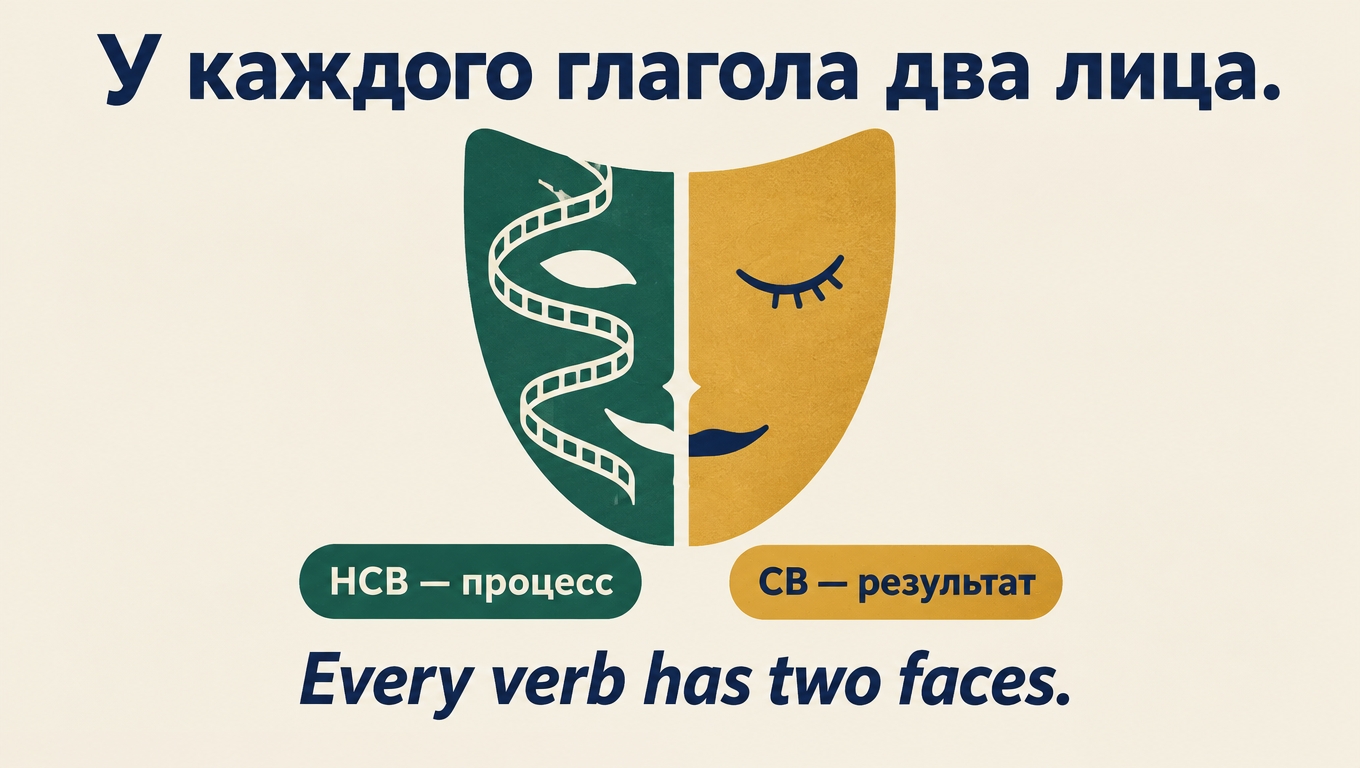
Every Russian verb comes in two halves, and this lesson installs both. Seventeen high-frequency aspect pairs, the ten prefixes that build the perfective, the rule that the present tense belongs to the imperfective alone, and the four meanings a past tense can carry.
⏱ About 60 minutes24 phrases34 exercises
What you will learn
Recognise that almost every Russian verb is half of a pair, and store the two halves as one vocabulary entry with two columns rather than as two words
Name the four labels the past tense carries — факт, процесс, повторение and результат — and say which aspect each one belongs to
Use the imperfective for the present tense and explain why a perfective verb has no present tense at all
Identify the ten perfective prefixes — по-, на-, с-, про-, пере-, до-, за-, вы-, у-, при- — and the core idea each one adds
Choose between «яписал» and «янаписал» in ordinary sentences about yesterday, and say what the choice changes
Conjugate the seventeen pairs of this lesson, including the mobile-stress verbs and the four irregulars дать, взять, начать and понять
Quick review
Say these aloud before you start. They come from earlier lessons.
Я чита́ю кни́гу.I am reading a book. (Lesson 2 — the present tense of a conjugation I verb)Listen in Russian:Slow in Russian:Я чита́ю кни́гу.
Вчера́ она́ рабо́тала.Yesterday she worked. (Lesson 2 — the past agrees in gender, not in person)Listen in Russian:Slow in Russian:Вчера́ она́ рабо́тала.
За́втра мы бу́дем гуля́ть.Tomorrow we shall go for a walk. (Lesson 2 — the compound future with быть)Listen in Russian:Slow in Russian:За́втра мы бу́дем гуля́ть.
У меня́ есть брат.I have a brother. (Lesson 4 — у + the genitive, with есть)Listen in Russian:Slow in Russian:У меня́ есть брат.
Я живу́ в Москве́.I live in Moscow. (Lesson 5 — в + the Prepositional for where something is)Listen in Russian:Slow in Russian:Я живу́ в Москве́.
У меня́ нет вре́мени.I have no time. (Lesson 8 — нет + the genitive)Listen in Russian:Slow in Russian:У меня́ нет вре́мени.
Theory
Every verb has two faces
Russian has no progressive tense, no perfect tense and no way of saying "have done". It has something smaller and far more useful instead: almost every verb exists twice. делать and сделать, писать and написать, читать and прочитать. The two halves are not two forms of one word — they are two vocabulary items that happen to share a meaning, and you learn them the way you learn the gender of a noun, as part of the word itself.
The first half is the imperfective, НСВ, несовершенныйвид. It describes the action itself: the process, the bare fact that it happened, the habit. The second half is the perfective, СВ, совершенныйвид. It describes the action as one completed whole with a result you can point at. English hides most of this inside its tenses; Russian puts it in the verb and leaves the tenses almost empty.
There is no ending that turns one into the other and no rule that reliably predicts a partner, so a pair is stored as one entry with two columns, never as two separate entries. The seventeen pairs in this lesson are the ones the rest of the course is built on. Learn them as pairs from day one and you will never again have to translate "have you ever…" word by word.
Я чита́ю кни́гу.I am reading a book. (imperfective present — the process)Listen in Russian:Slow in Russian:Я чита́ю кни́гу.
Я прочита́л кни́гу.I have read the book. (perfective past — the result: it is finished)Listen in Russian:Slow in Russian:Я прочита́л кни́гу.
Я писа́л письмо́.I was writing the letter. (imperfective past — the action under way)Listen in Russian:Slow in Russian:Я писа́л письмо́.
Я написа́л письмо́.I wrote the letter. (perfective past — the letter now exists)Listen in Russian:Slow in Russian:Я написа́л письмо́.
How a pair is made: a prefix, a suffix, or nothing at all
Three machines build the pairs. The commonest is a prefix, and it always produces the perfective half: писать → написать, делать → сделать, читать → прочитать. Ten prefixes do most of the work — по-, на-, с-, про-, пере-, до-, за-, вы-, у- and при- — and each one carries a core idea that recurs across dozens of verbs, so learning the ten pays for itself many times over.
The second machine is a suffix, and it produces the imperfective half. Sometimes it works on an already prefixed perfective — закончить → заканчивать, спросить → спрашивать — and sometimes on a plain one: купить → покупать, дать → давать, начать → начинать. The third machine is suppletion, where the two halves share no letters at all: говорить — сказать, брать — взять. Those simply have to be memorised, and there are only a handful of them.
One warning, and it is the mistake that costs beginners most. A prefix very often changes the meaning as well as the aspect. писать is "to write"; подписать is "to sign"; списать is "to copy out". Those are three different verbs that happen to share a root, not three aspects of one verb — and each one then acquires an imperfective of its own. Treat every prefixed verb as new vocabulary and learn its partner along with it.
писа́ть → написа́тьto write → to write and finish. The prefix на- makes the perfective.Listen in Russian:Slow in Russian:писа́ть → написа́ть
купи́ть → покупа́тьto buy → to be buying. Here the suffix -а- makes the imperfective instead.Listen in Russian:Slow in Russian:купи́ть → покупа́ть
говори́ть → сказа́тьto speak → to say. Suppletion: the two halves share not one letter.Listen in Russian:Slow in Russian:говори́ть → сказа́ть
писа́ть → подписа́тьto write → to sign. The prefix has changed the meaning, not only the aspect.Listen in Russian:Slow in Russian:писа́ть → подписа́ть
The present tense belongs to the imperfective alone
This is the rule that unlocks the whole system, and it admits no exceptions. A perfective verb has no present tense. Not a rare one, not an awkward one — none at all. The six forms that look exactly like a present, япрочитаю and тыпрочитаешь, are future forms, and Russian has no other way of saying "I shall read it and finish it".
So the two halves divide the tense system between them. The imperfective has a present, a past and a compound future built from быть: читаю, читал, будучитать. The perfective has a past and a simple future of six forms: прочитал, прочитаю. Both aspects have exactly the same four past forms — читал, читала, читало, читали — and the difference between them is entirely one of meaning.
The practical consequence is the one that catches English speakers out. "What are you doing?" can only ever be «Чтотыделаешь?». You cannot ask it with a perfective verb, because a perfective has no present to ask it in. Lesson 14 takes the two futures apart and shows you when to choose which; today the point is simply that the present-tense column has one occupant, and that this is a fact about the verb, not about the sentence.
Что ты де́лаешь?What are you doing? (imperfective — the only possible choice in the present)Listen in Russian:Slow in Russian:Что ты де́лаешь?
Сейча́с я чита́ю кни́гу.Right now I am reading a book.Listen in Russian:Slow in Russian:Сейча́с я чита́ю кни́гу.
Я прочита́ю кни́гу за́втра.I shall finish the book tomorrow. (a perfective’s "present" forms are future)Listen in Russian:Slow in Russian:Я прочита́ю кни́гу за́втра.
Он не понима́ет вопро́с.He does not understand the question. (понять, its partner, cannot say this)Listen in Russian:Slow in Russian:Он не понима́ет вопро́с.
The past: one set of endings, four meanings
In the past tense both halves exist, both are trivial to form, and the whole difficulty is choosing. The imperfective past carries three meanings. Факт, the bare fact that something happened: «Тычиталмоюкнигу?» — did you ever read it, yes or no. Процесс, the action under way at a particular moment: «Когдатыпришёл, ячитал». And повторение, the same thing again and again: «Онаписалаписьма» — she used to write letters.
The perfective past carries one, and it is the one English spends two tenses on. Результат: «Япрочиталкнигу» — I have read it, I know what is in it, the job is done. Завершённость is the same idea seen from the other end: «Янаписалписьмо» — the letter is written and now exists. Neither meaning says anything about when.
Two habits are worth acquiring straight away. Negation normally takes the imperfective, because you are describing a state of affairs rather than a failure to complete — «Янечиталтвоюкнигу» — but the perfective negative means precisely that the result was not reached, and «Янепонял» is the everyday way to say "I did not catch that". And a chain of completed steps, the way a story is told, is perfective all the way through: «Янаписалписьмоиполучилответ».
Ты чита́л мою́ кни́гу?Have you read my book (at all)? — факт, the bare factListen in Russian:Slow in Russian:Ты чита́л мою́ кни́гу?
Когда́ ты пришёл, я чита́л.When you came in I was reading. — процессListen in Russian:Slow in Russian:Когда́ ты пришёл, я чита́л.
Она́ писа́ла пи́сьма.She used to write letters. — повторение, the plural object does the workListen in Russian:Slow in Russian:Она́ писа́ла пи́сьма.
Я написа́л письмо́ и получи́л отве́т.I wrote the letter and got an answer. — two completed acts in a chainListen in Russian:Slow in Russian:Я написа́л письмо́ и получи́л отве́т.
Sound focus
The traps inside these seventeen pairs: stress and spelling
Several of the pairs move their stress, and if you learn them without the mark you will learn them wrong. писать gives япишу́ against тыпи́шешь; сказать gives яскажу́ against тыска́жешь; купить gives якуплю́ against тыку́пишь. In each case the first person singular throws its stress onto the ending and every other form pulls it back onto the stem. написать, спросить and посмотреть behave exactly the same way.
Four past tenses move too, and they all move in the feminine only: дал — дала́ — да́ло — да́ли, and the same shape for взял, понял and начал. The masculine, neuter and plural keep the stress on the root; only the feminine jumps to the ending. Notice that these are also the four verbs whose future is built on a different stem — дам, возьму, пойму, начну — so they are worth learning as one small irregular group rather than four surprises.
Two spelling traps finish the list. After ж, ш, щ and ч the third person plural of a second-conjugation verb is written -ат and never -ят: ониполучат, онизакончат, онипродолжат. And the imperfective узнавать is stressed on the ending — узнаю́, узнаёшь, узнаём — while its perfective partner узнать is stressed on the root: узна́ю, узна́ешь, узна́ем. узна́ем means "we shall find out"; узнаём means "we are finding out" or "we recognise". One letter apart, and the ё is never optional.
я пишу́ — ты пи́шешьmobile stress in the present of писатьListen in Russian:Slow in Russian:я пишу́ — ты пи́шешь
он дал — она́ дала́ — они́ да́лиonly the feminine past moves its stress, and only in these four of our pairsListen in Russian:Slow in Russian:он дал — она́ дала́ — они́ да́ли
они́ получа́т, они́ зако́нчатafter ж ш щ ч the ending is -ат, never -ятListen in Russian:Slow in Russian:они́ получа́т, они́ зако́нчат
узна́ем — узнаёмwe shall find out — we are finding out. The ё is the only differenceListen in Russian:Slow in Russian:узна́ем — узнаём
One pair, four slots: читать against прочитать
Form
НСВ imperfective: чита́ть
СВ perfective: прочита́ть
Present — what is happening now
Ячита́юкни́гу.
— none. A perfective verb has no present tense at all.
Past — the same four endings, different meanings
Ячита́лкни́гу.
Япрочита́лкни́гу.
Future
Ябу́дучита́тькни́гу.
Япрочита́юкни́гу.
Imperative
Чита́й!
Прочита́й!
The perfective column has one row fewer, and that missing row is the whole lesson. A perfective verb cannot describe what is happening now, because it has no present tense: its six present-shaped forms — прочита́ю, прочита́ешь — are future forms. Lesson 14 shows when to choose between the two futures; today the point is only that the present belongs to the imperfective.
The ten perfective prefixes and what each one adds
Form
what the prefix adds
in this lesson
elsewhere in the course
по-
a short bounded spell, or setting off
посмотре́ть
пойти́ (Lesson 7); поговори́ть
на-
completion by accumulation
написа́ть
накопи́ть — to save up
с-
completion; downwards in motion verbs
сде́лать, сказа́ть
съесть — to eat up
про-
through, to the end; time spent
прочита́ть
прожи́ть — to live through; пройти́ (Lesson 15)
пере-
again; across
—
переписа́ть — to rewrite; перее́хать (Lesson 15)
до-
up to a limit
—
дочита́ть — to read to the end; дойти́ (Lesson 15)
за-
a beginning; fetching; bringing to an end
зако́нчить
записа́ть — to write down; зайти́ (Lesson 15)
вы-
out; thoroughly, to completion
—
вы́учить — to learn by heart; вы́йти
у-
away, off
—
уйти́, уе́хать (Lesson 15)
при-
arrival
пригото́вить (the meaning has drifted)
прийти́ (Lesson 7); прие́хать
Six of the ten appear in this lesson’s own pairs. Read the middle column as a sample, not as a rule: the prefix tells you what kind of completion is meant, but it never tells you the meaning of the whole verb, and it very often changes that meaning outright. Every prefixed verb is new vocabulary with its own partner.
The past tense: three labels on the imperfective, one on the perfective
Form
what it says
example
Факт — the bare fact (imperfective)
Did it happen at all? The result is not the point.
Тычита́лмою́кни́гу?
Процесс — the process (imperfective)
It was under way at that moment.
Когда́тыпришёл, ячита́л.
Повторение — repetition (imperfective)
Again and again; a habit. The plural object does much of the work.
Она́писа́лапи́сьма.
Результат — the result (perfective)
It is finished, and there is something to show for it.
Япрочита́лкни́гу.
The tense forms themselves are identical — читал and прочитал differ only in the prefix — so the choice is made before you open your mouth, by deciding which question you are answering. Ask "did it happen?", "was it going on?", "did it keep happening?" and you get the imperfective; ask "is it done?" and you get the perfective.
The seventeen pairs of this lesson
Form
НСВ imperfective
СВ perfective
how the pair is built
to do, to make
де́лать
сде́лать
the prefix с- makes the perfective
to write
писа́ть
написа́ть
the prefix на- makes the perfective; с → ш
to read
чита́ть (Lesson 2)
прочита́ть
the prefix про- makes the perfective
to say
говори́ть (Lesson 3)
сказа́ть
suppletion — the halves share no letters
to buy
покупа́ть (Lesson 6)
купи́ть
the suffix -а- makes the imperfective
to cook, to prepare
гото́вить (Lesson 6)
пригото́вить
the prefix при- makes the perfective
to watch, to look at
смотре́ть (Lesson 3)
посмотре́ть
the prefix по- makes the perfective
to ask
спра́шивать
спроси́ть
the suffix -ива- makes the imperfective; с → ш
to answer
отвеча́ть
отве́тить
the suffix -а- makes the imperfective; т → ч
to receive, to get
получа́ть
получи́ть
the suffix -а- makes the imperfective
to give
дава́ть (Lesson 6)
дать
the suffix -ва- makes the imperfective
to take
брать (Lesson 6)
взять
suppletion
to begin
начина́ть
нача́ть
the suffix -а- makes the imperfective
to continue
продолжа́ть
про́должить
-а- against -и-; neither half comes from the other
to finish
зака́нчивать
зако́нчить
the suffix -ива- makes the imperfective
to understand
понима́ть (Lesson 2)
поня́ть
the suffix -а- makes the imperfective
to find out, to recognise
узнава́ть
узна́ть
the suffix -ва- makes the imperfective
Store each row as one vocabulary entry with two columns, never as two separate entries — that is how the pair stays together in your head. Eleven of these are among the twenty pairs the grammar reference recommends learning first; the other nine arrive with the vocabulary they belong to. Eight of the seventeen have an imperfective half you already know from Lessons 2, 3 and 6 — you have been using читать, говорить, смотреть, покупать, готовить, давать, брать and понимать for eleven lessons without knowing that a partner existed.
Vocabulary
Learn each word with its stress mark and its pronunciation. Nouns are given with their gender, animacy and their full six-case declension; verbs are given with their aspect and, where one exists, their partner verb.
The imperfective present is the only way to say what is happening right now. A perfective verb has no present tense at all, so «Сейчасяпрочитаюкнигу» is a promise about the future, not a description of this minute.
neutralpresentaspectreading
Listen in Russian:Slow in Russian:Я читаю книгу.
Я прочита́л кни́гу.
I have read the book — I finished it.
IPA/ja prətɕɪˈtal ˈknʲiɡʊ/
Say itYAH pruh-chih-TAHL kuh-NEE-goo.
The perfective past and its result: the book is finished and you know what is in it. English needs a whole auxiliary tense for this; Russian needs one word.
neutralpastaspectreading
Listen in Russian:Slow in Russian:Я прочитал книгу.
Ты чита́л мою́ кни́гу?
Have you read my book (at any point)?
IPA/tɨ tɕɪˈtal mɐˈju ˈknʲiɡʊ/
Say itTIH chih-TAHL muh-YOO kuh-NEE-goo?
Asking whether something ever happened at all is the imperfective’s факт. «Тыпрочиталмоюкнигу?» is a narrower question: did you get to the end of it?
informalquestionspastaspectreading
Listen in Russian:Slow in Russian:Ты читал мою книгу?
Что ты де́лал вчера́?
What were you doing yesterday?
IPA/ʂto tɨ ˈdʲeləl fˈtɕorə/
Say itSHTOH TIH DYEH-lul fuh-chih-RAH?
The imperfective past asks about the activity itself, however it turned out. «Чтотысделалвчера?» asks instead for the list of things you got done.
informalquestionspastaspect
Listen in Russian:Slow in Russian:Что ты делал вчера?
Что ты сде́лал вчера́?
What did you get done yesterday?
IPA/ʂto tɨ ˈzʲdʲeləl fˈtɕorə/
Say itSHTOH TIH ZDYEH-lul fuh-chih-RAH?
One prefix, and the question changes from «how did you spend the day» to «what is now finished». In speech the с voices to [з] before the д.
informalquestionspastaspect
Listen in Russian:Slow in Russian:Что ты сделал вчера?
Я писа́л письмо́.
I was writing the letter.
IPA/ja pʲɪˈsal pʲɪsʲˈmo/
Say itYAH pih-SAHL pih-SMOH.
The процесс label: the writing was under way, and the sentence says nothing at all about whether it was ever finished.
neutralpastaspectwriting
Listen in Russian:Slow in Russian:Я писал письмо.
Я написа́л письмо́.
I have written the letter.
IPA/ja nəpʲɪˈsal pʲɪsʲˈmo/
Say itYAH nuh-pih-SAHL pih-SMOH.
The результат label: the letter exists. на- carries its core idea of completion by accumulation — the same prefix gives накопи́ть «to save up».
neutralpastaspectwriting
Listen in Russian:Slow in Russian:Я написал письмо.
Он не отве́тил на мой вопро́с.
He did not answer my question.
IPA/on nʲe ɐˈtvʲetʲɪl nɐ moj vɐˈpros/
Say itOHN NYEH uh-TVYEH-til nuh MOY vuh-PROHS.
отвечать and ответить govern на + the accusative for the thing answered — навопрос, написьмо — and the dative for the person: ответитьмне. Never «отвечатьвопрос».
neutralpastaspectnegationgovernment
Listen in Russian:Slow in Russian:Он не ответил на мой вопрос.
Я не по́нял вопро́с.
I did not catch the question.
IPA/ja nʲe ˈponʲɪl vɐˈpros/
Say itYAH NYEH POH-nyul vuh-PROHS.
A negated perfective says the result was never reached. «Янепонял» on its own is the everyday «I did not catch that»; «янепонимал» describes a state that went on for a while.
neutralpastaspectnegationstudy
Listen in Russian:Slow in Russian:Я не понял вопрос.
Я не понима́л вопро́с.
I did not understand the question (at the time).
IPA/ja nʲe pənʲɪˈmal vɐˈpros/
Say itYAH NYEH puh-nih-MAHL vuh-PROHS.
Read this straight after the previous sentence and the whole lesson is in eight words: one form reports a failure, the other reports a state that lasted. Negation with no result in mind normally takes the imperfective.
neutralpastaspectnegationstudy
Listen in Russian:Slow in Russian:Я не понимал вопрос.
Купи́ хлеб, пожа́луйста.
Buy some bread, please.
IPA/kʊˈpʲi xlʲep pɐˈʐalujstə/
Say itkoo-PEE KHLYEP, puh-ZHAH-luy-stuh.
The imperative of a request is normally perfective, because you are asking for one completed act. The imperfective «Покупайхлеб» is a different speech act — a standing instruction to buy bread habitually, or a brusque «go on, buy it» — not this request.
politeimperativeaspectfoodshopping
Listen in Russian:Slow in Russian:Купи хлеб, пожалуйста.
Я купи́л хлеб и сыр.
I bought the bread and the cheese.
IPA/ja kʊˈpʲil xlʲep i sɨr/
Say itYAH koo-PEEL KHLYEP EE SIHR.
купить is the perfective of покупать, and the pair is built by a suffix rather than a prefix — which is why the two halves look so unlike each other.
neutralpastaspectfoodshopping
Listen in Russian:Slow in Russian:Я купил хлеб и сыр.
Она́ пригото́вила ры́бу.
She has cooked the fish.
IPA/ɐˈna prʲɪɡɐˈtovʲɪlə ˈrɨbə/
Say ituh-NAH prih-guh-TOH-vih-luh RIH-boo.
при- normally means arrival — прийти, приехать — but in приготовить it has drifted to «prepare, cook». That drift is exactly why every prefixed verb is new vocabulary.
neutralpastaspectfood
Listen in Russian:Slow in Russian:Она приготовила рыбу.
Мы начина́ем рабо́ту.
We are starting work.
IPA/mɨ nətɕɪˈnajɪm rɐˈbotʊ/
Say itMIH nuh-chih-NAH-yim ruh-BOH-too.
начинать takes the accusative for the thing begun, or an infinitive: «Мыначинаемработать». The present tense is available here precisely because начинать is imperfective.
neutralpresentaspectwork
Listen in Russian:Slow in Russian:Мы начинаем работу.
Я зако́нчил рабо́ту.
I have finished work.
IPA/ja zɐˈkontɕɨl rɐˈbotʊ/
Say itYAH zuh-KOHN-chil ruh-BOH-too.
закончить is perfective; its imperfective partner заканчивать is built with the -ива- suffix, which adds a syllable but leaves the stress where it was, on the root: зако́нчу — зака́нчиваю.
neutralpastaspectwork
Listen in Russian:Slow in Russian:Я закончил работу.
Продолжа́йте, пожа́луйста.
Please carry on.
IPA/prədəlˈʐajtʲə pɐˈʐalujstə/
Say itpruh-dul-ZHAY-tyuh, puh-ZHAH-luy-stuh.
The imperfective imperative asks somebody to keep doing what they were doing, and that is almost always what you want here. The perfective «Продолжите» is grammatical but rare in this sense: Russian reaches for the imperfective whenever the point is to carry an activity on rather than to bring it to an end.
politeimperativeaspectregisterwork
Listen in Russian:Slow in Russian:Продолжайте, пожалуйста.
Ты получи́л де́ньги?
Did you get the money?
IPA/tɨ pəlʊˈtɕil ˈdʲenʲɡʲɪ/
Say itTIH puh-loo-CHIHL DYEN-gih?
получить is end-stressed in every form — получу́, получи́шь, получи́т — and after ч the third person plural is они́получа́т, never *получя́т.
informalquestionspastaspectmoney
Listen in Russian:Slow in Russian:Ты получил деньги?
Я получи́л письмо́ от ма́мы.
I got a letter from Mum.
IPA/ja pəlʊˈtɕil pʲɪsʲˈmo ot ˈmamɨ/
Say itYAH puh-loo-CHIHL pih-SMOH ut MAH-mih.
от + the genitive is «from» a person (Lesson 8). ма́ма keeps its stress on the first syllable in every case form, so the genitive is ма́мы. The imperfective would describe the habit: «Яполучалписьмаотмамы».
neutralpastaspectfamily
Listen in Russian:Slow in Russian:Я получил письмо от мамы.
Он взял мою́ су́мку.
He took my bag.
IPA/on vzʲal mɐˈju ˈsumkʊ/
Say itOHN VZYAHL muh-YOO SOOM-koo.
взять and брать share not one letter — a suppletive pair, like говорить and сказать. The future of взять is built on a third stem again: возьму́, возьмёшь, возьму́т.
neutralpastaspectobjects
Listen in Russian:Slow in Russian:Он взял мою сумку.
Дай мне во́ду, пожа́луйста.
Give me the water, please.
IPA/daj mnʲe ˈvodʊ pɐˈʐalujstə/
Say itDAY muh-NYEH VOH-doo, puh-ZHAH-luy-stuh.
дать is one of the small irregular group: дам, дашь, даст, дади́м, дади́те, даду́т. Its government is датькомучто — dative for the person, accusative for the thing.
politeimperativeaspectgovernment
Listen in Russian:Slow in Russian:Дай мне воду, пожалуйста.
Я узна́л твою́ сестру́.
I recognised your sister.
IPA/ja ʊˈznal tvɐˈju sʲɪˈstru/
Say itYAH oo-ZNAHL tvuh-YOO sih-STROO.
узнать means both «to find out» and «to recognise», and the context decides which. Its imperfective узнавать is stressed on the ending — узнаю́, узнаёшь — while узнать is stressed on the root: узна́ю, узна́ешь.
neutralpastaspectfamily
Listen in Russian:Slow in Russian:Я узнал твою сестру.
Я спра́шивал, а он не отвеча́л.
I kept asking, and he did not answer.
IPA/ja ˈspraʂɨvəl a on nʲe ɐtvʲɪˈtɕal/
Say itYAH SPRAH-shih-vul, AH OHN NYEH uh-tvih-CHAHL.
Two imperfectives in the past describe two processes running side by side, and together they carry the repetition label: this went on, again and again. а here is the contrasting «but, whereas» of Lesson 3.
neutralpastaspectcommunication
Listen in Russian:Slow in Russian:Я спрашивал, а он не отвечал.
Она́ посмотре́ла фильм.
She watched the film — and finished it.
IPA/ɐˈna pəsmɐˈtrʲelə fʲilʲm/
Say ituh-NAH puh-smuh-TRYEH-luh FEELM.
посмотретьна + the accusative is «to look at»; посмотретьфильм is «to watch a film through». The mobile stress appears in the future: япосмотрю́, but тыпосмо́тришь.
neutralpastaspectmedia
Listen in Russian:Slow in Russian:Она посмотрела фильм.
Скажи́ мне, что ты де́лаешь.
Tell me what you are doing.
IPA/skɐˈʐɨ mnʲe ʂto tɨ ˈdʲeləɪʂ/
Say itskuh-ZHIH muh-NYEH, SHTOH TIH DYEH-luh-yish.
сказать is the perfective partner of говорить and shares no letters with it. It takes the first-conjugation endings, with two surprises: the з of the infinitive alternates with ж, and the stress is mobile — яскажу́, with the stress on the ending, but тыска́жешь and они́ска́жут, with the stress back on the stem.
informalimperativeaspectcommunication
Listen in Russian:Slow in Russian:Скажи мне, что ты делаешь.
Dialogues
Two questions about one book
Anna and Tom are friends, so they use ты. Anna wants to know whether Tom has got to the end of her book.
Anna
Том, ты читал мою книгу?
Tom, have you read my book?
Listen in Russian:Slow in Russian:Том, ты читал мою книгу?
Tom
Читал. Я читал её вчера.
I have. I was reading it yesterday.
Listen in Russian:Slow in Russian:Читал. Я читал её вчера.
Anna
И как?
And how is it?
Listen in Russian:Slow in Russian:И как?
Tom
Очень интересно. Но я не прочитал её.
Very interesting. But I have not finished it.
Listen in Russian:Slow in Russian:Очень интересно. Но я не прочитал её.
Anna
Я понимаю. Прочитай её, пожалуйста.
I understand. Please read it through.
Listen in Russian:Slow in Russian:Я понимаю. Прочитай её, пожалуйста.
Tom
Хорошо. Сегодня я прочитаю её.
All right. Today I shall finish it.
Listen in Russian:Slow in Russian:Хорошо. Сегодня я прочитаю её.
Anna
А что ты делаешь сейчас?
And what are you doing now?
Listen in Russian:Slow in Russian:А что ты делаешь сейчас?
Tom
Сейчас я пишу письмо.
Right now I am writing a letter.
Listen in Russian:Slow in Russian:Сейчас я пишу письмо.
Anna
Напиши его сегодня!
Write it today!
Listen in Russian:Slow in Russian:Напиши его сегодня!
At the office, first week
Marina is a manager. Viktor has just joined her team, so the two of them are still on вы.
Marina
Виктор, вы получили моё письмо?
Viktor, did you get my letter?
Listen in Russian:Slow in Russian:Виктор, вы получили моё письмо?
Viktor
Да, я получил его сегодня.
Yes, I got it today.
Listen in Russian:Slow in Russian:Да, я получил его сегодня.
Marina
А вы ответили на него?
And have you replied to it?
Listen in Russian:Slow in Russian:А вы ответили на него?
Viktor
Нет, я не ответил. Я писал письмо, но не закончил его.
No, I have not replied. I was writing the letter, but I did not finish it.
Listen in Russian:Slow in Russian:Нет, я не ответил. Я писал письмо, но не закончил его.
Marina
Я понимаю. Закончите его сегодня, пожалуйста.
I see. Please finish it today.
Listen in Russian:Slow in Russian:Я понимаю. Закончите его сегодня, пожалуйста.
Viktor
Хорошо, я закончу его сегодня.
All right, I shall finish it today.
Listen in Russian:Slow in Russian:Хорошо, я закончу его сегодня.
Marina
Спасибо. Вы поняли мой вопрос?
Thank you. Did you understand my question?
Listen in Russian:Slow in Russian:Спасибо. Вы поняли мой вопрос?
Viktor
Да, я понял ваш вопрос.
Yes, I understood your question.
Listen in Russian:Slow in Russian:Да, я понял ваш вопрос.
Marina
Очень хорошо. Продолжайте работу.
Very good. Carry on with the work.
Listen in Russian:Slow in Russian:Очень хорошо. Продолжайте работу.
Exercises
Answer actively — try to recall the Russian before you look at any hint.
Aspect ChoiceExercise 1
Choose the form that fits the meaning.
Choose the aspect: «Вчерая ___ книгу.» — Yesterday I was reading a book; I did not finish it.
Aspect ChoiceExercise 2
Choose the form that fits the meaning.
Choose the aspect: «Она ___ письмоиполучилаответ.» — She wrote the letter and got an answer.
Aspect ChoiceExercise 3
Choose the form that fits the meaning.
Choose the aspect: «Ты ___ моюкнигу?» — Have you ever read my book?
Aspect ChoiceExercise 4
Choose the form that fits the meaning.
Choose the form that can complete «Сейчася ___ книгу.» — Right now I am reading a book.
Aspect ChoiceExercise 5
Choose the form that fits the meaning.
Choose the aspect: «Она ___ рыбу. Рыбанастоле.» — She has cooked the fish. The fish is on the table.
Aspect ChoiceExercise 6
Choose the form that fits the meaning.
Choose the aspect: «Я ___ вашвопрос.» — I did not catch your question; it went straight over my head.
Aspect ChoiceExercise 7
Choose the form that fits the meaning.
Choose the aspect: «Он ___ мнеденьгивчера.» — He gave me the money yesterday, and I have it now.
ConjugationExercise 8
Give the future tense form for «я».
написать — я (future)
ConjugationExercise 9
Give the future tense form for «они».
дать — они (future)
ConjugationExercise 10
Give the future tense form for «они».
получить — они (future)
ConjugationExercise 11
Give the past tense form for a female subject.
понять — past, feminine
Translate To RussianExercise 12
Translate into Russian.
He has written the letter.
Translate To RussianExercise 13
Translate into Russian.
She has cooked the fish.
Translate To RussianExercise 14
Translate into Russian.
Give me the water, please. (to one person, informal)
Translate To RussianExercise 15
Translate into Russian.
Ask the doctor. (to one person, informal)
Translate To RussianExercise 16
Translate into Russian.
Today I shall finish the work.
Translate To EnglishExercise 17
Translate into English.
Оннаписа́лписьмо́иполучи́лотве́т.
Translate To EnglishExercise 18
Translate into English.
Она́гото́вилары́бу, аончита́л.
Translate To EnglishExercise 19
Translate into English.
Янепо́нял.
Multiple ChoiceExercise 20
Choose the correct sentence.
Which sentence means «I was reading the book» rather than «I finished it»?
Multiple ChoiceExercise 21
Choose the correct verb.
Which of these verbs has no present tense at all?
Multiple ChoiceExercise 22
Choose the correct meaning.
What idea does the prefix про- add in прочитать?
Fill GapExercise 23
Fill the gap with the present tense of начинать for «мы».
Сейчасмы ___ работу.
Fill GapExercise 24
Fill the gap with the past tense of дать for a male subject.
Вчераон ___ мнеденьги.
Fill GapExercise 25
Fill the gap with the past tense of узнать for a male speaker.
Я ___ твоюсеструвмагазиневчера.
Sentence TransformExercise 26
Use прочитать and keep the tense.
Rewrite with the perfective partner: «Ячиталкнигу.»
Sentence TransformExercise 27
Use готовить and keep the tense.
Rewrite with the imperfective partner: «Онаприготовиларыбу.»
Sentence TransformExercise 28
Rewrite it as the imperative for «ты».
Turn this into a command to one person: «Выответитенавопрос.»
Word OrderExercise 29
Put the words in order.
Build the sentence: «Yesterday he wrote the letter.»
Match PairsExercise 30
Pair the two halves of each aspect pair.
Match each imperfective verb with its perfective partner.
Stress ChoiceExercise 31
Choose the correctly stressed form.
Where does the stress fall in the perfective infinitive написать?
True FalseExercise 32
Answer true or false.
A perfective verb can be used in the present tense.
True FalseExercise 33
Answer true or false.
«Янепонял» and «Янепонимал» mean the same thing.
Listen And TypeExercise 34
Play the audio and type what you hear.
Listen and type the sentence.
Speak now
Take each sentence and run it through both halves of its pair out loud — the imperfective first, then the perfective — and say what changes in the meaning as you switch. «Ячита́л» against «япрочита́л», «яписа́л» against «янаписа́л». Do not translate; feel the difference between reporting an activity and reporting a finished thing. That spoken contrast, not the table, is what makes aspect stick.
Что ты де́лаешь сейча́с?What are you doing now?Listen in Russian:Slow in Russian:Что ты де́лаешь сейча́с?
Вчера́ я чита́л кни́гу. Сего́дня я прочита́л её.Yesterday I was reading the book. Today I finished it.Listen in Russian:Slow in Russian:Вчера́ я чита́л кни́гу. Сего́дня я прочита́л её.
Скажи́ мне, пожа́луйста.Tell me, please.Listen in Russian:Slow in Russian:Скажи́ мне, пожа́луйста.
Мы начина́ем рабо́ту.We are starting work.Listen in Russian:Slow in Russian:Мы начина́ем рабо́ту.
Ты получи́л мой отве́т?Did you get my reply?Listen in Russian:Slow in Russian:Ты получи́л мой отве́т?
Дай мне во́ду, пожа́луйста.Give me the water, please.Listen in Russian:Slow in Russian:Дай мне во́ду, пожа́луйста.
Lesson checkpoint
Before you move on, make sure you can do all of this without looking:
Take five pairs from the table of seventeen and say each one aloud in the past tense for «я»: яделал — ясделал, яписал — янаписал, ячитал — япрочитал
Give all six present-tense forms of делать, then say out loud why сделать cannot do the same thing
Give the four past forms of дать, взять, понять and начать, and name the one form in each that moves its stress
Name the ten perfective prefixes and the core idea each one adds, without looking at the table
Take three of your own sentences about yesterday and switch each one from «I was doing it» to «I did it and finished», saying out loud what the switch changed
Ask somebody whether they have ever read a book you know, using the imperfective, then ask whether they got to the end of it, using the perfective
Remember this
Aspect is not a tense and not an ending. Almost every Russian verb is half of a pair — делать / сделать, писать / написать — and the two halves are stored as one vocabulary entry with two columns, never as two separate entries.
The present tense belongs to the imperfective alone. A perfective verb has no present at all: its six present-shaped forms — сделаю, прочитаю, напишу — are future forms, and Lesson 14 shows when to choose them.
Three machines build a pair. A prefix makes the perfective (писать → написать). A suffix makes the imperfective (купить → покупать, дать → давать, закончить → заканчивать). Suppletion makes pairs that share no letters at all (говорить — сказать, брать — взять).
The imperfective past carries three meanings — the bare fact (ячитал), the process under way (когдатыпришёл, ячитал) and repetition (онаписалаписьма). The perfective past carries one: the result, the completed whole (япрочитал).
Negation normally takes the imperfective (янечитал), but a negated perfective means the result was never reached — «янепонял» is the everyday way to say «I did not catch that».
A prefix usually changes the meaning as well as the aspect: написать is «to finish writing», but подписать is «to sign» and списать is «to copy out». Treat every prefixed verb as new vocabulary and learn its partner along with it.