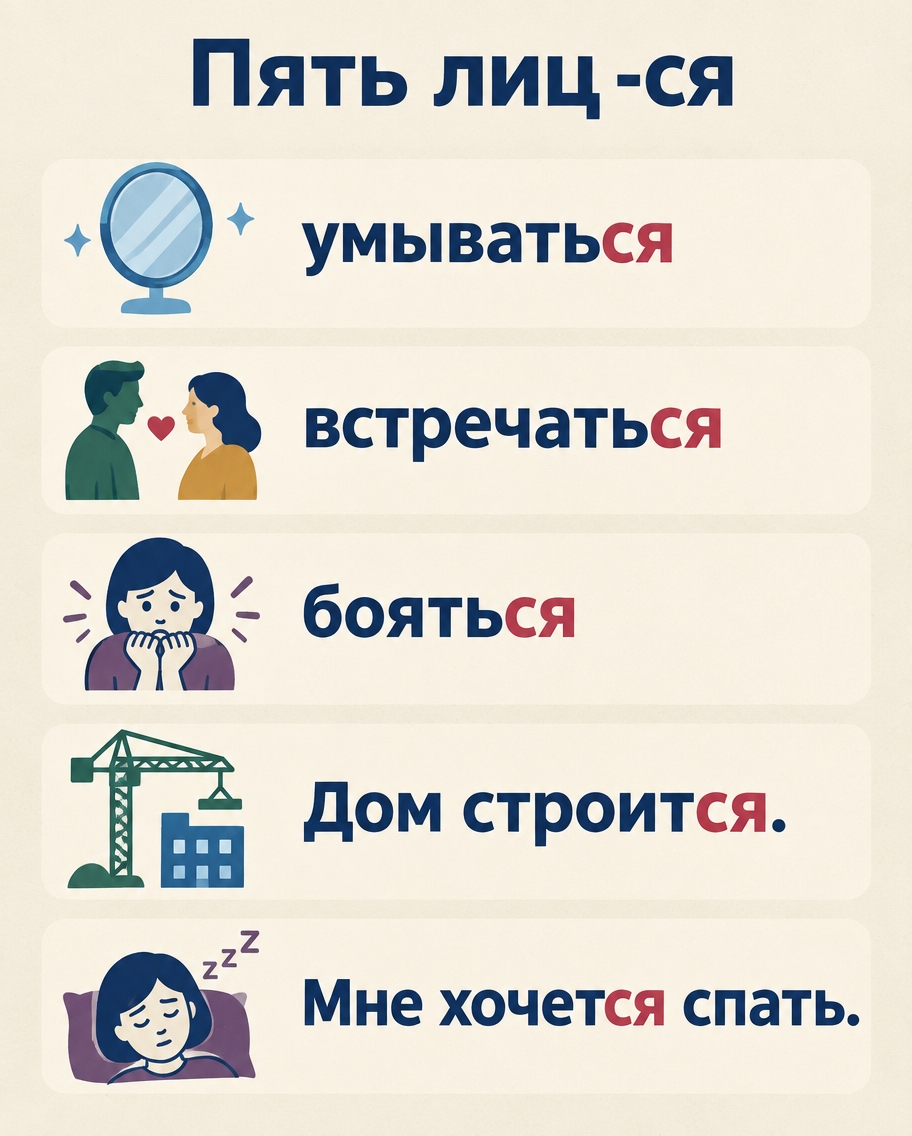
The little ending -ся hides five different meanings, from "wash yourself" to "the house is being built" to sentences with no subject at all. This lesson builds every -ся verb of daily life — умываться, встречаться, бояться, жениться, мнехочется — and ends with the story of your own day.
⏱ About 50 minutes24 phrases32 exercises
What you will learn
Bolt -ся / -сь onto any verb you know and pick the right allomorph without thinking: -сь after a vowel, -ся after a consonant, -ться in the infinitive
Sort -ся verbs into the five meaning types — reflexive, reciprocal, passive, state, impersonal — and explain why -ся does not mean "myself"
Conjugate the twenty -ся verbs of daily life, including the mobile-stress ones: ложусь but ложишься, женюсь but женишься, боюсь but бойся
Use the impersonal dative «мнехочется» with an infinitive, and «мненеспится», in the present and in the past
State the government of every new verb: бояться + genitive, интересоваться + instrumental, готовитьсяк + dative, женитьсяна + prepositional, выходитьзамужза + accusative
Tell the story of your own day from morning to night, with routine verbs, frequency adverbs and clock time
Quick review
Say these aloud before you start. They come from earlier lessons.
Я уже сделал работу.I have already done the work.Listen in Russian:Slow in Russian:Я уже сделал работу.
Обычно я работаю дома.I usually work at home.Listen in Russian:Slow in Russian:Обычно я работаю дома.
Мне нравится Москва.I like Moscow.Listen in Russian:Slow in Russian:Мне нравится Москва.
Потом я иду домой.Then I go home.Listen in Russian:Slow in Russian:Потом я иду домой.
Я никогда не опаздываю.I am never late.Listen in Russian:Slow in Russian:Я никогда не опаздываю.
Скажите, пожалуйста, который час?Could you tell me the time, please?Listen in Russian:Slow in Russian:Скажите, пожалуйста, который час?
Theory
The postfix: -ся after a consonant, -сь after a vowel
Lesson 16 asked you to recognise the -ся / -сь ending; this lesson puts it in your hands. The good news is that there is nothing new to conjugate. A -ся verb is an ordinary verb with an invariable postfix bolted onto the end: conjugate the verb you already know, then make exactly one decision — -ся or -сь — and that decision is purely phonetic. After a vowel write -сь: умываю → умываюсь, учи → учись. After a consonant write -ся, and the soft sign and й count as consonants here: умываешь → умываешься, готовь → готовься, мой → мойся.
The same two-way choice runs through the whole paradigm. The infinitive always ends in -ться: умываться, учиться, смеяться. The past adds -ся to the masculine, which ends in the consonant л (умывался), and -сь to the feminine, neuter and plural, which end in a vowel (умывалась, умывалось, умывались). The imperative is -сь after a vowel and -ся after a consonant: умойся, умойтесь, учись, but готовься. And because the postfix contains no vowel at all, it cannot move the stress: занимаю and занимаюсь are stressed on the same syllable, period.
One spelling trap matters more than all the others. -тся and -ться sound identical — in both, the т and с melt into a single [tsa]. Онумывается and the infinitive умываться are pronounced the same way; Russian ears never notice, but Russian spelling does. The test is substitution: if a "to do something" infinitive fits in the slot, write the soft sign — «Надоумываться», «Яхочуумываться». If it is a he-she-it present, no soft sign — «Онумывается». Learners who skip this test write the single most common native-visible spelling mistake there is.
Я умываюсь каждое утро.I wash every morning.Listen in Russian:Slow in Russian:Я умываюсь каждое утро.
Ты занимаешься каждый день?Do you practise every day?Listen in Russian:Slow in Russian:Ты занимаешься каждый день?
Умывайся быстро — мы опаздываем!Wash up quickly — we’re running late!Listen in Russian:Slow in Russian:Умывайся быстро — мы опаздываем!
Она уже умывается и одевается.She is already washing and getting dressed.Listen in Russian:Slow in Russian:Она уже умывается и одевается.
One ending, five meanings
The biggest trap for an English speaker is deciding that -ся means "myself". That is where the postfix came from — it is the worn-down accusative of себя — and for a handful of verbs it is still literally true. But most -ся verbs left that meaning behind long ago, and the drift is systematic enough to sort into five types. Type one, the true reflexive: the action does come back onto the subject — умываться wash oneself, одеваться dress oneself, купаться bathe.
Type two, the reciprocal: the subjects do it to each other — встречаться meet each other. Type three, the passive: the subject receives the action and nobody performs it in the sentence — «Домстроится» the house is being built. You have known a passive -ся verb since Lesson 5: находиться — «Гденаходитсяаптека?» is literally "where does the pharmacy find itself". Type four, the state verbs, which have no partner without -ся at all: нравиться from Lesson 4, plus бояться, улыбаться, смеяться, надеяться. There is no *улыбать and no *боять — the -ся is not adding a meaning, it is simply part of the word.
Type five bends the sentence itself: the impersonals хочется and спится refuse to have a subject and put the human being in the dative — «Мнехочетсяспать». In practice you will not need to name the five types in order to speak. What you do need is the habit of learning every -ся verb whole, with its meaning and its government, because the postfix usually changes the meaning of the base verb: готовить is "somebody cooks something", готовиться is "to get ready for something" — and готовитьсякчему, with к and the dative, never an accusative.
Летом дети любят купаться.In summer children love swimming.Listen in Russian:Slow in Russian:Летом дети любят купаться.
Мы встречаемся в субботу.We are meeting (each other) on Saturday.Listen in Russian:Slow in Russian:Мы встречаемся в субботу.
Здесь строится новый дом.A new house is being built here.Listen in Russian:Slow in Russian:Здесь строится новый дом.
Мне нравится музыка.I like music. (literally: music is pleasing to me)Listen in Russian:Slow in Russian:Мне нравится музыка.
Conjugating a -ся verb: nothing new, three stress patterns
Morphologically there is nothing new in this lesson. A -ся verb belongs to the same conjugation as its base verb, so conjugate the base and add the postfix. заниматься conjugates like знать (class I): занимаюсь, занимаешься. готовиться conjugates like говорить (class II): готовлюсь, готовишься — note the в → вл mutation in the я-form. The -овать drop of Lesson 16 survives inside reflexives too: интересоваться gives яинтересуюсь, with the -ова- of the infinitive vanishing before the endings.
What does have to be learned verb by verb is the stress, and the three patterns you already met in Lessons 5 and 16 all come back. Fixed stem stress — the easy one: занимаюсь, занимаешься, занимаются, the stress never budges. Mobile stress of the учиться type: the я-form throws the stress onto the ending — учусь, ложусь, женюсь — and every other form pulls it back onto the stem: учишься, ложишься, женишься. Ending stress of the находиться type: нахожусь, находишься, находятся, the stress parked on the ending all the way down. Plus one spelling mercy: wherever a stressed ending would carry an е, it is written ё instead — встаёшь, смеёшься, остаётся — and since ё is always stressed, those forms cannot be misread.
An honesty note, because this course does not pretend otherwise: this lesson is the first step beyond the strict A1 minimum. Reflexive verbs with mobile stress are genuinely A2 material — in бояться the stress sits somewhere different in the infinitive, the я-form, the imperative and the past — and no beginner is expected to derive those jumps from first principles under conversational pressure. Learn each verb as a chunk: the infinitive plus the я-form first, the rest by analogy. The tables above are there for reference, not for recitation.
Я занимаюсь, ты занимаешься, они занимаются.I practise, you practise, they practise.Listen in Russian:Slow in Russian:Я занимаюсь, ты занимаешься, они занимаются.
Я ложусь спать в одиннадцать.I go to bed at eleven.Listen in Russian:Slow in Russian:Я ложусь спать в одиннадцать.
Ты встаёшь в шесть?Do you get up at six?Listen in Russian:Slow in Russian:Ты встаёшь в шесть?
Мы смеёмся, они смеются.We are laughing, they are laughing.Listen in Russian:Slow in Russian:Мы смеёмся, они смеются.
«Мнехочется»: the impersonal family grows up
You have known this construction since Lesson 4 — «Мненравится» — and since Lesson 9 — «Мнехолодно», «Мненадо». Russian prefers to say that something happens to you rather than that you do it, and the dative case is where the experiencer lives. хочется and спится are two new members of the same family, and they obey the same rules to the letter: the human being goes into the dative (мне, тебе, ему, ей, нам, вам, им), the verb freezes into a single third-person form, and no grammatical subject exists anywhere in the sentence.
«Мнехочетсяспать» — literally "it wants itself to me, to sleep" — is the softer, more natural way to report a wish that has come over you; «Яхочуспать» states the same fact flatly, and is the form for decisions and demands. хочется takes an infinitive: «Мнехочетсягулять», «Ейхочетсяпить», «Намхочетсядомой». In the past the frozen form is the neuter хотелось: «Мнехотелосьспать». Its twin спится is met almost only in the negative: «Мненеспится» — "I can’t sleep", literally "it doesn’t sleep itself to me". Both verbs are built from хотеть and спать, but neither can ever be used personally: «яхочусь» is not a sentence.
One small structural consequence is worth stating plainly: impersonal verbs have no imperative. You cannot command a state into being, so the imperative cells in the vocabulary tables for хочется and спится show a dash. If you want somebody to sleep, use the plain verb: «Спи!» — and if you want to suggest a wish politely, use the conditional of Lesson 19: «Мнехотелосьбыкофе».
Мне хочется спать.I feel like sleeping.Listen in Russian:Slow in Russian:Мне хочется спать.
Тебе хочется гулять?Do you feel like a walk?Listen in Russian:Slow in Russian:Тебе хочется гулять?
Ему не спится.He can’t sleep.Listen in Russian:Slow in Russian:Ему не спится.
Нам хочется домой.We feel like going home.Listen in Russian:Slow in Russian:Нам хочется домой.
Telling the story of your day
Everything in this lesson converges on one skill: talking about your own day from morning to night. The cast of verbs is fixed — просыпаться, вставать, умываться, одеваться, завтракать, заниматься, возвращаться, ложитьсяспать — and the time frame is one you already own: «всемьчасов» (Lessons 11 and 17), «утром», «днём», «вечером» (Lesson 10), and the frequency adverbs of Lesson 17: всегда, обычно, часто, иногда, редко, никогда.
Two word-order habits make the story sound Russian rather than translated. First, the frequency adverb sits immediately before the verb: «Яобычновстаювсемь» — not at the end of the clause, where English would park it. Second, никогда already carries negation inside itself, and the verb still takes не: «Яникогданеопаздываю» — in Russian the double negative is not a mistake, it is the rule (Lesson 8). The time chain itself — «потом», «сначала», «обычно» — comes from Lesson 14 and simply strings the verbs together.
Here is a model to steal. «Обычнояпросыпаюсьвсемьчасов. Явстаю, умываюсь, одеваюсьизавтракаюдома. Потомяидунаработу. Вечеромявозвращаюсьдомойиотдыхаю. Яложусьспатьводиннадцать.» Read it aloud twice, then swap in the facts of your own life — that substitution, not the table, is the checkpoint task of this lesson.
Обычно я просыпаюсь в семь часов.I usually wake up at seven o’clock.Listen in Russian:Slow in Russian:Обычно я просыпаюсь в семь часов.
Потом я умываюсь, одеваюсь и завтракаю.Then I wash, get dressed and have breakfast.Listen in Russian:Slow in Russian:Потом я умываюсь, одеваюсь и завтракаю.
Вечером я возвращаюсь домой.In the evening I come home.Listen in Russian:Slow in Russian:Вечером я возвращаюсь домой.
Я никогда не опаздываю на работу.I am never late for work.Listen in Russian:Slow in Russian:Я никогда не опаздываю на работу.
The postfix through one whole paradigm: умываться · учиться · смеяться
Form
умыва́ться — conjugation I
учи́ться — conjugation II
смея́ться — mobile stress + ё
infinitive
умыва́ться
учи́ться
смея́ться
я
умыва́юсь
учу́сь
смею́сь
ты
умыва́ешься
у́чишься
смеёшься
он / она / оно
умыва́ется
у́чится
смеётся
мы
умыва́емся
у́чимся
смеёмся
вы
умыва́етесь
у́читесь
смеётесь
они
умыва́ются
у́чатся
смею́тся
past — он / она
умыва́лся · умыва́лась
учи́лся · учи́лась
смея́лся · смея́лась
imperative — ты / вы
умыва́йся · умыва́йтесь
учи́сь · учи́тесь
сме́йся · сме́йтесь
The postfix is chosen by sound alone: -сь after a vowel (умыва́юсь, учу́сь), -ся after any consonant — ь and й included (умыва́ешься, остава́йся, мо́йся). The infinitive always ends in -ться. Because the postfix has no vowel, the stress of the base verb survives untouched — but the base verbs differ: умыва́ться keeps the stress on one syllable all the way down, учи́ться throws it onto the ending in the я-form (учу́сь, but у́чишься), and смея́ться moves it around and writes it with ё wherever the ending is stressed (смеёшься — no acute needed, ё is always stressed).
One ending, five meanings
Form
умыва́ться
встреча́ться
стро́иться
нра́виться
хо́чется
What the -ся does
reflexive — the action comes back onto the subject
reciprocal — the subjects act on each other
passive — the subject is acted on, nobody named
state — no partner without -ся exists at all
impersonal — there is no subject and there cannot be one
Example
Онумыва́ется.
Они́встреча́ютсявкафе́.
Домстро́ится.
Мненра́витсячай.
Мнехо́четсяспать.
English feeling
he washes (himself)
they meet (each other)
the house is being built
I like tea (literally: tea is pleasing to me)
I feel like sleeping (literally: it wants itself to me)
One ending, five jobs. The first three types still have a subject doing or receiving something; the last two change the shape of the sentence itself. With нра́виться the thing that pleases is the grammatical subject (Мненра́витсячай — "to me, tea is pleasing"), and with хо́чется there is no subject at all: the person sits in the dative and the verb never changes. Do not translate -ся as "myself" — it stopped meaning that centuries ago.
The impersonal dative: хочется · неспится · нравится
Form
хо́чется + infinitive
неспи́тся
нра́вится
я → мне
Мнехо́четсяспать.
Мненеспи́тся.
Мненра́витсяко́фе.
ты → тебе
Тебе́хо́четсягуля́ть?
Тебе́неспи́тся?
Тебе́нра́витсяму́зыка?
он → ему
Ему́хо́четсяпить.
Ему́неспи́тся.
Ему́нра́витсячай.
она → ей
Ейхо́четсячита́ть.
Ейнеспи́тся.
Ейнра́витсяМосква́.
мы → нам
Намхо́четсядомо́й!
Намнеспи́тся.
Намнра́витсяпарк.
вы → вам
Вамхо́четсяотдыха́ть?
Вамнеспи́тся?
Вамнра́витсяфильм?
они → им
Имхо́четсяигра́ть.
Имнеспи́тся.
Имнра́витсяго́род.
Three constructions, one grammar: the person is in the dative — мне, тебе, ему, ей, нам, вам, им — and the verb agrees with the thing that pleases (нра́вится for one, нра́вятся for several) or with nothing at all: хо́чется and неспи́тся are frozen in one form for everybody, in the past too (хоте́лось, спа́лось, нра́вился). This is the same dative as Мнена́до and Мнехо́лодно (Lessons 4 and 9) with two new members.
Vocabulary
Learn each word with its stress mark and its pronunciation. Nouns are given with their gender, animacy and their full six-case declension; verbs are given with their aspect and, where one exists, their partner verb.
Russian
English
Gender / aspect
Pronunciation
Audio
учи́тьсяimperfective
to study, to learn (to be a student)
imperfective
/ʊˈtɕitsə/oo-CHIH-tsyuh
Listen in Russian:Slow in Russian:учиться
нра́витьсяimperfective
to be pleasing — мне нра́вится means "I like"
imperfective
/ˈnravʲɪt͜sə/NRAH-vih-tsyuh
Listen in Russian:Slow in Russian:нравиться
находи́тьсяimperfective
to be situated, to be located
imperfective
/nəxɐˈdʲitsə/nuh-khuh-DEE-tsyuh
Listen in Russian:Slow in Russian:находиться
занима́тьсяimperfective
to do, to practise, to spend time on (an activity)
one feels like, one wants — impersonal: мне хочется = I feel like
imperfective
/ˈxot͜ɕɪt͜sə/KHOH-chih-tsyuh
Listen in Russian:Slow in Russian:хочется
спи́тсяimperfective
sleep comes — impersonal, nearly always negative: мне не спится = I can’t sleep
imperfective
/ˈspʲit͜sə/SPEE-tsyuh
Listen in Russian:Slow in Russian:спится
за́втракатьimperfective
to have breakfast
imperfective
/ˈzaftrəkətʲ/ZAHF-truh-kyut
Listen in Russian:Slow in Russian:завтракать
домо́йadverb
home, homewards (where to)
adverb
/dɐˈmoj/duh-MOY
Listen in Russian:Slow in Russian:домой
рабо́таfeminine · inanimate
work, job
feminine · inanimate
/rɐˈbotə/ruh-BOH-tuh
Listen in Russian:Slow in Russian:работа
у́тромadverb
in the morning
adverb
/ˈutrəm/OO-trum
Listen in Russian:Slow in Russian:утром
ве́черомadverb
in the evening
adverb
/ˈvʲetɕɪrəm/VYEH-chih-rum
Listen in Russian:Slow in Russian:вечером
зима́feminine · inanimate
winter
feminine · inanimate
/zʲɪˈma/zih-MAH
Listen in Russian:Slow in Russian:зима
обы́чноadverb
usually
adverb
/ɐˈbɨtɕnə/uh-BIH-chnuh
Listen in Russian:Slow in Russian:обычно
Full six-case declension of the 2 nouns in this lesson
Each case is listed with the question word that selects it. Find the question you are answering and the ending follows.
Singular
Form
рабо́та (f)
зима́ (f)
nom · Кто? Что?
рабо́та
зима́
gen · Кого? Чего?
рабо́ты
зимы́
dat · Кому? Чему?
рабо́те
зиме́
acc · Кого? Что?
рабо́ту
зи́му
instr · Кем? Чем?
рабо́той
зимо́й
prep · Оком? Очём?
рабо́те
зиме́
Plural
Form
рабо́та (f)
зима́ (f)
nom · Кто? Что?
рабо́ты
зи́мы
gen · Кого? Чего?
рабо́т
зим
dat · Кому? Чему?
рабо́там
зи́мам
acc · Кого? Что?
рабо́ты
зи́мы
instr · Кем? Чем?
рабо́тами
зи́мами
prep · Оком? Очём?
рабо́тах
зи́мах
Ready-to-use phrases
Я просыпа́юсь в семь часо́в.
I wake up at seven o’clock.
IPA/ja prəsɨˈpajʊs fsʲemʲ tɕɪˈsof/
Say itYAH pruh-sih-PAH-yus f SYEM chuh-SOHF.
The first verb of the daily story. «в + accusative» for clock time is the chunk of Lesson 17: всемьчасов. Note how -юсь ends the verb: the postfix after a vowel is -сь.
neutraltimereflexives
Listen in Russian:Slow in Russian:Я просыпаюсь в семь часов.
Встава́й! Уже́ во́семь часо́в.
Get up! It’s already eight o’clock.
IPA/fstɐˈvaj ˈuʐɛ ˈvosʲɪm tɕɪˈsof/
Say itfuh-stuh-VAY! oo-ZHEH VOH-sim chuh-SOHF.
The morning alarm in one sentence. вставать is not reflexive — it is the plain -ва- drop verb (встаю, встаёшь); the imperative just adds -й. уже = "already", and the verb "is" stays invisible as always.
informaltimeimperative
Listen in Russian:Slow in Russian:Вставай! Уже восемь часов.
Я умыва́юсь и одева́юсь.
I wash and get dressed.
IPA/ja ʊmɨˈvajʊsʲ ɪ ədʲɪˈvajʊsʲ/
Say itYAH oo-mih-VAH-yus EE uh-dih-VAH-yus.
Two of the morning verbs back to back, both with the postfix after a vowel: -юсь, -юсь. Learn them as one rhythm — Russians say them in one breath.
neutraltimereflexives
Listen in Russian:Slow in Russian:Я умываюсь и одеваюсь.
Обы́чно я за́втракаю до́ма.
I usually have breakfast at home.
IPA/ɐˈbɨtɕnə ja ˈzaftrəkəjʊ ˈdomə/
Say ituh-BIH-chnuh YAH ZAHF-truh-kuh-yoo DOH-muh.
The frequency adverb (Lesson 17) sits right before the verb, and дома is the locative adverb of Lesson 5 — "at home", not a case form you have to build.
neutraltimefood
Listen in Russian:Slow in Russian:Обычно я завтракаю дома.
Мне хо́чется спать.
I feel like sleeping. (literally: it wants itself to me — to sleep)
IPA/mnʲe ˈxot͜ɕɪt͜sə spatʲ/
Say itmuh-NYEH KHOH-chih-tsyuh SPYAT.
The flagship impersonal: dative мне + the frozen form хочется + an infinitive. No subject, nothing to conjugate — and softer than «Яхочуспать».
neutralimpersonalfeelingshealth
Listen in Russian:Slow in Russian:Мне хочется спать.
Мне не спи́тся.
I can’t sleep. (literally: it doesn’t sleep itself to me)
IPA/mnʲe nʲɪ ˈspʲit͜sə/
Say itmuh-NYEH NYEH SPEE-tsyuh.
The negative twin of хочется, from спать. Almost the only form of спиться you will ever need, and it says "I can’t sleep" without a single word for "can".
neutralimpersonalhealthfeelings
Listen in Russian:Slow in Russian:Мне не спится.
Она́ занима́ется му́зыкой.
She practises music.
IPA/ɐˈna zənʲɪˈmajɪt͜sə ˈmuzɨkəj/
Say ituh-NAH zuh-nih-MAH-yih-tsyuh MOO-zih-kuy.
заниматься takes the instrumental for the activity — музыкой, not *музыку. One verb, one case: learn them together.
neutralhobbiesreflexivesstudy
Listen in Russian:Slow in Russian:Она занимается музыкой.
Мы встреча́емся в кафе́ в шесть.
We are meeting in the café at six.
IPA/mɨ fstrʲɪˈt͜ɕajʊmsə v kɐˈfɛ f ʂɛsʲtʲ/
Say itMIH fuh-strih-CHAH-yim-syuh f kuh-FYEH f SHEST.
The reciprocal -ся: мывстречаемся = WE meet EACH OTHER. The place is в + prepositional (вкафе — indeclinable, Lesson 5), the time is в + accusative.
neutralcitytimereflexives
Listen in Russian:Slow in Russian:Мы встречаемся в кафе в шесть.
Когда́ ты возвраща́ешься домо́й?
When do you get home?
IPA/kɐˈda tɨ vəzvraˈɕːajɪsʲə dɐˈmoj/
Say itkug-DAH TIH vuz-vruh-SHCHAH-yish-syuh duh-MOY?
домой is an adverb — "homewards" — so возвращаться needs no preposition and no case here. Contrast «возвращатьсявМоскву» (в + accusative).
neutralquestionstimereflexives
Listen in Russian:Slow in Russian:Когда ты возвращаешься домой?
Он гото́вится к зиме́.
He is getting ready for winter.
IPA/on ɡɐˈtovʲɪt͜sə k zʲɪˈmʲe/
Say itOHN guh-TOH-vih-tsyuh g zih-MYEH.
готовиться governs к + dative: зиме from зима. The same chunk serves every deadline — «Онаготовитсякэкзамену» once you know экзамен.
neutralweathertimereflexives
Listen in Russian:Slow in Russian:Он готовится к зиме.
Я интересу́юсь му́зыкой.
I am interested in music.
IPA/ja ɪntʲɪrʲɪsʊˈjusʲ ˈmuzɨkəj/
Say itYAH in-tih-rih-SOO-yus MOO-zih-kuy.
The -овать drop inside a reflexive: интересова́ться but яинтересу́юсь. The thing you are interested in goes in the instrumental, exactly like заниматься.
neutralhobbiesreflexivesstudy
Listen in Russian:Slow in Russian:Я интересуюсь музыкой.
Не бо́йся!
Don’t be afraid!
IPA/nʲɪ ˈbojsʲə/
Say itNYEH BOY-syuh!
The reassurance everybody needs to know. ты-form imperative + -ся after the vowel й; the polite version is «Небойтесь!». Remember the stress jump: бо́йся, but ябою́сь.
informalfeelingsimperative
Listen in Russian:Slow in Russian:Не бойся!
Я бою́сь опозда́ть.
I am afraid of being late.
IPA/ja bɐˈjusʲ əpɐˈzdatʲ/
Say itYAH buh-YUS uh-puh-ZDYAT.
With a verb, бояться takes the plain infinitive — the perfective опоздать (Lesson 14) because the fear is of the completed disaster, not the process. With a noun it takes the genitive: «Ябоюсьошибки».
neutralfeelingstime
Listen in Russian:Slow in Russian:Я боюсь опоздать.
Они́ улыба́ются.
They are smiling.
IPA/ɐˈnʲi ʊlɨˈbajʊt͜sə/
Say ituh-NEE oo-lih-BAH-yoo-tsyuh.
A state verb: there is no *улыбать to smile something. -ются after the consonant т — that is the whole rule for the postfix.
neutralfeelingsreflexives
Listen in Russian:Slow in Russian:Они улыбаются.
Не сме́йся!
Don’t laugh!
IPA/nʲɪ ˈsmʲejsʲə/
Say itNYEH SMEY-syuh!
From смеяться — and note the stress trap: the infinitive is смея́ться, the imperative is сме́йся. Same verb, two different syllables.
informalfeelingsimperative
Listen in Russian:Slow in Russian:Не смейся!
Мы наде́емся на тебя́.
We are counting on you. (literally: we hope on you)
IPA/mɨ nɐˈdʲejɪmsʲə nə tʲɪˈbʲa/
Say itMIH nuh-DYEH-yim-syuh nuh tih-BYAH.
надеятьсяна + accusative: the thing or person hoped for. «Мынадеемсянахорошуюпогоду» works exactly the same way once погода is in the accusative.
neutralfeelingsreflexives
Listen in Russian:Slow in Russian:Мы надеемся на тебя.
Пого́да меня́ется.
The weather is changing.
IPA/pɐˈɡodə mʲɪˈnʲajɪt͜sə/
Say itpuh-GOH-duh mih-NYAH-yih-tsyuh.
меняться is -ся as pure intransitivity: nothing is being changed by anybody, the weather changes itself. Compare менять (кого/что) = to change something.
neutralweatherreflexives
Listen in Russian:Slow in Russian:Погода меняется.
Я остаю́сь до́ма.
I am staying at home.
IPA/ja əstɐˈjusʲ ˈdomə/
Say itYAH uh-stuh-YUS DOH-muh.
остава́ться keeps the -ва- drop of давать: остаюсь, остаёшься, остаётся. дома again needs no preposition — it is an adverb.
neutralplacereflexives
Listen in Russian:Slow in Russian:Я остаюсь дома.
Здесь стро́ится но́вый дом.
A new house is being built here.
IPA/zdʲesʲ ˈstroɪt͜sə ˈnovɨj dom/
Say itZDYES STROH-ih-tsyuh NOH-viy DOHM.
The passive -ся in the wild: the house is the grammatical subject, the builders are invisible and irrelevant. This is what «Домстроится» and «Гденаходитсяаптека?» have in common.
neutralcityreflexives
Listen in Russian:Slow in Russian:Здесь строится новый дом.
Мой брат же́нится в ию́не.
My brother is getting married in June.
IPA/moj brat ˈʐɛnʲɪt͜sə v ɪˈjunʲe/
Say itMOY BRAHT ZHEH-nih-tsyuh v ih-YOO-nyuh.
же́нится with the stress on the first syllable — not *жени́тся in this form, though the infinitive is жени́ться. A man женитсянаком; the month is в + accusative (Lesson 17).
neutralfamilytimereflexives
Listen in Russian:Slow in Russian:Мой брат женится в июне.
Она́ вы́ходит за́муж за него́.
She is marrying him. (literally: she goes out married for him)
IPA/ɐˈna ˈvɨxodʲɪt ˈzamʊʃ zə nʲɪˈvo/
Say ituh-NAH VIH-khuh-dit ZAH-moosh zuh nih-VOH.
The other half of marriage: a woman выходитзамужза + accusative. After a preposition, он becomes него (Lesson 4). The mobile stress: явыхожу́, but онавы́ходит.
neutralfamilyreflexives
Listen in Russian:Slow in Russian:Она выходит замуж за него.
Я ложу́сь спать в оди́ннадцать.
I go to bed at eleven.
IPA/ja lɐˈʐusʲ spatʲ vɐˈdʲinət͜sətʲ/
Say itYAH luh-ZHUS SPYAT v uh-DEE-nut-tsit.
ложитьсяспать is one chunk — "to lie down to sleep". The mobile stress of the учиться type: яложу́сь, but тыло́жишься.
neutraltimehealth
Listen in Russian:Slow in Russian:Я ложусь спать в одиннадцать.
Ве́чером я возвраща́юсь домо́й.
In the evening I come home.
IPA/ˈvʲetɕɪrəm ja vəzvraˈɕːajʊsʲ dɐˈmoj/
Say itVYEH-chih-rum YAH vuz-vruh-SHCHAH-yus duh-MOY.
The evening half of the daily story, with the time adverb of Lesson 10 up front — Russian happily puts the "when" first and leaves the subject-verb order untouched.
neutraltimereflexives
Listen in Russian:Slow in Russian:Вечером я возвращаюсь домой.
Я никогда́ не опа́здываю на рабо́ту.
I am never late for work.
IPA/ja nʲɪkɐˈda nʲɪ əˈpazdɨvəjʊ nə rɐˈbotʊ/
Say itYAH nih-kug-DAH NYEH uh-PAH-zdih-vuh-yoo nuh ruh-BOH-too.
Two negatives, obligatorily: никогда already means "never" but the verb still takes не (Lesson 8). наработу is the "куда?" chunk — в/на + accusative.
neutraltimenegationwork
Listen in Russian:Slow in Russian:Я никогда не опаздываю на работу.
Dialogues
Sunday morning at home
Lena and her brother Mark at home on a Sunday morning. Brother and sister, so both use ты.
Lena
Марк, вставай! Уже десять часов.
Mark, get up! It’s already ten o’clock.
Listen in Russian:Slow in Russian:Марк, вставай! Уже десять часов.
Mark
Не хочу вставать… Сегодня воскресенье!
I don’t want to get up… It’s Sunday!
Listen in Russian:Slow in Russian:Не хочу вставать… Сегодня воскресенье!
Lena
А я уже не сплю. Я всегда встаю в семь.
Well, I’m not asleep any more. I always get up at seven.
Listen in Russian:Slow in Russian:А я уже не сплю. Я всегда встаю в семь.
Mark
Десять часов?! А я ещё сплю.
Ten o’clock?! And I’m still sleeping.
Listen in Russian:Slow in Russian:Десять часов?! А я ещё сплю.
Lena
Умывайся и иди завтракать. Мама готовит сыр и кофе.
Wash up and come and have breakfast. Mum is making cheese and coffee.
Listen in Russian:Slow in Russian:Умывайся и иди завтракать. Мама готовит сыр и кофе.
Mark
Сыр и кофе? Тогда я встаю!
Cheese and coffee? Then I’m getting up!
Listen in Russian:Slow in Russian:Сыр и кофе? Тогда я встаю!
Lena
Вот и хорошо. Я тоже хочу кофе.
That’s better. I want coffee too.
Listen in Russian:Slow in Russian:Вот и хорошо. Я тоже хочу кофе.
Mark
Хорошо, я умываюсь и иду.
OK, I’m washing up and coming.
Listen in Russian:Slow in Russian:Хорошо, я умываюсь и иду.
Arranging to meet on Friday
Olga and Timur are friends arranging an evening out; they use ты with each other.
Olga
Тимур, когда ты обычно возвращаешься с работы?
Timur, when do you usually get back from work?
Listen in Russian:Slow in Russian:Тимур, когда ты обычно возвращаешься с работы?
Timur
Обычно в шесть часов. А что?
Usually at six. Why?
Listen in Russian:Slow in Russian:Обычно в шесть часов. А что?
Olga
В пятницу я не работаю. Мы встречаемся вечером, как всегда?
On Friday I don’t work. We’re meeting in the evening, as usual?
Listen in Russian:Slow in Russian:В пятницу я не работаю. Мы встречаемся вечером, как всегда?
Timur
Как всегда! Я очень надеюсь, что погода будет хорошая.
As always! I really hope the weather will be good.
Listen in Russian:Slow in Russian:Как всегда! Я очень надеюсь, что погода будет хорошая.
Olga
А я боюсь, что будет дождь.
And I’m afraid it will rain.
Listen in Russian:Slow in Russian:А я боюсь, что будет дождь.
Timur
Не бойся! В пятницу будет солнце.
Don’t be afraid! On Friday there’ll be sun.
Listen in Russian:Slow in Russian:Не бойся! В пятницу будет солнце.
Olga
Тогда до пятницы! Я уже готовлюсь: покупаю кофе и чай.
Till Friday then! I’m already getting ready: buying coffee and tea.
Listen in Russian:Slow in Russian:Тогда до пятницы! Я уже готовлюсь: покупаю кофе и чай.
Timur
Очень хорошо! До пятницы.
Very good! See you Friday.
Listen in Russian:Slow in Russian:Очень хорошо! До пятницы.
News about Damir’s brother
Irina and Damir are old friends talking after class; they use ты.
Irina
Дамир, ты ещё занимаешься музыкой?
Damir, do you still do music?
Listen in Russian:Slow in Russian:Дамир, ты ещё занимаешься музыкой?
Damir
Да, занимаюсь каждый день. Мне очень хочется играть хорошо.
Yes, I practise every day. I really want to play well.
Listen in Russian:Slow in Russian:Да, занимаюсь каждый день. Мне очень хочется играть хорошо.
Irina
А твой брат тоже интересуется музыкой?
And is your brother interested in music too?
Listen in Russian:Slow in Russian:А твой брат тоже интересуется музыкой?
Damir
Нет. Он женится в июне!
No. He’s getting married in June!
Listen in Russian:Slow in Russian:Нет. Он женится в июне!
Irina
Он женится?! На Ане?
He’s getting married?! To Anya?
Listen in Russian:Slow in Russian:Он женится?! На Ане?
Damir
Да, на Ане. Она врач.
Yes, to Anya. She’s a doctor.
Listen in Russian:Slow in Russian:Да, на Ане. Она врач.
Irina
Как хорошо! Аня выходит замуж за твоего брата!
How lovely! Anya is marrying your brother!
Listen in Russian:Slow in Russian:Как хорошо! Аня выходит замуж за твоего брата!
Damir
Да, в июне. Я очень надеюсь, что это будет хороший день.
Yes, in June. I really hope it will be a good day.
Listen in Russian:Slow in Russian:Да, в июне. Я очень надеюсь, что это будет хороший день.
Exercises
Answer actively — try to recall the Russian before you look at any hint.
Multiple ChoiceExercise 1
Choose the correct postfix.
You have conjugated a verb and the form ends in a vowel: умываю. Which postfix goes on it?
ConjugationExercise 2
Give the present-tense form for "я".
умываться — я (present)
ConjugationExercise 3
Give the present-tense form for "ты".
заниматься — ты (present)
Fill GapExercise 4
Put the verb in brackets into the correct present-tense form.
Каждоеутроона ___ (одеваться).
ConjugationExercise 5
Give the past-tense form for a feminine subject.
просыпаться — past, feminine
True FalseExercise 6
Answer true or false.
«Онумывается» and «Онхочетумываться» — the two verb forms at the end sound different.
Translate To RussianExercise 7
Translate into Russian.
I wake up at seven o’clock.
Multiple ChoiceExercise 8
Choose the word that completes the sentence.
Мне ___ спать.
Sentence TransformExercise 9
Rewrite the sentence as an impersonal one with «хочется», keeping the meaning.
Яхочугулять.
Case ChoiceExercise 10
Choose the correct form of «музыка».
Яинтересуюсь ___.
Case ChoiceExercise 11
Choose the correct continuation.
Мыготовимся ___ .
Multiple ChoiceExercise 12
Choose the correct form.
Он ___ наАневиюне.
Translate To RussianExercise 13
Translate into Russian.
She is marrying him.
Stress ChoiceExercise 14
Choose the correctly stressed form of the «я» present of заниматься.
Which form carries the stress in the right place?
Stress ChoiceExercise 15
Choose the correctly stressed masculine past of бояться.
Which past form is stressed correctly?
Word OrderExercise 16
Put the words in order.
Every evening I come back home.
Match PairsExercise 17
Pair the words.
Match each -ся verb with its meaning.
Listen And TypeExercise 18
Play the audio and type what you hear.
Listen and type the sentence.
Translate To EnglishExercise 19
Translate into English.
Онаобычнопросыпаетсяввосемь.
Multiple ChoiceExercise 20
Choose the right description.
«Домстроится.» What is the -ся doing here?
True FalseExercise 21
Answer true or false.
«нравиться» and «бояться» have no partner verb without -ся with the same meaning.
ConjugationExercise 22
Give the present-tense form for "они".
смеяться — они (present)
ConjugationExercise 23
Give the present-tense form for "ты".
вставать — ты (present)
Fill GapExercise 24
Put the verb in brackets into the correct present-tense form.
КаждыйвечерДамир ___ музыкой. (интересоваться)
Fill GapExercise 25
Complete the impersonal expression: "…but I can’t sleep".
Ночь, всеспят, амнене ___ .
Sentence TransformExercise 26
Rewrite the sentence with «никогда» so that it means the opposite.
Онвсегдавозвращаетсядомойвшесть.
Translate To RussianExercise 27
Translate into Russian.
We are getting ready for winter.
Multiple ChoiceExercise 28
Choose the correct form.
Впятницумы ___ вкафевшесть.
ConjugationExercise 29
Give the present-tense form for "я".
ложиться — я (present)
Word OrderExercise 30
Put the words in order.
She is getting married in June.
Listen And ChooseExercise 31
Play the audio and pick the matching sentence.
Listen and choose the sentence you hear.
Flashcard Self RatingExercise 32
Recall the five Russian verbs in order, then rate yourself.
Say your morning out loud: wake up — get up — wash — get dressed — have breakfast.
Speak now
Say each sentence aloud three times: slowly, at normal speed, then from memory. Then change one word and say your own version — your real alarm time, your real evening, your real wish. The daily story only becomes yours once the numbers and the places are yours.
Обычно я просыпаюсь в семь часов.I usually wake up at seven o’clock.Listen in Russian:Slow in Russian:Обычно я просыпаюсь в семь часов.
Утром я умываюсь, одеваюсь и завтракаю.In the morning I wash, get dressed and have breakfast.Listen in Russian:Slow in Russian:Утром я умываюсь, одеваюсь и завтракаю.
Мне хочется гулять каждый день.I feel like walking every day.Listen in Russian:Slow in Russian:Мне хочется гулять каждый день.
Я не боюсь зимы.I am not afraid of winter.Listen in Russian:Slow in Russian:Я не боюсь зимы.
В субботу мы встречаемся с друзьями в кафе.On Saturday we meet our friends at the café.Listen in Russian:Slow in Russian:В субботу мы встречаемся с друзьями в кафе.
Вечером я возвращаюсь домой и отдыхаю.In the evening I come home and relax.Listen in Russian:Slow in Russian:Вечером я возвращаюсь домой и отдыхаю.
Lesson checkpoint
Before you move on, make sure you can do all of this without looking:
Conjugate умываться in the present and say out loud why «я» ends in -сь but «ты» ends in -ся
Give all four past forms of that verb and notice where -ся turns into -сь and why
Name one verb for each of the five meanings of -ся — reflexive, reciprocal, passive, state, impersonal — and say one sentence with each
Say five true sentences about your morning using просыпаться, вставать, умываться, одеваться and завтракать
Say three sentences with «мнехочется» plus an infinitive, then one with «мненеспится», then put all four in the past
Tell the whole story of your day from morning to night without stopping, with at least six -ся verbs in it
Remember this
The postfix is chosen by sound alone: -сь after a vowel (умываюсь, учусь), -ся after any consonant including ь and й (умываешься, готовься, мойся), and the infinitive always ends in -ться. The postfix has no vowel, so it never moves the stress of the base verb.
-ся does not mean "myself". One ending carries five meanings: reflexive (умываться), reciprocal (встречаться), passive (строиться, находиться), state (бояться, нравиться — no partner without -ся exists), and impersonal (хочется, спится). The postfix usually changes the verb’s meaning: готовить "to cook" but готовиться "to get ready".
A -ся verb conjugates as its base verb plus the postfix, and the three stress patterns of Lessons 5 and 16 reappear: fixed (занимаюсь, занимается), mobile in the я-form like учиться (ложусь but ложишься, женюсь but женишься), and ending-stressed like находиться. Where a stressed ending would carry е, it is written ё: встаёшь, смеёшься, остаётся.
онумывается and умываться sound identical — both end in [tsa]. Write the soft sign only where an infinitive belongs: «Надоумываться», but «Онумывается».
«Мнехочетсяспать», «Мненеспится»: the person stands in the dative, the verb is frozen in one form for everybody, the past is the neuter хотелось / спалось, and no imperative exists. хочется is the softer sibling of «яхочу».
Learn the government together with the verb: бояться + genitive or an infinitive, интересоваться + instrumental, готовитьсяк + dative, улыбаться + dative, смеятьсянад + instrumental, женитьсяна + prepositional, выходитьзамужза + accusative.