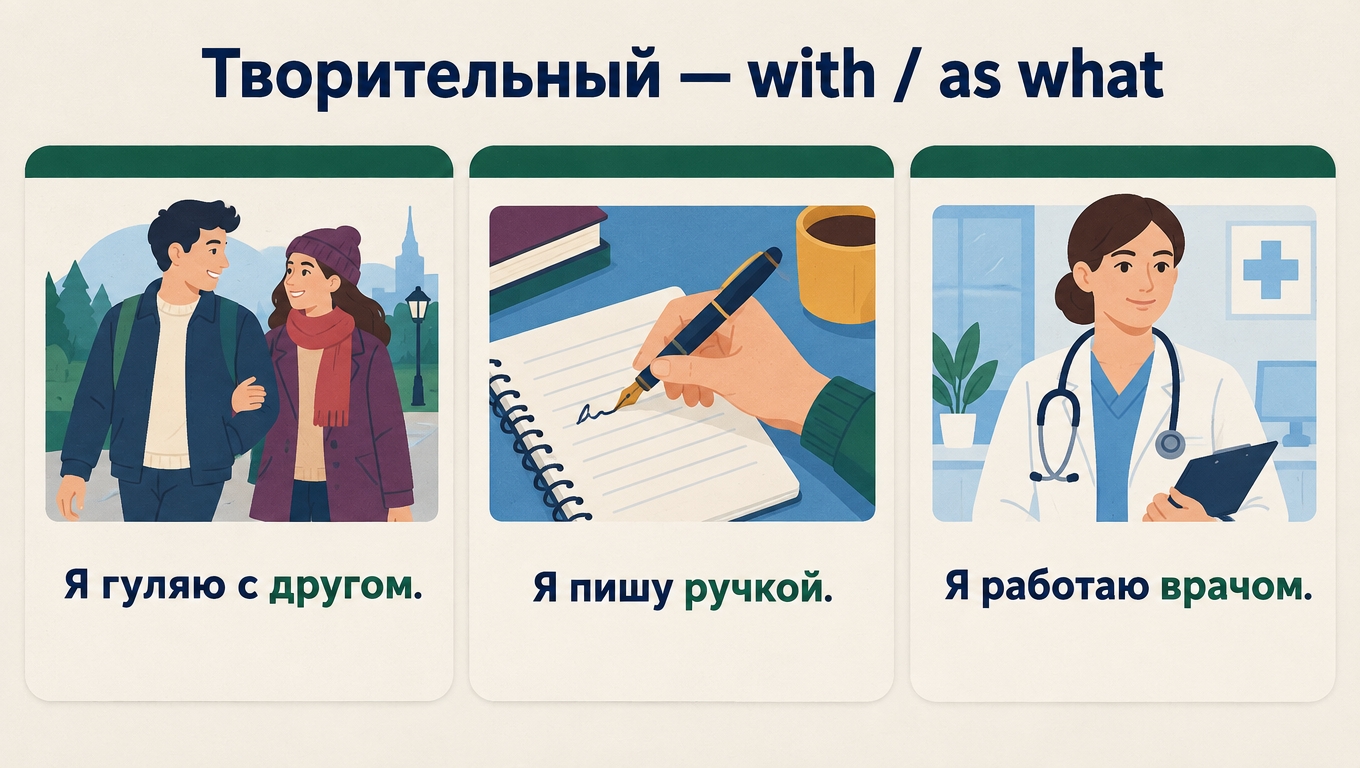
The last of the six cases, and the best shortcut in Russian: one set of endings covers "with a friend", "with a pen" and "as a doctor", and eight frozen forms tell you when anything happens — утром, вечером, зимой.
⏱ About 55 minutes26 phrases34 exercises
What you will learn
Recognise the instrumental as the case of company, means and role, and know the two questions it answers: Кем? Чем?
Form the instrumental singular and plural of masculine, feminine and neuter nouns, including the -ом / -ем spelling rule after ж, ш, щ, ч and ц
Use с + instrumental for "with" and keep it apart from the с + genitive of Lesson 8 that means "off, from"
Name the tool with a bare instrumental — писатьручкой, резатьножом — and never add the с that would change the meaning
Say what somebody is with работать and быть + instrumental: Яработаюврачом, Онбылучителем
Use the eight time adverbs утром, днём, вечером, ночью, зимой, весной, летом and осенью, and the five position prepositions над, под, перед, между and рядомс
Quick review
Say these aloud before you start. They come from earlier lessons.
Я живу́ в Москве́.I live in Moscow.Listen in Russian:Slow in Russian:Я живу́ в Москве́.
У меня́ есть брат.I have a brother.Listen in Russian:Slow in Russian:У меня́ есть брат.
Вчера́ я не ра́ботал.Yesterday I did not work.Listen in Russian:Slow in Russian:Вчера́ я не ра́ботал.
Мы идём в парк.We are walking to the park.Listen in Russian:Slow in Russian:Мы идём в парк.
У меня́ нет вре́мени.I have not got any time.Listen in Russian:Slow in Russian:У меня́ нет вре́мени.
Я ду́маю о рабо́те.I am thinking about work.Listen in Russian:Slow in Russian:Я ду́маю о рабо́те.
Theory
Кем? Чем? — the case of the tool, the company and the role
The instrumental answers two questions, Кем? and Чем?, and it is the last of the six cases this course teaches. After today you will have met every case Russian needs for ordinary conversation, which is worth pausing on: the genitive plural was the hard part, and you are through it. The instrumental endings are the most regular in the whole noun system.
Three meanings cover almost everything you will say. Company, always with the preposition с: «Яидувкиносдругом». The tool or the means, with no preposition at all: «Япишуручкой», «Онрежетхлебножом». And the role or profession, after быть and работать: «Яработаюврачом», «Онбылучителем». English needs three different constructions for those three ideas — "with", "with" and "as" — and Russian uses one set of endings for all of them.
There is a fourth use that pays for itself immediately and costs eight words. A handful of instrumental forms have frozen into plain adverbs of time: утром, днём, вечером, ночью, зимой, весной, летом, осенью. No preposition, no noun to decline, nothing to agree with. Learn those eight and you can say when anything happens for the rest of the course.
Я иду́ в кино́ с дру́гом.I am going to the cinema with a friend. (с + instrumental = company)Listen in Russian:Slow in Russian:Я иду́ в кино́ с дру́гом.
Она́ пи́шет ру́чкой.She writes with a pen. (bare instrumental = the tool)Listen in Russian:Slow in Russian:Она́ пи́шет ру́чкой.
Он рабо́тает инжене́ром.He works as an engineer. (instrumental = the role)Listen in Russian:Slow in Russian:Он рабо́тает инжене́ром.
У́тром я пью ко́фе.In the morning I drink coffee. (a frozen instrumental = an adverb of time)Listen in Russian:Slow in Russian:У́тром я пью ко́фе.
The endings: -ом / -ем, -ой / -ей, -ами / -ями
Masculine and neuter nouns add -ом after a hard consonant and -ем after a soft one: стол → столом, стакан → стаканом, дом → домом, окно → окном; учитель → учителем, музей → музеем. Feminine nouns in -а add -ой or -ей by exactly the same logic: мама → мамой, чашка → чашкой; Россия → Россией, семья → семьёй. Third-declension feminines in a soft sign add -ью: ночь → ночью, жизнь → жизнью. The plural is the same for all three genders: -ами after a hard consonant or a sibilant, -ями after a soft one — стаканами, вилками, ножами, ночами, but семьями and музеями.
One spelling rule decides between the о and the е variants, and it is the general Russian rule for о after a sibilant: after ж, ш, щ, ч or ц write -ом and -ой when the ending carries the stress and -ем and -ей when it does not. Every sibilant-stem noun you have met is end-stressed in the instrumental, so for now that rule always gives you о: ножо́м, врачо́м, ключо́м, карандашо́м. The unstressed half — това́рищем, ме́сяцем — is worth recognising rather than producing. Nothing here has to be memorised word by word: once you know where the stress falls, the vowel follows.
Stress behaves the way you now expect, which is to say it moves. стол has no mark at all in the nominative because it is one syllable, but every oblique form is stressed on the ending: стола́, столу́, столо́м, столе́. вода́ does the same: водо́й. дом keeps its stem stress and gives до́мом. Learn the instrumental as part of the noun rather than as a rule you apply to it — but be encouraged, because of the six paradigms this is the one that misbehaves least.
стол — стола́ — столо́мtable — of the table — with the table (stress moves into the ending)Listen in Russian:Slow in Russian:стол — стола́ — столо́м
учи́тель — учи́телемteacher — as a teacher (soft stem, so -ем)Listen in Russian:Slow in Russian:учи́тель — учи́телем
ча́шка — ча́шкойcup — with the cup (feminine in -а, so -ой)Listen in Russian:Slow in Russian:ча́шка — ча́шкой
нож — ножо́мknife — with the knife (stressed ending after ж, so -ом, not -ем)Listen in Russian:Slow in Russian:нож — ножо́м
с + instrumental: with whom, and with what inside it
This is the second life of a preposition you already own. In Lesson 8 с took the genitive and meant "off, from": сработы, свокзала. Here it takes the instrumental and means "with": сдругом, смолоком, сбратом. Same three letters, different case, unrelated meaning — and Russian tells them apart by the ending of the noun alone. «Яидусработы» is "I am coming back from work"; «Яидусбратом» is "I am walking with my brother".
с covers two kinds of "with" that English also keeps together: the person you are with, and the thing that is inside the food, the drink or the object. «Кофесмолоком», «хлебссыром», «яидувпарксподругой». All three are the same construction, none of them needs a verb, and neither kind takes any other preposition.
Two mechanical details finish it off. In front of a word that begins with с, з, ш or щ plus another consonant, с lengthens to со — состола́, сосне́га, состу́лом — and the same happens before a handful of other clusters Russian will not pronounce, of which the only one you need today is сомной. Second, after a preposition the third-person pronouns pick up an н, exactly as they did for унего and кней: сним, сней, сними. The whole set of instrumental pronouns is short enough to swallow at one go — мной, тобой, ним, ней, нами, вами, ими.
Я иду́ в парк с дру́гом.I am going to the park with a friend.Listen in Russian:Slow in Russian:Я иду́ в парк с дру́гом.
Ко́фе с молоко́м, пожалу́йста.Coffee with milk, please.Listen in Russian:Slow in Russian:Ко́фе с молоко́м, пожалу́йста.
Она́ гуля́ет с подру́гой.She is walking with her friend.Listen in Russian:Slow in Russian:Она́ гуля́ет с подру́гой.
Мы гу́ляем с ни́ми.We are walking with them. (с ними, never *с они)Listen in Russian:Slow in Russian:Мы гу́ляем с ни́ми.
The bare instrumental: the tool, and what somebody is
When the instrumental means "by means of", there is no preposition. English always says "with"; Russian never does. «Япишуручкой», «Онрежетхлебножом», «Онестложкой, аневилкой». This is the place where English speakers systematically add a с that does not belong, and it changes the meaning: «девушкассумкой» is "a girl carrying a bag", so «япишусручкой» would be "I write while in possession of a pen".
The same ending says what somebody is. After работать, быть and — later — стать the profession goes into the instrumental while the subject stays in the nominative: «Яработаюврачом», «Онбылучителем», «Онахочетбытьактрисой». You have been saying «Яврач» since Lesson 1, and that zero-copula nominative is still the normal way to state a profession in the present. The instrumental is what the past, the future and работать ask for.
The distinction is worth getting right, because in the past there is no choice at all: «Онбылучителем» is the norm, and «Онбылучитель» sounds unfinished to a Russian ear. A small group of verbs governs the instrumental directly, with no быть anywhere near them: интересоваться, заниматься and увлекаться. «Онинтересуетсямузыкой» — the thing you are interested in, busy with or keen on takes the bare case and nothing else, and all three work identically. They are -ся verbs, which Lesson 18 explains properly; for now learn each one as a chunk with its case attached, the way you learnt уменяесть.
Я пишу́ ру́чкой.I write with a pen. (no preposition — the bare instrumental)Listen in Russian:Slow in Russian:Я пишу́ ру́чкой.
Он ре́жет хлеб ножо́м.He is cutting the bread with a knife.Listen in Russian:Slow in Russian:Он ре́жет хлеб ножо́м.
Я рабо́таю врачо́м.I work as a doctor.Listen in Russian:Slow in Russian:Я рабо́таю врачо́м.
Она́ была́ учи́тельницей.She was a teacher.Listen in Russian:Slow in Russian:Она́ была́ учи́тельницей.
Time and place: eight adverbs and five prepositions
The eight time adverbs are the cheapest large win in the course: утром, днём, вечером, ночью, зимой, весной, летом, осенью. Each one is the frozen instrumental of a noun — утро, день, вечер, ночь, зима, весна, лето, осень — but you never decline the noun yourself and you never add a preposition. English "in the morning" and "in winter" are three words and two; Russian утром and зимой are one each. The nouns themselves arrive in Lessons 11, 12 and 17; these eight forms are all you need in order to say when anything happens.
For place, five prepositions govern the instrumental and all five answer Где?: над "above", под "under", перед "in front of", между "between" and рядомс "next to". Learn them as chunks with a noun attached — надгородом, подстолом, переддомом, междудомами, рядомсдомом — and the ending arrives with the chunk, exactly as it did for вМоскве and наработе in Lesson 5.
Three of them need a note. под also takes the accusative when something moves to a position under something else, which is the same где? / куда? split you met with в and на in Lesson 6; that half is Lesson 12, so today learn only под + instrumental for "where". перед becomes передо in front of a handful of words, and the only one you need today is передомной. And рядом is an adverb first — «Ониживутрядом» — and turns into a preposition only when с follows it. One more preposition, за "behind", governs the instrumental too; it belongs to Lesson 12.
У́тром я пью ко́фе, а ве́чером — чай.In the morning I drink coffee, in the evening tea.Listen in Russian:Slow in Russian:У́тром я пью ко́фе, а ве́чером — чай.
Зимо́й здесь хо́лодно.It is cold here in winter.Listen in Russian:Slow in Russian:Зимо́й здесь хо́лодно.
Су́мка под столо́м.The bag is under the table.Listen in Russian:Slow in Russian:Су́мка под столо́м.
Магази́н ря́дом с до́мом.The shop is next to the house.Listen in Russian:Slow in Russian:Магази́н ря́дом с до́мом.
The instrumental: five noun classes, four shapes
Form
студе́нт (m, hard)
нож (m, sibilant)
учи́тель (m, soft)
ча́шка (f, -а)
ночь (f, 3rd declension)
Кто? Что? — Nominative
студе́нт
нож
учи́тель
ча́шка
ночь
Кем? Чем? — Instrumental singular
студе́нтом
ножо́м
учи́телем
ча́шкой
но́чью
Instrumental plural
студе́нтами
ножа́ми
учи́телями
ча́шками
ноча́ми
The ending you add
-ом after a hard consonant
-ом (stressed after ж)
-ем after a soft one
-ой / -ей
-ью
Four shapes cover every noun in the language. -ом after a hard masculine or neuter consonant, -ем after a soft one, -ой or -ей for feminines in -а, -ью for third-declension feminines, and -ами or -ями for every plural. After ж, ш, щ, ч and ц the choice between о and е is decided by stress alone — ножо́м and врачо́м, but учи́телем and ме́сяцем. ночь itself is Lesson 12 vocabulary; it is here because но́чью, its frozen instrumental, is one of the eight time adverbs.
Three jobs, one case: with / by means of / as
Form
с + Instrumental — "with"
Instrumental alone — "by means of"
Instrumental after быть / работать — "as"
The question it answers
Скем? Счем?
Чем?
Кем?
A sentence
Яиду́вкино́сдру́гом.
Япишу́ру́чкой.
Ярабо́таюврачо́м.
Another one
Ко́фесмолоко́м, пожалу́йста.
Онре́жетхлебножо́м.
Она́была́учи́тельницей.
The trap
с + Genitive is a different meaning: сработы = "from work"
no с at all — сручкой means "carrying a pen"
the subject stays in the Nominative: я, она
One ending, three jobs, and only the first of them keeps its preposition. Notice that the tool never takes с: Russian names the instrument in the bare case form. Add с and you change the meaning from "with a pen" to "with a pen on you".
Time in the instrumental: eight adverbs that need no preposition
Form
у́тро
день
ве́чер
ночь
зима́
весна́
ле́то
о́сень
The adverb (Instrumental)
у́тром
днём
ве́чером
но́чью
зимо́й
весно́й
ле́том
о́сенью
English
in the morning
in the afternoon
in the evening
at night
in winter
in spring
in summer
in autumn
In a sentence
У́тромяпьюко́фе.
Днёмярабо́таю.
Ве́чероммысмо́тримфильм.
Но́чьюидётдождь.
Зимо́йздесьхо́лодно.
Весно́ймые́демвМоскву́.
Ле́томмыгу́ляемвпа́рке.
О́сеньюячита́юдо́ма.
Eight words, no preposition, no agreement and nothing to decline — the frozen instrumental of each noun, hardened into a plain adverb. The nouns in the top row arrive in Lessons 11, 12 and 17; you only ever need these eight forms to say when something happens. днём keeps its ё, which is always stressed and so never takes a mark.
Где? — the five prepositions that take the instrumental
Form
над
под
пе́ред
ме́жду
ря́домс
Meaning
above, over
under, below
in front of
between
next to
Где? + дом (m)
наддо́мом
поддо́мом
пе́реддо́мом
ме́ждудома́ми
ря́домсдо́мом
Где? + стол (m)
надстоло́м
подстоло́м
пе́редстоло́м
ме́ждустола́ми
ря́домсостоло́м
The trap
no accusative partner at this level
под + Accusative = movement "to under" (Lesson 12)
передомной — the о appears before мной
между + Genitive is bookish and survives in set phrases
рядом on its own is an adverb: Ониживутрядом
All five answer Где? and all five take the instrumental, so the ending is the one you have just learnt. Store them as chunks with a noun attached — надгородом, подстолом, переддомом, междудомами, рядомсдомом — the way you stored вМоскве and наработе. Note состолом: с lengthens to со before a cluster built on с, з, ш or щ. за, "behind", governs the instrumental too, and it is Lesson 12.
Vocabulary
Learn each word with its stress mark and its pronunciation. Nouns are given with their gender, animacy and their full six-case declension; verbs are given with their aspect and, where one exists, their partner verb.
Russian
English
Gender / aspect
Pronunciation
Audio
ви́лкаfeminine · inanimate
fork
feminine · inanimate
/ˈvʲilkə/VEEL-kuh
Listen in Russian:Slow in Russian:вилка
ло́жкаfeminine · inanimate
spoon
feminine · inanimate
/ˈloʂkə/LOH-shkuh
Listen in Russian:Slow in Russian:ложка
ножmasculine · inanimate
knife
masculine · inanimate
/noʂ/NOHSH
Listen in Russian:Slow in Russian:нож
таре́лкаfeminine · inanimate
plate, dish
feminine · inanimate
/tɐˈrʲelkə/tuh-RYEL-kuh
Listen in Russian:Slow in Russian:тарелка
ча́шкаfeminine · inanimate
cup
feminine · inanimate
/ˈtɕaʂkə/CHAH-shkuh
Listen in Russian:Slow in Russian:чашка
стака́нmasculine · inanimate
glass, tumbler
masculine · inanimate
/stɐˈkan/stuh-KAHN
Listen in Russian:Slow in Russian:стакан
ключmasculine · inanimate
key
masculine · inanimate
/klʲutɕ/KLYOOCH
Listen in Russian:Slow in Russian:ключ
дождьmasculine · inanimate
rain
masculine · inanimate
/doʂtʲ/DOHCH
Listen in Russian:Slow in Russian:дождь
снегmasculine · inanimate
snow
masculine · inanimate
/sʲnʲek/SNYEKH
Listen in Russian:Slow in Russian:снег
ве́терmasculine · inanimate
wind
masculine · inanimate
/ˈvʲetʲɪr/VYEH-tihr
Listen in Russian:Slow in Russian:ветер
со́лнцеneuter · inanimate
sun
neuter · inanimate
/ˈsontsə/SOHN-tsih
Listen in Russian:Slow in Russian:солнце
пого́даfeminine · inanimate
weather
feminine · inanimate
/pɐˈɡodə/puh-GOH-duh
Listen in Russian:Slow in Russian:погода
у́тромadverb
in the morning
adverb
/ˈutrəm/OO-trum
Listen in Russian:Slow in Russian:утром
днёмadverb
in the afternoon, during the day
adverb
/dnʲom/duh-NYOHM
Listen in Russian:Slow in Russian:днём
ве́черомadverb
in the evening
adverb
/ˈvʲetɕɪrəm/VYEH-chih-rum
Listen in Russian:Slow in Russian:вечером
но́чьюadverb
at night
adverb
/ˈnotɕjʊ/NOH-choo
Listen in Russian:Slow in Russian:ночью
зимо́йadverb
in winter
adverb
/zʲɪˈmoj/zih-MOY
Listen in Russian:Slow in Russian:зимой
весно́йadverb
in spring
adverb
/vʲɪˈsnoj/vih-SNOY
Listen in Russian:Slow in Russian:весной
ле́томadverb
in summer
adverb
/ˈlʲetəm/LYEH-tum
Listen in Russian:Slow in Russian:летом
о́сеньюadverb
in autumn, in the fall
adverb
/ˈosʲɪnʲjʊ/OH-sih-nyoo
Listen in Russian:Slow in Russian:осенью
надpreposition
above, over
preposition
/nat/NAHT
Listen in Russian:Slow in Russian:над
подpreposition
under, below
preposition
/pot/POHT
Listen in Russian:Slow in Russian:под
пе́редpreposition
in front of, before
preposition
/ˈpʲerʲɪt/PYEH-rit
Listen in Russian:Slow in Russian:перед
ме́ждуpreposition
between, among
preposition
/ˈmʲeʐdʊ/MYEH-zhdoo
Listen in Russian:Slow in Russian:между
ря́домadverb
close by; рядом с + instrumental = next to
adverb
/ˈrʲadəm/RYAH-dum
Listen in Russian:Slow in Russian:рядом
ре́затьimperfective
to cut
imperfective
/ˈrʲezətʲ/RYEH-zyut
Listen in Russian:Slow in Russian:резать
сpreposition
off, from (a surface or an event)
preposition
/s/S
Listen in Russian:Slow in Russian:с
ру́чкаfeminine · inanimate
pen, biro
feminine · inanimate
/ˈrutɕkə/ROO-chkuh
Listen in Russian:Slow in Russian:ручка
столmasculine · inanimate
table
masculine · inanimate
/stol/STOHL
Listen in Russian:Slow in Russian:стол
окно́neuter · inanimate
window
neuter · inanimate
/ɐˈkno/uk-NOH
Listen in Russian:Slow in Russian:окно
бытьimperfective
to be
imperfective
/bɨtʲ/BIHT
Listen in Russian:Slow in Russian:быть
учи́тельmasculine · animate
teacher (male, or generic)
masculine · animate
/ʊˈtɕitʲɪlʲ/oo-CHIH-til
Listen in Russian:Slow in Russian:учитель
врачmasculine · animate
doctor
masculine · animate
/vratɕ/VRAHCH
Listen in Russian:Slow in Russian:врач
писа́тьimperfective
to write
imperfective
/pʲɪˈsatʲ/pih-SYAT
Listen in Russian:Slow in Russian:писать
Full six-case declension of the 17 nouns in this lesson
Each case is listed with the question word that selects it. Find the question you are answering and the ending follows.
Singular
Form
ви́лка (f)
ло́жка (f)
нож (m)
таре́лка (f)
ча́шка (f)
стака́н (m)
ключ (m)
дождь (m)
снег (m)
ве́тер (m)
со́лнце (n)
пого́да (f)
ру́чка (f)
стол (m)
окно́ (n)
учи́тель (m)
врач (m)
nom · Кто? Что?
ви́лка
ло́жка
нож
таре́лка
ча́шка
стака́н
ключ
дождь
снег
ве́тер
со́лнце
пого́да
ру́чка
стол
окно́
учи́тель
врач
gen · Кого? Чего?
ви́лки
ло́жки
ножа́
таре́лки
ча́шки
стака́на
ключа́
дождя́
сне́га
ве́тра
со́лнца
пого́ды
ру́чки
стола́
окна́
учи́теля
врача
dat · Кому? Чему?
ви́лке
ло́жке
ножу́
таре́лке
ча́шке
стака́ну
ключу́
дождю́
сне́гу
ве́тру
со́лнцу
пого́де
ру́чке
столу́
окну́
учи́телю
врачу
acc · Кого? Что?
ви́лку
ло́жку
нож
таре́лку
ча́шку
стака́н
ключ
дождь
снег
ве́тер
со́лнце
пого́ду
ру́чку
стол
окно́
учи́теля
врача
instr · Кем? Чем?
ви́лкой
ло́жкой
ножо́м
таре́лкой
ча́шкой
стака́ном
ключо́м
дождём
сне́гом
ве́тром
со́лнцем
пого́дой
ру́чкой
столо́м
окно́м
учи́телем
врачом
prep · Оком? Очём?
ви́лке
ло́жке
ноже́
таре́лке
ча́шке
стака́не
ключе́
дожде́
сне́ге
ве́тре
со́лнце
пого́де
ру́чке
столе́
окне́
учи́теле
враче
Plural
Form
ви́лка (f)
ло́жка (f)
нож (m)
таре́лка (f)
ча́шка (f)
стака́н (m)
ключ (m)
дождь (m)
снег (m)
ве́тер (m)
со́лнце (n)
пого́да (f)
ру́чка (f)
стол (m)
окно́ (n)
учи́тель (m)
врач (m)
nom · Кто? Что?
ви́лки
ло́жки
ножи́
таре́лки
ча́шки
стака́ны
ключи́
дожди́
снега́
ве́тры
со́лнца
пого́ды
ру́чки
столы́
о́кна
учи́тели
врачи́
gen · Кого? Чего?
ви́лок
ло́жек
ноже́й
таре́лок
ча́шек
стака́нов
ключе́й
дожде́й
снего́в
ве́тров
солнц
пого́д
ру́чек
столо́в
о́кон
учи́телей
враче́й
dat · Кому? Чему?
ви́лкам
ло́жкам
ножа́м
таре́лкам
ча́шкам
стака́нам
ключа́м
дождя́м
снега́м
ве́трам
со́лнцам
пого́дам
ру́чкам
стола́м
о́кнам
учи́телям
врача́м
acc · Кого? Что?
ви́лки
ло́жки
ножи́
таре́лки
ча́шки
стака́ны
ключи́
дожди́
снега́
ве́тры
со́лнца
пого́ды
ру́чки
столы́
о́кна
учи́телей
враче́й
instr · Кем? Чем?
ви́лками
ло́жками
ножа́ми
таре́лками
ча́шками
стака́нами
ключа́ми
дождя́ми
снега́ми
ве́трами
со́лнцами
пого́дами
ру́чками
стола́ми
о́кнами
учи́телями
врача́ми
prep · Оком? Очём?
ви́лках
ло́жках
ножа́х
таре́лках
ча́шках
стака́нах
ключа́х
дождя́х
снега́х
ве́трах
со́лнцах
пого́дах
ру́чках
стола́х
о́кнах
учи́телях
врача́х
Ready-to-use phrases
Я пишу́ ру́чкой.
I write with a pen.
IPA/ja pʲɪˈʂu ˈrutɕkəj/
Say itYAH pih-SHOO ROO-chkuy.
The sentence the whole case exists for. The tool takes the bare instrumental, with no preposition at all: «сручкой» would mean "carrying a pen", which is a different idea.
neutralinstrumentalobjectsstudy
Listen in Russian:Slow in Russian:Я пишу ручкой.
Чем ты пи́шешь?
What are you writing with?
IPA/tɕem tɨ ˈpʲiʂɨʂ/
Say itCHEM TIH PEE-shish?
Чем? is the instrumental of что, and it is the question the case answers. The reply comes back in the same case: «Чемтыпишешь?» — «Ручкой». Drill these pairs aloud; they build the case system faster than any table.
informalinstrumentalquestionsobjects
Listen in Russian:Slow in Russian:Чем ты пишешь?
Он ре́жет хлеб ножо́м.
He is cutting the bread with a knife.
IPA/on ˈrʲeʐɨt xlʲep nɐˈʐom/
Say itOHN RYEH-zhit KHLYEP nuh-ZHOHM.
Two things at once: резать mutates its з to ж in the present tense (режет), and нож takes the stressed -ом ending because the stress has moved off the stem (ножо́м).
neutralinstrumentalfoodobjects
Listen in Russian:Slow in Russian:Он режет хлеб ножом.
Он ест ло́жкой, а не ви́лкой.
He eats with a spoon, not with a fork.
IPA/on jesʲtʲ ˈloʂkəj a nʲe ˈvʲilkəj/
Say itOHN YEST LOH-shkuy, AH NYEH VEEL-kuy.
а here is the contrastive "and/whereas" of Lesson 3, and не negates only the word after it. Both instrumentals are feminine -ой forms, and neither has a preposition in front of it.
neutralinstrumentalfoodobjectsnegation
Listen in Russian:Slow in Russian:Он ест ложкой, а не вилкой.
Ко́фе с молоко́м, пожалу́йста.
Coffee with milk, please.
IPA/ˈkofʲe s məlɐˈkom pɐˈʐalujstə/
Say itKOH-fyuh s muh-luh-KOHM, puh-zhuh-LUY-stuh.
с + instrumental also covers what is inside the food or drink, not only who is with you. кофе is masculine and indeclinable, so it never changes; only молоком carries the case. The opposite is без + genitive: «кофебезмолока» (Lesson 8).
politeinstrumentalfooddrinksrestaurant
Listen in Russian:Slow in Russian:Кофе с молоком, пожалуйста.
Я люблю́ хлеб с сы́ром.
I like bread with cheese.
IPA/ja lʲʊˈblʲu xlʲep s ˈsɨrəm/
Say itYAH lyoo-BLYOO KHLYEP s SIH-rum.
The same с, now meaning "with something in it". любить takes the accusative for the thing liked — хлеб — and the cheese simply rides along in the instrumental.
neutralinstrumentalfood
Listen in Russian:Slow in Russian:Я люблю хлеб с сыром.
Я иду́ в кино́ с дру́гом.
I am going to the cinema with a friend.
IPA/ja ɪˈdu f kʲɪˈno s ˈdruɡəm/
Say itYAH ih-DOO f kih-NOH z DROO-gum.
Three cases in seven words: в + accusative for the destination (кино, indeclinable), с + instrumental for the company (другом), and the nominative subject. идти is the one-way, on-foot verb of Lesson 7.
neutralinstrumentalmotionhobbies
Listen in Russian:Slow in Russian:Я иду в кино с другом.
Она́ гуля́ет с подру́гой.
She is walking with her friend.
IPA/ɐˈna ɡʊˈlʲajɪt s pɐˈdruɡəj/
Say ituh-NAH goo-LYAH-yit s puh-DROO-guy.
подруга keeps its stress on the у in every form, so the instrumental is подру́гой and not *подруго́й. Compare сестра́, which does move: сестро́й.
neutralinstrumentalfamily
Listen in Russian:Slow in Russian:Она гуляет с подругой.
Я рабо́таю врачо́м.
I work as a doctor.
IPA/ja rɐˈbotəjʊ vrɐˈtɕom/
Say itYAH ruh-BOH-tuh-yoo vruh-CHOHM.
The role use of the instrumental. In the present tense «Яврач» is the normal way to state the fact; «яработаюврачом» says which job you actually do. The subject stays in the nominative and only the profession changes case.
neutralinstrumentalprofessionswork
Listen in Russian:Slow in Russian:Я работаю врачом.
Он был учи́телем.
He was a teacher.
IPA/on bɨl ʊˈtɕitʲɪlʲɪm/
Say itOHN BIHL oo-CHIH-tih-lim.
Once a tense appears, the instrumental is the norm: былучителем, будетучителем. A soft stem takes -ем, so учителем and never *учителом — the same о/е rule that gives ножом under stress.
neutralinstrumentalprofessionspast
Listen in Russian:Slow in Russian:Он был учителем.
Кем ты хо́чешь быть?
What do you want to be?
IPA/kʲem tɨ ˈxotɕɪʂ bɨtʲ/
Say itKYEM TIH KHOH-chish BIHT?
Кем? is the instrumental of кто — the question for a person in this case, exactly as чем? is the question for a thing. хотеть is the irregular modal from Lesson 4 and is followed by the bare infinitive быть.
informalinstrumentalquestionsprofessions
Listen in Russian:Slow in Russian:Кем ты хочешь быть?
Она́ хо́чет быть актрисо́й.
She wants to be an actress.
IPA/ɐˈna ˈxotɕɪt bɨtʲ ɐˈktrʲisəj/
Say ituh-NAH KHOH-chit BIHT uk-trih-SOY.
The feminine form актриса becomes актрисой. Note that after быть the profession is always instrumental whatever the tense — онабылаактрисой, онабудетактрисой.
neutralinstrumentalprofessions
Listen in Russian:Slow in Russian:Она хочет быть актрисой.
Кем вы рабо́таете?
What do you do for a job?
IPA/kʲem vɨ rɐˈbotəɪtʲɪ/
Say itKYEM VIH ruh-BOH-tuh-yih-tyuh?
The polite вы form of the same question, used between adults who do not know each other well. «Ктовы?» asks who you are; «Кемвыработаете?» asks what job you do, and the instrumental is what makes the difference.
Listen in Russian:Slow in Russian:Кем вы работаете?
У́тром я пью ко́фе.
In the morning I drink coffee.
IPA/ˈutrəm ja pʲju ˈkofʲe/
Say itOO-trum YAH PYOO KOH-fyuh.
One Russian word for English "in the morning". The eight adverbs of this kind — утром, днём, вечером, ночью, зимой, весной, летом, осенью — are frozen instrumentals and never take a preposition.
neutralinstrumentaltimefooddrinks
Listen in Russian:Slow in Russian:Утром я пью кофе.
Днём я рабо́таю.
In the afternoon I work.
IPA/dnʲom ja rɐˈbotəjʊ/
Say itduh-NYOHM YAH ruh-BOH-tuh-yoo.
днём is a single syllable with an ё in it, so it carries no acute — ё is always stressed and never takes an extra mark. It covers the middle of the day, roughly noon to evening.
neutralinstrumentaltimework
Listen in Russian:Slow in Russian:Днём я работаю.
Ве́чером мы смо́трим фильм.
In the evening we watch a film.
IPA/ˈvʲetɕɪrəm mɨ ˈsmotrʲɪm fʲilʲm/
Say itVYEH-chih-rum MIH SMOH-trim FEELM.
смотреть takes the accusative for the thing watched, and фильм is inanimate, so it looks exactly like the nominative. The time adverb normally comes first, but Russian word order is free and «мысмотримфильмвечером» is equally correct.
neutralinstrumentaltimehobbies
Listen in Russian:Slow in Russian:Вечером мы смотрим фильм.
Но́чью идёт дождь.
It rains at night.
IPA/ˈnotɕjʊ ɪˈdʲot doʂtʲ/
Say itNOH-choo ih-DYOHT DOHCH.
идётдождь is the fixed way to say "it is raining" — literally "rain is walking". The subject of the sentence is дождь, in the nominative, and there is no impersonal "it" anywhere. идётснег works the same way.
neutralinstrumentaltimeweather
Listen in Russian:Slow in Russian:Ночью идёт дождь.
Зимо́й здесь хо́лодно.
It is cold here in winter.
IPA/zʲɪˈmoj zdʲesʲ ˈxolədnə/
Say itzih-MOY ZDYES KHOH-lud-nuh.
Two constructions you already know, side by side: the frozen instrumental зимо́й for "when", and the impersonal state хо́лодно from Lesson 4, which needs no subject and no verb. Add «мне» if you want to say who is cold.
neutralinstrumentaltimeweatherimpersonal
Listen in Russian:Slow in Russian:Зимой здесь холодно.
Ле́том мы гу́ляем в па́рке.
In summer we walk in the park.
IPA/ˈlʲetəm mɨ ɡʊˈlʲajɪm f ˈparkʲɪ/
Say itLYEH-tum MIH GOO-lyuh-yim f PAHR-kyuh.
One sentence, two cases and no preposition you have not met: летом is the frozen instrumental for "when", впарке is the prepositional for "where".
neutralinstrumentaltimeweathercity
Listen in Russian:Slow in Russian:Летом мы гуляем в парке.
О́сенью мы е́дем в Москву́.
In autumn we are going to Moscow.
IPA/ˈosʲɪnʲjʊ mɨ ˈjedʲɪm f mɐˈskvu/
Say itOH-sih-nyoo MIH YEH-dim v muh-SKVOO.
ехать is the by-vehicle verb of Lesson 7, so this is a journey by train, car or plane, not on foot. в + accusative for the destination, and Москва́ is feminine in -а, so the accusative is Москву́.
neutralinstrumentaltimeweathertravel
Listen in Russian:Slow in Russian:Осенью мы едем в Москву.
Самолёт над го́родом.
A plane over the city.
IPA/səmɐˈlʲot nad ˈɡorədəm/
Say itsuh-muh-LYOHT nud GOH-ruh-dum.
No verb, because the present tense of быть is invisible — the zero copula of Lesson 1. над + instrumental says where, and город keeps its stem stress: го́родом, not *городо́м.
neutralinstrumentalplacetransportcity
Listen in Russian:Slow in Russian:Самолёт над городом.
Су́мка под столо́м.
The bag is under the table.
IPA/ˈsumkə pɐt stɐˈlom/
Say itSOOM-kuh put stuh-LOHM.
под + instrumental for position. Listen to what happens to the two prepositions: the д of под devoices to [т] before the voiceless с, giving [pɐt stɐˈlom]. стол pushes its stress into the ending in every oblique form.
neutralinstrumentalplaceobjects
Listen in Russian:Slow in Russian:Сумка под столом.
Маши́на пе́ред до́мом.
A car in front of the house.
IPA/mɐˈʂɨnə ˈpʲerʲɪt ˈdoməm/
Say itmuh-SHIH-nuh PYEH-rit DOH-mum.
перед + instrumental, and the stress stays put: до́мом, unlike its plural дома́ми. Say передомной, not *передмной — the о appears before that particular pronoun.
neutralinstrumentalplacetransport
Listen in Russian:Slow in Russian:Машина перед домом.
Магази́н ря́дом с до́мом.
The shop is next to the house.
IPA/məɡɐˈzʲin ˈrʲadəm z ˈdoməm/
Say itmuh-guh-ZEEN RYAH-dum z DOH-mum.
рядом is an adverb that only becomes a preposition when с follows it. The с voices to [з] before the д of домом, which is why the respelling says Z.
neutralinstrumentalplacecityshopping
Listen in Russian:Slow in Russian:Магазин рядом с домом.
Ме́жду дома́ми — парк.
Between the houses there is a park.
IPA/ˈmʲeʐdʊ dɐˈmamɪ park/
Say itMYEH-zhdoo duh-MAH-mih — PAHRK.
"Between" implies more than one, so this is the plural instrumental дома́ми. The plural ending -ами is the same for masculine, feminine and neuter, and the dash stands where the missing "is" would be.
neutralinstrumentalplacecity
Listen in Russian:Slow in Russian:Между домами — парк.
Он интересу́ется му́зыкой.
He is interested in music.
IPA/on ɪntʲɪrʲɪˈsujɪtsə ˈmuzɨkəj/
Say itOHN in-tih-rih-SOO-yih-tsyuh MOO-zih-kuy.
интересоваться governs the instrumental directly — no preposition and no быть anywhere. заниматься does the same. Both are -ся verbs, which Lesson 18 unpacks; learn them here as chunks with their case attached.
neutralinstrumentalgovernmenthobbiesreflexives
Listen in Russian:Slow in Russian:Он интересуется музыкой.
Dialogues
Breakfast at Anna’s
Tom is having breakfast at Anna’s flat. They are friends, so they use ты.
Tom
Доброе утро, Анна!
Good morning, Anna!
Listen in Russian:Slow in Russian:Доброе утро, Анна!
Anna
Доброе утро! Ты хочешь кофе?
Good morning! Do you want coffee?
Listen in Russian:Slow in Russian:Доброе утро! Ты хочешь кофе?
Tom
Да, пожалуйста. Кофе с молоком.
Yes, please. Coffee with milk.
Listen in Russian:Slow in Russian:Да, пожалуйста. Кофе с молоком.
Anna
Вот кофе и хлеб с сыром. Ложка на столе.
Here is the coffee, and bread with cheese. The spoon is on the table.
Listen in Russian:Slow in Russian:Вот кофе и хлеб с сыром. Ложка на столе.
Tom
Спасибо! А где нож? Я режу хлеб ножом.
Thank you! And where is the knife? I cut the bread with a knife.
Listen in Russian:Slow in Russian:Спасибо! А где нож? Я режу хлеб ножом.
Anna
Нож рядом с тарелкой, вот.
The knife is next to the plate, here.
Listen in Russian:Slow in Russian:Нож рядом с тарелкой, вот.
Tom
А чашка? Она под столом?
And the cup? Is it under the table?
Listen in Russian:Slow in Russian:А чашка? Она под столом?
Anna
Нет, твоя чашка здесь, рядом со мной.
No, your cup is here, next to me.
Listen in Russian:Slow in Russian:Нет, твоя чашка здесь, рядом со мной.
A new colleague
Ivan and Marina have only just met at the office, so they use вы.
Ivan
Здравствуйте! Меня зовут Иван. Вы работаете здесь?
Hello! My name is Ivan. Do you work here?
Listen in Russian:Slow in Russian:Здравствуйте! Меня зовут Иван. Вы работаете здесь?
Marina
Здравствуйте! Очень приятно. Да, я работаю здесь. А вы?
Hello! Pleased to meet you. Yes, I work here. And you?
Listen in Russian:Slow in Russian:Здравствуйте! Очень приятно. Да, я работаю здесь. А вы?
Ivan
Я тоже. Кем вы работаете?
So do I. What do you do?
Listen in Russian:Slow in Russian:Я тоже. Кем вы работаете?
Marina
Я работаю журналисткой. А вы?
I work as a journalist. And you?
Listen in Russian:Slow in Russian:Я работаю журналисткой. А вы?
Ivan
Я работаю инженером, а мой брат работает врачом.
I work as an engineer, and my brother works as a doctor.
Listen in Russian:Slow in Russian:Я работаю инженером, а мой брат работает врачом.
Marina
Вы интересуетесь музыкой?
Are you interested in music?
Listen in Russian:Slow in Russian:Вы интересуетесь музыкой?
Ivan
Да. Вечером я слушаю музыку, а утром читаю.
Yes. In the evening I listen to music, and in the morning I read.
Listen in Russian:Slow in Russian:Да. Вечером я слушаю музыку, а утром читаю.
Marina
А я вечером смотрю фильм. До свидания!
And I watch a film in the evening. Goodbye!
Listen in Russian:Slow in Russian:А я вечером смотрю фильм. До свидания!
The weather today
Tom and Anna are looking out of the window at home. They are friends, so they use ты.
Tom
Анна, сегодня идёт дождь?
Anna, is it raining today?
Listen in Russian:Slow in Russian:Анна, сегодня идёт дождь?
Anna
Да, идёт дождь. И холодно.
Yes, it is raining. And it is cold.
Listen in Russian:Slow in Russian:Да, идёт дождь. И холодно.
Tom
А зимой здесь тоже холодно?
And is it cold here in winter too?
Listen in Russian:Slow in Russian:А зимой здесь тоже холодно?
Anna
Зимой очень холодно и идёт снег.
In winter it is very cold and it snows.
Listen in Russian:Slow in Russian:Зимой очень холодно и идёт снег.
Tom
А летом?
And in summer?
Listen in Russian:Slow in Russian:А летом?
Anna
Летом хорошо. Солнце, и дождя нет.
In summer it is nice. Sun, and no rain.
Listen in Russian:Slow in Russian:Летом хорошо. Солнце, и дождя нет.
Tom
А осенью?
And in autumn?
Listen in Russian:Slow in Russian:А осенью?
Anna
Осенью дождь и ветер. Но вечером мы гуляем в парке.
In autumn there is rain and wind. But in the evening we walk in the park.
Listen in Russian:Slow in Russian:Осенью дождь и ветер. Но вечером мы гуляем в парке.
Tom
Хорошо! Вечером я тоже гуляю.
Good! In the evening I walk too.
Listen in Russian:Slow in Russian:Хорошо! Вечером я тоже гуляю.
Exercises
Answer actively — try to recall the Russian before you look at any hint.
Case ChoiceExercise 1
Choose the correct form of ручка.
Япишу ___ . (ручка)
Case ChoiceExercise 2
Choose the correct form of молоко.
Кофес ___ , пожалуйста. (молоко)
Case ChoiceExercise 3
Choose the correct form of учительница.
Онабыла ___ . (учительница)
Case ChoiceExercise 4
Choose the correct form of стол.
Сумкапод ___ . (стол)
Case ChoiceExercise 5
Choose the correct plural form of дом.
Паркмежду ___ . (дом, plural)
Case ChoiceExercise 6
Choose the correct form of музыка.
Онинтересуется ___ . (музыка)
Ending ChoiceExercise 7
Choose the ending.
Instrumental singular of «стакан»: стакан___
Ending ChoiceExercise 8
Choose the ending.
Instrumental singular of «чашка»: чашк___
Ending ChoiceExercise 9
Choose the ending.
Instrumental singular of «нож»: нож___
Ending ChoiceExercise 10
Choose the ending.
Instrumental singular of «учитель»: учител___
Stress ChoiceExercise 11
Choose the correctly stressed form.
Where does the stress fall in «погода»?
Pronoun ChoiceExercise 12
Choose the correct form of я.
Яидувкиносо ___ .
Translate To RussianExercise 13
Translate into Russian.
Coffee with milk, please.
Translate To RussianExercise 14
Translate into Russian.
I work as a doctor.
Translate To RussianExercise 15
Translate into Russian.
In the evening we watch a film.
Translate To RussianExercise 16
Translate into Russian.
In winter it is cold here.
Translate To RussianExercise 17
Translate into Russian.
She wants to be an actress.
Translate To EnglishExercise 18
Translate into English.
Онбылучителем.
Translate To EnglishExercise 19
Translate into English.
Утромяпьюкофе, авечером — чай.
Fill GapExercise 20
Fill the gap with the adverb for "at night".
___ идётдождь. (at night)
Fill GapExercise 21
Fill the gap with the preposition for "under".
Книга ___ столом. (under)
Fill GapExercise 22
Fill the gap.
Магазин ___ сдомом. (next to)
Multiple ChoiceExercise 23
Choose the correct preposition.
Which preposition means "in front of"?
Multiple ChoiceExercise 24
Choose the correct meaning.
What does «Кемвыработаете?» mean?
True FalseExercise 25
Answer true or false.
To say "I write with a pen" you put с in front of the instrumental: «Япишусручкой».
True FalseExercise 26
Answer true or false.
The same с means "with" in «сдругом» and "from" in «сработы».
Sentence TransformExercise 27
Rewrite the sentence using работать and the instrumental.
Say this with работать: «Яврач.»
Sentence TransformExercise 28
Rewrite the sentence with a different time adverb.
Say this about the evening instead of the morning: «Утромяпьюкофе.»
Word OrderExercise 29
Put the words in order.
Build the sentence: "In the evening we walk in the park."
Match PairsExercise 30
Pair the prepositions.
Match each preposition with its meaning.
Listen And TypeExercise 31
Play the audio and type what you hear.
Listen and type the sentence.
Listen And ChooseExercise 32
Play the audio and pick the matching sentence.
Listen and choose what you hear.
ConjugationExercise 33
Give the present tense form for "я".
резать — я
Flashcard Self RatingExercise 34
Recall the English meaning, then rate how well you knew it.
вечером
Speak now
Say each sentence aloud three times: slowly, at normal speed, then from memory. Then swap the instrumental word for another one you know — ложкой for вилкой, учителем for врачом, ночью for утром — and say the sentence again. The ending is the whole lesson, so say it loudly.
Я пишу́ ру́чкой.I write with a pen.Listen in Russian:Slow in Russian:Я пишу́ ру́чкой.
Я рабо́таю врачо́м.I work as a doctor.Listen in Russian:Slow in Russian:Я рабо́таю врачо́м.
Ко́фе с молоко́м, пожалу́йста.Coffee with milk, please.Listen in Russian:Slow in Russian:Ко́фе с молоко́м, пожалу́йста.
У́тром я пью ко́фе, а ве́чером — чай.In the morning I drink coffee, in the evening tea.Listen in Russian:Slow in Russian:У́тром я пью ко́фе, а ве́чером — чай.
Зимо́й здесь хо́лодно.It is cold here in winter.Listen in Russian:Slow in Russian:Зимо́й здесь хо́лодно.
Су́мка под столо́м, ря́дом со сту́лом.The bag is under the table, next to the chair.Listen in Russian:Slow in Russian:Су́мка под столо́м, ря́дом со сту́лом.
Lesson checkpoint
Before you move on, make sure you can do all of this without looking:
Give the instrumental singular of these six nouns out loud, without looking: стол, нож, учитель, чашка, окно, ночь
Say three things you do with a tool, using the bare instrumental and no preposition
Say your job — or the job you would like — with «Яработаю …» and then with «Яхочубыть …»
Explain out loud the difference between «Яидусработы» and «Яидусбратом», and say which case each noun is in
Take four sentences you already know and put each one into a different time of day or season using утром, днём, вечером, ночью, зимой, весной, летом or осенью
Say where five things in the room you are in are, using над, под, перед, между and рядомс
Remember this
The instrumental answers Кем? Чем? and does three jobs at this level: company after с, the tool or means with no preposition at all, and the role or profession after быть and работать.
Instrumental singular: -ом after a hard masculine or neuter consonant, -ем after a soft one, -ой or -ей for feminines in -а, -ью for third-declension feminines. Plural: -ами or -ями for every gender. After ж, ш, щ, ч and ц the vowel is о when the ending is stressed and е when it is not — ножо́м, врачо́м, ключо́м; -ем without a sibilant is simply the soft-stem ending, as in учи́телем and музе́ем.
с + instrumental means "with": сдругом, смолоком, ссыром. The same с with the genitive means "off, from": сработы, свокзала. The ending of the noun, not the preposition, tells you which is which.
The tool never takes с: писатьручкой, резатьножом, естьложкой. «Сручкой» is grammatical but means "carrying a pen".
A profession after работать, быть and стать goes into the instrumental while the subject stays in the nominative: Яработаюврачом, Онбылучителем, Онахочетбытьактрисой. интересоваться, заниматься and увлекаться govern the instrumental directly.
Eight frozen instrumentals are adverbs of time and need no preposition: утром, днём, вечером, ночью, зимой, весной, летом, осенью. Five prepositions govern the instrumental for position: над, под, перед, между and рядомс.