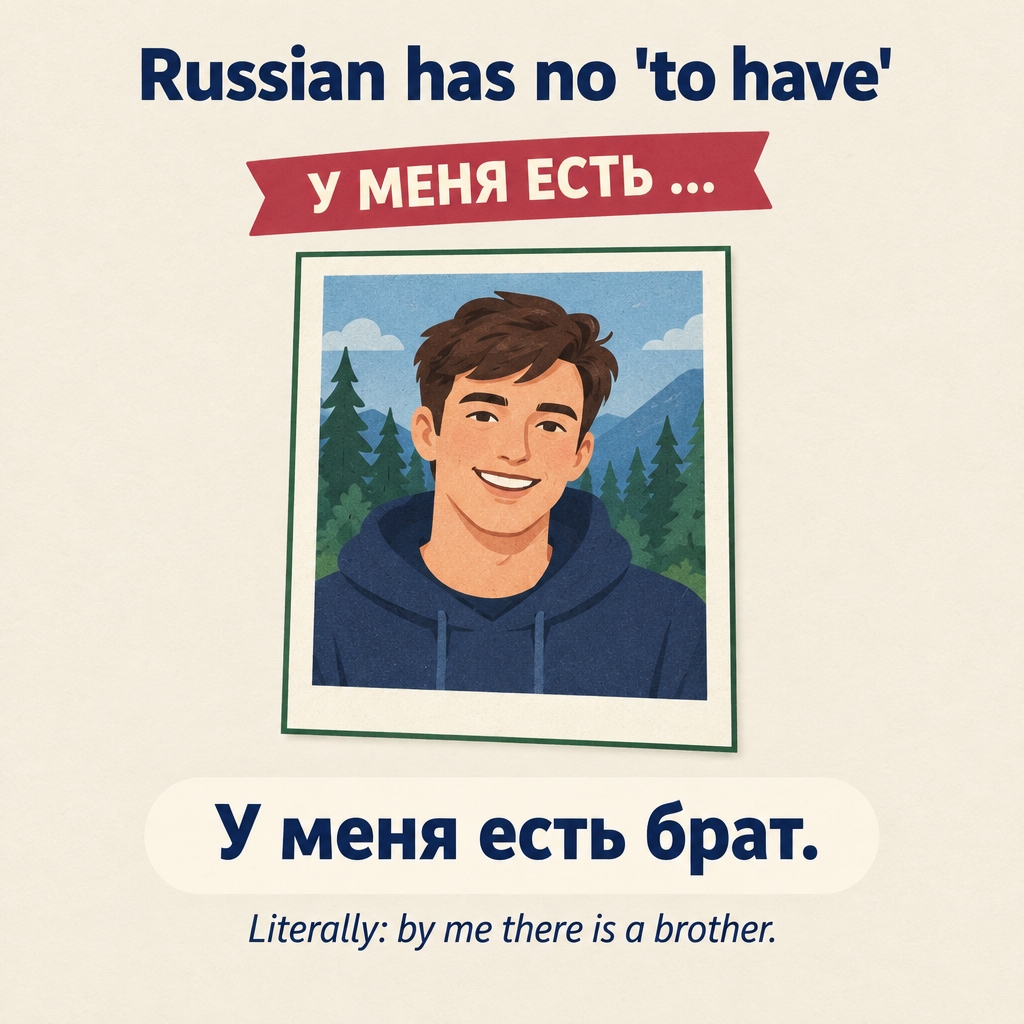
Russian has no verb "to have", so this lesson installs the frame that replaces it — уменяесть — fills it with the family vocabulary, adds the two irregular modals хотеть and мочь, and puts you in the dative for мненравится, мненадо and your first imperatives.
⏱ About 55 minutes26 phrases34 exercises
What you will learn
Say who has what with the fixed frame у + genitive + есть, using меня, тебя, него, неё, нас, вас, них
Make a possessive agree with the noun that follows it: мой, моя, моё, мои; твой, наш, ваш
Talk about a family, including the mobile stress of сестра → сёстры and the odd plural ребёнок → дети
Conjugate the two mixed paradigms хотеть and мочь and follow them with a bare infinitive
Say what you like with мненравится and мненравятся, and describe states with мнехолодно, мненадо, мнеможно
Make a request with the first imperatives: скажи, скажите, дай, дайте, иди
Quick review
Say these aloud before you start. They come from earlier lessons.
Я студе́нт.I am a student.Listen in Russian:Slow in Russian:Я студе́нт.
Она́ чита́ет кни́гу.She is reading a book.Listen in Russian:Slow in Russian:Она́ чита́ет кни́гу.
Как тебя́ зову́т?What is your name? — меня and тебя in the next hour stop being a mysteryListen in Russian:Slow in Russian:Как тебя́ зову́т?
Мы не понима́ем.We do not understand.Listen in Russian:Slow in Russian:Мы не понима́ем.
Вчера́ они́ отдыха́ли.Yesterday they rested.Listen in Russian:Slow in Russian:Вчера́ они́ отдыха́ли.
Вы говори́те по-ру́сски?Do you speak Russian?Listen in Russian:Slow in Russian:Вы говори́те по-ру́сски?
Theory
Уменяесть: how Russian says "I have"
Russian has no verb "to have", and it never needed one. Where English says "I have a brother", Russian says the equivalent of "at me there is a brother": `Уменя́естьбрат`. Four pieces, always in this order: the preposition у, the owner in the genitive, есть, and the thing owned. That last piece is the grammatical subject of the sentence, so it stays in the nominative — the form you find in the dictionary.
The owner changes, and that is the only moving part. Learn these seven forms now, because they are the whole of the pattern: меня́, тебя́, него́, неё, нас, вас, них. Third-person pronouns grow an initial н after any preposition — унего́, унеё, уних — and that н never appears when there is no preposition in front (Язнаю́его́). If меня looks familiar, it should be: you have been saying it since Lesson 3 in `Меня́зову́т…`, without knowing yet which case it was.
есть does not conjugate. It is the same word for one owner and for ten, and it is the last survivor of the present tense of быть (Lesson 2), which otherwise disappears entirely. In the past and the future the frame simply swaps it for the right form of быть: `Уменя́бы́ломолоко́` and `Уменя́бу́детдом`. The negative swaps есть for нет — `Уменя́нетсестры́` — and that construction also changes the ending of the thing owned. Learn it as one fixed chunk for now; Lesson 8 explains why.
У меня́ есть сестра́.I have a sister. (literally "at me there is a sister")Listen in Russian:Slow in Russian:У меня́ есть сестра́.
У тебя́ есть брат?Do you have a brother?Listen in Russian:Slow in Russian:У тебя́ есть брат?
У него́ есть дом, у неё есть дочь.He has a house, she has a daughter.Listen in Russian:Slow in Russian:У него́ есть дом, у неё есть дочь.
У нас есть ко́фе и молоко́.We have coffee and milk.Listen in Russian:Slow in Russian:У нас есть ко́фе и молоко́.
Possessives agree with the thing owned, not with the owner
мой has four forms in the nominative — мой, моя́, моё, мои́ — and which one you need is decided entirely by the noun that follows: мойдом, моя́ма́ма, моёмолоко́, мои́кни́ги. A man says моямама and a woman says моямама: the speaker is irrelevant, the noun is everything. This is the same agreement you met with adjectives in Lesson 3 (большо́йдом, больша́яМосква́), applied to a pronoun.
твой is the possessive of ты and ваш the possessive of вы, so the Lesson 3 register split carries straight over: one friend, one relative, one child gets твой; several people, or one adult you do not know well, get ваш. наш means "our" and declines exactly like ваш. Three further possessives never change at all — его́, её and их mean "his", "her" and "their" whatever follows: его́дом, его́ма́ма, его́кни́ги.
There is a fifth possessive, свой, which also means "my/your/his own" and points back at the subject of its own sentence. It is worth knowing that it exists, because you will see it constantly, but it is not safe to produce yet: choosing between его and свой changes who owns the thing, and Russian is strict about it. Lesson 19 teaches it properly. Until then, мой, твой, наш and ваш will never let you down.
Э́то мой дом и моя́ ма́ма.This is my house and my mother.Listen in Russian:Slow in Russian:Э́то мой дом и моя́ ма́ма.
Твой брат — врач?Is your brother a doctor?Listen in Russian:Slow in Russian:Твой брат — врач?
На́ше молоко́ и ва́ши кни́ги.Our milk and your books.Listen in Russian:Slow in Russian:На́ше молоко́ и ва́ши кни́ги.
Его́ семья́ о́чень больша́я.His family is very big. — его never changesListen in Russian:Slow in Russian:Его́ семья́ о́чень больша́я.
Sound focus
The family nest, and why the stress keeps moving
Family vocabulary comes as a nest, and it is worth learning in pairs rather than as a list. The formal words are оте́ц and мать, the everyday ones па́па and ма́ма (Lesson 1); both sets are completely normal, and отец/мать simply sound more grown-up. Then бра́т and сестра́, сын and дочь, ба́бушка and де́душка, муж and жена́, and the two words for a friend — друг for a man, подру́га for a woman, the same split you saw with professions in Lesson 3. ребёнок means one child; its plural is a different word altogether, де́ти.
Half of these nouns move their stress between singular and plural, and there is no rule that will tell you which. сестра́ becomes сёстры, жена́ becomes жёны, while ба́бушка and де́душка stay put from end to end. Four of them also build their plural on a different stem: брат → бра́тья, муж → мужья́, друг → друзья́, сын → сыновья́. That -ья plural is a family trait of exactly these close-relationship words, so learn the four together.
Sound focus. Wherever a form contains ё, that ё is the stressed vowel, and ё is never written with an accent mark — сёстры, жёны, моё, твоё, неё all carry their stress on their face. Elsewhere in the lesson the reductions are the usual ones: the unstressed о of хо́лодно and мо́жно collapses to [ə], the unstressed е of нельзя́ and интере́сно to [ɪ]. Two traps are worth saying out loud now: ску́чно is pronounced [ску́шно], with чн read as шн, and the ж of жена́ is always hard, so its first syllable sounds like [жы], not [же].
Э́то моя́ ба́бушка и мой де́душка.This is my grandmother and my grandfather.Listen in Russian:Slow in Russian:Э́то моя́ ба́бушка и мой де́душка.
У меня́ есть бра́тья и сёстры.I have brothers and sisters.Listen in Russian:Slow in Russian:У меня́ есть бра́тья и сёстры.
Де́ти игра́ют и отдыха́ют.The children are playing and resting.Listen in Russian:Slow in Russian:Де́ти игра́ют и отдыха́ют.
Мой оте́ц и моя́ мать до́ма.My father and my mother are at home.Listen in Russian:Slow in Russian:Мой оте́ц и моя́ мать до́ма.
хотеть and мочь: two verbs that refuse the pattern
A modal verb in Russian is followed by a bare infinitive. Nothing goes between them — no preposition, no particle, no agreement: `Яхочугулять`, `Мыможемработать`. The infinitive never changes, whatever the person, so all the grammar is carried by the first verb. If you know the six forms of хотеть and the six of мочь, you can express wanting and ability with every verb you have met so far.
Those two verbs are the awkward ones. хотеть is mixed within a single tense: the singular takes the endings of conjugation I (яхочу́, тыхо́чешь, онхо́чет) and the plural takes those of conjugation II (мыхоти́м, выхоти́те, онихотя́т). There is no way to derive that, so it is learnt whole. мочь alternates г and ж — ямогу́, тымо́жешь, онимо́гут — and moves its stress in the past: мог, могла́, мо́гло, мо́гли.
Everything else about them is completely regular. Negation is one particle in front of the conjugated verb (Онанехочетотдыхать), a question is the statement with a rising intonation (Тыхочешькофе?), and the past is the four familiar forms -л, -ла, -ло, -ли. Neither verb has a useful imperative — you do not order somebody to want or to be able — and that is why Russian asks for permission with можно instead: `Мо́жно?`, `Мо́жночита́тьздесь?`.
Я хочу́ гуля́ть.I want to go for a walk.Listen in Russian:Slow in Russian:Я хочу́ гуля́ть.
Ты мо́жешь чита́ть по-ру́сски?Can you read in Russian?Listen in Russian:Slow in Russian:Ты мо́жешь чита́ть по-ру́сски?
Она́ не хо́чет отдыха́ть.She does not want to rest.Listen in Russian:Slow in Russian:Она́ не хо́чет отдыха́ть.
Мы мо́жем рабо́тать за́втра.We can work tomorrow.Listen in Russian:Slow in Russian:Мы мо́жем рабо́тать за́втра.
The person in the dative — and how to ask for something
МненравитсяМосква does not contain a subject "I". The person who likes is in the dative — мне, тебе, ему, ей, нам, вам, им — and the thing liked is the subject, which is why the verb agrees with it and not with you: `Мненравитсякнига` but `Мненравятсякниги`. One thing, нравится; several things, нравятся. If you know Italian, this is mi piace / mi piacciono with a different verb; if you do not, learn it as the fixed shape it is.
The same dative frame carries a whole family of states and obligations, none of which conjugates at all: мнехолодно, мнежарко, мнеинтересно, мнескучно, мненадо, мненужно, мнеможно, мненельзя. English says "I am cold" and "I must go"; Russian says "to me it is cold" and "to me it is necessary to go". Drop the dative pronoun and the meaning barely changes — Надоработать — which is why these sentences so often come out with no person in them at all.
When you want somebody else to act, you use the imperative, and it is easy to build. Take the они-form of the present tense, drop the -т, and add -й if what is left ends in a vowel or -и if it ends in a consonant: читают → читай, знают → знай, говорят → говори, смотрят → смотри. Add -те for several people or for one person you address as вы: читайте, говорите, смотрите. Three of these are worth memorising as survival chunks today — скажи / скажите "tell me", дай / дайте "give me", иди / идите "go" — because with пожалуйста attached they turn any request polite.
Мне нра́вится Москва́.I like Moscow. (literally "to me Moscow is pleasing")Listen in Russian:Slow in Russian:Мне нра́вится Москва́.
Мне нра́вятся на́ши де́ти.I like our children.Listen in Russian:Slow in Russian:Мне нра́вятся на́ши де́ти.
Мне хо́лодно и ску́чно.I am cold and bored.Listen in Russian:Slow in Russian:Мне хо́лодно и ску́чно.
Да́йте, пожа́луйста, ко́фе.Coffee, please. (literally "give, please, coffee")Listen in Russian:Slow in Russian:Да́йте, пожа́луйста, ко́фе.
У + the genitive pronoun: the frame for "to have"
Form
subject (Nominative)
after у (Genitive)
the frame: у … естькнига
я
я
меня́
Уменя́естькни́га
ты
ты
тебя́
Утебя́естькни́га
он
он
него́
Унего́естькни́га
она
она́
неё
Унеёестькни́га
мы
мы
нас
Унасестькни́га
вы
вы
вас
Увасестькни́га
они
они́
них
Унихестькни́га
Russian has no verb "to have". The owner goes into the genitive after у, the thing owned is the grammatical subject and stays in the nominative, and есть never changes. Third-person pronouns grow an initial н after any preposition: унего, унеё, уних. In the past and future есть becomes the right form of быть: Уменя́бы́ломолоко́, Уменя́бу́детдом.
Possessives agree with the thing owned, not with the owner
Form
мой
твой
наш
masculine: дом
мойдом
твойдом
нашдом
feminine: мама
моя́ма́ма
твоя́ма́ма
на́шама́ма
neuter: молоко
моёмолоко́
твоёмолоко́
на́шемолоко́
plural: книги
мои́кни́ги
твои́кни́ги
на́шикни́ги
Four forms each, chosen by the noun that follows: мойдом, моямама, моёмолоко, моикниги. ваш behaves exactly like наш (ваша, ваше, ваши). Three possessives never change at all — его, её and их mean "his", "her" and "their" in every combination: егодом, егомама, егокниги. The reflexive possessive свой exists too, but it points back at the subject of its own sentence and is not safe to use yet; it is taught in Lesson 19.
хотеть and мочь: two verbs that refuse the pattern
Form
хоте́ть — to want
мочь — can, to be able to
я
хочу́
могу́
ты
хо́чешь
мо́жешь
он / она / оно
хо́чет
мо́жет
мы
хоти́м
мо́жем
вы
хоти́те
мо́жете
они
хотя́т
мо́гут
хотеть is genuinely mixed: the three singular forms take the endings of conjugation I (хочу, хочешь, хочет) and the three plural forms those of conjugation II (хотим, хотите, хотят). мочь alternates г and ж, and moves its stress in the past (мог, могла, могло, могли). Both are followed by a bare infinitive, and neither has a usable imperative.
Мненравится / Мненравятся: the verb agrees with the thing liked
Form
нравится + one thing (Nominative singular)
нравятся + several things (Nominative plural)
мне — to me
Мненра́витсядом
Мненра́вятсякни́ги
тебе — to you (one friend)
Тебе́нра́витсяМосква́?
Тебе́нра́вятсяде́ти?
ему / ей — to him, to her
Ему́нра́витсяко́фе
Ейнра́витсянашго́род
нам — to us
Намнра́витсяМосква́
Намнра́вятсяде́ти
вам — to you (plural or polite)
Вамнра́витсядом?
Вамнра́вятсякни́ги?
им — to them
Имнра́витсяко́фе
Имнра́вятсягорода́
There is no subject "I" anywhere in these sentences. The person doing the liking is in the dative, the thing liked is the grammatical subject and therefore controls the verb: однакниганравится, двекнигинравятся. Exactly the same frame carries the state words — мнехолодно, мнеинтересно, мненадо, мнеможно.
Vocabulary
Learn each word with its stress mark and its pronunciation. Nouns are given with their gender, animacy and their full six-case declension; verbs are given with their aspect and, where one exists, their partner verb.
Russian
English
Gender / aspect
Pronunciation
Audio
братmasculine · animate
brother
masculine · animate
/brat/BRAHT
Listen in Russian:Slow in Russian:брат
сестра́feminine · animate
sister
feminine · animate
/sʲɪˈstra/sih-STRAH
Listen in Russian:Slow in Russian:сестра
сынmasculine · animate
son
masculine · animate
/sɨn/SIHN
Listen in Russian:Slow in Russian:сын
дочьfeminine · animate
daughter
feminine · animate
/dotɕ/DOHCH
Listen in Russian:Slow in Russian:дочь
матьfeminine · animate
mother
feminine · animate
/matʲ/MYAT
Listen in Russian:Slow in Russian:мать
оте́цmasculine · animate
father
masculine · animate
/ɐˈtʲets/uh-TYETS
Listen in Russian:Slow in Russian:отец
ба́бушкаfeminine · animate
grandmother, granny
feminine · animate
/ˈbabʊʂkə/BAH-boo-shkuh
Listen in Russian:Slow in Russian:бабушка
де́душкаmasculine · animate
grandfather, grandad
masculine · animate
/ˈdʲedʊʂkə/DYEH-doo-shkuh
Listen in Russian:Slow in Russian:дедушка
мужmasculine · animate
husband
masculine · animate
/muʂ/MOOSH
Listen in Russian:Slow in Russian:муж
жена́feminine · animate
wife
feminine · animate
/ʐɨˈna/zhih-NAH
Listen in Russian:Slow in Russian:жена
ребёнокmasculine · animate
child (plural: дети, children)
masculine · animate
/rʲɪˈbʲɵnək/rih-BYOH-nuk
Listen in Russian:Slow in Russian:ребёнок
семья́feminine · inanimate
family
feminine · inanimate
/sʲɪˈmʲja/sih-MYAH
Listen in Russian:Slow in Russian:семья
другmasculine · animate
friend (male); plural друзья covers both sexes
masculine · animate
/druk/DROOKH
Listen in Russian:Slow in Russian:друг
подру́гаfeminine · animate
friend (female)
feminine · animate
/pɐˈdruɡə/puh-DROO-guh
Listen in Russian:Slow in Russian:подруга
мойPronoun
my, mine
Pronoun
/moj/MOY
Listen in Russian:Slow in Russian:мой
твойPronoun
your, yours (one person you know well)
Pronoun
/tvoj/TVOY
Listen in Russian:Slow in Russian:твой
нашPronoun
our, ours
Pronoun
/naʂ/NAHSH
Listen in Russian:Slow in Russian:наш
вашPronoun
your, yours (several people, or one you address formally)
Pronoun
/vaʂ/VAHSH
Listen in Russian:Slow in Russian:ваш
хоте́тьimperfective
to want
imperfective
/xɐˈtʲetʲ/khuh-TYET
Listen in Russian:Slow in Russian:хотеть
мочьimperfective
can, to be able to
imperfective
/motɕ/MOHCH
Listen in Russian:Slow in Russian:мочь
нра́витьсяimperfective
to be pleasing — мне нра́вится means "I like"
imperfective
/ˈnravʲɪt͜sə/NRAH-vih-tsyuh
Listen in Russian:Slow in Russian:нравиться
хо́лодноAdverb
cold — мне холодно = I am cold
Adverb
/ˈxolədnə/KHOH-lud-nuh
Listen in Russian:Slow in Russian:холодно
жа́ркоAdverb
hot — мне жарко = I am hot
Adverb
/ˈʐarkə/ZHAHR-kuh
Listen in Russian:Slow in Russian:жарко
интере́сноAdverb
interesting — мне интересно = I find it interesting
Adverb
/ɪntʲɪˈrʲesnə/in-tih-RYEH-snuh
Listen in Russian:Slow in Russian:интересно
ску́чноAdverb
boring — мне скучно = I am bored
Adverb
/ˈskuʂnə/SKOOSH-nuh
Listen in Russian:Slow in Russian:скучно
на́доAdverb
must, have to, need to — мне надо + infinitive
Adverb
/ˈnadə/NAH-duh
Listen in Russian:Slow in Russian:надо
ну́жноAdverb
must, need to — a shade more formal than надо
Adverb
/ˈnuʐnə/NOOZH-nuh
Listen in Russian:Slow in Russian:нужно
мо́жноAdverb
may, it is allowed — можно? = may I?
Adverb
/ˈmoʐnə/MOHZH-nuh
Listen in Russian:Slow in Russian:можно
нельзя́Adverb
must not, it is forbidden, it is impossible
Adverb
/nʲɪlʲˈzʲa/nil-ZYAH
Listen in Russian:Slow in Russian:нельзя
яPronoun
I
Pronoun
/ja/YAH
Listen in Russian:Slow in Russian:я
тыPronoun
you (informal, singular)
Pronoun
/tɨ/TIH
Listen in Russian:Slow in Russian:ты
онPronoun
he
Pronoun
/on/OHN
Listen in Russian:Slow in Russian:он
она́Pronoun
she
Pronoun
/ɐˈna/uh-NAH
Listen in Russian:Slow in Russian:она
бытьimperfective
to be
imperfective
/bɨtʲ/BIHT
Listen in Russian:Slow in Russian:быть
Full six-case declension of the 14 nouns in this lesson
Each case is listed with the question word that selects it. Find the question you are answering and the ending follows.
Singular
Form
брат (m)
сестра́ (f)
сын (m)
дочь (f)
мать (f)
оте́ц (m)
ба́бушка (f)
де́душка (m)
муж (m)
жена́ (f)
ребёнок (m)
семья́ (f)
друг (m)
подру́га (f)
Nominative · Кто? Что?
брат
сестра́
сын
дочь
мать
оте́ц
ба́бушка
де́душка
муж
жена́
ребёнок
семья́
друг
подру́га
Genitive · Кого? Чего?
бра́та
сестры́
сы́на
до́чери
ма́тери
отца́
ба́бушки
де́душки
му́жа
жены́
ребёнка
семьи́
дру́га
подру́ги
Dative · Кому? Чему?
бра́ту
сестре́
сы́ну
до́чери
ма́тери
отцу́
ба́бушке
де́душке
му́жу
жене́
ребёнку
семье́
дру́гу
подру́ге
Accusative · Кого? Что?
бра́та
сестру́
сы́на
дочь
мать
отца́
ба́бушку
де́душку
му́жа
жену́
ребёнка
семью́
дру́га
подру́гу
Instrumental · Кем? Чем?
бра́том
сестро́й
сы́ном
до́черью
ма́терью
отцо́м
ба́бушкой
де́душкой
му́жем
жено́й
ребёнком
семьёй
дру́гом
подру́гой
Prepositional · Оком? Очём?
бра́те
сестре́
сы́не
до́чери
ма́тери
оботце́
ба́бушке
де́душке
му́же
жене́
ребёнке
семье́
дру́ге
подру́ге
Plural
Form
брат (m)
сестра́ (f)
сын (m)
дочь (f)
мать (f)
оте́ц (m)
ба́бушка (f)
де́душка (m)
муж (m)
жена́ (f)
ребёнок (m)
семья́ (f)
друг (m)
подру́га (f)
Nominative · Кто? Что?
бра́тья
сёстры
сыновья́
до́чери
ма́тери
отцы́
ба́бушки
де́душки
мужья́
жёны
де́ти
се́мьи
друзья́
подру́ги
Genitive · Кого? Чего?
бра́тьев
сестёр
сынове́й
дочере́й
матере́й
отцо́в
ба́бушек
де́душек
муже́й
жён
дете́й
семе́й
друзе́й
подру́г
Dative · Кому? Чему?
бра́тьям
сёстрам
сыновья́м
дочеря́м
матеря́м
отца́м
ба́бушкам
де́душкам
мужья́м
жёнам
де́тям
семья́м
друзья́м
подру́гам
Accusative · Кого? Что?
бра́тьев
сестёр
сынове́й
дочере́й
матере́й
отцо́в
ба́бушек
де́душек
муже́й
жён
дете́й
се́мьи
друзе́й
подру́г
Instrumental · Кем? Чем?
бра́тьями
сёстрами
сыновья́ми
дочеря́ми
матеря́ми
отца́ми
ба́бушками
де́душками
мужья́ми
жёнами
детьми́
семья́ми
друзья́ми
подру́гами
Prepositional · Оком? Очём?
бра́тьях
сёстрах
сыновья́х
дочеря́х
матеря́х
оботца́х
ба́бушках
де́душках
мужья́х
жёнах
оде́тях
семья́х
друзья́х
подру́гах
Ready-to-use phrases
У меня́ есть брат.
I have a brother. (literally "at me there is a brother")
IPA/u mʲɪˈnʲa jesʲt brat/
Say itoo mih-NYAH YEST BRAHT.
The whole frame is fixed: у + the owner in the genitive + есть + the thing owned in the nominative. Russian has no verb "to have", and яимею is not how anybody says this.
neutralfamilypossession
Listen in Russian:Slow in Russian:У меня есть брат.
У тебя́ есть сестра́?
Do you have a sister?
IPA/u tʲɪˈbʲa jesʲt sʲɪˈstra/
Say itoo tih-BYAH YEST sih-STRAH?
A yes/no question again changes nothing but the voice: the ИК-3 rise lands on -стра. ты becomes тебя after у, exactly as it does in Менязовут… (Lesson 3).
informalfamilyquestionspossession
Listen in Russian:Slow in Russian:У тебя есть сестра?
У него́ есть дом.
He has a house.
IPA/u nʲɪˈvo jesʲt dom/
Say itoo nih-VOH YEST DOHM.
Two things happen to он after у: it grows an initial н, and its г is pronounced [в] — so него sounds like [nʲɪˈvo], not [nʲɪˈɡo].
neutralfamilypossession
Listen in Russian:Slow in Russian:У него есть дом.
У неё есть дочь.
She has a daughter.
IPA/u nʲɪˈjo jesʲt dotɕ/
Say itoo nih-YOH YEST DOHCH.
The ё of неё is always stressed, so the word needs no accent mark. дочь ends in a soft sign and is feminine, like ночь and мать.
neutralfamilypossession
Listen in Russian:Slow in Russian:У неё есть дочь.
У нас есть ребёнок.
We have a child.
IPA/u nas jesʲt rʲɪˈbʲɵnək/
Say itoo NAHS YEST rih-BYOH-nuk.
One child is ребёнок; two or more are дети. The plural is a different word entirely.
neutralfamilypossession
Listen in Russian:Slow in Russian:У нас есть ребёнок.
У вас есть де́ти?
Do you have children?
IPA/u vas jesʲt ˈdʲetʲɪ/
Say itoo VAHS YEST DYEH-tih?
вы and its genitive вас cover both "you all" and the polite singular. This is the form to use with an adult you have just met.
neutralfamilyquestionspossessionregister
Listen in Russian:Slow in Russian:У вас есть дети?
У них есть друзья́.
They have friends.
IPA/u nʲɪx jesʲt drʊˈzʲja/
Say itoo NEEKH YEST droo-ZYAH.
они → них after a preposition. друзья is the plural of друг for both men and women.
neutralfamilypossession
Listen in Russian:Slow in Russian:У них есть друзья.
Э́то моя́ семья́.
This is my family.
IPA/ˈɛtə mɐˈja sʲɪˈmʲja/
Say itEH-tuh muh-YAH sih-MYAH.
моя, not мой, because семья is feminine. The possessive follows the noun it describes, never the speaker.
neutralfamilypossessives
Listen in Russian:Slow in Russian:Это моя семья.
Моя́ жена́ — врач.
My wife is a doctor.
IPA/mɐˈja ʐɨˈna vratɕ/
Say itmuh-YAH zhih-NAH — VRAHCH.
Still no verb "is", and still the Lesson 1 dash between two nouns. жена is stressed on the ending in the singular and on the ё in the plural: жена́, жёны.
neutralfamilyprofessionszero-copula
Listen in Russian:Slow in Russian:Моя жена — врач.
Твой брат — студе́нт?
Is your brother a student?
IPA/tvoj brat stʊˈdʲent/
Say itTVOY BRAHT — stoo-DYENT?
твой is the ты-form of "your". With one person you address as вы it becomes ваш: Вашбрат — студент?
informalfamilyquestionsstudy
Listen in Russian:Slow in Russian:Твой брат — студент?
Э́то наш дом.
This is our house.
IPA/ˈɛtə naʂ dom/
Say itEH-tuh NAHSH DOHM.
наш keeps its stress in every form — на́ша, на́ше, на́ши, на́шего — unlike мой, which moves it onto the ending.
neutralpossessivesplaces
Listen in Russian:Slow in Russian:Это наш дом.
Э́то ва́ша кни́га.
This is your book.
IPA/ˈɛtə ˈvaʂə ˈknʲiɡə/
Say itEH-tuh VAH-shih kuh-NEE-guh.
ваш declines exactly like наш: ва́ша, ва́ше, ва́ши. It is both the plural and the polite singular.
neutralpossessivesobjectsregister
Listen in Russian:Slow in Russian:Это ваша книга.
Я хочу́ гуля́ть.
I want to go for a walk.
IPA/ja xɐˈtɕu ɡʊˈlʲatʲ/
Say itYAH khuh-CHOO goo-LYAT.
A modal verb plus a bare infinitive — no preposition, no conjunction, nothing in between. The infinitive never changes.
neutralmodalhobbies
Listen in Russian:Slow in Russian:Я хочу гулять.
Ты хо́чешь ко́фе?
Do you want coffee?
IPA/tɨ ˈxotɕɪʂ ˈkofʲe/
Say itTIH KHOH-chish KOH-fyuh?
Note the split inside one verb: хо́чешь has the -ешь of conjugation I, but мыхоти́м has the -им of conjugation II.
informalmodaldrinksquestions
Listen in Russian:Slow in Russian:Ты хочешь кофе?
Она́ не хо́чет отдыха́ть.
She does not want to rest.
IPA/ɐˈna nʲe ˈxotɕɪt ɐtdɨˈxatʲ/
Say ituh-NAH NYEH KHOH-chit uh-dih-KHYAT.
не goes straight in front of the conjugated verb, not in front of the infinitive: нехочетотдыхать, never *хочетнеотдыхать in this meaning.
neutralmodalnegation
Listen in Russian:Slow in Russian:Она не хочет отдыхать.
Мы мо́жем говори́ть по-ру́сски.
We can speak Russian.
IPA/mɨ ˈmoʐɪm ɡəvɐˈrʲitʲ pɐˈruskʲɪ/
Say itMIH MOH-zhim guh-vuh-REET puh-ROO-skih.
могу, можешь, может, можем, можете, могут: the г becomes ж everywhere except in the я-form and the они-form.
neutralmodallanguages
Listen in Russian:Slow in Russian:Мы можем говорить по-русски.
Мне нра́вится Москва́.
I like Moscow.
IPA/mnʲe ˈnravʲɪt͜sə mɐˈskva/
Say itmuh-NYEH NRAH-vih-tsyuh muh-SKVAH.
Literally "to me Moscow is pleasing". The thing you like is the subject and stays in the nominative; you are the dative.
neutralfeelingscity
Listen in Russian:Slow in Russian:Мне нравится Москва.
Мне нра́вятся ва́ши кни́ги.
I like your books.
IPA/mnʲe ˈnravʲət͜sə ˈvaʂɨ ˈknʲiɡʲɪ/
Say itmuh-NYEH NRAH-vyuh-tsyuh VAH-shih kuh-NEE-gih.
Plural thing liked, plural verb: нравятся. Getting this agreement right is the whole trick of the construction.
neutralfeelingsobjects
Listen in Russian:Slow in Russian:Мне нравятся ваши книги.
Мне интере́сно.
I find it interesting.
IPA/mnʲe ɪntʲɪˈrʲesnə/
Say itmuh-NYEH in-tih-RYEH-snuh.
No subject, no verb "to be", nothing to conjugate: a dative person plus a state word. Интересно! on its own is the everyday "interesting!" or "I see".
neutralfeelingsimpersonal
Listen in Russian:Slow in Russian:Мне интересно.
Мне хо́лодно.
I am cold.
IPA/mnʲe ˈxolədnə/
Say itmuh-NYEH KHOH-lud-nuh.
English says "I am cold"; Russian says "to me it is cold". The same frame covers жарко, скучно, надо and можно.
neutralfeelingsimpersonalweather
Listen in Russian:Slow in Russian:Мне холодно.
Мне на́до рабо́тать.
I have to work.
IPA/mnʲe ˈnadə rɐˈbotətʲ/
Say itmuh-NYEH NAH-duh ruh-BOH-tyut.
надо never changes for person or number. Drop мне and it becomes a general "one has to work" — Надоработать.
neutralimpersonalwork
Listen in Russian:Slow in Russian:Мне надо работать.
Мне на́до идти́.
I have to go.
IPA/mnʲe ˈnadə ɪˈtʲtʲi/
Say itmuh-NYEH NAH-duh ih-TEE.
The standard way to leave a conversation. идти "to go (on foot)" is taught properly in Lesson 7; learn Мненадоидти as one chunk for now.
neutralimpersonalmotion
Listen in Russian:Slow in Russian:Мне надо идти.
Мо́жно?
May I? / Is that all right?
IPA/ˈmoʐnə/
Say itMOHZH-nuh?
One word that opens doors, asks for permission and checks whether something is acceptable. Add an infinitive and it names the action: Мо́жночита́тьздесь?
politepolitenessimpersonalquestions
Listen in Russian:Slow in Russian:Можно?
Здесь нельзя́.
It is not allowed here.
IPA/zdʲesʲ nʲɪlʲˈzʲa/
Say itZDYES nil-ZYAH.
нельзя is the negative of можно and cannot be built from it. Stress falls on the final я.
neutralimpersonalpolitenessplace
Listen in Russian:Slow in Russian:Здесь нельзя.
Скажи́те, пожа́луйста, где кни́га.
Could you tell me where the book is?
IPA/skɐˈʐɨtʲə pɐˈʐalujstə ɡdʲe ˈknʲiɡə/
Say itskuh-ZHIH-tyuh, puh-ZHAH-luy-stuh, guh-DYEH kuh-NEE-guh.
скажите is the polite imperative of сказать "to say": the -те ending is what makes it вы, and therefore polite. The informal version is скажи́.
politepolitenessimperativequestions
Listen in Russian:Slow in Russian:Скажите, пожалуйста, где книга.
Да́йте ко́фе, пожа́луйста.
Coffee, please. (literally "give coffee, please")
IPA/ˈdajtʲə ˈkofʲe pɐˈʐalujstə/
Say itDAY-tyuh KOH-fyuh, puh-ZHAH-luy-stuh.
да́йте is the polite imperative of дать "to give". This is the shortest possible order in a Russian café, and with пожалуйста it is perfectly polite.
politepolitenessimperativedrinks
Listen in Russian:Slow in Russian:Дайте кофе, пожалуйста.
Dialogues
A family photograph
Anna shows Tom a photograph on her phone. They are friends, so they use ты.
Tom
Это твоя семья?
Is this your family?
Listen in Russian:Slow in Russian:Это твоя семья?
Anna
Да, это моя семья. Вот мой отец и моя мать.
Yes, this is my family. Here are my father and my mother.
Listen in Russian:Slow in Russian:Да, это моя семья. Вот мой отец и моя мать.
Tom
А это твой брат?
And is this your brother?
Listen in Russian:Slow in Russian:А это твой брат?
Anna
Нет, это мой муж. У меня есть брат и сестра.
No, that is my husband. I have a brother and a sister.
Listen in Russian:Slow in Russian:Нет, это мой муж. У меня есть брат и сестра.
Tom
У тебя есть дети?
Do you have children?
Listen in Russian:Slow in Russian:У тебя есть дети?
Anna
Да, у нас есть сын и дочь.
Yes, we have a son and a daughter.
Listen in Russian:Slow in Russian:Да, у нас есть сын и дочь.
Tom
У тебя большая семья!
You have a big family!
Listen in Russian:Slow in Russian:У тебя большая семья!
Anna
Да. Это моя бабушка и мой дедушка.
Yes. That is my grandmother and my grandfather.
Listen in Russian:Slow in Russian:Да. Это моя бабушка и мой дедушка.
Making plans for the afternoon
Anna and Tom are at home on a free afternoon and cannot agree what to do.
Tom
Анна, что ты хочешь?
Anna, what do you want?
Listen in Russian:Slow in Russian:Анна, что ты хочешь?
Anna
Я хочу отдыхать. Мне надо отдыхать!
I want to rest. I need to rest!
Listen in Russian:Slow in Russian:Я хочу отдыхать. Мне надо отдыхать!
Tom
Ты не можешь гулять?
Can't you go for a walk?
Listen in Russian:Slow in Russian:Ты не можешь гулять?
Anna
Нет, мне надо работать. А ты что хочешь?
No, I have to work. And what do you want?
Listen in Russian:Slow in Russian:Нет, мне надо работать. А ты что хочешь?
Tom
Я хочу читать. Дай мне книгу, пожалуйста!
I want to read. Give me the book, please!
Listen in Russian:Slow in Russian:Я хочу читать. Дай мне книгу, пожалуйста!
Anna
Вот, пожалуйста.
Here you are.
Listen in Russian:Slow in Russian:Вот, пожалуйста.
Tom
Спасибо! Мне нравится читать.
Thank you! I like reading.
Listen in Russian:Slow in Russian:Спасибо! Мне нравится читать.
Anna
Хорошо. Тебе можно отдыхать!
Good. You may rest!
Listen in Russian:Slow in Russian:Хорошо. Тебе можно отдыхать!
Meeting Anna's father
Anna introduces Tom to her father. Tom is a stranger, so both men use вы.
Anna
Том, это мой отец.
Tom, this is my father.
Listen in Russian:Slow in Russian:Том, это мой отец.
Tom
Здравствуйте! Очень приятно. Меня зовут Том.
Hello! Pleased to meet you. My name is Tom.
Listen in Russian:Slow in Russian:Здравствуйте! Очень приятно. Меня зовут Том.
Viktor
Очень приятно. Вы студент?
Pleased to meet you. Are you a student?
Listen in Russian:Slow in Russian:Очень приятно. Вы студент?
Tom
Да, я студент. А вы?
Yes, I am a student. And you?
Listen in Russian:Slow in Russian:Да, я студент. А вы?
Viktor
Я учитель. У меня есть жена и дочь.
I am a teacher. I have a wife and a daughter.
Listen in Russian:Slow in Russian:Я учитель. У меня есть жена и дочь.
Tom
У вас большая семья! Вам нравится Москва?
You have a big family! Do you like Moscow?
Listen in Russian:Slow in Russian:У вас большая семья! Вам нравится Москва?
Viktor
Да, мне нравится Москва. А вам?
Yes, I like Moscow. And you?
Listen in Russian:Slow in Russian:Да, мне нравится Москва. А вам?
Tom
Мне тоже нравится Москва. Но мне холодно!
I like Moscow too. But I am cold!
Listen in Russian:Slow in Russian:Мне тоже нравится Москва. Но мне холодно!
Exercises
Answer actively — try to recall the Russian before you look at any hint.
ConjugationExercise 1
Give the present-tense form for "я".
хотеть — я
ConjugationExercise 2
Give the present-tense form for "они".
хотеть — они
ConjugationExercise 3
Give the present-tense form for "я".
мочь — я
ConjugationExercise 4
Give the present-tense form for "они".
нравиться — они
ConjugationExercise 5
Give the polite imperative for "вы".
читать — imperative, вы (polite)
ConjugationExercise 6
Give the imperative for "ты".
говорить — imperative, ты
Choose the pronounExercise 7
Choose the genitive form of я.
У ___ естьбрат.
Choose the pronounExercise 8
Choose the form that means "he" after у.
У ___ естьдом.
Choose the pronounExercise 9
Choose the form that means "we" after у.
У ___ естьдети?
Choose the caseExercise 10
Choose the correct form of брат: "I have a brother."
Уменяесть ___ .
Choose the caseExercise 11
Choose the correct form of книга: "I like the books."
Мненравятся ___ .
Choose the endingExercise 12
Choose the right ending.
Тыхоч___ .
Choose the stressExercise 13
Choose the correctly stressed form.
Where does the stress fall in «сестра»?
Choose the stressExercise 14
Choose the correctly stressed form.
Where does the stress fall in «холодно»?
Fill the gapExercise 15
Fill the gap: "I have a brother."
Уменя ___ брат.
Fill the gapExercise 16
Fill the gap: "I like Moscow."
___ нравитсяМосква.
Fill the gapExercise 17
Fill the gap: "I have to work."
Мне ___ работать.
Translate into RussianExercise 18
Translate into Russian.
I have a brother.
Translate into RussianExercise 19
Translate into Russian.
This is my family.
Translate into RussianExercise 20
Translate into Russian.
She wants to read.
Translate into RussianExercise 21
Translate into Russian.
I have to work.
Translate into EnglishExercise 22
Translate into English.
Унего́естьжена́идочь.
Translate into EnglishExercise 23
Translate into English.
Намнра́витсявашго́род.
Multiple choiceExercise 24
Choose the correct sentence.
Which sentence means "I have a book"?
Multiple choiceExercise 25
Choose the correct sentence.
Which sentence means "We like the children"?
True or falseExercise 26
Answer true or false.
«Мненравитсякниги» is correct Russian.
True or falseExercise 27
Answer true or false.
After the preposition у, она becomes неё: «унеё».
Match the pairsExercise 28
Pair the words.
Match each family word with its English meaning.
Match the pairsExercise 29
Pair the words.
Match each subject pronoun with its form after у.
Word orderExercise 30
Put the words in order.
Build the question: "Do you have a sister?"
Transform the sentenceExercise 31
Rewrite it with не.
Make this sentence negative: «Яхочугулять.»
Transform the sentenceExercise 32
Rewrite it so that it means "I like the books."
Make this sentence plural: «Мненравитсякнига.»
Listen and typeExercise 33
Play the audio and type what you hear.
Listen and type the sentence.
FlashcardExercise 34
Recall the English meaning, then rate how well you knew it.
жена́
Speak now
Say each sentence aloud three times — slowly, at normal speed, then from memory — and then change one word so that it is true for you: swap in your own family, your own city, your own verb. Say the у-frames without looking at the table. That frame is the one you will use every single day, and it is worth more than any other five sentences in this lesson.
У меня́ есть брат и сестра́.I have a brother and a sister.Listen in Russian:Slow in Russian:У меня́ есть брат и сестра́.
Э́то моя́ семья́.This is my family.Listen in Russian:Slow in Russian:Э́то моя́ семья́.
Я хочу́ чита́ть, а ты?I want to read, and you?Listen in Russian:Slow in Russian:Я хочу́ чита́ть, а ты?
Мне нра́вится Москва́.I like Moscow.Listen in Russian:Slow in Russian:Мне нра́вится Москва́.
Мне на́до рабо́тать.I have to work.Listen in Russian:Slow in Russian:Мне на́до рабо́тать.
Да́йте, пожа́луйста, ко́фе!Coffee, please!Listen in Russian:Slow in Russian:Да́йте, пожа́луйста, ко́фе!
Lesson checkpoint
Before you move on, make sure you can do all of this without looking:
Say the seven у-forms from memory: я → меня, ты → тебя, он → него, она → неё, мы → нас, вы → вас, они → них
Name eight members of your own family in Russian, each with the right possessive: мой, моя, моё or мои
Conjugate хотеть and мочь aloud, all six forms of each, without looking at the table
Say three things you like with Мненравится and three with Мненравятся, and check the verb agrees each time
Build the imperative of читать, говорить and смотреть for ты and for вы, and say which form is the polite one
Describe how you feel right now with four of the dative state words: холодно, жарко, интересно, скучно
Remember this
Russian has no verb "to have". Possession is the fixed frame у + genitive + есть + nominative: Уменяестьбрат.
After у the pronouns are меня, тебя, него, неё, нас, вас, них. The third person always grows an initial н after a preposition, and never without one.
A possessive agrees with the thing owned, not with the owner: мойдом, моямама, моёмолоко, моикниги. его, её and их never change at all.
хотеть is mixed — хочу, хочешь, хочет but хотим, хотите, хотят — and мочь alternates г and ж: могу, можешь, могут. Both take a bare infinitive.
In Мненравится and in the state words (мнехолодно, мнеинтересно, мненадо, мнеможно) the person is in the dative and there is no subject; the verb agrees with the thing liked: книганравится, книгинравятся.
The imperative is built from the они-form: читают → читай, говорят → говори. Add -те for several people or for the polite singular: читайте, говорите, скажите, дайте.