
Помоги́те!
Help!
IPA /pəmɐˈɡʲitʲə/
Say it puh-muh-GEE-tyuh!
The вы imperative of помогать, used on its own as a cry for help. One word, loud, and understood everywhere.
Listen in Russian:
Slow in Russian:
Помогите!
The last of the sixteen core lessons: the whole Russian verb in one grid — three tenses, two aspects, six persons — then the fourteen conjugation classes, every irregular that matters, the complete imperative, and twelve survival scenarios you can now handle without a single new word.
Say these aloud before you start. They come from earlier lessons.
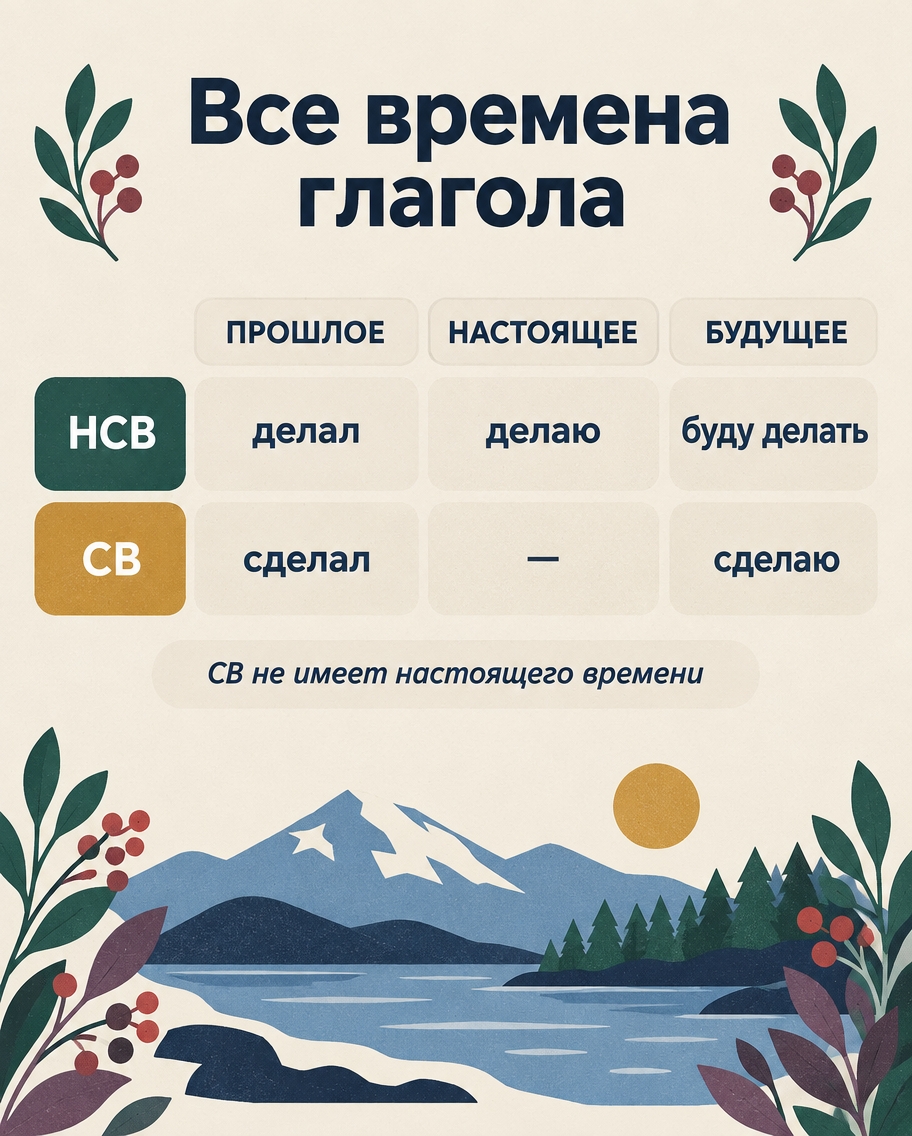
In Lesson 2 the whole Russian verb fitted into one table: three tenses against statement, negative and question. Since then the table has grown three new dimensions. Lesson 13 split every verb in two, Lesson 14 showed that the second face has a future of its own, and Lesson 15 hung prefixes off the motion verbs. This lesson puts all of it back into a single grid, and that grid is the last piece of machinery the engine needs.
Read the grid from the aspect inward, not from the tense. The imperfective column is full: a present (читаю), a compound future built with быть (буду читать) and a past (читал). The perfective column has a hole where the present should be, and the six forms sitting in that hole — прочитаю, прочитаешь, прочитает — are not a present tense at all. They are the future. That is why the perfective future looks exactly like a present: structurally, it is one, and that is also why a perfective verb has no present at all.
The past row is the cheapest thing on the page and it is worth seeing why. Four forms, no person, and identical for both aspects: читал, читала, читало, читали, and прочитал, прочитала, прочитало, прочитали. So when you build a Russian sentence the order of decisions is aspect first, then tense, then person — and person, the thing English speakers worry about most, is the smallest choice of the three. Drill this grid with twenty verbs and the rest of the language is substitution.
The A1 standard sorts Russian verbs into fourteen conjugation classes, which sounds like bad news until you see how they divide. Two ending sets do all the work. Class I is -у/-ю, -ешь, -ет, -ем, -ете, -ут/-ют. Class II is -у/-ю, -ишь, -ит, -им, -ите, -ат/-ят. Every one of the other twelve classes is a variation on one of those two: a different stress pattern, a consonant alternation, or a present stem that does not look like the infinitive.
The variation that catches everybody out is -овать. танцевать does not give *танцеваю; the -ева- belongs to the infinitive only, so the present stem is танц- and you get танцую, танцуешь, танцуют. рисовать gives рисую. But работать is not an -овать verb at all — its -а- is part of the root — so it gives работаю, and путешествовать keeps its stress where the infinitive has it: путешествую. The test is always the я-form, which is why you should learn it with the infinitive every single time.
The second variation is the exception list, and it is short enough to learn whole. Eleven verbs take class-II endings without looking like class-II verbs: four end in -ать or -ять (гнать, держать, дышать, слышать) and seven end in -еть (смотреть, видеть, ненавидеть, обидеть, терпеть, зависеть, вертеть). A handful go the other way, ending in -ить but taking class-I endings: жить, пить, бить, шить, лить, вить. Between those two lists and the -овать group you have every surprise Russian conjugation holds at this level, and everything else is mechanical.
Twelve verbs refuse both patterns, and they are the twelve most useful verbs in the language: быть, мочь, хотеть, дать, есть, идти, ехать, бежать, сказать, стать, взять, создать. That is not a coincidence. High-frequency words erode fastest in every language, so the exceptions and the essentials are the same list, and learning the list properly covers a very large share of everyday speech.
Three of them share one shape, and it is worth learning it as a single block rather than as three verbs: дать, есть and создать all conjugate -м, -шь, -ст, -дим, -дите, -дут. дам, дашь, даст, дадим, дадите, дадут; ем, ешь, ест, едим, едите, едят; создам, создашь, создаст, создадим, создадите, создадут. Notice what the stress does in the plural — it leaves the stem in every one of them: дади́м, даду́т, еди́м, едя́т, создади́м, создаду́т.
The rest are irregular in smaller, individually learnable ways. хотеть takes class-I endings in the singular and class-II in the plural: хочу, хочешь, хочет, but хотим, хотите, хотят. бежать does two things at once: бегу, бежишь, бежим, but они бегут. сказать alternates only in the я-form: скажу, but скажешь, скажет, скажут. стать and взять both build the present on a stem the infinitive hides: стану, станешь; возьму, возьмёшь. And идти has a present that is perfectly regular — иду, идёшь, идут — sitting on a past tense from a completely different root: шёл, шла, шло, шли.
Take the present stem — the они-form minus its -ут or -ют ending — and add -й if that stem ends in a vowel or -и if it ends in a consonant. читают leaves чита-, so читай. говорят leaves говор-, so говори. бегут leaves бег-, so беги. дадут leaves да-, so дай. The plural and polite form simply adds -те: читайте, говорите, бегите, дайте. That covers the perfective in exactly the same way — скажут leaves скаж-, so скажи. Two verbs break the rule outright and must be learnt whole: есть gives ешь and ешьте, быть gives будь and будьте. And a consonant stem whose stress stays on the stem ends in -ь instead of -и, so стать gives стань, never *стани.
Stress follows one rule as well. If the я-form is stressed on the ending, so is the imperative: пишу gives пиши, скажу gives скажи, бегу gives беги. If the я-form is stressed on the stem, the imperative keeps the stem stress: делаю gives делай, знаю gives знай, стану gives стань. Learn the я-form and you get the imperative for free — which is the third reason that form is the one to memorise with every new verb.
For "let's" Russian uses давай with one friend and давайте with several people or with anyone you call вы, followed either by a first-person plural form or by an infinitive: давай пойдём, давайте поедем, давай читать. For a third person there is no imperative at all; you use пусть plus the ordinary present or future form: пусть он придёт, пусть она скажет, пусть будет так. пусть is not a softener and it cannot replace давай — it works only when the doer is somebody other than you and your listener.
One ending before the scenarios, because it costs nothing and you are already using it. Add -ся after a consonant or -сь after a vowel to any form you have just built and you have a reflexive verb. Mechanically nothing changes: conjugate the verb exactly as you already do and glue the ending on afterwards — я учусь, ты учишься, они учатся; я нахожусь, он находится. What it does to the meaning is another matter, because -ся covers true reflexives (умываться), reciprocals (встречаться), passives (дом строится), states (улыбаться) and impersonals (мне хочется), and a large group — нравиться, бояться, учиться — has no non-reflexive partner at all. Lesson 18 takes -ся apart properly. For now it is enough to recognise it, produce the two forms you already know, and never drop it.
Now the point of the whole sixteen lessons. Twelve scenarios, no new words. One: introduce yourself and say where you are from. Two: stop a conversation you cannot follow — «Я не понимаю», «Скажите ещё раз, пожалуйста», «Говорите медленно», «Как вы сказали?». Three: ask a stranger for help — «Помогите», «Помогите мне, пожалуйста». Four: ask the way — «Скажите, пожалуйста, где метро», «Это далеко?», «Как пройти к вокзалу?».
Five: buy something — «Сколько это стоит?», «Дайте мне это, пожалуйста», «Я плачу картой». Six: order in a café — «Я буду кофе, пожалуйста», «Мне, пожалуйста, чай». Seven: pay — «Можно заплатить?». Eight: take transport — «Автобус идёт до вокзала?», «Давайте поедем на метро». Nine: say you feel ill and find help — «Мне плохо», «Где аптека?», «Мне нужно к врачу». Ten: report a problem — «У меня проблема», «Это не работает». Eleven: make and change plans — «Давай пойдём в кино», «Пусть он придёт в три часа». Twelve: end a conversation properly — «Я позвоню вам завтра», «Большое спасибо», «До свидания». If you can get through all twelve without falling back into English, the framework is installed, and everything from Lesson 17 onwards adds words to it rather than structure.
| Form | НСВ: чита́ть | СВ: прочита́ть |
|---|---|---|
| настоящее — я / ты / он | чита́ю · чита́ешь · чита́ет | — the perfective has no present tense |
| настоящее — мы / вы / они | чита́ем · чита́ете · чита́ют | — the six forms in the future rows ARE the present-shaped forms |
| будущее — я / ты / он | бу́ду · бу́дешь · бу́дет чита́ть | прочита́ю · прочита́ешь · прочита́ет |
| будущее — мы / вы / они | бу́дем · бу́дете · бу́дут чита́ть | прочита́ем · прочита́ете · прочита́ют |
| прошедшее — он / она / оно | чита́л · чита́ла · чита́ло | прочита́л · прочита́ла · прочита́ло |
| прошедшее — они | чита́ли | прочита́ли |
| повелительное — ты / вы | чита́й · чита́йте | прочита́й · прочита́йте |
Read the grid from the aspect inward, not from the tense. The imperfective column is full — a present, a compound future built with быть, and a past. The perfective column has a hole where the present would be, and the six forms sitting in that hole are not a present tense at all: structurally the perfective future IS a present tense, which is exactly why a perfective verb has no present. The past row is the cheapest thing on the page — four forms, no person, and identical for both aspects. So when you build a sentence the order of decisions is aspect first, then tense, then person, and person is the smallest choice of the three. Drill this grid with twenty verbs and the rest of the language is substitution.
| Form | What changes in the stem | Verbs of this class | я · ты · они |
|---|---|---|---|
| Class 1 · -ать/-ять with the stress on the stem | nothing — the present stem is the infinitive minus -ть | читать, знать, работать, думать, слушать, играть, гулять, отдыхать | чита́ю · чита́ешь · чита́ют |
| Class 2 · -овать/-евать: the -ова- drops | the -ова-/-ева- disappears before every ending | танцевать, рисовать, организовать | танцу́ю · танцу́ешь · танцу́ют |
| Class 3 · -овать that keeps its stem stress | the same drop, but the stress never moves | путешествовать | путеше́ствую · путеше́ствуешь · путеше́ствуют |
| Class 4 · a consonant alternation in the я-form only | с → ш, з → ж, к → ч, ск → щ before -у/-ю | сказать, писать, искать, плакать | скажу́ · ска́жешь · скажу́т |
| Class 5 · a present stem of its own | the vowel of the infinitive disappears before the endings | звать, брать, ждать | зову́ · зовёшь · зову́т |
| Class 6 · a -н- present stem | -ать verbs that insert -ну- in the present | стать, встать, начать | ста́ну · ста́нешь · ста́нут |
| Class 7 · -ить with class-I endings | a closed list of six short verbs; the ending is stressed and so written ё | жить, пить, бить, шить, лить, вить | живу́ · живёшь · живу́т |
| Class 8 · -ить with class-II endings | -ю/-ишь/-ит/-им/-ите/-ят; the stress is not predictable, learn the paradigm | говорить, любить, платить, готовить | говорю́ · говори́шь · говоря́т |
| Class 9 · -ать/-ять that take class-II endings | the four -ать/-ять verbs of the eleven-verb exception list | гнать, держать, дышать, слышать | слы́шу · слы́шишь · слы́шат |
| Class 10 · -еть that take class-II endings | the seven -еть verbs of the exception list | смотреть, видеть, терпеть, зависеть, ненавидеть, обидеть, вертеть | смотрю́ · смо́тришь · смо́трят |
| Class 11 · mixed conjugation | class-I endings in the singular, class-II in the plural | хотеть, чтить | хочу́ · хо́чешь · хотя́т |
| Class 12 · two alternations at once | г → ж in the stem, class-II endings, but -ут in the они-form | бежать | бегу́ · бежи́шь · бегу́т |
| Class 13 · a unique ending set: -м, -шь, -ст | -м/-шь/-ст/-дим/-дите/-дут; learn the six forms as one block | дать, есть (to eat), создать | дам · дашь · даду́т |
| Class 14 · suppletive, or an irregular past | no pattern in the present, or none in the past | быть, идти, мочь | иду́ · идёшь · иду́т |
The numbering above is this course’s own ordering of the fourteen conjugation classes of the A1 standard; the classes themselves are not a teaching invention — each one is defined by the shape of the present stem, by the ending set, or by where the stress sits. The practical news is that only two ending sets exist: -у/-ю, -ешь, -ет, -ем, -ете, -ут/-ют and -у/-ю, -ишь, -ит, -им, -ите, -ат/-ят. Everything from class 3 down is a variation on one of those two. So when you meet a new verb, learn four things with it and you have the whole of it: its aspect pair, its я-form (that is where every alternation and every stress surprise lives), the case it governs, and its past tense if that past is irregular.
| Form | быть | мочь | хоте́ть | дать | есть (to eat) | идти́ | е́хать |
|---|---|---|---|---|---|---|---|
| я | — | могу́ | хочу́ | дам | ем | иду́ | е́ду |
| ты | — | мо́жешь | хо́чешь | дашь | ешь | идёшь | е́дешь |
| он / она / оно | — | мо́жет | хо́чет | даст | ест | идёт | е́дет |
| мы | — | мо́жем | хоти́м | дади́м | еди́м | идём | е́дем |
| вы | — | мо́жете | хоти́те | дади́те | еди́те | идёте | е́дете |
| они | — | мо́гут | хотя́т | даду́т | едя́т | иду́т | е́дут |
| past — он | был | мог | хоте́л | дал | ел | шёл | е́хал |
| past — она | была́ | могла́ | хоте́ла | дала́ | е́ла | шла | е́хала |
| past — они | бы́ли | мо́гли | хоте́ли | да́ли | е́ли | шли | е́хали |
| imperative — ты / вы | будь / бу́дьте | — | — | дай / да́йте | ешь / е́шьте | иди́ / иди́те | — |
Two of these seven deserve a second look. быть has no present tense at all — the copula is zero in «Я студент» — and its future буду, будешь, будет, будем, будете, будут doubles as the auxiliary that builds the imperfective future of every other verb in the language. And ехать has no imperative of its own: Russian sends you to поехать and says поезжай, поезжайте. мочь and хотеть have no imperative either, because you do not command somebody to be able or to want. Notice what the past row does to the stress — был but была́, мог but могла́, дал but дала́, ел but е́ла. The feminine is the one that moves, and it is the one learners get wrong. The rest of the awkward squad — бежать, сказать, стать, взять, создать — is in the class table above.
| Form | ты (informal) | вы (polite or plural) | давай / давайте (let’s) | пусть + form (third person) |
|---|---|---|---|---|
| читать — class 1, stem ends in a vowel | чита́й | чита́йте | Дава́й чита́ть! | Пусть он чита́ет. |
| говорить — class 8, stem ends in a consonant | говори́ | говори́те | Дава́йте говори́ть по-ру́сски! | Пусть она́ говори́т. |
| сказать — perfective, с becomes ж | скажи́ | скажи́те | Дава́й ска́жем ему́! | Пусть он ска́жет. |
| дать — unique; built on the stem да- | дай | да́йте | Дава́й дади́м ему́ вре́мя! | Пусть он даст мне кни́гу. |
| бежать — г becomes ж, but they-form is бегут | беги́ | беги́те | — | Пусть они́ бегу́т. |
| быть — suppletive | будь | бу́дьте | — | Пусть бу́дет так. |
One rule does almost all of it: take the present stem — the они-form minus its -ут/-ют ending — and add -й if that stem ends in a vowel or -и if it ends in a consonant. читают leaves чита-, so читай; говорят leaves говор-, so говори; бегут leaves бег-, so беги; дадут leaves да-, so дай. Add -те for the plural or polite form. Stress follows the я-form: if the я-form is stressed on the ending, so is the imperative — пишу → пиши, скажу → скажи, бегу → беги; if it is stressed on the stem, the imperative keeps the stem stress — делаю → делай, знаю → знай — and a consonant stem that keeps its stress ends in -ь instead of -и: стать → стань, while the ending-stressed начать still gives начни. Two verbs ignore the rule completely and must be learnt whole: ешь and ешьте, будь and будьте. For "let's" put давай (ты) or давайте (вы) in front of a first-person plural form or of an imperfective infinitive. For a third person there is no imperative at all — пусть plus the ordinary verb form is the only way Russian has of saying "let him". The dash in the third column means the construction does not exist for that verb, not that it is forbidden.
Learn each word with its stress mark and its pronunciation. Nouns are given with their gender, animacy and their full six-case declension; verbs are given with their aspect and, where one exists, their partner verb.
| Russian | English | Gender / aspect | Pronunciation | Audio |
|---|---|---|---|---|
| бежа́ть imperfective | to run; to flee | imperfective | /bʲɪˈʐatʲ/ bih-ZHAT | Listen in Russian: Slow in Russian: бежать |
| стать perfective | to become; to start (doing) | perfective | /statʲ/ STYAT | Listen in Russian: Slow in Russian: стать |
| созда́ть perfective | to create (perfective: the finished result) | perfective Aspect partner: создава́ть | /sɐzˈdatʲ/ suh-ZDYAT | Listen in Russian: Slow in Russian: создать |
| создава́ть imperfective | to create (imperfective: the process, or repeatedly) | imperfective Aspect partner: созда́ть | /səzdɐˈvatʲ/ suh-zduh-VYAT | Listen in Russian: Slow in Russian: создавать |
| танцева́ть imperfective | to dance | imperfective | /təntsɪˈvatʲ/ tun-tsih-VYAT | Listen in Russian: Slow in Russian: танцевать |
| рисова́ть imperfective | to draw, to paint | imperfective | /rʲɪsɐˈvatʲ/ rih-suh-VYAT | Listen in Russian: Slow in Russian: рисовать |
| путеше́ствовать imperfective | to travel | imperfective | /pʊtʲɪˈʂɛstvəvətʲ/ poo-tih-SHEH-stvuh-vyut | Listen in Russian: Slow in Russian: путешествовать |
| дава́й particle | let's (to one friend; the ты form) | particle | /dɐˈvaj/ duh-VAY | Listen in Russian: Slow in Russian: давай |
| дава́йте particle | let's (to several people, or politely to one; the вы form) | particle | /dɐˈvajtʲə/ duh-VAY-tyuh | Listen in Russian: Slow in Russian: давайте |
| пусть particle | let (him / her / them); may | particle | /pusʲtʲ/ POOST | Listen in Russian: Slow in Russian: пусть |
| быть imperfective | to be | imperfective | /bɨtʲ/ BIHT | Listen in Russian: Slow in Russian: быть |
| мочь imperfective | can, to be able to | imperfective | /motɕ/ MOHCH | Listen in Russian: Slow in Russian: мочь |
| хоте́ть imperfective | to want | imperfective | /xɐˈtʲetʲ/ khuh-TYET | Listen in Russian: Slow in Russian: хотеть |
| чита́ть imperfective | to read | imperfective | /tɕɪˈtatʲ/ chih-TYAT | Listen in Russian: Slow in Russian: читать |
| говори́ть imperfective | to speak, to talk, to say | imperfective | /ɡəvɐˈrʲitʲ/ guh-vuh-REET | Listen in Russian: Slow in Russian: говорить |
| жить imperfective | to live | imperfective | /ʐɨtʲ/ ZHIHT | Listen in Russian: Slow in Russian: жить |
| смотре́ть imperfective | to look at, to watch | imperfective | /smɐˈtrʲetʲ/ smuh-TRYET | Listen in Russian: Slow in Russian: смотреть |
| люби́ть imperfective | to love, to like | imperfective | /lʲʊˈbʲitʲ/ lyoo-BEET | Listen in Russian: Slow in Russian: любить |
| плати́ть imperfective | to pay | imperfective | /plɐˈtʲitʲ/ pluh-TEET | Listen in Russian: Slow in Russian: платить |
| звать imperfective | to call; in the fixed formula Меня зовут… "my name is…" | imperfective | /zvatʲ/ ZVYAT | Listen in Russian: Slow in Russian: звать |
| дава́ть imperfective | to give | imperfective | /dɐˈvatʲ/ duh-VYAT | Listen in Russian: Slow in Russian: давать |
| есть imperfective | to eat | imperfective | /jesʲtʲ/ YEST | Listen in Russian: Slow in Russian: есть |
| ви́деть imperfective | to see | imperfective | /ˈvʲidʲɪtʲ/ VEE-dit | Listen in Russian: Slow in Russian: видеть |
| ждать imperfective | to wait for, to expect | imperfective | /ʐdatʲ/ ZHDYAT | Listen in Russian: Slow in Russian: ждать |
| пить imperfective | to drink | imperfective | /pʲitʲ/ PEET | Listen in Russian: Slow in Russian: пить |
| идти́ imperfective | to go, to walk (on foot, one way, now) | imperfective | /ɪˈtʲtʲi/ ih-TEE | Listen in Russian: Slow in Russian: идти |
| е́хать imperfective | to go, to travel (by vehicle, one way, now) | imperfective | /ˈjexətʲ/ YEH-khyut | Listen in Russian: Slow in Russian: ехать |
| учи́ться imperfective | to study, to learn (to be a student) | imperfective | /ʊˈtɕitsə/ oo-CHIH-tsyuh | Listen in Russian: Slow in Russian: учиться |
| нра́виться imperfective | to be pleasing — мне нра́вится means "I like" | imperfective | /ˈnravʲɪt͜sə/ NRAH-vih-tsyuh | Listen in Russian: Slow in Russian: нравиться |
| сде́лать perfective | to do, to get done | perfective | /ˈzʲdʲelətʲ/ ZDYEH-lyut | Listen in Russian: Slow in Russian: сделать |
| сказа́ть perfective | to say, to tell | perfective Aspect partner: говори́ть | /skɐˈzatʲ/ skuh-ZYAT | Listen in Russian: Slow in Russian: сказать |
| дать perfective | to give | perfective Aspect partner: дава́ть | /datʲ/ DYAT | Listen in Russian: Slow in Russian: дать |
| взять perfective | to take | perfective | /vzʲatʲ/ VZYAT | Listen in Russian: Slow in Russian: взять |
Помоги́те!
Help!
IPA /pəmɐˈɡʲitʲə/
Say it puh-muh-GEE-tyuh!
The вы imperative of помогать, used on its own as a cry for help. One word, loud, and understood everywhere.
Помоги́те мне, пожа́луйста.
Please help me.
IPA /pəmɐˈɡʲitʲə mnʲe pɐˈʐalujstə/
Say it puh-muh-GEE-tyuh muh-NYEH, puh-ZHAH-luy-stuh.
помогать governs the DATIVE, so "help me" is помогите мне and never *помогите меня. Add пожалуйста and the same sentence becomes a polite request rather than an alarm.
Я не понима́ю.
I don't understand.
IPA /ja nʲe pənʲɪˈmaju/
Say it YAH NYEH puh-nih-MAH-yoo.
You have had this sentence since Lesson 2 and it is still the most useful thing in your mouth. не goes straight before the verb and nothing else moves.
Скажи́те ещё раз, пожа́луйста.
Say it once more, please.
IPA /skɐˈʐɨtʲə ɪˈʂːo ras pɐˈʐalujstə/
Say it skuh-ZHIH-tyuh yih-SHCHOH RAHS, puh-ZHAH-luy-stuh.
скажите is the вы imperative of сказать; the stem alternates з → ж, so the ты form is скажи. ещё раз is literally "one more time" — раз is the counting noun from Lesson 11. The ё of ещё carries no acute of its own (§13).
Вы меня́ понима́ете?
Do you understand me?
IPA /vɨ mʲɪˈna pənʲɪˈmajɪtʲə/
Say it VIH mih-NYAH puh-nih-MAH-yih-tyuh?
понимать takes the accusative, so "me" is меня, not мне — the opposite government from помогать. Learn the two together and the contrast sticks.
Как вы сказа́ли?
What did you say? (literally: how did you say)
IPA /kak vɨ skɐˈzalʲɪ/
Say it KAHK VIH skuh-ZAH-lih?
The polite way to ask someone to repeat themselves. Literally "how did you say?" — English asks "what", Russian asks "how", and как is doing that job here exactly as it does in как дела?
Говори́те ме́дленно, пожа́луйста.
Speak slowly, please.
IPA /ɡəvɐˈrʲitʲə ˈmʲedlʲɪnə pɐˈʐalujstə/
Say it guh-vuh-REE-tyuh MYEH-dlih-nuh, puh-ZHAH-luy-stuh.
говорите is the вы imperative of говорить. медленно is one of the manner adverbs from Lesson 14; its opposite is быстро.
Скажи́те, пожа́луйста, где метро́.
Tell me please where the metro is.
IPA /skɐˈʐɨtʲə pɐˈʐalujstə ɡdʲe mʲɪˈtro/
Say it skuh-ZHIH-tyuh, puh-ZHAH-luy-stuh, guh-DYEH mih-TROH.
The embedded question keeps statement word order — где метро, never *где есть метро — because the present copula is zero. Please can go in the middle of a sentence in Russian, where it sounds natural rather than fussy.
Э́то далеко́?
Is it far?
IPA /ˈɛtə dʲɪlʲɪˈko/
Say it EH-tuh duh-lih-KOH?
далеко is a predicate adverb, so the question needs no verb at all: "it far?". Its opposite близко answers the same shape: это близко?
Как пройти́ к вокза́лу?
How do I get to the station?
IPA /kak prɐjˈtʲi k vɐɡˈzalu/
Say it KAHK pruy-TEE k vug-ZAH-loo?
к + dative is the "towards a person or a building" preposition from Lesson 9, and пройти is one of the prefixed motion verbs of Lesson 15. Listen for two sound changes inside вокзалу: the first о reduces to [ɐ], and the к voices to [ɡ] in front of the з that follows it.
Ско́лько э́то сто́ит?
How much is this?
IPA /ˈskolʲkə ˈɛtə ˈstoit/
Say it SKOHL-kuh EH-tuh STOH-it?
стоить is stressed on the first syllable in every form — сто́ит, сто́ят — even though its near-homophone звони́т is stressed on the last. The price answer takes a numeral plus the genitive: пять рублей.
Да́йте мне э́то, пожа́луйста.
Give me that, please.
IPA /ˈdajtʲə mnʲe ˈɛtə pɐˈʐalujstə/
Say it DAY-tyuh muh-NYEH EH-tuh, puh-ZHAH-luy-stuh.
дать takes two complements and they are in different cases: the thing given is accusative (это, воду, книгу), the person who receives it is dative (мне, ему, ей). дайте is the polite вы imperative.
Я плачу́ ка́ртой.
I'm paying by card.
IPA /ja plɐˈtɕu ˈkartəj/
Say it YAH pluh-CHOO KAHR-tuy.
The instrument use of the instrumental from Lesson 10: платить чем — картой, наличными, деньгами. Watch the stress: the я-form of платить is плачу́, with the acute on the ending, while every other form keeps it on the stem — пла́тишь, пла́тит, пла́тят.
Я бу́ду ко́фе, пожа́луйста.
I'll have a coffee, please.
IPA /ja ˈbudu ˈkofʲə pɐˈʐalujstə/
Say it YAH BOO-doo KOH-fyuh, puh-ZHAH-luy-stuh.
The standard way to order: the imperfective future of быть plus the thing in the accusative, which for an inanimate masculine noun like кофе looks exactly like the nominative. кофе is indeclinable, so it cannot go wrong.
Мне, пожа́луйста, чай.
A tea for me, please.
IPA /mnʲe pɐˈʐalujstə tɕaj/
Say it muh-NYEH, puh-ZHAH-luy-stuh, CHAY.
Even shorter than я буду чай: a dative "for me" and the thing itself, with no verb at all. This is the zero-copula habit from Lesson 1 doing real work in a real queue.
Мо́жно заплати́ть?
Can I pay?
IPA /ˈmoʐnə zəplɐˈtʲitʲ/
Say it MOHZH-nuh zuh-pluh-TEET?
можно plus an infinitive is the impersonal permission construction from Lesson 4 — literally "is it possible to pay?". заплатить is платить with the prefix за-, the same perfective-making model as Lesson 13: заплатить, заплачу́, заплати́т.
У меня́ пробле́ма.
I have a problem.
IPA /ʊ mʲɪˈna prɐˈblʲemə/
Say it oo mih-NYAH pruh-BLYEH-muh.
у + genitive for possession, and the thing possessed stays in the nominative: у меня проблема, not *у меня проблему. Say what the problem is with с + instrumental: у меня проблема с телефоном.
Э́то не рабо́тает.
This doesn't work.
IPA /ˈɛtə nʲe rɐˈbotəɪt/
Say it EH-tuh NYEH ruh-BOH-tuh-yit.
The one sentence that covers a broken lift, a dead phone, a card machine that will not read your card and a ticket that will not scan. работать is class 1 despite looking like an -овать verb: its -а- belongs to the root, so the я-form is работаю and never *работую.
Мне пло́хо.
I feel ill.
IPA /mnʲe ˈploxə/
Say it muh-NYEH PLOH-khuh.
An impersonal state with the experiencer in the dative — the construction from Lessons 4 and 9. There is no subject and no verb to conjugate: мне плохо, мне холодно, мне интересно, мне надо. To name the symptom use болит: у меня болит голова.
Где апте́ка?
Where is the pharmacy?
IPA /ɡdʲe ɐˈtʲekə/
Say it guh-DYEH up-TYEH-kuh?
Two words, no verb, and the first о of аптека reduces to [ɐ]. Russian needs no article and no copula, which is why the shortest useful questions are also the easiest ones.
Мне ну́жно к врачу́.
I need to get to a doctor.
IPA /mnʲe ˈnuʐnə k vrɐˈtɕu/
Say it muh-NYEH NOOZH-nuh k vruh-CHOO.
мне нужно plus an infinitive means "I need to …"; here the infinitive is replaced by a destination, and к + dative is the preposition for going towards a person (к врачу, к другу). The same shape covers everything from мне нужно домой to мне нужно к начальнику.
Дава́й пойдём в кино́!
Let's go to the cinema!
IPA /dɐˈvaj pɐjˈdʲom f kʲɪˈno/
Say it duh-VAY puy-DYOHM f kih-NOH!
давай plus a first-person plural form is the ты version of "let's". пойдём is the perfective future of пойти — and remember that the six forms of a perfective verb look like a present but always mean a future.
Дава́йте пое́дем на метро́!
Let's go by metro!
IPA /dɐˈvajtʲə pɐˈjedʲɪm nə mʲɪˈtro/
Say it duh-VAY-tyuh puh-YEH-dim nuh mih-TROH!
давайте is the same construction in the вы form, for several people or for one person you do not know well. на метро is the fixed transport chunk from Lesson 7 — on the metro, with no case ending to choose because метро is indeclinable.
Пусть он придёт в три часа́.
Let him come at three o'clock.
IPA /pusʲtʲ on prʲɪˈdʲot f trʲɪ tɕɪˈsa/
Say it POOST OHN prih-DYOHT f TREE chuh-SAH.
A third person cannot be told what to do, so Russian uses пусть with the ordinary verb form: придёт is the perfective future of прийти. Two numbers meet in в три часа — the numeral три governs the genitive singular, hence часа, not часов.
Я позвоню́ вам за́втра.
I'll ring you tomorrow.
IPA /ja pəzvɐˈnʲu vam ˈzavtrə/
Say it YAH puh-zvuh-NYOO VAHM ZAHF-truh.
позвонить is звонить with the perfective prefix по-, and it governs the dative: позвонить кому — позвоню вам. The stress stays on the ending right through: позвоню́, позвони́шь, позвони́т, позвоня́т.
Она́ хо́чет стать врачо́м.
She wants to become a doctor.
IPA /ɐˈna ˈxotɕɪt statʲ vrɐˈtɕom/
Say it uh-NAH KHOH-chit STYAT vruh-CHOHM.
Three irregulars in one sentence and you already know all of them: хотеть mixes both conjugations (хочет, but хотим), стать builds a future on a stem the infinitive does not show (стану), and a profession after стать goes in the instrumental (врачом). хотеть plus an imperfective infinitive would mean she wants to be becoming a doctor; plus стать it means she wants the result.
Nora stops Pavel in the street. They are strangers, so both of them use вы and the polite imperative.
Здравствуйте! Скажите, пожалуйста, где метро?
Hello! Tell me please, where is the metro?
Listen in Russian: Slow in Russian: Здравствуйте! Скажите, пожалуйста, где метро?Метро там, прямо. Это недалеко.
The metro is over there, straight ahead. It isn't far.
Listen in Russian: Slow in Russian: Метро там, прямо. Это недалеко.А пешком это далеко?
And is it far on foot?
Listen in Russian: Slow in Russian: А пешком это далеко?Нет, пять минут. Идите прямо, потом направо.
No, five minutes. Go straight ahead, then turn right.
Listen in Russian: Slow in Russian: Нет, пять минут. Идите прямо, потом направо.Потом направо? Спасибо!
Then right? Thank you!
Listen in Russian: Slow in Russian: Потом направо? Спасибо!Пожалуйста. Вот остановка автобуса.
You're welcome. Here is the bus stop.
Listen in Russian: Slow in Russian: Пожалуйста. Вот остановка автобуса.Автобус идёт до вокзала?
Does the bus go as far as the station?
Listen in Russian: Slow in Russian: Автобус идёт до вокзала?Да, идёт. Но пешком это пять минут. Давайте я вам покажу.
Yes, it does. But on foot it's five minutes. Let me show you.
Listen in Russian: Slow in Russian: Да, идёт. Но пешком это пять минут. Давайте я вам покажу.Спасибо большое! До свидания!
Thank you very much! Goodbye!
Listen in Russian: Slow in Russian: Спасибо большое! До свидания!Marco and Anya are friends, so they use ты and давай. Marco is trying to get Anya out of the flat.
Аня, что ты делаешь сегодня вечером?
Anya, what are you doing this evening?
Listen in Russian: Slow in Russian: Аня, что ты делаешь сегодня вечером?Ничего. Я буду дома. А что?
Nothing. I'll be at home. Why?
Listen in Russian: Slow in Russian: Ничего. Я буду дома. А что?Давай пойдём в кафе! Там будет музыка.
Let's go to a café! There'll be music.
Listen in Russian: Slow in Russian: Давай пойдём в кафе! Там будет музыка.Я не танцую.
I don't dance.
Listen in Russian: Slow in Russian: Я не танцую.Хорошо. Давай посмотрим фильм у меня.
All right. Let's watch a film at my place.
Listen in Russian: Slow in Russian: Хорошо. Давай посмотрим фильм у меня.Давай! А завтра мы поедем в парк?
Let's! And tomorrow shall we go to the park?
Listen in Russian: Slow in Russian: Давай! А завтра мы поедем в парк?Поедем. Ты будешь рисовать, а я буду читать.
We shall. You'll draw and I'll read.
Listen in Russian: Slow in Russian: Поедем. Ты будешь рисовать, а я буду читать.Да! Летом я хочу путешествовать. Поедем в Италию?
Yes! In the summer I want to travel. Shall we go to Italy?
Listen in Russian: Slow in Russian: Да! Летом я хочу путешествовать. Поедем в Италию?Поедем! Но тебе надо много работать.
We shall! But you need to work a lot.
Listen in Russian: Slow in Russian: Поедем! Но тебе надо много работать.Answer actively — try to recall the Russian before you look at any hint.
Give the present-tense form for "я".
Give the present-tense form for "они".
Give the present-tense form for "ты".
Choose the correct form.
Choose the correct form.
Fill the gap with the "они" form of бежать: "They are running towards the metro."
Answer true or false.
Recall the English meaning, then rate how well you knew it.
Translate into Russian.
Translate into English.
Choose the correct sentence.
Choose the correctly stressed form.
Give the future-tense form for "я".
Fill the gap: "Let him come at three o'clock."
Give the present-tense form for "ты".
Give the present-tense form for "мы".
Give the present-tense form for "вы".
Give the future-tense form for "они".
Choose the aspect that fits: "Tomorrow I shall get through the book in one evening."
Choose the aspect that fits: "Every evening she listens to music."
Change the aspect and the tense.
Rewrite it with давай or давайте.
Translate into Russian.
Translate into Russian.
Put the words in order.
Pair the words.
Play the audio and type what you hear.
Play the audio and pick the match.
Choose the ending.
Choose the odd one out.
Choose the correct form of учитель.
Choose the correct form of я.
Translate into Russian.
Rewrite it with the perfective infinitive.
Work through the twelve survival scenarios out loud, one at a time. Say the Russian first, then check it against the phrase list, then say your own version of the same scenario with different words — a different place, a different thing, a different person. Speed matters more than precision here. If you can get through all twelve without falling back into English, the framework is installed, and everything from Lesson 17 onwards is vocabulary rather than structure.
Before you move on, make sure you can do all of this without looking:
Go deeper: The fourteen A1 conjugation classes · Irregular and awkward verbs · The imperative: -й, -и, -те, давай, пусть · The two futures side by side · Aspect pairs · The -ся and -сь ending