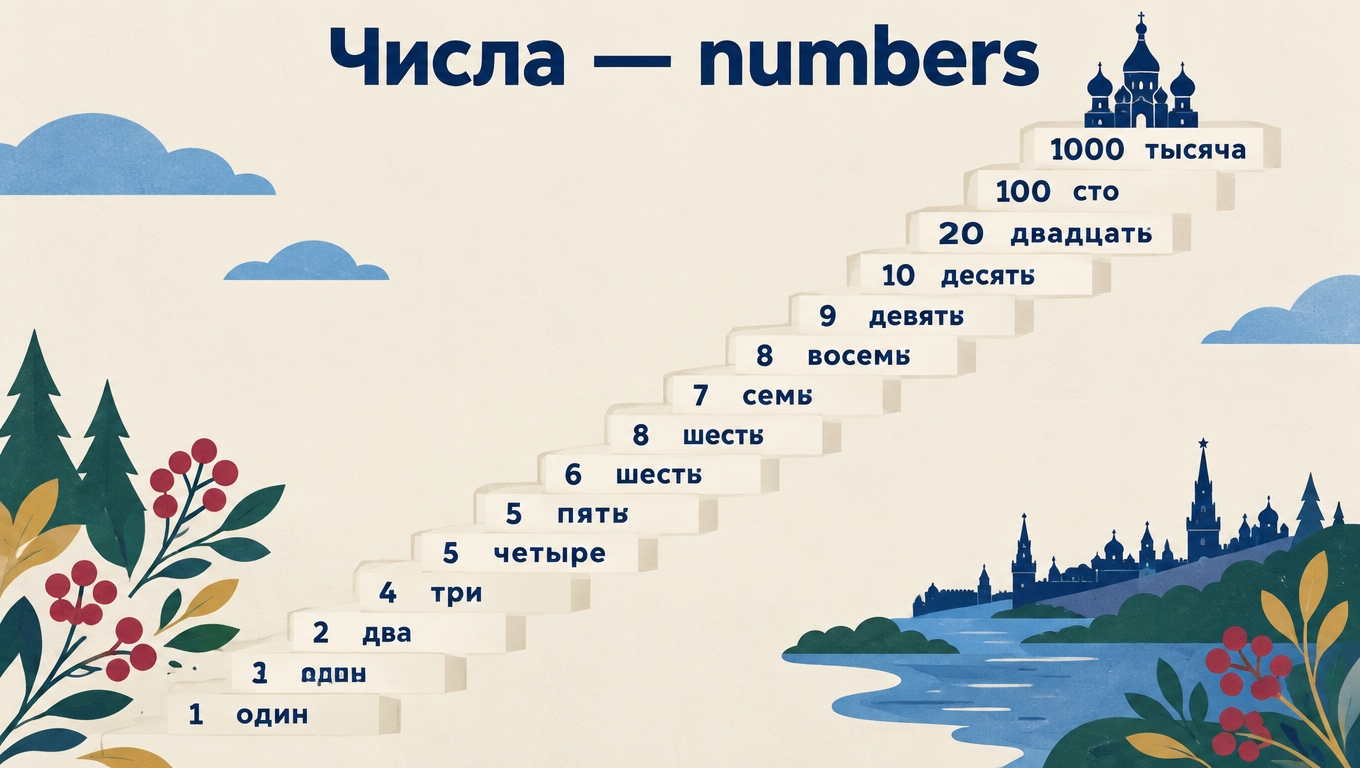
Numbers arrive, and with them the one rule that changes the ending of every noun in Russian: one takes the nominative, two to four the genitive singular, five and above the genitive plural. Prices, payment and the nine counting nouns come with it — and by the end of the hour you can buy something in Russian from start to finish.
⏱ About 60 minutes26 phrases34 exercises
What you will learn
Count aloud from zero to a thousand, and know which numerals follow a pattern and which four simply have to be learnt whole
Apply the rule the whole lesson turns on: оди́н takes the nominative singular, два / три / четы́ре the genitive singular, пять and everything above the genitive plural
Let the last digit of a compound numeral do the governing — два́дцатьоди́нгод, два́дцатьдваго́да, два́дцатьпятьлет
Give all three counting forms of год, час, рубль, человек, раз, день, месяц, минута and неделя without hesitating
Ask and answer the three «ско́лько» questions: Ско́лькоэ́тосто́ит? Ско́льковре́мени? Ско́лькотебе́лет?
Pay for something in Russian — by card or in cash — and handle the price, the discount and the change
Quick review
Say these aloud before you start. They come from earlier lessons.
Ско́лько у тебя́ де́нег?How much money have you got?Listen in Russian:Slow in Russian:Ско́лько у тебя́ де́нег?
У меня́ мно́го рабо́ты.I have a lot of work.Listen in Russian:Slow in Russian:У меня́ мно́го рабо́ты.
Мне ну́жно вре́мя.I need time.Listen in Russian:Slow in Russian:Мне ну́жно вре́мя.
У нас больша́я семья́.We have a big family.Listen in Russian:Slow in Russian:У нас больша́я семья́.
Я покупа́ю хлеб и сыр.I am buying bread and cheese.Listen in Russian:Slow in Russian:Я покупа́ю хлеб и сыр.
Сейча́с я рабо́таю.I am working now.Listen in Russian:Slow in Russian:Сейча́с я рабо́таю.
Theory
One, two, three — and the two numerals that change shape
Russian has one word for "one" that behaves like an adjective and one word for "two" that has two shapes. Everything from three to ten is a single invariable form. That is less to learn than it looks, and the two irregular ones are the two you will use most often.
оди́н agrees with its noun in gender and number, exactly like большо́й does: оди́ндом, одна́кни́га, одно́окно́, одни́часы́. The noun after it stays in the nominative singular. оди́н also does the job English does with "a" — «Якупи́лодну́кни́гу» is simply "I bought a book". The plural form одни́ turns up with nouns that have no singular at all: одни́часы́, одни́де́ньги.
два is the form used before a masculine or neuter noun, две the one used before a feminine noun: двадо́ма, дваокна́, двекни́ги, двесестры́. English lost this distinction centuries ago; Russian kept it, and it is worth getting right from the first day, because «двакниги» marks a learner out immediately. From три onwards there is one shape for every gender, and that shape never changes.
Оди́н дом, одна́ кни́га, одно́ окно́.one house, one book, one windowListen in Russian:Slow in Russian:Оди́н дом, одна́ кни́га, одно́ окно́.
Два до́ма и две кни́ги.two houses and two booksListen in Russian:Slow in Russian:Два до́ма и две кни́ги.
Три часа́ и четы́ре мину́ты.three hours and four minutesListen in Russian:Slow in Russian:Три часа́ и четы́ре мину́ты.
У меня́ одна́ сестра́.I have one sister.Listen in Russian:Slow in Russian:У меня́ одна́ сестра́.
The rule the whole lesson turns on: 1 / 2–4 / 5+
Here is the sentence that justifies the hour. After оди́н the noun is in the nominative singular. After два, три and четы́ре it is in the genitive singular. After пять and every number above it — including every teen — it is in the genitive plural. Three cases, one trigger, and it works for every noun in the language without exception.
It is worth understanding why rather than simply memorising it. Two to four describe a quantity you can still picture as separate items, so the noun keeps a singular form; five and above describe an undifferentiated amount, and the genitive plural is exactly the case that мно́го, ма́ло and нет already govern (Lesson 8). That is why «двекни́ги» and «мно́гокниг» feel different to a Russian ear — because grammatically they are.
Two exceptions matter, and both are the kind of thing that stays wrong for years unless it is named early. First, the teens govern the genitive plural even when they end in 1 to 4: оди́ннадцатьлет, двена́дцатьдней, пятна́дцатьрубле́й — the -на́дцать swallows the digit. Second, in a compound numeral only the LAST digit governs: два́дцатьоди́нгод, два́дцатьдваго́да, два́дцатьпятьлет. Everything before that final digit is ignored, however large it is.
Оди́н год, два го́да, пять лет.one year, two years, five years — three forms of one nounListen in Russian:Slow in Russian:Оди́н год, два го́да, пять лет.
Две кни́ги и пять книг.two books and five booksListen in Russian:Slow in Russian:Две кни́ги и пять книг.
Два́дцать два го́да.twenty-two years (the last digit governs)Listen in Russian:Slow in Russian:Два́дцать два го́да.
Оди́ннадцать лет.eleven years (the teens always take the genitive plural)Listen in Russian:Slow in Russian:Оди́ннадцать лет.
Eleven to a thousand: compounds, and four that refuse the pattern
Everything above ten is a compound, and compounds are simply juxtaposed — largest first, with no conjunction and no word for "and". The teens are a digit plus -на́дцать, and the stress sits on that suffix in every one of them except оди́ннадцать and четы́рнадцать, which keep it on the stem. Learn оди́ннадцать properly and you have the shape of all nine.
The tens are a digit plus -дцать or -десят: два́дцать, три́дцать, пятьдеся́т, шестьдеся́т, се́мьдесят, во́семьдесят. Three forms sit right outside the system and have to be taken whole — со́рок (forty), девяно́сто (ninety) and сто (a hundred). There is no *четыредцать and no *девятьдесят, and inventing them is the most common mistake an English speaker makes with Russian numbers.
The hundreds carry on in the same way: две́сти, три́ста and четы́реста keep the stress forward, while пятьсо́т and everything above it throw the stress onto -со́т. ты́сяча is a feminine noun rather than an invariable numeral, so it declines like кни́га and obeys the counting rule itself: одна́ты́сячарубле́й, дветы́сячирубле́й, пятьты́сячрубле́й. миллио́н is masculine and behaves the same way.
Оди́ннадцать, двена́дцать, трина́дцать, четы́рнадцать.eleven, twelve, thirteen, fourteenListen in Russian:Slow in Russian:Оди́ннадцать, двена́дцать, трина́дцать, четы́рнадцать.
Со́рок, девяно́сто, сто, ты́сяча.forty, ninety, a hundred, a thousand — the four that refuse the patternListen in Russian:Slow in Russian:Со́рок, девяно́сто, сто, ты́сяча.
Две́сти пятьдеся́т семь.two hundred and fifty-sevenListen in Russian:Slow in Russian:Две́сти пятьдеся́т семь.
Сто три́дцать рубле́й.a hundred and thirty roublesListen in Russian:Slow in Russian:Сто три́дцать рубле́й.
Nine nouns with three forms each
Nine nouns come up so often after numbers that Russian effectively asks you to learn three forms of each, not one: год, час, рубль, человек, раз, день, месяц, минута and неделя. No rule predicts the triple. You learn «оди́нгод, дваго́да, пятьлет» as a single unit, the way you learn a telephone number, and you say it out loud until it stops being three separate facts.
год is the wildest of the nine. Its genitive plural for counting and for age is лет, which is not a form of год at all but a different word that Russian has folded into the paradigm; the regular годов survives only in set phrases such as девяностыегоды. человек counts on its own stem — оди́нчелове́к, двачелове́ка, пятьчелове́к — but means "people" as лю́ди everywhere else, so мно́голюде́й and пятьчелове́к are both correct and neither can replace the other.
The rest are less dramatic but still need saying aloud. день loses its vowel (дня, дней), рубль loses its soft sign and moves the stress onto the ending (рубля́, рубле́й), неделя inserts a soft sign in the genitive plural (неде́ль), and минута, месяц and раз simply follow their endings. Drill the triples in both directions: «оди́нчас — двачаса́ — пятьчасо́в», then back again. Add полтора́ (masculine and neuter) and полторы́ (feminine) for "one and a half"; they behave like two to four — полтора́часа́, полторы́неде́ли.
Оди́н рубль, два рубля́, пять рубле́й.one rouble, two roubles, five roublesListen in Russian:Slow in Russian:Оди́н рубль, два рубля́, пять рубле́й.
Оди́н челове́к, два челове́ка, пять челове́к.one person, two people, five peopleListen in Russian:Slow in Russian:Оди́н челове́к, два челове́ка, пять челове́к.
Оди́н день, два дня, пять дней.one day, two days, five daysListen in Russian:Slow in Russian:Оди́н день, два дня, пять дней.
Два ра́за в неде́лю.twice a weekListen in Russian:Slow in Russian:Два ра́за в неде́лю.
Money: the price, the payment and the change
Numbers earn their keep in one place above all others: paying for things. The question is «Ско́лькоэ́тосто́ит?» — literally "how much does this cost?" — and сто́ить makes the thing itself the subject, so «Ко́фесто́итсторубле́й» has the same shape as "the coffee costs a hundred roubles". With a plural subject the verb is plural: «Я́блокисто́ятстодва́дцатьрубле́й».
Asking for the total has its own fixed phrase, «Ско́лькосменя́?», literally "how much from me", and the answer mirrors it: «Свасстопятьдеся́трубле́й». Neither sentence contains a verb. Payment is an instrumental chunk — «Яплачу́ка́ртой», «Мо́жнонали́чными?» — and the money that comes back to you is сда́ча: «Вотва́шасда́ча». A discount is ски́дка, and you ask for one with «Увасестьски́дка?».
Three words finish the set. цена́ is the price, and it moves its stress exactly the way вода́ does: цены́, цене́, цено́й in the oblique singular, but це́ну and це́ны pull back onto the stem. кошелё́к is the purse or wallet, and its о disappears the moment an ending appears — кошелька́, кошельку́, кошелько́в. нали́чные is cash: a plural-only adjective used as a noun, so it has no singular to fall back on. One caution to carry away: сто́ит (it costs) and стои́т (it stands) are spelled identically, and only the stress separates them.
Ско́лько э́то сто́ит?How much is this?Listen in Russian:Slow in Russian:Ско́лько э́то сто́ит?
С вас сто пятьдеся́т рубле́й.That’s a hundred and fifty roubles.Listen in Russian:Slow in Russian:С вас сто пятьдеся́т рубле́й.
Я плачу́ ка́ртой.I am paying by card.Listen in Russian:Slow in Russian:Я плачу́ ка́ртой.
Вот ва́ша сда́ча — пятьдеся́т рубле́й.Here is your change — fifty roubles.Listen in Russian:Slow in Russian:Вот ва́ша сда́ча — пятьдеся́т рубле́й.
One to twenty: the digits, the teens and the first ten
Form
1–5
6–10
11–15
16–20
1 · 6 · 11 · 16
оди́н
шесть
оди́ннадцать
шестна́дцать
2 · 7 · 12 · 17
два
семь
двена́дцать
семна́дцать
3 · 8 · 13 · 18
три
во́семь
трина́дцать
восемна́дцать
4 · 9 · 14 · 19
четы́ре
де́вять
четы́рнадцать
девятна́дцать
5 · 10 · 15 · 20
пять
де́сять
пятна́дцать
два́дцать
Read down a column and the same five digits come back; read across and the shape repeats. The teens are the digit plus -на́дцать, and the stress sits on that suffix in every one of them except оди́ннадцать and четы́рнадцать, which keep it on the stem. два́дцать closes the last row because it is the first of the tens, not a teen. Monosyllables — два, три, пять, шесть, семь — carry no stress mark at all.
Twenty to a thousand: the tens, the hundreds and the four odd ones
Form
the digit
× 10 → the tens
× 100 → the hundreds
2
два
два́дцать
две́сти
3
три
три́дцать
три́ста
4
четы́ре
со́рок
четы́реста
5
пять
пятьдеся́т
пятьсо́т
6
шесть
шестьдеся́т
шестьсо́т
7
семь
се́мьдесят
семьсо́т
8
во́семь
во́семьдесят
восемьсо́т
9
де́вять
девяно́сто
девятьсо́т
learn these separately
ноль · оди́н · де́сять
со́рок · девяно́сто
сто · ты́сяча · миллио́н
Everything from twenty upwards is a compound of pieces you already have, largest first, with no conjunction and no word for "and": два́дцатьпять, стотри́дцатьсемь, дветы́сячидва́дцатьшесть. Four forms refuse the pattern and must be learnt whole — со́рок (not *четыредцать), девяно́сто (not *девятьдесят), сто and ты́сяча. Note the stress split inside the tens: пятьдеся́т and шестьдеся́т lean on the ending, while се́мьдесят and во́семьдесят lean on the stem. All the hundreds do the same — две́сти, три́ста, четы́реста keep the stress forward, пятьсо́т and above throw it onto -со́т.
THE RULE: 1 / 2–4 / 5+ — what a numeral does to its noun
Form
1 → Nominative singular
2, 3, 4 → Genitive singular
5 and above → Genitive plural
дом (m, inanimate)
оди́ндом
двадо́ма
пятьдомо́в
книга (f)
одна́кни́га
двекни́ги
пятькниг
окно (n)
одно́окно́
четы́реокна́
пятьо́кон
стол (m)
оди́нстол
тристола́
пятьстоло́в
студент (m, animate)
оди́нстуде́нт
двастуде́нта
пятьстуде́нтов
the verb in the past tense
чита́л
чита́ли
чита́ло
This is the single most useful rule in Russian arithmetic. After оди́н the noun is nominative singular and the numeral agrees with it in gender — оди́ндом, одна́кни́га, одно́окно́, одни́часы́. After два (feminine две), три and четы́ре the noun is genitive singular. After пять and everything above it, including every teen, the noun is genitive plural. Two things catch people out. First, the teens govern the genitive plural even when they end in 1 to 4: оди́ннадцатьлет, never *одиннадцатьгод. Second, in a compound numeral only the LAST digit governs — два́дцатьоди́нгод, два́дцатьдваго́да, два́дцатьпятьлет. The verb follows the phrase: plural after 2–4, normally neuter singular in the past after 5+.
Three forms each: the counting nouns you have to learn whole
Form
1 → Nominative singular
2, 3, 4 → Genitive singular
5 and above → Genitive plural
год (m) — year
оди́нгод
дваго́да
пятьлет
час (m) — hour
оди́нчас
двачаса́
пятьчасо́в
рубль (m) — rouble
оди́нрубль
дварубля́
пятьрубле́й
человек (m) — person
оди́нчелове́к
двачелове́ка
пятьчелове́к
раз (m) — time, occasion
оди́нраз
двара́за
пятьраз
день (m) — day
оди́ндень
двадня
пятьдней
месяц (m) — month
оди́нме́сяц
дваме́сяца
пятьме́сяцев
минута (f) — minute
одна́мину́та
двемину́ты
пятьмину́т
неделя (f) — week
одна́неде́ля
двенеде́ли
пятьнеде́ль
Nine everyday nouns keep three forms in your head at once, and no rule predicts them — you learn each one as a triple and say it out loud until it is automatic. год is the wildest: its counting genitive plural, лет, is historically a different word. человек counts on its own stem (пятьчелове́к) but means "people" as лю́ди everywhere else (мно́голюде́й). The genitive plurals of день and раз are single syllables, so neither carries an acute. Add полтора́ (masculine and neuter) and полторы́ (feminine) for "one and a half"; they behave like 2–4 — полтора́часа́, полторы́неде́ли.
Vocabulary
Learn each word with its stress mark and its pronunciation. Nouns are given with their gender, animacy and their full six-case declension; verbs are given with their aspect and, where one exists, their partner verb.
Russian
English
Gender / aspect
Pronunciation
Audio
оди́нnumeral
one; a, an (with a noun)
numeral
/ɐˈdʲin/uh-DEEN
Listen in Russian:Slow in Russian:один
дваnumeral
two
numeral
/dva/DVAH
Listen in Russian:Slow in Russian:два
триnumeral
three
numeral
/trʲi/TREE
Listen in Russian:Slow in Russian:три
четы́реnumeral
four
numeral
/tɕɪˈtɨrʲɪ/chih-TIH-ryuh
Listen in Russian:Slow in Russian:четыре
пятьnumeral
five
numeral
/pʲatʲ/PYAT
Listen in Russian:Slow in Russian:пять
де́сятьnumeral
ten
numeral
/ˈdʲesʲɪtʲ/DYEH-syut
Listen in Russian:Slow in Russian:десять
со́рокnumeral
forty
numeral
/ˈsorək/SOH-ruk
Listen in Russian:Slow in Russian:сорок
стоnumeral
a hundred
numeral
/sto/STOH
Listen in Russian:Slow in Russian:сто
нольnumeral
zero, nought
numeral
/nolʲ/NYOL
Listen in Russian:Slow in Russian:ноль
ты́сячаfeminine · inanimate
a thousand
feminine · inanimate
/ˈtɨsʲɪtɕə/TIH-syuh-chuh
Listen in Russian:Slow in Russian:тысяча
годmasculine · inanimate
year
masculine · inanimate
/ɡot/GOHT
Listen in Russian:Slow in Russian:год
часmasculine · inanimate
hour; o’clock
masculine · inanimate
/tɕas/CHAHS
Listen in Russian:Slow in Russian:час
мину́таfeminine · inanimate
minute
feminine · inanimate
/mʲɪˈnutə/mih-NOO-tuh
Listen in Russian:Slow in Russian:минута
деньmasculine · inanimate
day
masculine · inanimate
/dʲenʲ/DYEN
Listen in Russian:Slow in Russian:день
неде́ляfeminine · inanimate
week
feminine · inanimate
/nʲɪˈdʲelʲə/nih-DYEH-lyuh
Listen in Russian:Slow in Russian:неделя
ме́сяцmasculine · inanimate
month; the moon
masculine · inanimate
/ˈmʲesʲɪts/MYEH-syuts
Listen in Russian:Slow in Russian:месяц
рубльmasculine · inanimate
rouble (the Russian currency)
masculine · inanimate
/rublʲ/ROOBL
Listen in Russian:Slow in Russian:рубль
челове́кmasculine · animate
person; (plural) people
masculine · animate
/tɕɪlɐˈvʲek/chih-luh-VYEK
Listen in Russian:Slow in Russian:человек
разmasculine · inanimate
time (as in once, twice); occasion
masculine · inanimate
/ras/RAHS
Listen in Russian:Slow in Russian:раз
цена́feminine · inanimate
price
feminine · inanimate
/t͡sɨˈna/tsih-NAH
Listen in Russian:Slow in Russian:цена
сда́чаfeminine · inanimate
change (money given back)
feminine · inanimate
/ˈsdatɕə/ZDAH-chuh
Listen in Russian:Slow in Russian:сдача
кошелёкmasculine · inanimate
purse, wallet
masculine · inanimate
/kəʂɨˈlʲɵk/kuh-shih-LYOHK
Listen in Russian:Slow in Russian:кошелёк
ка́ртаfeminine · inanimate
card (bank card); map
feminine · inanimate
/ˈkartə/KAHR-tuh
Listen in Russian:Slow in Russian:карта
на́личныеinanimate
cash
inanimate
/ˈnalʲɪtɕnɨjə/NAH-lih-chnih-yuh
Listen in Russian:Slow in Russian:наличные
ски́дкаfeminine · inanimate
discount
feminine · inanimate
/ˈskʲitkə/SKEET-kuh
Listen in Russian:Slow in Russian:скидка
сто́итьimperfective
to cost; to be worth
imperfective
/ˈstoɪtʲ/STOH-it
Listen in Russian:Slow in Russian:стоить
продава́тьimperfective
to sell
imperfective
/prədɐˈvatʲ/pruh-duh-VYAT
Listen in Russian:Slow in Russian:продавать
ско́лькоadverb
how much, how many
adverb
/ˈskolʲkə/SKOHL-kuh
Listen in Russian:Slow in Russian:сколько
плати́тьimperfective
to pay
imperfective
/plɐˈtʲitʲ/pluh-TEET
Listen in Russian:Slow in Russian:платить
покупа́тьimperfective
to buy
imperfective
/pəkʊˈpatʲ/puh-koo-PYAT
Listen in Russian:Slow in Russian:покупать
дава́тьimperfective
to give
imperfective
/dɐˈvatʲ/duh-VYAT
Listen in Russian:Slow in Russian:давать
де́ньгиinanimate
money
inanimate
/ˈdʲenʲɡʲɪ/DYEN-gih
Listen in Russian:Slow in Russian:деньги
вре́мяneuter · inanimate
time
neuter · inanimate
/ˈvrʲemʲə/VRYEH-myuh
Listen in Russian:Slow in Russian:время
продаве́цmasculine · animate
shop assistant, salesperson (male, or generic)
masculine · animate
/prədɐˈvʲets/pruh-duh-VYETS
Listen in Russian:Slow in Russian:продавец
Full six-case declension of the 19 nouns in this lesson
Each case is listed with the question word that selects it. Find the question you are answering and the ending follows.
Singular
Form
ты́сяча (f)
год (m)
час (m)
мину́та (f)
день (m)
неде́ля (f)
ме́сяц (m)
рубль (m)
челове́к (m)
раз (m)
цена́ (f)
сда́ча (f)
кошелёк (m)
ка́рта (f)
на́личные
ски́дка (f)
де́ньги
вре́мя (n)
продаве́ц (m)
nom · Кто? Что?
ты́сяча
год
час
мину́та
день
неде́ля
ме́сяц
рубль
челове́к
раз
цена́
сда́ча
кошелёк
ка́рта
—
ски́дка
—
вре́мя
продаве́ц
gen · Кого? Чего?
ты́сячи
го́да
часа́
мину́ты
дня
неде́ли
ме́сяца
рубля́
челове́ка
ра́за
цены́
сда́чи
кошелька́
ка́рты
—
ски́дки
—
вре́мени
продавца́
dat · Кому? Чему?
ты́сяче
го́ду
ча́су
мину́те
дню
неде́ле
ме́сяцу
рублю́
челове́ку
ра́зу
цене́
сда́че
кошельку́
ка́рте
—
ски́дке
—
вре́мени
продавцу́
acc · Кого? Что?
ты́сячу
год
час
мину́ту
день
неде́лю
ме́сяц
рубль
челове́ка
раз
це́ну
сда́чу
кошелёк
ка́рту
—
ски́дку
—
вре́мя
продавца́
instr · Кем? Чем?
ты́сячой
го́дом
ча́сом
мину́той
днём
неде́лей
ме́сяцом
рублём
челове́ком
ра́зом
цено́й
сда́чой
кошелько́м
ка́ртой
—
ски́дкой
—
вре́менем
продавцо́
prep · Оком? Очём?
ты́сяче
го́де
ча́се
мину́те
дне
неде́ле
ме́сяце
рубле́
челове́ке
ра́зе
цене́
сда́че
кошельке́
ка́рте
—
ски́дке
—
вре́мени
продавце́
Plural
Form
ты́сяча (f)
год (m)
час (m)
мину́та (f)
день (m)
неде́ля (f)
ме́сяц (m)
рубль (m)
челове́к (m)
раз (m)
цена́ (f)
сда́ча (f)
кошелёк (m)
ка́рта (f)
на́личные
ски́дка (f)
де́ньги
вре́мя (n)
продаве́ц (m)
nom · Кто? Что?
ты́сячи
года́
часы́
мину́ты
дни
неде́ли
ме́сяцы
рубли́
лю́ди
разы́
це́ны
—
кошельки́
ка́рты
на́личные
ски́дки
де́ньги
времена́
продавцы́
gen · Кого? Чего?
ты́сяч
лет
часо́в
мину́т
дней
неде́ль
ме́сяцев
рубле́й
люде́й
раз
цен
—
кошелько́в
карт
на́личных
ски́док
де́нег
времён
продавцо́в
dat · Кому? Чему?
ты́сячам
года́м
часа́м
мину́там
дням
неде́лам
ме́сяцам
рубля́м
лю́дям
раза́м
це́нам
—
кошелька́м
ка́ртам
на́личным
ски́дкам
де́ньгам
времена́м
продавца́м
acc · Кого? Что?
ты́сячи
года́
часы́
мину́ты
дни
неде́ли
ме́сяцы
рубли́
люде́й
разы́
це́ны
—
кошельки́
ка́рты
на́личные
ски́дки
де́ньги
времена́
продавцо́в
instr · Кем? Чем?
ты́сячами
года́ми
часа́ми
мину́тами
дня́ми
неде́лами
ме́сяцами
рубля́ми
людьми́
раза́ми
це́нами
—
кошелька́ми
ка́ртами
на́личными
ски́дками
де́ньгами
времена́ми
продавца́ми
prep · Оком? Очём?
ты́сячах
года́х
часа́х
мину́тах
днях
неде́лах
ме́сяцах
рубля́х
лю́дях
раза́х
це́нах
—
кошелька́х
ка́ртах
на́личных
ски́дках
де́ньгах
времена́х
продавца́х
A dash means the form does not exist. Plural-only nouns such as де́ньги and су́тки have no singular, and indeclinable nouns such as ко́фе and метро́ keep one form in all six cases.
Ready-to-use phrases
Оди́н, два, три, четы́ре, пять.
One, two, three, four, five.
IPA/ɐˈdʲin dva trʲi tɕɪˈtɨrʲɪ pʲatʲ/
Say ituh-DEEN, DVAH, TREE, chih-TIH-ryuh, PYAT.
The counting drill, and the first thing to say out loud. Only оди́н and четы́ре are long enough to need a mark in this line; два, три and пять are single syllables, and a monosyllable never carries an acute.
neutralnumberscorepronunciation
Listen in Russian:Slow in Russian:Один, два, три, четыре, пять.
Шесть, семь, во́семь, де́вять, де́сять.
Six, seven, eight, nine, ten.
IPA/ʂɛsʲtʲ sʲemʲ ˈvosʲɪmʲ ˈdʲevʲɪtʲ ˈdʲesʲɪtʲ/
Say itSHEST, SYEM, VOH-sim, DYEH-vyut, DYEH-syut.
шесть and семь are monosyllables. All five end in a soft consonant, which the apostrophe in the respelling shows: [tʲ], [mʲ]. In each of во́семь, де́вять and де́сять the unstressed vowel — е in the first, я in the other two — is reduced to [ɪ], never a full [e].
neutralnumberscorepronunciation
Listen in Russian:Slow in Russian:Шесть, семь, восемь, девять, десять.
Ско́лько э́то сто́ит?
How much is this?
IPA/ˈskolʲkə ˈɛtə ˈstoɪtʲ/
Say itSKOHL-kuh EH-tuh STOH-it?
The single most useful shopping sentence in Russian. «это» never changes form, so you can point at anything and ask it. The verb is singular сто́ит because «это» is singular — with several things it becomes сто́ят.
neutralquestionsshoppingnumbers
Listen in Russian:Slow in Russian:Сколько это стоит?
Ско́лько сто́ит ко́фе?
How much is the coffee?
IPA/ˈskolʲkə ˈstoɪt ˈkofʲe/
Say itSKOHL-kuh STOH-it KOH-fyuh?
кофе is indeclinable and masculine, so it looks the same in every case and every position. Add «пожа́луйста» at the end and it works as an order too.
neutralquestionsshoppingfood
Listen in Russian:Slow in Russian:Сколько стоит кофе?
Ско́лько сто́ят я́блоки?
How much are the apples?
IPA/ˈskolʲkə ˈstojət ˈjabləkʲɪ/
Say itSKOHL-kuh STOH-yit YAH-bluh-kih?
With a plural subject the verb is plural: сто́ят, not сто́ит. That is the only difference between this sentence and the one before it — and the reason сто́ит (it costs) and стои́т (it stands) are so easy to mix up by ear.
neutralquestionsshoppingfoodplural
Listen in Russian:Slow in Russian:Сколько стоят яблоки?
Э́то сто́ит два́дцать пять рубле́й.
That costs twenty-five roubles.
IPA/ˈɛtə ˈstoɪt ˈdvatsətʲ pʲatʲ rʊˈblʲej/
Say itEH-tuh STOH-it DVAH-tsit PYAT roo-BLEY.
два́дцатьпять ends in пять, so the noun takes the genitive plural рубле́й. Compound numerals are simply juxtaposed, largest first, with no word for "and".
neutralshoppingnumbersgenitive
Listen in Russian:Slow in Russian:Это стоит двадцать пять рублей.
Э́то сто́ит сто рубле́й.
That costs a hundred roubles.
IPA/ˈɛtə ˈstoɪt sto rʊˈblʲej/
Say itEH-tuh STOH-it STOH roo-BLEY.
сто is a monosyllable and carries no acute. Every case other than the nominative is ста, so "just under a hundred" is «безстарубле́й».
neutralshoppingnumbers
Listen in Russian:Slow in Russian:Это стоит сто рублей.
Ско́лько вре́мени?
What time is it?
IPA/ˈskolʲkə ˈvrʲemʲɪnʲɪ/
Say itSKOHL-kuh VRYEH-mih-nih?
Literally "how much of time": время is an -мя noun, so its genitive is вре́мени (Lesson 8). The answer is a numeral plus час — «Сейча́стричаса́». Lesson 17 gives you the whole clock, including the other way of asking, «Кото́рыйчас?».
neutralquestionstime
Listen in Russian:Slow in Russian:Сколько времени?
Сейча́с три часа́.
It’s three o’clock.
IPA/sʲɪˈtɕas trʲi tɕɪˈsa/
Say itsiy-CHAHS TREE chuh-SAH.
три takes the genitive singular, and the genitive singular of час is часа́ with the stress on the ending. The same words also mean "three hours" — «Яждалтричаса́». Russian needs no separate formula for the clock at this level.
neutraltimenumbersgenitive
Listen in Russian:Slow in Russian:Сейчас три часа.
Ско́лько тебе́ лет?
How old are you?
IPA/ˈskolʲkə tʲɪˈbʲe lʲet/
Say itSKOHL-kuh tih-BYEH LYET?
Literally "how many years to you": the person is in the dative (тебе́), the years are the genitive plural лет, and there is no verb at all. Informal — use it with friends and children.
informalquestionsnumberstime
Listen in Russian:Slow in Russian:Сколько тебе лет?
Ско́лько вам лет?
How old are you? (polite)
IPA/ˈskolʲkə vam lʲet/
Say itSKOHL-kuh VAHM LYET?
The вы version, and the one to use with anyone older than you or newly met. Asking an adult their age can sound as blunt in Russian as it does in English; this is the normal form on a document or at a doctor’s, less usual at a party.
politequestionsnumbersregisterpoliteness
Listen in Russian:Slow in Russian:Сколько вам лет?
Мне два́дцать пять лет.
I am twenty-five.
IPA/mnʲe ˈdvatsətʲ pʲatʲ lʲet/
Say itmuh-NYEH DVAH-tsit PYAT LYET.
Age is a dative construction with no verb: «мне» + a number + лет. Because the number ends in пять, the noun is the genitive plural лет. Swap in your own: «Мнетри́дцатьлет», «Мнедвадцатьлет».
neutralnumberstimedative
Listen in Russian:Slow in Russian:Мне двадцать пять лет.
Оди́н год, два го́да, пять лет.
One year, two years, five years.
IPA/ɐˈdʲin ɡot dva ˈɡodə pʲatʲ lʲet/
Say ituh-DEEN GOHT, DVAH GOH-duh, PYAT LYET.
The whole lesson in one line: one year, two years, five years — three different forms of the same noun. год keeps its stem stress in the genitive singular (го́да) and switches to an unrelated word in the genitive plural (лет).
neutralnumberstimegenitive
Listen in Russian:Slow in Russian:Один год, два года, пять лет.
Оди́н рубль, два рубля́, пять рубле́й.
One rouble, two roubles, five roubles.
IPA/ɐˈdʲin rublʲ dva rʊˈblʲa pʲatʲ rʊˈblʲej/
Say ituh-DEEN ROOBL, DVAH roo-BLYAH, PYAT roo-BLEY.
The same three-form pattern. The soft sign of рубль disappears in every oblique case and the stress jumps onto the ending: рубля́, рубле́й, рубля́м.
neutralnumbersshoppinggenitive
Listen in Russian:Slow in Russian:Один рубль, два рубля, пять рублей.
Три дня без рабо́ты.
Three days without work.
IPA/trʲi dnʲa bʲes rɐˈbotɨ/
Say itTREE duh-NYAH biz ruh-BOH-tih.
два, три and четы́ре take the genitive singular, and the genitive singular of день is дня — the vowel drops and one syllable is left, so there is no acute to place. пять would give the genitive plural дней. «без» + genitive is Lesson 8.
neutralnumberstimegenitivework
Listen in Russian:Slow in Russian:Три дня без работы.
Две кни́ги, пожа́луйста.
Two books, please.
IPA/dvʲe ˈknʲiɡʲɪ pɐˈʐalujstə/
Say itDVYEH kuh-NEE-gih, puh-ZHAH-luy-stuh.
книга is feminine, so two is две, and the noun is genitive singular: кни́ги. Say «пятькниг» and the ending changes again — that contrast is the drill of the lesson.
politeshoppingnumberspoliteness
Listen in Russian:Slow in Russian:Две книги, пожалуйста.
Пять книг, пожа́луйста.
Five books, please.
IPA/pʲatʲ ˈknʲik pɐˈʐalujstə/
Say itPYAT kuh-NEEKH, puh-ZHAH-luy-stuh.
пять takes the genitive plural, and the genitive plural of книга is the bare stem: книг. The г devoices to [к] before the pause.
politeshoppingnumbersgenitive
Listen in Russian:Slow in Russian:Пять книг, пожалуйста.
Два ча́я, пожа́луйста.
Two teas, please.
IPA/dva ˈtɕajə pɐˈʐalujstə/
Say itDVAH CHAH-yuh, puh-ZHAH-luy-stuh.
"Two teas" — an uncountable noun counted anyway, exactly as in English. чай is a -й stem, so its genitive singular is ча́я (Lesson 6): двача́я, трича́я, четы́реча́я.
politeshoppingfoodnumbers
Listen in Russian:Slow in Russian:Два чая, пожалуйста.
Ско́лько с меня́?
How much do I owe you?
IPA/ˈskolʲkə s mʲɪˈna/
Say itSKOHL-kuh s mih-NYAH?
Literally "how much from me": с + genitive, the preposition you met in «срабо́ты» (Lesson 8). This is the fixed way to ask for the total in a shop, at a market or in a café, and it needs no verb.
neutralquestionsshopping
Listen in Russian:Slow in Russian:Сколько с меня?
С вас сто два́дцать рубле́й.
That’s a hundred and twenty roubles.
IPA/s vas sto ˈdvatsətʲ rʊˈblʲej/
Say its VAHS STOH DVAH-tsit roo-BLEY.
The seller’s mirror image of «Ско́лькосменя́?» — "that’ll be 120 roubles". Again no verb: с + genitive, then the amount.
neutralshoppingnumbers
Listen in Russian:Slow in Russian:С вас сто двадцать рублей.
Мо́жно на́личными?
Can I pay in cash?
IPA/ˈmoʐnə ˈnalʲɪtɕnɨmʲɪ/
Say itMOHZH-nuh NAH-lih-chnih-mih?
«можно» + instrumental is the polite way to ask whether something is allowed (Lesson 4). нали́чные is a plural-only adjective used as a noun, and its instrumental is нали́чными.
politeshoppingquestionspoliteness
Listen in Russian:Slow in Russian:Можно наличными?
Я плачу́ ка́ртой.
I’m paying by card.
IPA/jɪ plɐˈtɕu ˈkartəj/
Say itYAH pluh-CHOO KAHR-tuy.
плачу́ is the first person of плати́ть, which turns its т into ч: яплачу́, тыпла́тишь. The means of payment is instrumental — ка́ртой or нали́чными — the same case you used for «смо́локом» in Lesson 10.
neutralshoppinginstrumental
Listen in Russian:Slow in Russian:Я плачу картой.
Вот ва́ша сда́ча.
Here’s your change.
IPA/vot ˈvaʂə ˈsdatɕə/
Say itVOHT VAH-shih ZDAH-chuh.
«Here is your change.» ва́ша is the feminine form of ваш, agreeing with the feminine noun сда́ча. «Вот» is the pointing word from Lesson 1 and needs no verb after it.
neutralshopping
Listen in Russian:Slow in Russian:Вот ваша сдача.
У вас есть ски́дка?
Do you have a discount?
IPA/ʊ vas jesʲtʲ ˈskʲitkə/
Say itoo VAHS YEST SKEET-kuh?
Literally "at you there is a discount" — the у + genitive possession chunk of Lesson 4. The д is pronounced [т] before the к: [ˈskʲitkə].
neutralshoppingquestions
Listen in Russian:Slow in Russian:У вас есть скидка?
Сего́дня мой пе́рвый день.
Today is my first day.
IPA/sʲɪˈvodʲnʲə moj ˈpʲervɨj dʲenʲ/
Say itsih-VOHD-nyuh MOY PYEH-rviy DYEN.
Ordinal numbers agree like adjectives and change for gender: пе́рвый (m), пе́рвая (f), пе́рвое (n), пе́рвые (pl). At this level you need them in the nominative only — the oblique forms come later.
neutralnumberstimework
Listen in Russian:Slow in Russian:Сегодня мой первый день.
Я здесь в пе́рвый раз.
I’m here for the first time.
IPA/jɪ zdʲesʲ f ˈpʲervɨj ras/
Say itYAH ZDYES f PYEH-rviy RAHS.
раз here is the counting noun "occasion", not the conjunction "since": оди́нраз, двара́за, пятьраз. «впе́рвыйраз» is a fixed chunk; the masculine inanimate form of the ordinal looks exactly like the nominative.
neutralnumberstimecity
Listen in Russian:Slow in Russian:Я здесь в первый раз.
Dialogues
In a bookshop
Tom is buying school things in a Moscow bookshop. He and the shop assistant are strangers, so they use вы.
Tom
Здравствуйте! Скажите, сколько стоит книга?
Hello! Could you tell me how much the book costs?
Listen in Russian:Slow in Russian:Здравствуйте! Скажите, сколько стоит книга?
Shop assistant
Двести пятьдесят рублей.
Two hundred and fifty roubles.
Listen in Russian:Slow in Russian:Двести пятьдесят рублей.
Tom
А ручка? Сколько она стоит?
And the pen? How much is it?
Listen in Russian:Slow in Russian:А ручка? Сколько она стоит?
Shop assistant
Пятьдесят рублей.
Fifty roubles.
Listen in Russian:Slow in Russian:Пятьдесят рублей.
Tom
Хорошо. Две книги и три ручки, пожалуйста.
Right. Two books and three pens, please.
Listen in Russian:Slow in Russian:Хорошо. Две книги и три ручки, пожалуйста.
Shop assistant
С вас шестьсот пятьдесят рублей.
That’s six hundred and fifty roubles.
Listen in Russian:Slow in Russian:С вас шестьсот пятьдесят рублей.
Tom
Можно картой?
Can I pay by card?
Listen in Russian:Slow in Russian:Можно картой?
Shop assistant
Да, можно. Спасибо!
Yes, of course. Thank you!
Listen in Russian:Slow in Russian:Да, можно. Спасибо!
At the market
Marina is buying fruit at a market. She does not know the seller, so they use вы.
Seller
Добрый день! Что вы хотите?
Good afternoon! What would you like?
Listen in Russian:Slow in Russian:Добрый день! Что вы хотите?
Marina
Добрый день! Сколько стоят яблоки?
Good afternoon! How much are the apples?
Listen in Russian:Slow in Russian:Добрый день! Сколько стоят яблоки?
Seller
Сто двадцать рублей.
A hundred and twenty roubles.
Listen in Russian:Slow in Russian:Сто двадцать рублей.
Marina
А скидка есть?
Is there a discount?
Listen in Russian:Slow in Russian:А скидка есть?
Seller
Да, девяносто рублей.
Yes, ninety roubles.
Listen in Russian:Slow in Russian:Да, девяносто рублей.
Marina
Хорошо. Пять яблок, пожалуйста.
Right. Five apples, please.
Listen in Russian:Slow in Russian:Хорошо. Пять яблок, пожалуйста.
Seller
С вас девяносто рублей. Картой или наличными?
That’s ninety roubles. Card or cash?
Listen in Russian:Slow in Russian:С вас девяносто рублей. Картой или наличными?
Marina
Наличными. Вот сто рублей.
Cash. Here’s a hundred.
Listen in Russian:Slow in Russian:Наличными. Вот сто рублей.
Seller
Спасибо! Вот ваша сдача — десять рублей.
Thank you! Here’s your change — ten roubles.
Listen in Russian:Slow in Russian:Спасибо! Вот ваша сдача — десять рублей.
Paying at a café counter
Anna is paying for her order. Staff and customers always start with вы.
Barista
Кофе и чай. С вас сто пятьдесят рублей.
A coffee and a tea. That’s a hundred and fifty roubles.
Listen in Russian:Slow in Russian:Кофе и чай. С вас сто пятьдесят рублей.
Anna
Можно наличными?
Can I pay in cash?
Listen in Russian:Slow in Russian:Можно наличными?
Barista
Да, можно.
Yes, of course.
Listen in Russian:Slow in Russian:Да, можно.
Anna
Вот двести рублей.
Here’s two hundred roubles.
Listen in Russian:Slow in Russian:Вот двести рублей.
Barista
Спасибо! Вот ваша сдача — пятьдесят рублей.
Thank you! Here’s your change — fifty roubles.
Listen in Russian:Slow in Russian:Спасибо! Вот ваша сдача — пятьдесят рублей.
Anna
Спасибо! Сколько стоит вода?
Thanks! How much is the water?
Listen in Russian:Slow in Russian:Спасибо! Сколько стоит вода?
Barista
Тридцать рублей.
Thirty roubles.
Listen in Russian:Slow in Russian:Тридцать рублей.
Anna
Хорошо. И воду, пожалуйста. Вот тридцать рублей.
Right. And a water, please. Here’s thirty roubles.
Listen in Russian:Slow in Russian:Хорошо. И воду, пожалуйста. Вот тридцать рублей.
Exercises
Answer actively — try to recall the Russian before you look at any hint.
Numeral AgreementExercise 1
Choose the correct Russian.
two hours
Numeral AgreementExercise 2
Choose the correct Russian.
five years
Numeral AgreementExercise 3
Choose the correct Russian.
twenty-one roubles
Numeral AgreementExercise 4
Choose the correct Russian.
four people
Numeral AgreementExercise 5
Choose the correct Russian.
two weeks
Numeral AgreementExercise 6
Choose the correct Russian.
eleven years
Case ChoiceExercise 7
Choose the correct form of рубль.
Мненужнопять ___ . (рубль)
Case ChoiceExercise 8
Choose the correct form of карта.
Яплачу ___ . (карта)
Case ChoiceExercise 9
Choose the correct form of цена.
Мыговорилио ___ . (цена)
Case ChoiceExercise 10
Choose the correct form of день.
Ябылдомадва ___ . (день)
Ending ChoiceExercise 11
Choose the ending.
Genitive plural of «рубль»: рубл___
Ending ChoiceExercise 12
Choose the ending.
Genitive plural of «час»: час___
Ending ChoiceExercise 13
Choose the ending.
Genitive plural of «неделя»: неде___
Stress ChoiceExercise 14
Choose the correctly stressed form.
Where does the stress fall in «четыре»?
Stress ChoiceExercise 15
Choose the correctly stressed form.
«Книга ___ сторублей.» — choose the form of the verb.
Multiple ChoiceExercise 16
Choose the correct sentence.
Which sentence means "How much is this?"
Multiple ChoiceExercise 17
Choose the correct sentence.
Which is the right way to say "I am twenty-five"?
Translate To EnglishExercise 18
Translate into English.
Ско́лькосменя́?
Translate To EnglishExercise 19
Translate into English.
Всемье́четы́речелове́ка.
Translate To RussianExercise 20
Translate into Russian.
How much does the coffee cost?
Translate To RussianExercise 21
Translate into Russian.
Five roubles, please.
Translate To RussianExercise 22
Translate into Russian.
I am paying by card.
Translate To RussianExercise 23
Translate into Russian.
Two books and three pens.
Translate To RussianExercise 24
Translate into Russian.
How old are you? (to a friend)
Fill GapExercise 25
Fill the gap with the right form of час.
Два ___ . (час)
Fill GapExercise 26
Fill the gap with the right form of минута.
Пять ___ . (минута)
Fill GapExercise 27
Fill the gap with the Russian for "in cash".
Можно ___ ? (in cash)
Fill GapExercise 28
Fill the gap with the Russian for "first".
Яздесьв ___ раз. (for the first time)
Word OrderExercise 29
Put the words in order.
Build the sentence: "Today I am buying two books."
Sentence TransformExercise 30
Change the numeral and the noun with it.
Rewrite this with пять instead of два: «Двачаса́».
Listen And TypeExercise 31
Play the audio and type what you hear.
Listen and type the sentence.
Match PairsExercise 32
Pair the nouns with their genitive plurals.
Match each noun with the form that follows пять.
ConjugationExercise 33
Give the verb form.
сто́ить — present tense, он / она́ / оно́
True FalseExercise 34
Answer true or false.
«Пятьчасов» can mean both "five hours" and "five o’clock".
Speak now
Say each sentence aloud three times: slowly, at normal speed, then from memory. Then change the number and say the new version out loud — from двачаса́ to пятьчасо́в, from одна́неде́ля to двенеде́ли. That swap is the whole lesson in one movement, and it is the only way the three forms of a counting noun stop competing in your head.
Ско́лько э́то сто́ит?How much is this?Listen in Russian:Slow in Russian:Ско́лько э́то сто́ит?
Э́то сто́ит два́дцать пять рубле́й.It costs twenty-five roubles.Listen in Russian:Slow in Russian:Э́то сто́ит два́дцать пять рубле́й.
Мне два́дцать пять лет.I am twenty-five.Listen in Russian:Slow in Russian:Мне два́дцать пять лет.
Оди́н год, два го́да, пять лет.One year, two years, five years.Listen in Russian:Slow in Russian:Оди́н год, два го́да, пять лет.
Сейча́с три часа́.It is three o’clock.Listen in Russian:Slow in Russian:Сейча́с три часа́.
Я плачу́ ка́ртой.I am paying by card.Listen in Russian:Slow in Russian:Я плачу́ ка́ртой.
Lesson checkpoint
Before you move on, make sure you can do all of this without looking:
Count aloud from one to twenty without looking, then run up the tens to a hundred and say сорок, девяносто and сто three times each
Take five nouns you already know and give all three counting forms of each — one, two, five — out loud
Say your own age in Russian, then say how old two people you know are, and check that the noun after the number is the genitive plural
Ask the price of three things around you and answer each with a number and рублей
Say двадцатьодингод, двадцатьдвагода and двадцатьпятьлет in order, then explain out loud why the ending changes each time
Role-play paying in a shop from memory: ask the total, offer card or cash, and ask for the change
Remember this
оди́н agrees like an adjective and leaves its noun in the nominative singular: оди́ндом, одна́кни́га, одно́окно́, одни́часы́. два is for masculine and neuter nouns, две for feminine ones.
два, три and четы́ре put the noun into the genitive singular: двадо́ма, двекни́ги, тричаса́, четы́реокна́. пять and everything above it put the noun into the genitive plural: пятьдомо́в, пятькниг, пятьчасо́в.
The teens govern the genitive plural even when they end in 1 to 4 — оди́ннадцатьлет, never *одиннадцатьгод. In a compound numeral only the last digit governs: два́дцатьоди́нгод, два́дцатьдваго́да, два́дцатьпятьлет.
Compound numerals are juxtaposed, largest first, with no word for "and". со́рок, девяно́сто, сто and ты́сяча sit outside every pattern and have to be learnt whole; ты́сяча is a feminine noun and declines like кни́га.
Nine nouns have three counting forms that must be learnt as triples: год — го́да — лет, час — часа́ — часо́в, рубль — рубля́ — рубле́й, человек — челове́ка — челове́к, раз — ра́за — раз, день — дня — дней, месяц — месяца — месяцев, минута — минуты — минут, неделя — недели — недель.
Buying things: «Ско́лькоэ́тосто́ит?», «Ско́лькосменя́?», «Свассторубле́й», «Мо́жнока́ртой?», «Мо́жнонали́чными?», «Вотва́шасда́ча». сто́ит means "it costs"; стои́т means "it stands", and only the stress tells them apart.