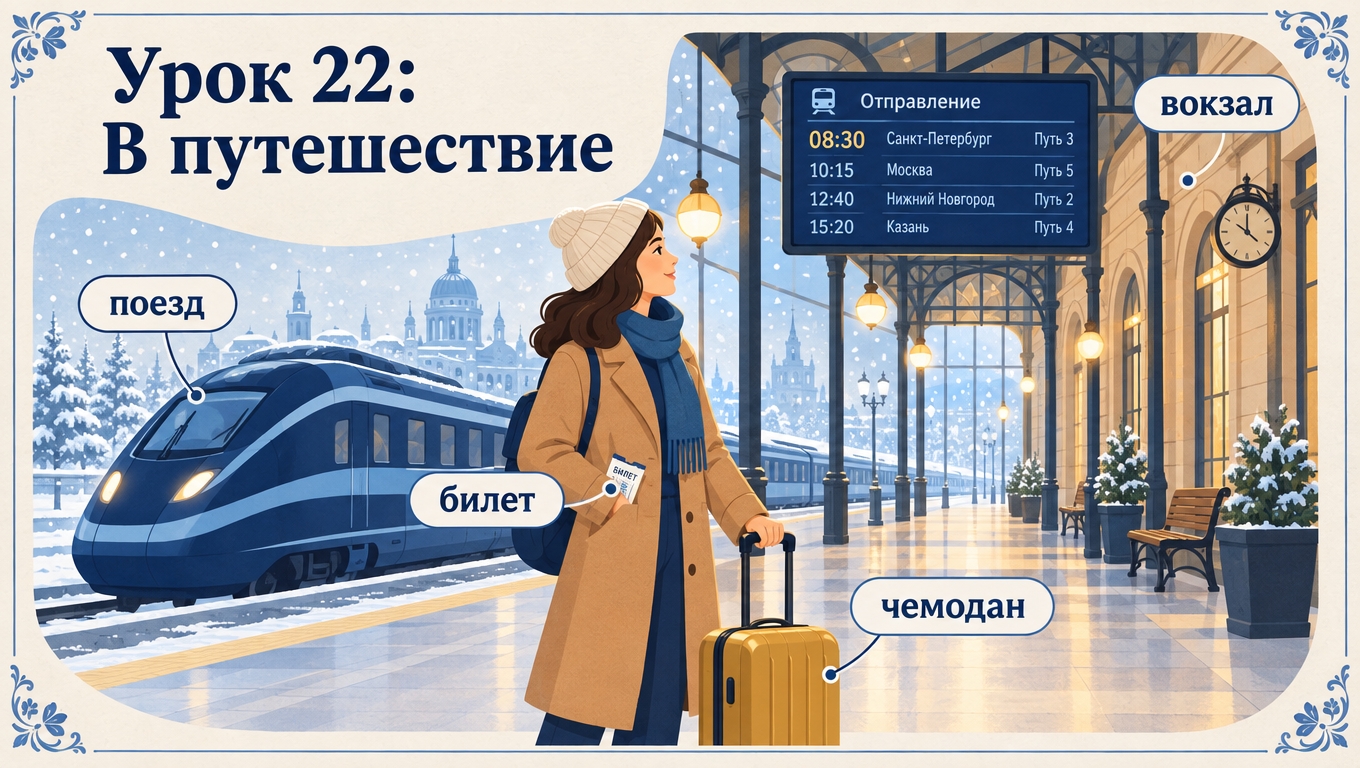
Everything the journey throws at you, in Russian: buying tickets, checking into a hotel, shopping for clothes and handling an emergency — eight real-life scenarios built entirely from the cases, aspects and imperatives you already own, plus the fixed chunks that get you a room, a receipt and, if it comes to it, help.
⏱ About 60 minutes24 phrases33 exercises
What you will learn
Handle the whole journey in Russian — buy a ticket, name the destination with до + genitive, and find your gate, your floor and the way out
Check into a hotel: say you have a booking, ask whether breakfast is included and find out when check-out is
Shop with confidence — ask for a size, find the fitting room, pay by card or in cash, ask for the receipt and make a return
Summon help in an emergency with the right case after each verb: вызовите + accusative, помогите + dative
Report a loss with the correct gendered past and the reflexive -ся: япотерял / япотерялась, багажпотерялся
Recognise and reuse the fixed chunks забронирован, включён and нужен / нужна without rebuilding them from grammar
Quick review
Say these aloud before you start. They come from earlier lessons.
Я живу в Москве.I live in Moscow.Listen in Russian:Slow in Russian:Я живу в Москве.
Сколько это стоит?How much is this?Listen in Russian:Slow in Russian:Сколько это стоит?
Я плачу картой.I pay by card.Listen in Russian:Slow in Russian:Я плачу картой.
Мне нужно к врачу.I need to get to the doctor.Listen in Russian:Slow in Russian:Мне нужно к врачу.
Помогите мне, пожалуйста.Help me, please.Listen in Russian:Slow in Russian:Помогите мне, пожалуйста.
Где метро?Where is the metro?Listen in Russian:Slow in Russian:Где метро?
Theory
Getting around: до, в and на on the road
A ticket names where it takes you in one of two ways, and both are cases you already own. The far endpoint of the journey uses до + genitive — билетдоМосквы, билетдоПитера — exactly the до of Lesson 8 (довокзала, доостановки). The direction sense uses в + accusative, the "куда?" of Lesson 6 — билетвМоскву, рейсвЛондон. The two overlap so much that at a ticket window either is fine; до simply stresses the distance covered.
The thing you travel by, or the event you are ticketed for, takes на + accusative: билетнапоезд, билетнасамолёт, посадканарейс. That is the same на you met for transport in Lesson 7 (ехатьнаавтобусе), here in its direction form. And the floor of a hotel room uses на + prepositional, the "где?" of Lesson 5: мойномернапятомэтаже.
Everything else in this lesson is vocabulary dropped into frames you have been building since Lesson 5. рейс takes a plain number in the nominative (рейсномерсемь); выход is any way out and, at an airport, the gate as well (выходвгород, выходнапосадку). Learn the preposition with the noun and the whole journey follows.
Билет до Москвы, пожалуйста.A ticket to Moscow, please.Listen in Russian:Slow in Russian:Билет до Москвы, пожалуйста.
Рейс номер семь, посадка в два часа.Flight number seven, boarding at two o’clock.Listen in Russian:Slow in Russian:Рейс номер семь, посадка в два часа.
Мой номер на пятом этаже.My room is on the fifth floor.Listen in Russian:Slow in Russian:Мой номер на пятом этаже.
Выход в город — там.The way out into the city is over there.Listen in Russian:Slow in Russian:Выход в город — там.
Chunks you buy whole: забронирован, включён, нужен
Two of the most useful hotel sentences contain a form this course never asks you to build. «Уменязабронированномер» — I have a room booked — and «Завтраквключён?» — is breakfast included? The words забронирован and включён are short passive forms; you will not conjugate them, and you do not need to. Buy them whole, as single words, and use them with the noun they agree with.
They do agree, though, and that part you already know: a short form matches the gender of its noun. забронирован and включён are masculine because номер and завтрак are masculine; with a feminine noun the ending becomes -а (нужнапомощь, not нуженпомощь). The pattern is the short-adjective agreement of Lesson 12 doing its ordinary job.
Be honest with yourself about the level here: these participles sit above A1, and a beginner is not expected to produce them from a rule. That is precisely why they are taught as fixed chunks in this Expansion lesson — you recognise and reuse them, and the grammar of how they were formed can wait. The same goes for the у + genitive frame that carries half the lesson: уменязабронированномер, уменябронь, увасестьэтотразмер.
У меня забронирован номер.I have a room booked.Listen in Russian:Slow in Russian:У меня забронирован номер.
Завтрак включён?Is breakfast included?Listen in Russian:Slow in Russian:Завтрак включён?
У меня бронь на две ночи.I have a reservation for two nights.Listen in Russian:Slow in Russian:У меня бронь на две ночи.
Мне нужен чек, пожалуйста.I need a receipt, please.Listen in Russian:Slow in Russian:Мне нужен чек, пожалуйста.
Agreement you already own: sizes, payment, help
Shopping reuses three things and adds almost nothing. Sizes are plain numbers, so «размерсороквосемь» needs no new grammar; asking whether one exists is the у + genitive existence frame of Lesson 4, «Увасестьэтотразмер?», where этот and размер are accusative but, being inanimate, look just like the nominative. The fitting room is примерочная — an adjective standing alone for примерочнаякомната, the way русская stands for a Russian woman in Lesson 3.
Paying is the instrumental of means you drilled in Lesson 10, with no preposition: картой, наличными. The till or ticket window is касса, and the receipt is чек — ask for it, because a return usually hangs on it. The sign you will read is «Возвраттолькосчеком», where с + instrumental is the "with" of Lesson 10.
Asking for help is government under pressure, so get the cases straight now. вызвать takes the accusative for the thing called — вызовитеполицию, вызовитескорую, вызовитетакси — and can add a dative for the person it is called for: вызовитемневрача. помогать, by contrast, takes the dative for the person helped: помогитемне, never *помогитеменя. The two verbs sit side by side in this lesson precisely because their cases are opposite.
У вас есть этот размер?Do you have this size?Listen in Russian:Slow in Russian:У вас есть этот размер?
Оплата картой или наличными?Payment by card or in cash?Listen in Russian:Slow in Russian:Оплата картой или наличными?
Вызовите скорую!Call an ambulance!Listen in Russian:Slow in Russian:Вызовите скорую!
Помогите мне, пожалуйста.Help me, please.Listen in Russian:Slow in Russian:Помогите мне, пожалуйста.
Reporting what happened: the gendered past and -ся
When something goes wrong you report it in the past, and the Russian past carries gender, not person (Lesson 2): -л for a man, -ла for a woman, -ли for a group. So a man says «Япотерялпаспорт» and a woman says «Япотерялапаспорт» — the verb tells the listener who is speaking. потерять is perfective, which is right here: you are reporting a single completed mishap, not a habit.
Add the reflexive -ся of Lesson 18 and the verb turns round onto its subject: потерять "to lose something" becomes потеряться "to lose yourself, to get lost". A man says «Япотерялся», a woman «Япотерялась». The same -ся lets you say the luggage went missing without blaming anyone: «Мойбагажпотерялся», with the verb singular because багаж is grammatically singular even for ten suitcases.
These frames, plus «Гдепосольство?» and «Мненужнапомощь», cover almost every emergency a traveller meets. From any phone in Russia, 112 reaches the emergency services. You do not need new grammar to be understood in a crisis — you need the right case after the right verb, and the right gender ending on the past.
Я потерял паспорт.I have lost my passport. (said by a man)Listen in Russian:Slow in Russian:Я потерял паспорт.
Я потерялась.I’m lost. (said by a woman)Listen in Russian:Slow in Russian:Я потерялась.
Мой багаж потерялся.My luggage has gone missing.Listen in Russian:Slow in Russian:Мой багаж потерялся.
Где посольство?Where is the embassy?Listen in Russian:Slow in Russian:Где посольство?
Destination and vehicle — which preposition, which case
Form
биле́т (ticket)
рейс (flight)
поса́дка (boarding)
до + Genitive — as far as
биле́тдоМосквы́
рейсдоПи́тера
—
в + Accusative — to a city
биле́твМоскву́
рейсвЛо́ндон
—
на + Accusative — for the vehicle / flight
биле́тнапо́езд
биле́тнарейсно́мерсемь
поса́дканарейс
A ticket names its endpoint with до + genitive (the distance covered) or в + accusative (the direction) — both correct, and both cases you already own from Lessons 6 and 8. The vehicle or the flight you are ticketed for takes на + accusative, the direction form of the transport на of Lesson 7. посадка always takes на: посадканарейс.
нужный in the short form — it agrees with the thing needed
Form
Masculine
Feminine
Neuter
Plural
the short adjective
ну́жен
нужна́
ну́жно
ну́жны
in a sentence
Мнену́женчек
Мненужна́по́мощь
Мнену́жновре́мя
Мнену́жныде́ньги
нужный shortens to нужен / нужна / нужно / нужны, agreeing in gender and number with the thing needed, while the person who needs it stands in the dative (мне, вам). The same agreement runs through the hotel chunks: забронированномер, включёнзавтрак, but нужнапомощь — all learnt whole.
Asking for help — the case after each verb
Form
вы́звать + Accusative (call something)
помога́ть + Dative (help someone)
the cry for help
Вы́зовитеполи́цию!
Помоги́темне!
for another person
Вы́зовитеему́врача́
Помоги́теей, пожа́луйста
what you need
Вы́зовитеско́рую!
Мненужна́по́мощь
вызвать governs the accusative — the thing called: полицию, скорую, врача — and adds a dative for the person it is called for: вызовитеемуврача, вызовитемнетакси. помогать governs the dative — the person helped: помогитемне, помогитеей. Crossing them (помогитеменя) is the classic mistake; the two verbs sit together in this lesson because their cases are opposite.
Vocabulary
Learn each word with its stress mark and its pronunciation. Nouns are given with their gender, animacy and their full six-case declension; verbs are given with their aspect and, where one exists, their partner verb.
Russian
English
Gender / aspect
Pronunciation
Audio
биле́тmasculine · inanimate
ticket
masculine · inanimate
/bʲɪˈlʲetʲ/bih-LYET
Listen in Russian:Slow in Russian:билет
рейсmasculine · inanimate
flight; scheduled service (of a plane, bus or ship)
Full six-case declension of the 29 nouns in this lesson
Each case is listed with the question word that selects it. Find the question you are answering and the ending follows.
Singular
Form
биле́т (m)
рейс (m)
бага́ж (m)
поса́дка (f)
вы́ход (m)
па́спорт (m)
ви́за (f)
тамо́жня (f)
грани́ца (f)
но́мер (m)
бронь (f)
эта́ж (m)
разме́р (m)
приме́рочная (f)
ка́сса (f)
чек (m)
возвра́т (m)
поли́ция (f)
ско́рая (f)
пожа́р (m)
посо́льство (n)
по́мощь (f)
гости́ница (f)
вокза́л (m)
аэропо́рт (m)
ключ (m)
за́втрак (m)
ка́рта (f)
на́личные
nom · Кто? Что?
биле́т
рейс
бага́ж
поса́дка
вы́ход
па́спорт
ви́за
тамо́жня
грани́ца
но́мер
бронь
эта́ж
разме́р
приме́рочная
ка́сса
чек
возвра́т
поли́ция
ско́рая
пожа́р
посо́льство
по́мощь
гостиница
вокзал
аэропорт
ключ
за́втрак
ка́рта
—
gen · Кого? Чего?
биле́та
ре́йса
багажа́
поса́дки
вы́хода
па́спорта
ви́зы
тамо́жни
грани́цы
но́мера
бро́ни
этажа́
разме́ра
приме́рочной
ка́ссы
че́ка
возвра́та
поли́ции
ско́рой
пожа́ра
посо́льства
по́мощи
гостиницы
вокзала
аэропорта
ключа́
за́втрака
ка́рты
—
dat · Кому? Чему?
биле́ту
ре́йсу
багажу́
поса́дке
вы́ходу
па́спорту
ви́зе
тамо́жне
грани́це
но́меру
бро́ни
этажу́
разме́ру
приме́рочной
ка́ссе
че́ку
возвра́ту
поли́ции
ско́рой
пожа́ру
посо́льству
по́мощи
гостинице
вокзалу
аэропорту
ключу́
за́втраку
ка́рте
—
acc · Кого? Что?
биле́т
рейс
бага́ж
поса́дку
вы́ход
па́спорт
ви́зу
тамо́жню
грани́цу
но́мер
бронь
эта́ж
разме́р
приме́рочную
ка́ссу
чек
возвра́т
поли́цию
ско́рую
пожа́р
посо́льство
по́мощь
гостиницу
вокзал
аэропорт
ключ
за́втрак
ка́рту
—
instr · Кем? Чем?
биле́том
ре́йсом
багажо́м
поса́дкой
вы́ходом
па́спортом
ви́зой
тамо́жней
грани́цой
но́мером
бро́нью
этажо́м
разме́ром
приме́рочной
ка́ссой
че́ком
возвра́том
поли́цией
ско́рой
пожа́ром
посо́льством
по́мощью
гостиницой
вокзалом
аэропортом
ключо́м
за́втраком
ка́ртой
—
prep · Оком? Очём?
биле́те
ре́йсе
багаже́
поса́дке
вы́ходе
па́спорте
ви́зе
тамо́жне
грани́це
но́мере
бро́ни
этаже́
разме́ре
приме́рочной
ка́ссе
че́ке
возвра́те
поли́ции
ско́рой
пожа́ре
посо́льстве
по́мощи
гостинице
вокзале
аэропорте
ключе́
за́втраке
ка́рте
—
Plural
Form
биле́т (m)
рейс (m)
бага́ж (m)
поса́дка (f)
вы́ход (m)
па́спорт (m)
ви́за (f)
тамо́жня (f)
грани́ца (f)
но́мер (m)
бронь (f)
эта́ж (m)
разме́р (m)
приме́рочная (f)
ка́сса (f)
чек (m)
возвра́т (m)
поли́ция (f)
ско́рая (f)
пожа́р (m)
посо́льство (n)
по́мощь (f)
гости́ница (f)
вокза́л (m)
аэропо́рт (m)
ключ (m)
за́втрак (m)
ка́рта (f)
на́личные
nom · Кто? Что?
биле́ты
ре́йсы
—
поса́дки
вы́ходы
па́спорта
ви́зы
тамо́жни
грани́цы
номера́
бро́ни
этажи́
разме́ры
приме́рочные
ка́ссы
че́ки
возвра́ты
поли́ции
ско́рые
пожа́ры
посо́льства
по́мощи
гостиницы
вокзалы
аэропорты
ключи́
за́втраки
ка́рты
на́личные
gen · Кого? Чего?
биле́тов
ре́йсов
—
поса́док
вы́ходов
па́спортов
виз
тамо́жен
грани́ц
номеро́в
бро́ней
этаже́й
разме́ров
приме́рочных
касс
че́ков
возвра́тов
поли́ций
ско́рых
пожа́ров
посо́льств
по́мощей
гостиниц
вокзалов
аэропортов
ключе́й
за́втраков
карт
на́личных
dat · Кому? Чему?
биле́там
ре́йсам
—
поса́дкам
вы́ходам
па́спортам
ви́зам
тамо́жнам
грани́цам
номера́м
бро́ням
этажа́м
разме́рам
приме́рочным
ка́ссам
че́кам
возвра́там
поли́циям
ско́рым
пожа́рам
посо́льствам
по́мощам
гостиницам
вокзалам
аэропортам
ключа́м
за́втракам
ка́ртам
на́личным
acc · Кого? Что?
биле́ты
ре́йсы
—
поса́дки
вы́ходы
па́спорта
ви́зы
тамо́жни
грани́цы
номера́
бро́ни
этажи́
разме́ры
приме́рочные
ка́ссы
че́ки
возвра́ты
поли́ции
ско́рые
пожа́ры
посо́льства
по́мощи
гостиницы
вокзалы
аэропорты
ключи́
за́втраки
ка́рты
на́личные
instr · Кем? Чем?
биле́тами
ре́йсами
—
поса́дками
вы́ходами
па́спортами
ви́зами
тамо́жнами
грани́цами
номера́ми
бро́нями
этажа́ми
разме́рами
приме́рочными
ка́ссами
че́ками
возвра́тами
поли́циями
ско́рыми
пожа́рами
посо́льствами
по́мощами
гостиницами
вокзалами
аэропортами
ключа́ми
за́втраками
ка́ртами
на́личными
prep · Оком? Очём?
биле́тах
ре́йсах
—
поса́дках
вы́ходах
па́спортах
ви́зах
тамо́жнах
грани́цах
номера́х
бро́нях
этажа́х
разме́рах
приме́рочных
ка́ссах
че́ках
возвра́тах
поли́циях
ско́рых
пожа́рах
посо́льствах
по́мощах
гостиницах
вокзалах
аэропортах
ключа́х
за́втраках
ка́ртах
на́личных
A dash means the form does not exist. Plural-only nouns such as де́ньги and су́тки have no singular, and indeclinable nouns such as ко́фе and метро́ keep one form in all six cases.
Ready-to-use phrases
Биле́т до Москвы́, пожа́луйста.
A ticket to Moscow, please.
IPA/bʲɪˈlʲet də mɐˈskvɨ pɐˈʐalujstə/
Say itbih-LYET duh muh-SKVIH, puh-ZHAH-luy-stuh.
до + genitive names the destination of a ticket: билетдоМосквы, билетдоПитера. The genitive Москвы́ throws its stress onto the ending, as вода does (Lesson 8). You can also say билетвМоскву (в + accusative); both are normal, and до is the one you will hear most at a ticket window.
traveltraveltransportgenitive
Listen in Russian:Slow in Russian:Билет до Москвы, пожалуйста.
Рейс но́мер семь, поса́дка в два часа́.
Flight number seven, boarding at two o’clock.
IPA/rʲejs ˈnomʲɪr sʲemʲ pɐˈsatkə v dvə tɕɪˈsa/
Say itREYS NOH-mihr SYEM, puh-SAHT-kuh v DVAH chuh-SAH.
A departure-board sentence. рейс takes a plain number in the nominative — рейсномерсемь, not a case ending. посадка covers both boarding and landing; here, boarding. After a number, час goes to the genitive singular: двачаса́, with the stress on the ending, exactly as in Lesson 11.
traveltraveltransporttime
Listen in Russian:Slow in Russian:Рейс номер семь, посадка в два часа.
Где па́спортный контро́ль?
Where is passport control?
IPA/ɡdʲe ˈpaspərtɨj kənˈtrolʲ/
Say itguh-DYEH PAH-spuhrt-niy kun-TRYOL?
The fixed name for the border desk; паспортныйконтроль is a single idea, "passport control". The adjective паспортный is built straight off паспорт. Таможенныйконтроль is the customs desk, and both sit between you and the выходвгород.
traveltravelplacequestions
Listen in Russian:Slow in Russian:Где паспортный контроль?
У меня́ то́лько ручна́я кладь.
I only have hand luggage.
IPA/ʊ mʲɪˈnʲa ˈtolʲkə rʊtɕˈnajə klatʲ/
Say itoo mih-NYAH TOHL-kuh roo-CHNAH-yuh KLYAT.
The у + genitive possession frame of Lesson 4: уменя (есть) …, with есть understood. ручнаякладь — literally "hand freight" — is the fixed term for cabin baggage; кладь is feminine, so ручная agrees. Say this when you have nothing to check in.
traveltraveltransportpossession
Listen in Russian:Slow in Russian:У меня только ручная кладь.
Мой бага́ж потеря́лся.
My luggage has gone missing.
IPA/moj bɐˈɡaʂ pʲɪtʲɪˈralsə/
Say itMOY buh-GAHSH puh-tih-RYAHL-syuh.
потеряться is потерять + the -ся of Lesson 18, turned round onto the subject: the luggage "lost itself". багаж stays grammatically singular whether it is one case or five, so the verb is потерялся, not *потерялись.
traveltravelemergencyreflexives
Listen in Russian:Slow in Russian:Мой багаж потерялся.
Ско́лько сто́ит биле́т до Пи́тера?
How much is a ticket to Saint Petersburg?
IPA/ˈskolʲkə ˈstoɪt bʲɪˈlʲet də ˈpʲitʲɪrə/
Say itSKOHL-kuh STOH-it bih-LYET duh PEE-tih-ruh?
The price question of Lesson 11 pointed at a ticket. стоит keeps its stress on the first syllable here (сто́ит), unlike the plural стоя́т. Питер is the everyday spoken name for Санкт-Петербург; both take до + genitive.
traveltraveltransportnumbers
Listen in Russian:Slow in Russian:Сколько стоит билет до Питера?
Вы́ход в го́род — там.
The way out into the city is over there.
IPA/ˈvɨxət v ˈɡorət tam/
Say itVIH-khut v GOH-rut — TAHM.
выходвгород is the signed route from arrivals out into the city — literally "exit into town". город after в is the accusative, which for an inanimate masculine looks just like the nominative, so the ending gives nothing away; the preposition and the question word (куда?) do the work.
traveltravelplacecity
Listen in Russian:Slow in Russian:Выход в город — там.
У меня́ заброниро́ван но́мер.
I have a room booked.
IPA/ʊ mʲɪˈnʲa zəbrənʲɪˈrovən ˈnomʲɪr/
Say itoo mih-NYAH zuh-bruh-nih-ROH-vun NOH-mihr.
The single most useful hotel sentence. забронирован is the short passive participle of забронировать — learnt whole, not built, and it agrees with the masculine номер. The у + genitive frame (Lesson 4) again: "at me there is a booked room".
traveltravelsurvival
Listen in Russian:Slow in Russian:У меня забронирован номер.
Вот мой па́спорт.
Here is my passport.
IPA/vot moj ˈpaspərt/
Say itVOHT MOY PAH-spuhrt.
вот hands something over — "here is / here you are" — and takes the nominative, not a case ending. At check-in the receptionist asks for the паспорт and you hand it across with this line.
traveltravelobjects
Listen in Russian:Slow in Russian:Вот мой паспорт.
За́втрак включён?
Is breakfast included?
IPA/ˈzaftrək fklʲʊˈtɕon/
Say itZAHF-truk fuh-klyoo-CHOHN?
включён is another short participle, masculine to agree with завтрак, and its ё is always stressed, so it carries no acute (§13). Intonation alone makes it a question (ИК-3): the voice rises sharply on включён.
traveltravelfoodquestions
Listen in Russian:Slow in Russian:Завтрак включён?
Мой но́мер на пя́том этаже́.
My room is on the fifth floor.
IPA/moj ˈnomʲɪr nə pʲɪˈtom ɪtɐˈʐɨ/
Say itMOY NOH-mihr nuh PYAH-tum ih-tuh-ZHEH.
на + prepositional for a floor, the "where?" case of Lesson 5. The ordinal пятый agrees with the masculine этаж in the prepositional: напятомэтаже. этаж moves its stress onto the ending in every oblique form — этаже́ — the same pattern as стол → столе́.
traveltravelplacenumbers
Listen in Russian:Slow in Russian:Мой номер на пятом этаже.
Да́йте, пожа́луйста, ключ.
The key, please.
IPA/ˈdajtʲə pɐˈʐalujstə klʲʉtɕ/
Say itDAY-tyuh, puh-ZHAH-luy-stuh, KLYOOCH.
дайте is the вы imperative of дать (Lesson 13), the polite way to ask for something by name. ключ is the accusative here, which for an inanimate masculine equals the nominative. пожалуйста, placed before the noun, softens the request.
traveltravelpolitenessimperative
Listen in Russian:Slow in Russian:Дайте, пожалуйста, ключ.
Во ско́лько вы́езд?
What time is check-out?
IPA/və ˈskolʲkə ˈvɨjɪst/
Say itvuh SKOHL-kuh VIH-yist?
восколько — "at what time" — is the question frame from Lesson 11; во is the lengthened form of в used before the ск- cluster. выезд is the noun "departure / check-out", built on вы- + ездить. The answer uses the same frame: выездводиннадцать.
traveltraveltimequestions
Listen in Russian:Slow in Russian:Во сколько выезд?
У вас есть э́тот разме́р?
Do you have this size?
IPA/ʊ vas jesʲtʲ ˈetət rəzˈmʲer/
Say itoo VAHS YEST EH-tut ruh-ZMYER?
у + genitive for what a shop has in stock (Lesson 4): "at you, is there this size?". этот and размер are both accusative, matching the nominative because they are inanimate. The reply is often just the number: сороквосемь, сорокдва.
neutralshoppingpossessionquestions
Listen in Russian:Slow in Russian:У вас есть этот размер?
Где приме́рочная?
Where is the fitting room?
IPA/ɡdʲe prʲɪˈmʲerətɕnəjə/
Say itguh-DYEH prih-MYEH-ruh-chnuh-yuh?
примерочная is an adjective standing alone for примерочнаякомната, exactly like русская for a Russian woman in Lesson 3. From примерить, "to try on", so «Можнопримерить?» — "may I try it on?" — is built from the same root.
neutralshoppingplacequestions
Listen in Russian:Slow in Russian:Где примерочная?
Опла́та ка́ртой и́ли на́личными?
Payment by card or in cash?
IPA/ɐˈplatə ˈkartəj ˈilʲɪ ˈnalʲɪtɕnɨmʲɪ/
Say ituh-PLAH-tuh KAHR-tuy EE-lih NAH-lih-chnih-mih?
The cashier’s question, and both means of payment are in the instrumental of manner (Lesson 10): картой, наличными, with no preposition. наличные is really an adjective ("cash [money]"), so it declines in the plural only. The stress follows Lesson 11’s на́личные.
neutralshoppinginstrumental
Listen in Russian:Slow in Russian:Оплата картой или наличными?
Мне ну́жен чек, пожа́луйста.
I need a receipt, please.
IPA/mnʲe ˈnuʐɨn tɕek pɐˈʐalujstə/
Say itmuh-NYEH NOO-zhin CHEK, puh-ZHAH-luy-stuh.
нужен is the short adjective that goes with мне (Lesson 9), and it agrees in gender with the thing needed: нуженчек (masc.), нужнапомощь (fem.). Without a чек a возврат is usually impossible, so ask for it before you leave the till.
politeshoppingobjectspoliteness
Listen in Russian:Slow in Russian:Мне нужен чек, пожалуйста.
Я хочу́ сде́лать возвра́т.
I would like to make a return.
IPA/jə xɐˈtɕu ˈzdʲelətʲ vəzˈvrat/
Say itYAH khuh-CHOO ZDYEH-lyut vuz-VRAHT.
The aspect pair of Lesson 13 in a shop: хочу (imperfective, the standing wish) + сделать (perfective, the single completed act). возврат is the noun behind вернуть; the sign you will read is «Возвраттолькосчеком».
neutralshoppingaspectsurvival
Listen in Russian:Slow in Russian:Я хочу сделать возврат.
Помоги́те!
Help!
IPA/pəmɐˈɡʲitʲə/
Say itpuh-muh-GEE-tyuh!
The вы imperative of помогать used as a bare cry for help — the same word Lesson 16 gave you, now heading the emergency set. One word, loud, understood everywhere. To say who needs it, add the dative: помогитемне, помогитеему.
emergencyemergencysurvival
Listen in Russian:Slow in Russian:Помогите!
Вы́зовите поли́цию!
Call the police!
IPA/ˈvɨzvətʲə pəˈlʲitsɨjʊ/
Say itVIH-zuh-vih-tyuh puh-LEE-tsih-yoo!
вызвать governs the accusative, so the -ия noun полиция becomes полицию (Lesson 22 vocabulary, -ия → -ию). вызовите is the вы imperative; the present stem is вызов-, off звать, which is why it is not *вызавите.
emergencyemergencyimperativecity
Listen in Russian:Slow in Russian:Вызовите полицию!
Вы́зовите ско́рую!
Call an ambulance!
IPA/ˈvɨzvətʲə ˈskorʊjʊ/
Say itVIH-zuh-vih-tyuh SKOH-roo-yoo!
скорая is скораяпомощь with the noun dropped, so it declines as a feminine adjective: the accusative is скорую. «Вызовитескоруюпомощь» is correct but twice as long — in an emergency you want the short one. The number is 112 from any phone.
emergencyemergencyhealthimperative
Listen in Russian:Slow in Russian:Вызовите скорую!
Я потеря́лся.
I’m lost. (said by a man)
IPA/jə pʲɪtʲɪˈralsə/
Say itYAH puh-tih-RYAHL-syuh.
потеряться, "to lose oneself", is how Russian says "to be lost". The past carries gender, not person: a man says япотерялся, a woman япотерялась. Add где and a place to say where you have lost your way: япотерялсявгороде.
emergencyemergencyreflexives
Listen in Russian:Slow in Russian:Я потерялся.
Где посо́льство?
Where is the embassy?
IPA/ɡdʲe pɐˈsolʲstvə/
Say itguh-DYEH puh-SOHL-stvuh?
посольство is neuter, so the zero-copula "where is" question needs no verb (Lesson 1): где + nominative. A consulate is консульство, the same shape. This is the question that solves a lost-passport evening.
emergencyemergencyplacequestions
Listen in Russian:Slow in Russian:Где посольство?
Мне нужна́ по́мощь.
I need help.
IPA/mnʲe nʊˈzna ˈpoməɕː/
Say itmuh-NYEH noozh-NAH POH-mushch.
The dative + short-adjective state of Lesson 9: literally "to me help is needed". нужна agrees in the feminine with помощь. помощь is third declension, like ночь, and its verb помогать takes the dative — so "help me" is помогитемне.
emergencyemergencyimpersonalhealth
Listen in Russian:Slow in Russian:Мне нужна помощь.
Dialogues
Checking into a hotel in Moscow
Daniel Nowak arrives in the evening. He and the receptionist are strangers, so both use вы and the polite forms.
Daniel
Здравствуйте! У меня забронирован номер.
Hello! I have a room booked.
Listen in Russian:Slow in Russian:Здравствуйте! У меня забронирован номер.
Receptionist
Добрый вечер! Ваша фамилия, пожалуйста.
Good evening! Your surname, please.
Listen in Russian:Slow in Russian:Добрый вечер! Ваша фамилия, пожалуйста.
Daniel
Новак. У меня бронь на две ночи.
Nowak. I have a reservation for two nights.
Listen in Russian:Slow in Russian:Новак. У меня бронь на две ночи.
Receptionist
Да, вот ваш ключ. Номер триста пять, на третьем этаже.
Yes, here is your key. Room three hundred and five, on the third floor.
Listen in Russian:Slow in Russian:Да, вот ваш ключ. Номер триста пять, на третьем этаже.
Daniel
Спасибо. Завтрак включён?
Thank you. Is breakfast included?
Listen in Russian:Slow in Russian:Спасибо. Завтрак включён?
Receptionist
Да, завтрак с семи до десяти.
Yes, breakfast is from seven until ten.
Listen in Russian:Slow in Russian:Да, завтрак с семи до десяти.
Daniel
А во сколько выезд?
And what time is check-out?
Listen in Russian:Slow in Russian:А во сколько выезд?
Receptionist
Выезд в одиннадцать. Спокойной ночи!
Check-out is at eleven. Good night!
Listen in Russian:Slow in Russian:Выезд в одиннадцать. Спокойной ночи!
Daniel
Спасибо большое!
Thank you very much!
Listen in Russian:Slow in Russian:Спасибо большое!
Buying a ticket at the station in Kazan
Leila buys a train ticket. The cashier is a stranger, so they use вы throughout.
Leila
Здравствуйте! Билет до Москвы, пожалуйста.
Hello! A ticket to Moscow, please.
Listen in Russian:Slow in Russian:Здравствуйте! Билет до Москвы, пожалуйста.
Cashier
На поезд или на самолёт?
By train or by plane?
Listen in Russian:Slow in Russian:На поезд или на самолёт?
Leila
На поезд. Сколько стоит билет?
By train. How much is the ticket?
Listen in Russian:Slow in Russian:На поезд. Сколько стоит билет?
Cashier
Две тысячи рублей. Поезд в семь часов.
Two thousand roubles. The train is at seven o’clock.
Listen in Russian:Slow in Russian:Две тысячи рублей. Поезд в семь часов.
Leila
Хорошо, я беру. Вот деньги.
All right, I’ll take it. Here is the money.
Listen in Russian:Slow in Russian:Хорошо, я беру. Вот деньги.
Cashier
Спасибо. Ваш билет и чек. Посадка в семь, выход номер три.
Thank you. Your ticket and receipt. Boarding at seven, gate number three.
Listen in Russian:Slow in Russian:Спасибо. Ваш билет и чек. Посадка в семь, выход номер три.
Leila
Спасибо большое!
Thank you very much!
Listen in Russian:Slow in Russian:Спасибо большое!
A lost passport in the city
Sofia has lost her passport. Igor, a passer-by, helps her. They are strangers, so they use вы.
Sofia
Помогите! Я потеряла паспорт!
Help! I have lost my passport!
Listen in Russian:Slow in Russian:Помогите! Я потеряла паспорт!
Igor
Вы потеряли паспорт? Где вы были?
You lost your passport? Where were you?
Listen in Russian:Slow in Russian:Вы потеряли паспорт? Где вы были?
Sofia
Не знаю. Я была в метро и на вокзале.
I don’t know. I was in the metro and at the station.
Listen in Russian:Slow in Russian:Не знаю. Я была в метро и на вокзале.
Igor
Это проблема. Вам нужно в посольство.
That’s a problem. You need to get to the embassy.
Listen in Russian:Slow in Russian:Это проблема. Вам нужно в посольство.
Sofia
А где посольство?
And where is the embassy?
Listen in Russian:Slow in Russian:А где посольство?
Igor
Вот, на этой улице, рядом с банком.
Here, on this street, next to the bank.
Listen in Russian:Slow in Russian:Вот, на этой улице, рядом с банком.
Sofia
Спасибо! Вызовите полицию, пожалуйста.
Thank you! Call the police, please.
Listen in Russian:Slow in Russian:Спасибо! Вызовите полицию, пожалуйста.
Igor
Хорошо. Вот мой телефон.
All right. Here is my phone.
Listen in Russian:Slow in Russian:Хорошо. Вот мой телефон.
Exercises
Answer actively — try to recall the Russian before you look at any hint.
Multiple ChoiceExercise 1
Choose the correct meaning.
What does «багаж» mean?
Translate To EnglishExercise 2
Translate into English.
Вызовитескорую!
Translate To RussianExercise 3
Translate into Russian.
Help!
Multiple ChoiceExercise 4
Choose the correct answer.
«примерочная» is the place where you…
Case ChoiceExercise 5
Choose the correct form of полиция.
Вызовите ___ ! (полиция)
Fill GapExercise 6
Fill the gap with one word.
Уменя ___ надвеночи. (reservation)
Stress ChoiceExercise 7
Choose the correctly stressed form.
Where does the stress fall in «багаж»?
Translate To RussianExercise 8
Translate into Russian.
Where is the fitting room?
Pronoun ChoiceExercise 9
Choose the correct form of я.
Помогите ___ ! (me)
Multiple ChoiceExercise 10
Choose the correct answer.
At a hotel, «выезд» means…
Fill GapExercise 11
Fill the gap with the prepositional singular of этаж.
Мойномернапятом ___ . (floor)
Stress ChoiceExercise 12
Choose the correctly stressed form.
Where does the stress fall in «полиция»?
Translate To EnglishExercise 13
Translate into English.
Гдепосольство?
True FalseExercise 14
Answer true or false.
«Вызовитеполицию» means "Call the police".
ConjugationExercise 15
Give the present-tense form for «они».
вызывать — они (present)
Translate To RussianExercise 16
Translate into Russian.
A ticket to Moscow, please.
Case ChoiceExercise 17
Choose the correct form.
Мыедем ___ . (Москва)
Fill GapExercise 18
Fill the gap.
Завтрак ___ ? (included)
Translate To RussianExercise 19
Translate into Russian.
I have lost my passport. (said by a man)
Aspect ChoiceExercise 20
Choose the form that fits the meaning.
Choose the aspect: «Вчерая ___ номер, ивотподтверждение.» — I booked a room, and it is done.
Word OrderExercise 21
Put the words in order.
Build the emergency call: "Call an ambulance!"
Ending ChoiceExercise 22
Choose the ending.
Prepositional singular of «этаж»: наэтаж___
Translate To EnglishExercise 23
Translate into English.
Уменязабронированномер.
Sentence TransformExercise 24
Rewrite as an imperative.
Turn into a polite command (вы): «Явызываютакси.»
Match PairsExercise 25
Pair the words.
Match each Russian word with its meaning.
Fill GapExercise 26
Fill the gap with the instrumental of карта.
Оплата ___ илиналичными? (by card)
Stress ChoiceExercise 27
Choose the correctly stressed form.
Where does the stress fall in «этаж»?
Translate To RussianExercise 28
Translate into Russian.
Where is passport control?
ConjugationExercise 29
Give the future-tense form for «вы».
потерять — вы (future)
Listen And ChooseExercise 30
Play the audio and pick the matching sentence.
Listen and choose what you hear.
Listen And TypeExercise 31
Play the audio and type what you hear.
Listen and type the sentence.
Translate To RussianExercise 32
Translate into Russian.
My room is on the fifth floor, and breakfast is included.
Translate To RussianExercise 33
Translate into Russian.
Call the police — I have lost my passport! (said by a woman)
Speak now
Say each sentence aloud three times — slowly, at normal speed, then from memory. Then run the scenario behind it: change the city, the floor, the item or the emergency and say your own version. If you can get through all six without falling back into English, the travel frames are installed and everything from here is vocabulary.
Билет до Москвы, на поезд, пожалуйста.A ticket to Moscow, by train, please.Listen in Russian:Slow in Russian:Билет до Москвы, на поезд, пожалуйста.
У меня забронирован номер. Завтрак включён?I have a room booked. Is breakfast included?Listen in Russian:Slow in Russian:У меня забронирован номер. Завтрак включён?
У вас есть этот размер? Где примерочная?Do you have this size? Where is the fitting room?Listen in Russian:Slow in Russian:У вас есть этот размер? Где примерочная?
Вызовите, пожалуйста, такси.Call a taxi, please.Listen in Russian:Slow in Russian:Вызовите, пожалуйста, такси.
Я потерял паспорт. Где посольство?I have lost my passport. Where is the embassy?Listen in Russian:Slow in Russian:Я потерял паспорт. Где посольство?
Помогите мне, пожалуйста! Мне нужна помощь.Help me, please! I need help.Listen in Russian:Slow in Russian:Помогите мне, пожалуйста! Мне нужна помощь.
Lesson checkpoint
Before you move on, make sure you can do all of this without looking:
Book a hotel room out loud: say you have a reservation, give your surname, ask which floor your room is on, whether breakfast is included and what time check-out is
Buy a ticket to a city of your choice twice — once with до + genitive, once with в + accusative — and say you are travelling by train
Ask five shop questions without stopping: a size, the fitting room, card or cash, the receipt, and a return
Report three emergencies aloud: a lost passport (with the right gender ending), losing your way, and a call for an ambulance — then check you used the dative after помогите and the accusative after вызовите
Say the whole singular of этаж and багаж out loud and point at the syllable where the stress moves onto the ending
Walk through all eight scenarios — ticket, passport control, check-in, a hotel problem, a taxi, clothes shopping, a return and an emergency — and note which one still makes you hesitate
Remember this
A destination has two shapes: до + genitive names the far endpoint (билетдоМосквы) and в + accusative the direction (билетвМоскву); the vehicle or the flight itself takes на + accusative (билетнапоезд, посадканарейс).
Location is the old question-word machine: Где? — напятомэтаже; Куда? — напятыйэтаж. The ordinal agrees like an adjective, and in Russia the ground floor is первыйэтаж.
The hotel formulas Уменязабронированномер and Завтраквключён? are learnt whole; their everyday twin is Уменяброньнадвеночи, with the third-declension noun бронь.
Means of payment is the bare instrumental with no preposition — картой, наличными — the same case as the tool of Lesson 10, and a return usually needs the receipt: Возвраттолькосчеком.
Emergency frames are government in disguise: помогите + dative (мне, нам, ему), вызовите + accusative (полицию, скорую, такси), and the report itself is a perfective past with a gender ending — япотерял / япотеряла / япотерялся.
Masculine nouns in a sibilant often keep the stem stress in the nominative and throw it onto the ending everywhere else: этаж — этажа, багаж — багажа, exactly like врач — врача and карандаш — карандаша.