The clock in four frames, the seven days and twelve months in lowercase, dates that change case, the two grammars of the weather, and the frequency adverbs that put your whole week on a scale.
⏱ About 55 minutes28 phrases33 exercises
What you will learn
Tell the time four ways — exactly, with четверть, with половина and with безчетверти — and explain why the half and the quarter name the hour that is coming
Name all seven days and all twelve months, write them in lowercase, and put each into its frame: «всреду» (accusative) for days, «виюне» (prepositional) for months
Give today's date with the nominative ordinal — «Сегоднятретьемая» — and say when something happens with the genitive — «пятогомая»
Talk about the weather with both of its grammars: «Идётдождь» for what falls, and the impersonal words ветрено, пасмурно, солнечно, тепло, холодно, жарко for how it feels
Place your own habits on the frequency scale всегда — обычно — часто — иногда — редко — никогда, keeping the double negation that никогда demands
Say when something happens end to end: the clock hour, the day, the month, a span with «с … до …», and repetition with «каждыйдень» and «попятницам»
Quick review
Say these aloud before you start. They come from earlier lessons.
Я живу в Москве.I live in Moscow. (Lesson 5 — в + prepositional for location; this lesson adds в + accusative for time)Listen in Russian:Slow in Russian:Я живу в Москве.
Завтра мы поедем в парк.Tomorrow we will go to the park. (Lesson 15 — the perfective future of motion)Listen in Russian:Slow in Russian:Завтра мы поедем в парк.
У меня нет времени.I don't have time. (Lesson 8 — нет + genitive; время keeps its -мя declension)Listen in Russian:Slow in Russian:У меня нет времени.
Вчера он написал письмо.Yesterday he wrote the letter — and finished it. (Lesson 13 — the perfective past for a result)Listen in Russian:Slow in Russian:Вчера он написал письмо.
Мне холодно.I'm cold. (Lesson 4 — the impersonal state; drop the «мне» and you have this lesson's weather words)Listen in Russian:Slow in Russian:Мне холодно.
Сколько времени ты ждал?How long did you wait? (Lessons 6 and 8 — ждать + accusative, сколько + genitive)Listen in Russian:Slow in Russian:Сколько времени ты ждал?
Theory
Которыйчас? Asking and telling the time
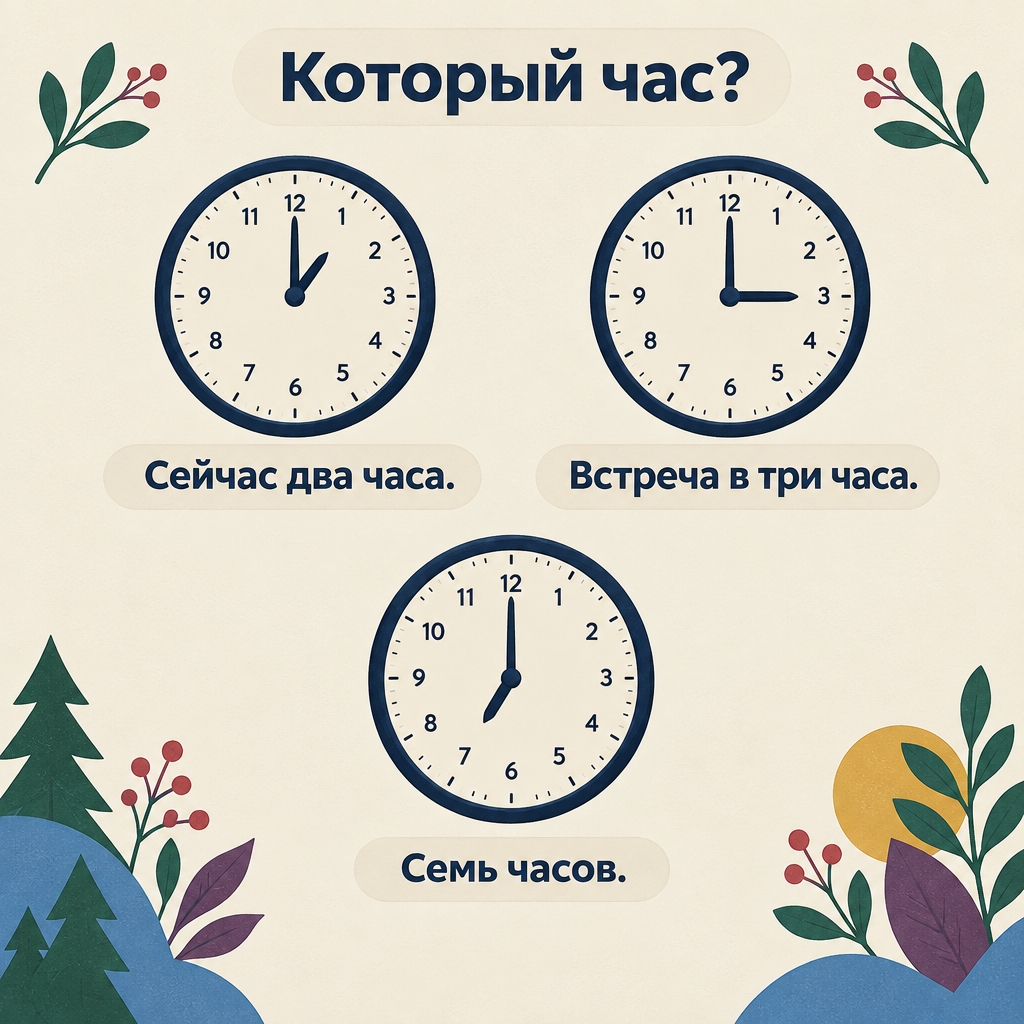
Two questions ask the clock and both are worth knowing: «Которыйчас?» and «Скольковремени?» — the second literally "how much time?". Either gets the same answer, and neither needs a verb. The grammar of the answer you already built in Lesson 11, where numbers were given their government: одинчас, двачаса, тричаса, but пятьчасов. «Сейчастричаса» is pure Lesson 11 arithmetic. Lesson 11 also promised its plural: часы means "hours" and, with no singular of its own, it is the everyday word for a clock or a watch — «Часыпоказываюттричаса», the clock shows three o'clock.
There are four ways to name a moment. The digital way stacks hours and minutes: «Сейчастричасапятнадцатьминут». The other three are shorter and far more common: «четвертьчетвёртого» (a quarter past three), «половиначетвёртого» (half past three) and «безчетвертичетыре» (a quarter to four). Notice what the middle two do: they name the hour that is COMING, in the genitive of its ordinal number. «Половиначетвёртого» is literally "half of the fourth". Once that idea clicks, every half and quarter in Russian stops being a memorised list.
One honest warning. Lesson 11 introduced ordinal numbers in the nominative only, because that is what the A1 standard asks for. Here the ordinals appear in the genitive — четвёртого, шестого, восьмого — and that form belongs to A2. Do not analyse it and do not decline it yourself yet: learn «половиначетвёртого» and «четвертьшестого» as ready-made frames and swap the number in whole.
Который час? — Сейчас три часа.What time is it? — It is three o'clock now.Listen in Russian:Slow in Russian:Который час? — Сейчас три часа.
Сколько времени? — Половина четвёртого.What time is it? — Half past three.Listen in Russian:Slow in Russian:Сколько времени? — Половина четвёртого.
Без четверти пять.A quarter to five (4:45).Listen in Russian:Slow in Russian:Без четверти пять.
Четверть шестого.A quarter past five (5:15).Listen in Russian:Slow in Russian:Четверть шестого.
в + accusative: saying when
Lesson 6 made в + accusative the case of direction: «вМоскву», «наработу». The same preposition and the same case also carry WHEN: «втричаса», «впонедельник», «всреду». If you can already say where you are going, you can say when you are doing it — it is the same machine with a different job.
Two details. Before the cluster вт- the preposition grows a vowel: «вовторник», exactly as «воФранции» would. And adverbs of time need no preposition at all — «сегодня», «завтра», «вчера» (Lesson 2), «утром», «вечером», «ночью» (Lesson 10) stand alone. «Всегодня» is not Russian.
A span of time is «с … до …» with both ends in the genitive, the prepositions of Lesson 8: «сдевятидошести». In everyday speech the numerals inside this frame decline, and declined numerals are genuinely A2 — so take «сдевятидошести» as one frozen chunk for now, and build your own spans later. One more preposition joins the timetable: через + accusative, which Lesson 15 gave you for crossing a street, also crosses time — «черезчас» means "in an hour's time", «Мыедемчерезчас».
В среду я работаю.On Wednesday I work.Listen in Russian:Slow in Russian:В среду я работаю.
Во вторник мы не работаем.On Tuesday we don't work.Listen in Russian:Slow in Russian:Во вторник мы не работаем.
Поезд в семь часов.The train is at seven o'clock.Listen in Russian:Slow in Russian:Поезд в семь часов.
Магазин работает с девяти до шести.The shop is open from nine till six (literally: works).Listen in Russian:Slow in Russian:Магазин работает с девяти до шести.
The calendar: lowercase letters and two different cases
Russian writes days and months with a small letter: понедельник, март — not Понедельник, Март. The week starts on понедельник and ends on воскресенье, whose name means "resurrection". Six of the seven days are transparent compounds — вторник from второй (second), среда the "middle", четверг the fourth, пятница the fifth, суббота the sabbath — and learning them as meanings rather than sounds makes the list stick.
Days and months look alike after в, but they take different cases. The day is accusative — «впятницу», «всреду» — a point you aim at, like a direction. The month is prepositional — «вмае», «воктябре» — a stretch you are inside, like a location (Lesson 5). Only среда shows the case in its ending and in its stress: the nominative is stressed on the ending, the accusative «всреду» on the stem. The rest are inanimate nouns whose accusative equals the nominative, so the case is invisible but real.
Dates come in two shapes. To say what today IS, use the nominative neuter ordinal plus the genitive month: «Сегоднятретьемая». To say WHEN something happens, put the ordinal in the genitive too: «двадцатогомарта». The genitive ordinal is beyond the A1 nominative-only list — as with the clock, learn the two frames whole; they cover almost everything a beginner needs to say about a date.
Какой сегодня день? — Сегодня среда.What day is it today? — It is Wednesday.Listen in Russian:Slow in Russian:Какой сегодня день? — Сегодня среда.
Какая сегодня дата? — Сегодня третье мая.What is the date today? — Today is the third of May.Listen in Russian:Slow in Russian:Какая сегодня дата? — Сегодня третье мая.
Мы едем в мае.We are going in May.Listen in Russian:Slow in Russian:Мы едем в мае.
День рождения мамы — двадцатого марта.Mum's birthday is on the twentieth of March.Listen in Russian:Slow in Russian:День рождения мамы — двадцатого марта.
Seasons and weather: идёт and the impersonal -о
The four seasons are nouns — зима, весна, лето, осень — and Lesson 10 already put their adverbs in your mouth: зимой, весной, летом, осенью. Those adverbs are simply the instrumental case of these nouns, which is why «зимой» answers «when?» all by itself. Use the noun when it is the subject or object of the sentence — «Ялюблюзиму», accusative — and the adverb for the season as a time.
The weather question is «Какаяпогода?», and it is какой's first real workout: the question word agrees with its noun, какая with погода. Russian answers it with two different grammars. For what falls from the sky there is a real sentence: «Идётдождь», «Идётснег» — идёт, "walks", from Lesson 7, plus a noun in the nominative. English says "it rains" with an empty it; Russian names the actual thing that is falling.
For everything else there is no subject and no verb at all: «Ветрено. Пасмурно. Солнечно. Тепло. Холодно. Жарко.» These are the impersonal state words you met in «мнехолодно» (Lesson 4) with the «мне» taken out. In the past add было, in the future будет (Lesson 2): «Вчерабылотепло», «Завтрабудетхолодно». That is the whole weather grammar, and it is enough for any small talk anywhere in Russia.
Какая погода сегодня?What is the weather like today?Listen in Russian:Slow in Russian:Какая погода сегодня?
Идёт дождь, и ветрено.It is raining, and it is windy.Listen in Russian:Slow in Russian:Идёт дождь, и ветрено.
Вчера было тепло, а сегодня холодно.Yesterday it was warm, but today it is cold.Listen in Russian:Slow in Russian:Вчера было тепло, а сегодня холодно.
Какая погода зимой? — Зимой холодно и часто идёт снег.What is the weather like in winter? — In winter it is cold and it often snows.Listen in Russian:Slow in Russian:Какая погода зимой? — Зимой холодно и часто идёт снег.
How often: the frequency scale
Six adverbs put everything you do on a scale: всегда (ten days out of ten), обычно (eight or nine), часто (seven), иногда (five), редко (two), никогда (zero). None of them changes form, and their natural home is just before the verb — «Ячастохожувпарк» — though the start of the sentence works too, especially for обычно and иногда.
Никогда keeps the double negation of Lesson 8: «Яникогданеопаздываю» carries both никогда and не, and dropping the не is the classic beginner slip. Russian does not treat two negatives as a positive; it treats them as emphasis.
"Every day" is not an adverb but an adjective plus a noun: каждыйдень. Каждый agrees with the noun the way мой does (Lesson 4): каждыйдень, каждаянеделя, каждоеутро. For "every Friday" Russian offers two frames — «каждуюпятницу» in the accusative and «попятницам» in the dative plural (Lesson 9's по, in its repeated-action meaning) — and the two are interchangeable in practice.
Я всегда пью кофе утром.I always drink coffee in the morning.Listen in Russian:Slow in Russian:Я всегда пью кофе утром.
Обычно мы работаем, а в субботу отдыхаем.Usually we work, and on Saturday we rest.Listen in Russian:Slow in Russian:Обычно мы работаем, а в субботу отдыхаем.
Иногда я смотрю фильм, но редко смотрю телевизор.Sometimes I watch a film, but I rarely watch television.Listen in Russian:Slow in Russian:Иногда я смотрю фильм, но редко смотрю телевизор.
Он никогда не опаздывает.He is never late.Listen in Russian:Slow in Russian:Он никогда не опаздывает.
The days of the week — all lowercase
Form
English
on … (в + accusative)
понеде́льник
Monday
впонеде́льник
вто́рник
Tuesday
вовто́рник
среда́
Wednesday
всре́ду
четве́рг
Thursday
вчетве́рг
пя́тница
Friday
впя́тницу
суббо́та
Saturday
всуббо́ту
воскресе́нье
Sunday
ввоскресе́нье
The week starts on Monday. Every day takes в + accusative, and only среда shows it: the nominative is stressed on the ending, but «всреду» jumps back onto the stem. The others are inanimate nouns whose accusative equals the nominative, so the case is invisible — but it is still the accusative. Note вовторник: the preposition grows a vowel before the вт- cluster.
The months — genitive for dates, prepositional for «in»
Form
English
of … (genitive, for dates)
in … (в + prepositional)
я́нварь
January
января́
вянваре́
фе́враль
February
февраля́
вфеврале́
март
March
ма́рта
вма́рте
апре́ль
April
апреля́
вапреле́
май
May
ма́я
вма́е
ию́нь
June
ию́ня
вию́не
ию́ль
July
ию́ля
вию́ле
а́вгуст
August
а́вгуста
ва́вгусте
сентя́брь
September
сентября́
всентябре́
о́ктябрь
October
октября́
воктябре́
ноя́брь
November
ноября́
вноябре́
дека́брь
December
декабря́
вдекабре́
Two columns, two cases, two jobs. The genitive answers «when?» in a date: пятогоянваря, двадцатьтретьегофевраля — the month never changes form, only the ordinal does. The prepositional answers «in which month?»: вянваре, вмае. Seven of the twelve months push the stress onto the ending in the oblique forms — январь, февраль, апрель, сентябрь, октябрь, ноябрь, декабрь; the other five (март, май, июнь, июль, август) never move it at all.
The clock: four ways to say the time
Form
Formula
Example
Exactly seven
number + час / часа́ / часо́в (Lesson 11)
Сейча́ссемьчасо́в.
A quarter past seven
че́тверть + genitive of the NEXT hour
Че́твертьвосьмо́го.
Half past seven
полови́на + genitive of the NEXT hour
Полови́навосьмо́го.
A quarter to eight
безче́тверти + the NEXT hour in the nominative
Безче́твертиво́семь.
The trick that catches everyone: четверть and половина name the hour that is COMING, in the genitive of its ordinal number. Половинавосьмого is literally «half of the eighth», and it means 7:30. Безчетверти flips back to the plain cardinal: безчетвертивосемь, «a quarter less eight», is 7:45. And «которыйчас?» and «скольковремени?» ask the same question — the first is the older, slightly more polite formula.
The weather kit — two grammars in one table
Form
What you say
English
rain
Идётдождь.
It's raining.
snow
Идётснег.
It's snowing.
wind
Ве́трено.
It's windy.
grey sky
Па́смурно.
It's overcast.
sun
Со́лнечно.
It's sunny.
thermometer up
Тепло́. / Жа́рко.
It's warm. / It's hot.
thermometer down
Хо́лодно.
It's cold.
The first two rows are a real sentence: идёт (Lesson 7) plus a noun in the nominative — literally «rain is walking». The rest are impersonal state words ending in -о, the same grammar as «мнехолодно» from Lesson 4 with the «мне» dropped: nobody does anything, the state just is. Ask about any of it with «Какаяпогода?» or «Какаяпогодазимой?».
How often? The frequency scale
Form
Out of 10 days
Example
всегда́
10
Явсегда́пьюко́феу́тром.
обы́чно
8–9
Обы́чноярабо́таюдо́ма.
ча́сто
7
Мыча́стохо́димвпарк.
иногда́
5
Иногда́ясмотрю́фильм.
ре́дко
2
Онре́дкосмо́триттелеви́зор.
никогда́
0
Яникогда́неопа́здываю.
ка́ждыйдень
10
Ка́ждыйденьячита́ю
Никогда keeps Lesson 8's double negation: никогдаНЕ, both words, always. Каждыйдень is a chunk, not an adverb — каждый is an adjective and agrees: каждыйдень, каждаянеделя, каждоеутро. The adverbs themselves are invariable and normally sit just before the verb.
Vocabulary
Learn each word with its stress mark and its pronunciation. Nouns are given with their gender, animacy and their full six-case declension; verbs are given with their aspect and, where one exists, their partner verb.
Russian
English
Gender / aspect
Pronunciation
Audio
како́йPronoun
which; what (kind of)
Pronoun
/kɐˈkoj/kuh-KOY
Listen in Russian:Slow in Russian:какой
понеде́льникmasculine · inanimate
Monday
masculine · inanimate
/pənʲɪˈdʲelʲnʲɪk/puh-nih-DYEL-nik
Listen in Russian:Slow in Russian:понедельник
вто́рникmasculine · inanimate
Tuesday
masculine · inanimate
/ˈftornʲɪk/FTOH-rnik
Listen in Russian:Slow in Russian:вторник
среда́feminine · inanimate
Wednesday
feminine · inanimate
/srʲɪˈda/srih-DAH
Listen in Russian:Slow in Russian:среда
четве́ргmasculine · inanimate
Thursday
masculine · inanimate
/tɕɪtˈvʲerk/chih-TVYERKH
Listen in Russian:Slow in Russian:четверг
пя́тницаfeminine · inanimate
Friday
feminine · inanimate
/ˈpʲatnʲɪtsə/PYAHT-nih-tsih
Listen in Russian:Slow in Russian:пятница
суббо́таfeminine · inanimate
Saturday
feminine · inanimate
/sʊˈbotə/soo-BOH-tuh
Listen in Russian:Slow in Russian:суббота
воскресе́ньеneuter · inanimate
Sunday
neuter · inanimate
/vəskrʲɪˈsʲenʲjə/vuh-skrih-SYEH-nyuh
Listen in Russian:Slow in Russian:воскресенье
я́нварьmasculine · inanimate
January
masculine · inanimate
/jɪnˈvarʲ/YAH-nvyur
Listen in Russian:Slow in Russian:январь
фе́вральmasculine · inanimate
February
masculine · inanimate
/fʲɪvˈralʲ/FYEH-vryul
Listen in Russian:Slow in Russian:февраль
мартmasculine · inanimate
March
masculine · inanimate
/mart/MAHRT
Listen in Russian:Slow in Russian:март
апре́льmasculine · inanimate
April
masculine · inanimate
/ɐˈprʲelʲ/uh-PRYEL
Listen in Russian:Slow in Russian:апрель
майmasculine · inanimate
May
masculine · inanimate
/maj/MAY
Listen in Russian:Slow in Russian:май
ию́ньmasculine · inanimate
June
masculine · inanimate
/ɪˈjunʲ/ih-YUN
Listen in Russian:Slow in Russian:июнь
ию́льmasculine · inanimate
July
masculine · inanimate
/ɪˈjulʲ/ih-YUL
Listen in Russian:Slow in Russian:июль
а́вгустmasculine · inanimate
August
masculine · inanimate
/ˈavɡʊst/AHV-goost
Listen in Russian:Slow in Russian:август
сентя́брьmasculine · inanimate
September
masculine · inanimate
/sʲɪnˈtʲabrʲ/sin-TYAHBR
Listen in Russian:Slow in Russian:сентябрь
о́ктябрьmasculine · inanimate
October
masculine · inanimate
/ɐkˈtʲabrʲ/OHK-tyubr
Listen in Russian:Slow in Russian:октябрь
ноя́брьmasculine · inanimate
November
masculine · inanimate
/nɐˈjabrʲ/nuh-YAHBR
Listen in Russian:Slow in Russian:ноябрь
дека́брьmasculine · inanimate
December
masculine · inanimate
/dʲɪˈkabrʲ/dih-KAHBR
Listen in Russian:Slow in Russian:декабрь
зима́feminine · inanimate
winter
feminine · inanimate
/zʲɪˈma/zih-MAH
Listen in Russian:Slow in Russian:зима
весна́feminine · inanimate
spring
feminine · inanimate
/vʲɪˈsna/vih-SNAH
Listen in Russian:Slow in Russian:весна
ле́тоneuter · inanimate
summer
neuter · inanimate
/ˈlʲetə/LYEH-tuh
Listen in Russian:Slow in Russian:лето
о́сеньfeminine · inanimate
autumn, fall
feminine · inanimate
/ˈosʲɪnʲ/OH-sin
Listen in Russian:Slow in Russian:осень
че́твертьfeminine · inanimate
a quarter; a fourth part
feminine · inanimate
/ˈtɕetvʲɪrtʲ/CHEH-tvihrt
Listen in Russian:Slow in Russian:четверть
полови́наfeminine · inanimate
half
feminine · inanimate
/pəlɐˈvʲinə/puh-luh-VEE-nuh
Listen in Russian:Slow in Russian:половина
всегда́Adverb
always
Adverb
/fsʲɪˈda/fsig-DAH
Listen in Russian:Slow in Russian:всегда
ча́стоAdverb
often
Adverb
/ˈtɕastə/CHAH-stuh
Listen in Russian:Slow in Russian:часто
иногда́Adverb
sometimes
Adverb
/ɪnɐɡˈda/ih-nug-DAH
Listen in Russian:Slow in Russian:иногда
ре́дкоAdverb
rarely, seldom
Adverb
/ˈrʲetkə/RYET-kuh
Listen in Russian:Slow in Russian:редко
обы́чноAdverb
usually
Adverb
/ɐˈbɨtɕnə/uh-BIH-chnuh
Listen in Russian:Slow in Russian:обычно
ве́треноAdverb
windy (of weather); it is windy
Adverb
/ˈvʲetrʲɪnə/VYEH-trih-nuh
Listen in Russian:Slow in Russian:ветрено
па́смурноAdverb
overcast, gloomy (of weather); it is overcast
Adverb
/ˈpasmərnə/PAH-smoo-rnuh
Listen in Russian:Slow in Russian:пасмурно
тепло́Adverb
warm; warmly; it is warm
Adverb
/tʲɪˈplo/tih-PLOH
Listen in Russian:Slow in Russian:тепло
Full six-case declension of the 25 nouns in this lesson
Each case is listed with the question word that selects it. Find the question you are answering and the ending follows.
Singular
Form
понеде́льник (m)
вто́рник (m)
среда́ (f)
четве́рг (m)
пя́тница (f)
суббо́та (f)
воскресе́нье (n)
я́нварь (m)
фе́враль (m)
март (m)
апре́ль (m)
май (m)
ию́нь (m)
ию́ль (m)
а́вгуст (m)
сентя́брь (m)
о́ктябрь (m)
ноя́брь (m)
дека́брь (m)
зима́ (f)
весна́ (f)
ле́то (n)
о́сень (f)
че́тверть (f)
полови́на (f)
Nominative · Кто? Что?
понеде́льник
вто́рник
среда́
четве́рг
пя́тница
суббо́та
воскресе́нье
я́нварь
фе́враль
март
апре́ль
май
ию́нь
ию́ль
а́вгуст
сентя́брь
о́ктябрь
ноя́брь
дека́брь
зима́
весна́
ле́то
о́сень
че́тверть
полови́на
Genitive · Кого? Чего?
понеде́льника
вто́рника
среды́
четверга́
пя́тницы
суббо́ты
воскресе́нья
января́
февраля́
ма́рта
апреля́
ма́я
ию́ня
ию́ля
а́вгуста
сентября́
октября́
ноября́
декабря́
зимы́
весны́
ле́та
о́сени
че́тверти
полови́ны
Dative · Кому? Чему?
понеде́льнику
вто́рнику
среде́
четвергу́
пя́тнице
суббо́те
воскресе́нью
январю́
февралю́
ма́рту
апрелю́
ма́ю
ию́ню
ию́лю
а́вгусту
сентябрю́
октябрю́
ноябрю́
декабрю́
зиме́
весне́
ле́ту
о́сени
че́тверти
полови́не
Accusative · Кого? Что?
понеде́льник
вто́рник
сре́ду
четве́рг
пя́тницу
суббо́ту
воскресе́нье
я́нварь
фе́враль
март
апре́ль
май
ию́нь
ию́ль
а́вгуст
сентя́брь
о́ктябрь
ноя́брь
дека́брь
зи́му
весну́
ле́то
о́сень
че́тверть
полови́ну
Instrumental · Кем? Чем?
понеде́льником
вто́рником
средо́й
четверго́м
пя́тницей
суббо́той
воскресе́ньем
январём
февралём
ма́ртом
апрелём
ма́ем
ию́нем
ию́лем
а́вгустом
сентябрём
октябрём
ноябрём
декабрём
зимо́й
весно́й
ле́том
о́сенью
че́твертью
полови́ной
Prepositional · Оком? Очём?
понеде́льнике
вто́рнике
среде́
четверге́
пя́тнице
суббо́те
воскресе́нье
январе́
феврале́
ма́рте
апреле́
ма́е
ию́не
ию́ле
а́вгусте
сентябре́
октябре́
ноябре́
декабре́
зиме́
весне́
ле́те
о́сени
че́тверти
полови́не
Plural
Form
понеде́льник (m)
вто́рник (m)
среда́ (f)
четве́рг (m)
пя́тница (f)
суббо́та (f)
воскресе́нье (n)
я́нварь (m)
фе́враль (m)
март (m)
апре́ль (m)
май (m)
ию́нь (m)
ию́ль (m)
а́вгуст (m)
сентя́брь (m)
о́ктябрь (m)
ноя́брь (m)
дека́брь (m)
зима́ (f)
весна́ (f)
ле́то (n)
о́сень (f)
че́тверть (f)
полови́на (f)
Nominative · Кто? Что?
понеде́льники
вто́рники
сре́ды
четверги́
пя́тницы
суббо́ты
воскресе́нья
январи́
феврали́
ма́рты
апре́ли
ма́и
ию́ни
ию́ли
а́вгусты
сентябри́
октябри́
ноябри́
декабри́
зи́мы
вёсны
ле́та
о́сени
че́тверти
полови́ны
Genitive · Кого? Чего?
понеде́льников
вто́рников
сред
четверго́в
пя́тниц
суббо́т
воскресе́ний
январе́й
феврале́й
ма́ртов
апре́лей
ма́ев
ию́ней
ию́лей
а́вгустов
сентябре́й
октябре́й
ноябре́й
декабре́й
зим
вёсен
лет
осене́й
че́твертей
полови́н
Dative · Кому? Чему?
понеде́льникам
вто́рникам
сре́дам
четверга́м
пя́тницам
суббо́там
воскресе́ньям
января́м
февраля́м
ма́ртам
апре́лям
ма́ям
ию́ням
ию́лям
а́вгустам
сентября́м
октября́м
ноября́м
декабря́м
зи́мам
вёснам
ле́там
осеня́м
че́твертям
полови́нам
Accusative · Кого? Что?
понеде́льники
вто́рники
сре́ды
четверги́
пя́тницы
суббо́ты
воскресе́нья
январи́
феврали́
ма́рты
апре́ли
ма́и
ию́ни
ию́ли
а́вгусты
сентябри́
октябри́
ноябри́
декабри́
зи́мы
вёсны
ле́та
о́сени
че́тверти
полови́ны
Instrumental · Кем? Чем?
понеде́льниками
вто́рниками
сре́дами
четверга́ми
пя́тницами
суббо́тами
воскресе́ньями
января́ми
февраля́ми
ма́ртами
апре́лями
ма́ями
ию́нями
ию́лями
а́вгустами
сентября́ми
октября́ми
ноября́ми
декабря́ми
зи́мами
вёснами
ле́тами
осеня́ми
че́твертями
полови́нами
Prepositional · Оком? Очём?
понеде́льниках
вто́рниках
сре́дах
четверга́х
пя́тницах
суббо́тах
воскресе́ньях
января́х
февраля́х
ма́ртах
апре́лях
ма́ях
ию́нях
ию́лях
а́вгустах
сентября́х
октября́х
ноября́х
декабря́х
зи́мах
вёснах
ле́тах
осеня́х
че́твертях
полови́нах
Ready-to-use phrases
Кото́рый час?
What time is it?
IPA/kɐˈtorɨj tɕas/
Say itkuh-TOH-riy CHAHS?
The frozen clock question. который survives in everyday speech almost only here — elsewhere it is bookish — so learn the whole phrase as one sound. The everyday twin is «Скольковремени?».
neutraltimequestions
Listen in Russian:Slow in Russian:Который час?
Ско́лько вре́мени?
What time is it? (literally: how much time?)
IPA/ˈskolʲkə ˈvrʲemʲɪnʲɪ/
Say itSKOHL-kuh VRYEH-mih-nih?
времени is the genitive of время after сколько (Lesson 8). The two clock questions are interchangeable; this one is the more literal and the more common in the street.
neutraltimequestions
Listen in Russian:Slow in Russian:Сколько времени?
Сейча́с три часа́.
It's three o'clock now.
IPA/sʲɪˈtɕas trʲɪ tɕɪˈsa/
Say itsiy-CHAHS TREE chuh-SAH.
The Lesson 11 rule at work: два, три, четыре take the genitive singular — тричаса́ — while пять and above take the genitive plural: пятьчасо́в. The answer needs no verb.
neutraltimenumbers
Listen in Russian:Slow in Russian:Сейчас три часа.
Сейча́с полови́на четвёртого.
It's half past three (literally: half of the fourth).
IPA/sʲɪˈtɕas pəlɐˈvʲinə tɕɪtˈvʲortəvə/
Say itsiy-CHAHS puh-luh-VEE-nuh chih-TVYOHR-tuh-vuh.
The hour named is the one that is coming, in the genitive of its ordinal: 3:30 is "half of the fourth". In fast speech the first word shortens to пол-: «полчетвёртого», same meaning, heard everywhere.
neutraltimenumbers
Listen in Russian:Slow in Russian:Сейчас половина четвёртого.
Без че́тверти пять.
It's a quarter to five (4:45).
IPA/bʲɪs ˈtɕetvʲɪrtʲɪ pʲatʲ/
Say itbis CHEH-tvihr-tih PYAT.
без + genitive, the "minus" preposition of Lesson 8: literally "without a quarter, five". Here the number is the coming hour in the plain nominative — contrast «четвертьшестого», where it goes into the genitive.
neutraltimenumbers
Listen in Russian:Slow in Russian:Без четверти пять.
Че́тверть шесто́го.
It's a quarter past five (5:15).
IPA/ˈtɕetvʲɪrtʲ ʂɨˈstoɡə/
Say itCHEH-tvihrt shih-STOH-vuh.
Literally "a quarter of the sixth". The -ого of the genitive ordinal is pronounced [əvə] — шесто́го is "shyih-STOH-vuh", with no [g] anywhere in it.
neutraltimenumbers
Listen in Russian:Slow in Russian:Четверть шестого.
Во ско́лько?
At what time?
IPA/və ˈskolʲkə/
Say itvuh SKOHL-kuh?
The question that belongs to в + accusative time: «— Восколько? — Всемьчасов.» Note the во before ск- and the stress that stays on ско́лько.
neutraltimequestions
Listen in Russian:Slow in Russian:Во сколько?
В семь часо́в.
At seven o'clock.
IPA/fsʲemʲ tɕɪˈsof/
Say itf SYEM chuh-SOHF.
в + accusative for the clock hour, and часов is the genitive plural that everything from пять upwards demands (Lesson 11). The final в of часов is devoiced to [f]: [tɕɪˈsof].
neutraltimenumbers
Listen in Russian:Slow in Russian:В семь часов.
Мы е́дем че́рез час.
We're leaving in an hour.
IPA/mɨ ˈjedʲɪm ˈtɕerʲɪs tɕas/
Say itMIH YEH-dim CHEH-ris CHAHS.
через + accusative does for time what Lesson 15 showed it doing for space: черезулицу is "across the street", черезчас is "an hour from now". The present tense едем already carries the arranged future (Lesson 7). «Черездвеминуты», «черезнеделю» — the frame never changes.
neutraltimetransport
Listen in Russian:Slow in Russian:Мы едем через час.
В понеде́льник я рабо́таю.
On Monday I work.
IPA/v pənʲɪˈdʲelʲnʲɪk ja rɐˈbotəju/
Say itf puh-nih-DYEL-nik YAH ruh-BOH-tuh-yoo.
Days take в + accusative. For six of the seven days the accusative looks exactly like the nominative; only среда and пятница show the case in the ending — «всреду», «впятницу».
neutraltimework
Listen in Russian:Slow in Russian:В понедельник я работаю.
Во вто́рник мы не рабо́таем.
On Tuesday we don't work.
IPA/və ˈftornʲɪk mɨ nʲɪ rɐˈbotəjɪm/
Say itvuh FTOH-rnik MIH NYEH ruh-BOH-tuh-yim.
вовторник — the preposition takes its long form before the вт- cluster, the same во as in «воФранции». The не sits directly before the verb, as always (Lesson 2).
neutraltimework
Listen in Russian:Slow in Russian:Во вторник мы не работаем.
Како́й сего́дня день?
What day is it today?
IPA/kɐˈkoj sʲɪˈvodʲnʲə dʲenʲ/
Say itkuh-KOY sih-VOHD-nyuh DYEN?
какой agrees with the noun it asks about: какойдень (masculine), какаяпогода (feminine), какоеутро (neuter), какиемесяцы (plural). This is the question word Lesson 10 promised for this lesson.
neutralquestionstime
Listen in Russian:Slow in Russian:Какой сегодня день?
Кака́я сего́дня пого́да?
What's the weather like today?
IPA/kɐˈkajə sʲɪˈvodʲnʲə pɐˈɡodə/
Say itkuh-KAH-yuh sih-VOHD-nyuh puh-GOH-duh?
The universal small-talk opener, and погода's natural question (Lesson 10). какая is the feminine of какой, agreeing with погода.
neutralweatherquestions
Listen in Russian:Slow in Russian:Какая сегодня погода?
Идёт дождь.
It's raining.
IPA/ɪˈdʲot doʂtʲ/
Say itih-DYOHT DOHCH.
Literally "rain walks": идёт (Lesson 7) plus the nominative noun. Lesson 10 handed this chunk over to this lesson, and here it is. The same verb runs anything in progress — «идётснег», «идётфильм», «идётурок».
neutralweather
Listen in Russian:Slow in Russian:Идёт дождь.
Идёт снег.
It's snowing.
IPA/ɪˈdʲot sʲnʲek/
Say itih-DYOHT SNYEKH.
English needs the empty "it"; Russian names the thing itself and gives it a verb. снег stays in the nominative, and the final к is devoiced before nothing at all — word-final devoicing, Lesson 1.
neutralweather
Listen in Russian:Slow in Russian:Идёт снег.
Сего́дня ве́трено и па́смурно.
Today it's windy and overcast.
IPA/sʲɪˈvodʲnʲə ˈvʲetrʲɪnə ɪ ˈpasmərnə/
Say itsih-VOHD-nyuh VYEH-trih-nuh EE PAH-smoo-rnuh.
Two impersonal words joined by и (Lesson 3), and no verb at all — the zero copula of Lesson 1 doing its oldest job. In the past: «Вчерабыловетрено.»
neutralweather
Listen in Russian:Slow in Russian:Сегодня ветрено и пасмурно.
Зимо́й хо́лодно, а ле́том тепло́.
In winter it's cold, but in summer it's warm.
IPA/zʲɪˈmoj ˈxolədnə ɐ ˈlʲetəm tʲɪˈplo/
Say itzih-MOY KHOH-lud-nuh, AH LYEH-tum tih-PLOH.
The season adverbs of Lesson 10 — they are the instrumental case of the season nouns this lesson introduces. а is the contrastive "and" (Lesson 3); холодно is from Lesson 4.
neutralweathertime
Listen in Russian:Slow in Russian:Зимой холодно, а летом тепло.
Кака́я сего́дня да́та?
What's the date today?
IPA/kɐˈkajə sʲɪˈvodʲnʲə ˈdatə/
Say itkuh-KAH-yuh sih-VOHD-nyuh DAH-tuh?
дата is the everyday word for a calendar date. The answer uses the nominative ordinal: «Сегоднятретьемая» — and «когда» questions flip it to the genitive: «третьегомая».
neutralquestionstime
Listen in Russian:Slow in Russian:Какая сегодня дата?
Сего́дня тре́тье ма́я.
Today is the third of May.
IPA/sʲɪˈvodʲnʲə ˈtrʲetʲje ˈmajə/
Say itsih-VOHD-nyuh TRYEH-tyuh MAH-yuh.
третье is the neuter of третий (Lesson 11 ordinal), agreeing with the understood слово «число». The month stands in the genitive and never changes: мая, июня, декабря.
neutraltimenumbers
Listen in Russian:Slow in Russian:Сегодня третье мая.
День рожде́ния ма́мы — два́дцатого ма́рта.
Mum's birthday is on the twentieth of March.
IPA/ˈdʲenʲ rɐˈdʲenʲɪjə ˈmamɨ ˈdvatsətəvə ˈmartə/
Say itDYEN ruh-ZHDYEH-nih-yuh MAH-mih — DVAHT-tsih-tuh-vuh MAHR-tuh.
деньрождения, "day of birth", is one concept, and both words are yours already (день — Lesson 11). When a date says WHEN, the ordinal goes into the genitive: двадцатогомарта. The month form is the ordinary genitive from the table above.
neutralfamilytime
Listen in Russian:Slow in Russian:День рождения мамы — двадцатого марта.
В како́м ме́сяце?
In which month?
IPA/f kɐˈkom ˈmʲesʲɪtsə/
Say itf kuh-KOHM MYEH-syuh-tsih?
месяц is Lesson 11's "month" (and "moon"). After в the month stands in the prepositional: «— Вкакоммесяце? — Виюне.» Contrast the days of the week, which take the accusative.
neutralquestionstime
Listen in Russian:Slow in Russian:В каком месяце?
Мой день рожде́ния в ию́не.
My birthday is in June.
IPA/moj ˈdʲenʲ rɐˈdʲenʲɪjə v ˈijʉnʲɪ/
Say itMOY DYEN ruh-ZHDYEH-nih-yuh v ih-YOO-nyuh.
в + prepositional for the month — июнь keeps its stress on the ю through the whole paradigm, so «вию́не» is the nominative stem in a new ending.
neutralfamilytime
Listen in Russian:Slow in Russian:Мой день рождения в июне.
Магази́н рабо́тает с девяти́ до шести́.
The shop is open from nine till six.
IPA/mɐɡɐˈzʲin rɐˈbotəjɪt s dʲɪvʲɪˈtʲi dɐ ʂɨˈsʲtʲi/
Say itmuh-guh-ZEEN ruh-BOH-tuh-yit z dih-vyuh-TEE duh shih-STEE.
с … до … with both ends in the genitive (Lesson 8). The numeral forms inside — девяти, шести — are declined numerals, properly A2; take this sentence as one frozen chunk and the hours will fall out of it whenever a shop sign needs reading.
neutraltimeshoppingcity
Listen in Russian:Slow in Russian:Магазин работает с девяти до шести.
Обы́чно я пью ко́фе у́тром.
Usually I drink coffee in the morning.
IPA/ɐˈbɨtɕnə ja pʲju ˈkofʲe ˈutrəm/
Say ituh-BIH-chnuh YAH PYOO KOH-fyuh OO-trum.
The habitual present stays imperfective (Lesson 13): обычно and the imperfective belong together. утром is Lesson 10's instrumental time adverb; пью is from Lesson 6.
neutraltimefood
Listen in Russian:Slow in Russian:Обычно я пью кофе утром.
Иногда́ по пя́тницам мы хо́дим в кино́.
On Fridays we sometimes go to the cinema.
IPA/ɪnɐɡˈda pə ˈpʲatnʲɪtsəm mɨ ˈxodʲɪm v kʲɪˈno/
Say itih-nug-DAH puh PYAHT-nih-tsim MIH KHOH-dim f kih-NOH.
по + dative plural is the repeated-action frame: «попятницам» = on Fridays, every Friday-ish Friday. It is Lesson 9's по doing a new job. хожу/ходим is the multidirectional verb of Lesson 7 — the going is a habit, not one trip.
neutraltimehobbies
Listen in Russian:Slow in Russian:Иногда по пятницам мы ходим в кино.
Я никогда́ не опа́здываю.
I'm never late.
IPA/ja nʲɪkɐɡˈda nʲɪ ɐˈpazdɨvəju/
Say itYAH nih-kug-DAH NYEH uh-PAH-zdih-vuh-yoo.
Lesson 8's double negation in one sentence: никогда and не both stay. опаздывать is imperfective (Lesson 14) — being never late is a standing state, not a single completed non-arrival.
neutraltimenegation
Listen in Russian:Slow in Russian:Я никогда не опаздываю.
Что ты де́лаешь в суббо́ту?
What are you doing on Saturday?
IPA/ʂto tɨ ˈdʲeləjɪʂ f sʊˈbotʊ/
Say itSHTOH TIH DYEH-luh-yish f soo-BOH-too?
в + accusative for the day, and the imperfective present doing its Lesson 7 job — the present tense asks about plans as naturally as about the minute happening now.
informaltimequestions
Listen in Russian:Slow in Russian:Что ты делаешь в субботу?
Ка́ждый день я чита́ю три́дцать мину́т.
Every day I read for thirty minutes.
IPA/ˈkaʐdɨj ˈdʲenʲ ja tɕɪˈtajʉ ˈtrʲitsətʲ mʲɪˈnut/
Say itKAH-zhdiy DYEN YAH chih-TAH-yoo TREE-tsit mih-NOOT.
каждыйдень stands in the bare accusative — duration needs no preposition, the same frame as «яждалтричаса». тридцатьминут is the genitive plural after five and up (Lesson 11).
neutraltimestudy
Listen in Russian:Slow in Russian:Каждый день я читаю тридцать минут.
Dialogues
Late for the train
Lena runs into her friend Mark near the metro. They are friends, so they use «ты». Lena has a train to catch and not much time left.
Lena
Привет, Марк! Который час?
Hi Mark! What time is it?
Listen in Russian:Slow in Russian:Привет, Марк! Который час?
Mark
Сейчас половина четвёртого.
It's half past three now.
Listen in Russian:Slow in Russian:Сейчас половина четвёртого.
Lena
Ой! Я опаздываю на поезд.
Oh no! I am going to be late for the train.
Listen in Russian:Slow in Russian:Ой! Я опаздываю на поезд.
Mark
Твой поезд в четыре часа?
Is your train at four?
Listen in Russian:Slow in Russian:Твой поезд в четыре часа?
Lena
Да, в четыре. У меня только тридцать минут.
Yes, at four. I have only thirty minutes.
Listen in Russian:Slow in Russian:Да, в четыре. У меня только тридцать минут.
Mark
Метро рядом. Беги быстро!
The metro is close by. Run fast!
Listen in Russian:Slow in Russian:Метро рядом. Беги быстро!
Lena
Спасибо! До завтра!
Thanks! See you tomorrow!
Listen in Russian:Slow in Russian:Спасибо! До завтра!
Small talk at the office window
Nina and Oleg are colleagues who are on «ты» terms. It is a grey, windy day in November, and the weather is doing what weather does best: giving them something to talk about.
Nina
Олег, какая сегодня погода?
Oleg, what's the weather like today?
Listen in Russian:Slow in Russian:Олег, какая сегодня погода?
Oleg
Пасмурно и ветрено. Идёт дождь.
Overcast and windy. It's raining.
Listen in Russian:Slow in Russian:Пасмурно и ветрено. Идёт дождь.
Nina
А вчера было тепло и солнечно!
But yesterday it was warm and sunny!
Listen in Russian:Slow in Russian:А вчера было тепло и солнечно!
Oleg
Да. Но зимой часто идёт снег, а сегодня только дождь.
True. But in winter it often snows — today it's only rain.
Listen in Russian:Slow in Russian:Да. Но зимой часто идёт снег, а сегодня только дождь.
Nina
Я не люблю ноябрь. А ты?
I don't like November. Do you?
Listen in Russian:Slow in Russian:Я не люблю ноябрь. А ты?
Oleg
Я люблю ноябрь! В ноябре мы много читаем.
I love November! In November we read a lot.
Listen in Russian:Slow in Russian:Я люблю ноябрь! В ноябре мы много читаем.
Nina
Хорошо. Я тоже читаю. И пью кофе.
Fair enough. I read too. And drink coffee.
Listen in Russian:Slow in Russian:Хорошо. Я тоже читаю. И пью кофе.
When is your birthday?
Anna and Karim are classmates, so they use «ты». The conversation starts with the date and ends with the weather — a very Russian route.
Anna
Карим, какая сегодня дата?
Karim, what's the date today?
Listen in Russian:Slow in Russian:Карим, какая сегодня дата?
Karim
Сегодня третье мая.
Today is the third of May.
Listen in Russian:Slow in Russian:Сегодня третье мая.
Anna
О! А когда у тебя день рождения?
Oh! And when is your birthday?
Listen in Russian:Slow in Russian:О! А когда у тебя день рождения?
Karim
Двадцатого мая. А у тебя?
On the twentieth of May. And yours?
Listen in Russian:Slow in Russian:Двадцатого мая. А у тебя?
Anna
У меня первого октября.
Mine is on the first of October.
Listen in Russian:Slow in Russian:У меня первого октября.
Karim
Осенью! Ты любишь осень?
In autumn! Do you like autumn?
Listen in Russian:Slow in Russian:Осенью! Ты любишь осень?
Anna
Да, очень люблю. В октябре ещё тепло.
Yes, I love it very much. In October it is still warm.
Listen in Russian:Slow in Russian:Да, очень люблю. В октябре ещё тепло.
Karim
А в мае в Москве уже жарко?
And is it already hot in Moscow in May?
Listen in Russian:Slow in Russian:А в мае в Москве уже жарко?
Anna
Иногда да, но обычно ещё не жарко.
Sometimes yes, but usually it is not hot yet.
Listen in Russian:Slow in Russian:Иногда да, но обычно ещё не жарко.
Exercises
Answer actively — try to recall the Russian before you look at any hint.
Multiple choiceExercise 1
Choose the correct question.
Which phrase asks the time?
Match the pairsExercise 2
Pair the words.
Match the days of the week with their English names.
Choose the stressExercise 3
Choose the correctly stressed form.
Where does the stress fall in «всреду» (on Wednesday)?
Fill the gapExercise 4
Fill the gap: "It is half past three."
3:30 = Сейчас ___ четвёртого.
Multiple choiceExercise 5
Choose the right clock face.
What time is «безчетвертипять»?
Translate into RussianExercise 6
Translate into Russian.
It is half past three now.
Choose the caseExercise 7
Choose the correct date form: "We are leaving for Moscow on the fifth of May."
МыедемвМоскву ___ .
Choose the endingExercise 8
Choose the right ending.
«in January»: вянвар___
Numeral agreementExercise 9
Choose the correct form of час: "It is two o'clock now."
Сейчасдва ___ .
Fill the gapExercise 10
Fill the gap with the preposition: "a quarter to five".
___ четвертипять. (4:45)
Multiple choiceExercise 11
Choose the correct answer.
Which word means "Sunday"?
Translate into RussianExercise 12
Translate into Russian.
On Monday I work, but on Tuesday I rest.
Word orderExercise 13
Put the words in order.
Build the sentence: "Usually I drink coffee in the morning."
True or falseExercise 14
Answer true or false.
The Russian week starts on Sunday.
FlashcardExercise 15
Recall the time it means, then rate how well you knew it.
половиначетвёртого
Transform the sentenceExercise 16
Rewrite the sentence with не.
Make it negative: «Всубботуяработаю.»
Listen and typeExercise 17
Play the audio and type what you hear.
Listen and type the sentence.
Choose the caseExercise 18
Choose the correct month form: "We are resting in May."
Мыотдыхаем ___ .
Match the pairsExercise 19
Pair the words.
Match each month with its number in the year.
Choose the stressExercise 20
Choose the correctly stressed form.
Where does the stress fall in «иногда»?
Multiple choiceExercise 21
Choose the right clock face.
What time is «половинаседьмого»?
Translate into RussianExercise 22
Translate into Russian.
In winter it is cold, and it often snows.
Fill the gapExercise 23
Fill the gap with the verb.
___ дождь. (It is raining.)
Multiple choiceExercise 24
Choose the correct sentence.
How do you say "It is overcast"?
True or falseExercise 25
Answer true or false.
«Зимой» is the instrumental case of «зима».
Transform the sentenceExercise 26
Rewrite the sentence as a question.
Turn it into a yes/no question: «Сегоднясреда.»
Listen and chooseExercise 27
Play the audio and pick the match.
Listen and choose the sentence you hear.
Word orderExercise 28
Put the words in order.
Build the sentence: "On Fridays we often go to the cinema."
Numeral agreementExercise 29
Choose the correct form of минута: "The meeting lasted fifty minutes."
Встречадлиласьпятьдесят ___ .
Translate into RussianExercise 30
Translate into Russian.
In October it often rains.
Fill the gapExercise 31
Fill the gap: "Today is Wednesday."
Сегодня ___ . (Wednesday)
Translate into EnglishExercise 32
Translate into English.
Сегодняветреноипасмурно.
ConjugationExercise 33
Give the present-tense form behind «___ дождь».
идти — он / она / оно (present)
Speak now
Take each line and say it three times with your own real information — the actual time, the actual day, the actual weather outside your window. Then change one word and say the new version from memory.
Который час? Сейчас ...What time is it? It is ... — say the real time, then say it again using половина or без четверти.Listen in Russian:Slow in Russian:Который час? Сейчас ...
Сегодня среда. Я работаю.Today is Wednesday. I am working. — swap in the real day and your real plan for it.Listen in Russian:Slow in Russian:Сегодня среда. Я работаю.
Какая сегодня погода? Сегодня ветрено и пасмурно.What is the weather like today? Today it is windy and overcast. — describe the sky you can actually see.Listen in Russian:Slow in Russian:Какая сегодня погода? Сегодня ветрено и пасмурно.
Мой день рождения двадцатого марта.My birthday is on the twentieth of March. — say your own date: the ordinal in the genitive, the month in the genitive.Listen in Russian:Slow in Russian:Мой день рождения двадцатого марта.
Обычно я пью кофе утром.Usually I drink coffee in the morning. — say one real habit of your own, with обычно, часто or иногда.Listen in Russian:Slow in Russian:Обычно я пью кофе утром.
Зимой холодно, а летом тепло. Я люблю зиму.In winter it is cold, in summer warm. I love winter. — say which season you love instead, and one reason why.Listen in Russian:Slow in Russian:Зимой холодно, а летом тепло. Я люблю зиму.
Lesson checkpoint
Before you move on, make sure you can do all of this without looking:
Tell the current time out loud four ways — the digital way, with четверть, with половина and with безчетверти — then check all four against the clock matrix
Recite the seven days from понедельник, giving each one its «в» form as you go: впонедельник, вовторник, всреду, вчетверг, впятницу, всубботу, ввоскресенье
Say the twelve months in order, then give your own birthday twice: as a genitive date («двадцатогомарта») and with «в» + prepositional («вмарте»)
Describe the weather outside right now with one «идёт» sentence and two impersonal words, then put the same description into the past with было and into the future with будет
Put six of your own habits on the frequency scale from всегда down to никогда, saying each sentence aloud with the не that никогда demands
Explain aloud why «всреду» and «виюне» take different cases, and what среда does to its stress in the accusative
Remember this
Days and months are written in lowercase, and the week starts on понедельник. The two columns answer different questions: a day takes в + accusative (всреду, вовторник), a month takes в + prepositional (вмае, воктябре).
The clock has four frames. «Сейчастричаса» is Lesson 11's numeral government; «четвертьчетвёртого» and «половиначетвёртого» name the hour that is coming, in the genitive of its ordinal; «безчетвертичетыре» subtracts a quarter from the next plain number.
A date says what today is in the nominative — «Сегоднятретьемая» — and when something happens in the genitive — «пятогомая». Both frames carry ordinal forms beyond the A1 nominative-only list, and both are learnt whole, not declined from scratch.
The weather has two grammars. What falls is a real sentence — «Идётдождь», «Идётснег»; everything else is an impersonal -о word with no subject and no verb: ветрено, пасмурно, солнечно, тепло, холодно, жарко. Past adds было, future adds будет.
The frequency scale — всегда, обычно, часто, иногда, редко, никогда — never changes form and sits close to the verb. никогда keeps the double negation of Lesson 8: «Яникогданеопаздываю».
каждый is an adjective, not an adverb: каждыйдень, каждаянеделя, каждоеутро. For "every Friday" Russian also offers «попятницам» — по with the dative plural, the repeated-action frame.