
Приве́т!
Hi!
IPA /prʲɪˈvʲet/
Say it prih-VYET!
Informal greeting. Use Здравствуйте with people you do not know.
Listen in Russian:
Slow in Russian:
Привет!
Learn to read Cyrillic in one hour, discover why Russian needs no word for 'is', and build your first affirmative, negative and question sentences without conjugating a single verb.
Sound focus
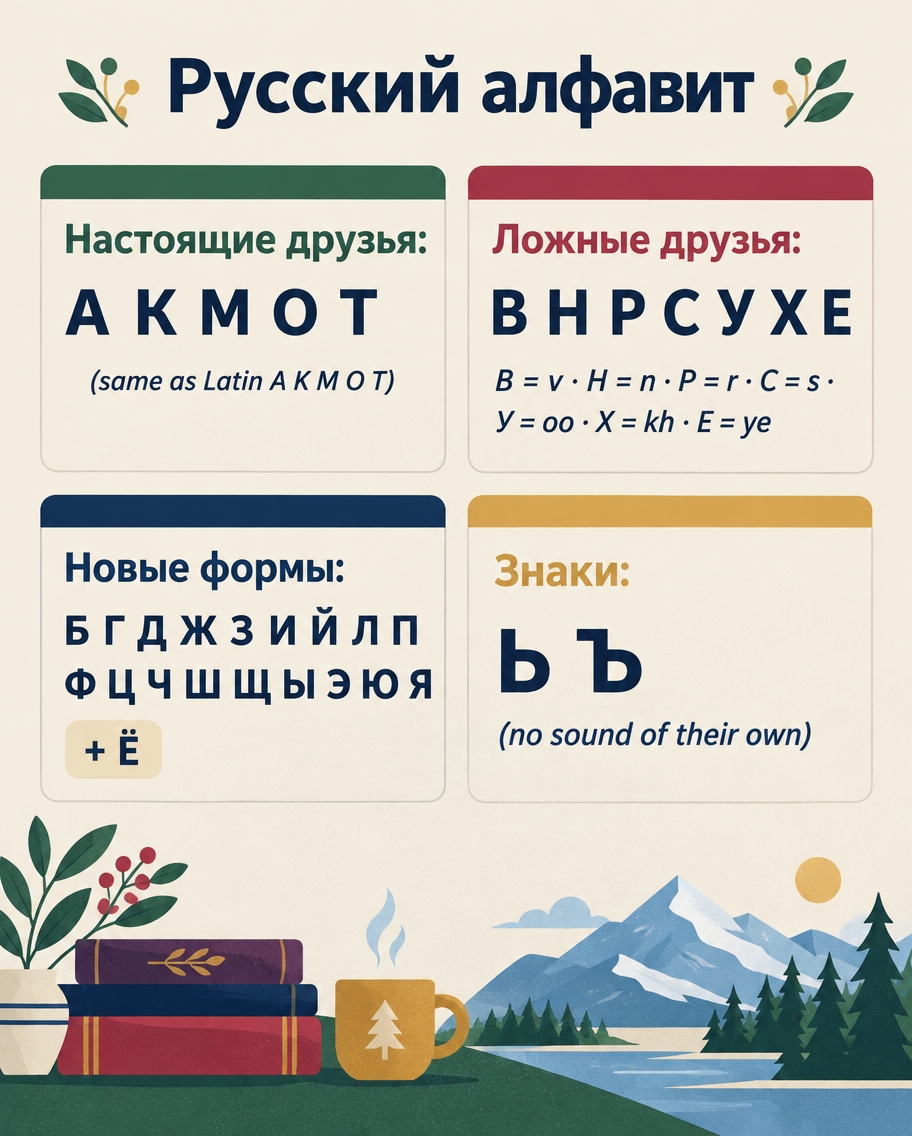
The Cyrillic alphabet looks frightening from the outside and is almost trivial from the inside. Of its 33 letters, a large group is either identical to a Latin letter or so close that you will not have to think about it. A second group are the famous false friends: shapes you recognise with sounds you do not expect. A third group is genuinely new, and most of those are learnable in a single sitting because each one has exactly one sound.
The fourth group is the one that actually makes Russian spelling efficient. Vowels come in hard and soft pairs: А-Я, О-Ё, У-Ю, Э-Е, Ы-И. The second letter of each pair does two jobs at once — it names its own vowel sound and tells you that the consonant before it is soft. That single trick removes most of the guesswork from Russian reading, and it is why the spelling system is far more regular than English.
Work through the matrix below out loud rather than silently. Say each letter's sound, not its name: Russian letter names (а, бэ, вэ, гэ…) are not the sounds they make in words, and learning the names first only slows you down.
Sound focus
Here is the honest difficulty, and it is better to meet it in the first hour than to discover it in the tenth. Russian stress is free: it can fall on any syllable of any word, and it moves as the word changes form. `Го́род` (city) becomes `города́` (cities). `Вода́` (water) becomes `во́ды` (waters). Nothing in the spelling tells you this, and there is no default rule of the kind Italian or Polish learners can rely on.
Stress matters twice over, because unstressed vowels change their sound. An unstressed `о` is not pronounced [o] at all — it collapses towards [a], so `молоко́` (milk) is really pronounced [məlɐˈko]. An unstressed `е` moves towards [и]. This is called reduction, and it is why Russians seem to speak a different language from the one they write.
This course therefore marks stress on every new word with an acute accent — `кни́га`, `вода́`, `хорошо́` — and gives you both IPA and an English-friendly respelling. Learn the stress as part of the word, the way you learn the letters. A word learnt without its stress is only half learnt, and in a small number of cases the stress is the whole meaning: `пла́чу` means 'I pay' while `плачу́` means 'I cry'.
One letter is exempt. `Ё` is always stressed, always pronounced [yo], and — this is the trap — very often printed as plain `е` in real Russian texts. When you see `е` in a word you do not recognise, part of your job is to ask whether it is secretly `ё`.
In English you cannot say *I student*. You need the little word 'am'. In the Russian present tense you do not, because the verb 'to be' simply is not there: `Я студент.` `Она врач.` `Москва — город.` The absence is not informal or elliptical — it is the standard, correct, neutral way to say it in the present.
This is the single most useful fact in your first hour of Russian. Before you have learnt one verb ending, you can already produce hundreds of true sentences, because the pattern is fixed: subject, then what it is. Nothing agrees with anything, nothing changes with person, and there is no conjugation to get wrong.
When both halves of the sentence are nouns, Russian often puts a dash between them: `Москва — город.` `Студент — это хорошо.` The dash stands exactly where the missing 'is' would be. It is optional when a pronoun or a negative is involved (`Я студент`, `Это не книга`), and it is a courtesy to the reader rather than a rule you will be marked on. Learn the pattern first and the punctuation second.
The verb 'to be' does exist in Russian — `быть` — and you will meet it properly in the next lesson, where it turns up as `был` in the past and `буду` in the future. In the present it stays invisible.
Four small words let you talk about the world around you immediately. `Это` means 'this is' and is invariable — it never changes its ending, whatever comes after it. `Это книга.` `Это дом.` `Это Москва.` One form, all situations.
`Вот` is the word you use when you are physically handing something over or drawing attention to something in front of you: 'here it is', 'here you are'. `Вот дом.` — here is the house, look at it. `Вот кофе.` — here is your coffee.
`Здесь` and `там` place things in space: here and there. `Я здесь.` `Он там.` They are adverbs, so they too never change. Combined with `это` and `вот` they give you a complete pointing-and-placing system with four words and zero grammar.
Sound focus
English builds a yes/no question by moving things around and importing an auxiliary: 'You are a student' becomes 'Are you a student?'. Russian does none of that. The word order stays exactly as it was in the statement, and your voice does the entire job.
`Ты студент.` — you are a student. `Ты студент?` — are you a student? Identical on the page, different in the air. The pattern Russian phonetics calls ИК-3 is a sharp, clear rise on the stressed syllable of the word carrying the question, then a level or falling tail. In `Ты студе́нт?` the rise lands on `-де́нт`. It is a bigger movement than English speakers expect, and under-doing it is the most common reason a beginner's question is heard as a statement.
Because the question lives in the intonation and not in the grammar, there is no inversion, no auxiliary and no conjugation to master. That is a genuine gift, and it is why you can start asking real questions in your first hour. Practise the rise out loud — reading this paragraph silently will not teach you ИК-3.
| Form | Letters | Sounds | Watch out for |
|---|---|---|---|
| 1. Look familiar, sound the same | А К М О Т | a k m o t | О is 'o' as in 'more' — but only when stressed |
| 2. Look familiar, sound different | В Н Р С У Х Ж Э Ё Й | v n r s u kh zh e yo y | В is V, Н is N, Р is R, С is S, У is OO, Х is KH |
| 3. New shapes | Б Г Д З И Л П Ф Ц Ч Ш Щ Ъ Ь | b g d z i l p f ts ch sh shch (no sound) (softens) | Г is a hard G as in 'go', never as in 'genre' |
| 4. Vowel pairs: hard → soft | А-Я О-Ё У-Ю Э-Е Ы-И | a-ya o-yo u-yu e-ye ih-ee | The second of each pair also softens the consonant before it |
Learn the sounds, not the letter names. Say them aloud in this order and you can read most of this lesson's vocabulary within the hour.
| Form | Masculine | Feminine | Neuter |
|---|---|---|---|
| Ends in | a consonant, -й or -ь | -а or -я | -о or -е |
| Examples from this lesson | дом, город, студент, врач | мама, книга, вода, Москва | молоко |
| The three traps | кофе ends in -е but is masculine | папа ends in -а but is masculine (it means a man) | the ending tells you the gender, not the meaning |
Russian has no articles — no 'a', no 'the'. The bare nominative form is what you find in the dictionary and what you use as the subject of a sentence.
Learn each word with its stress mark and its pronunciation. Nouns are given with their gender, animacy and their full six-case declension; verbs are given with their aspect and, where one exists, their partner verb.
| Russian | English | Gender / aspect | Pronunciation | Audio |
|---|---|---|---|---|
| ма́ма feminine · animate | mum, mother | feminine · animate | /ˈmamə/ MAH-muh | Listen in Russian: Slow in Russian: мама |
| па́па masculine · animate | dad, father | masculine · animate | /ˈpapə/ PAH-puh | Listen in Russian: Slow in Russian: папа |
| дом masculine · inanimate | house, home | masculine · inanimate | /dom/ DOHM | Listen in Russian: Slow in Russian: дом |
| го́род masculine · inanimate | city, town | masculine · inanimate | /ˈɡorət/ GOH-rut | Listen in Russian: Slow in Russian: город |
| Москва́ feminine · inanimate | Moscow | feminine · inanimate | /mɐˈskva/ muh-SKVAH | Listen in Russian: Slow in Russian: Москва |
| студе́нт masculine · animate | student (male, or generic) | masculine · animate | /stʊˈdʲent/ stoo-DYENT | Listen in Russian: Slow in Russian: студент |
| врач masculine · animate | doctor | masculine · animate | /vratɕ/ VRAHCH | Listen in Russian: Slow in Russian: врач |
| кни́га feminine · inanimate | book | feminine · inanimate | /ˈknʲiɡə/ kuh-NEE-guh | Listen in Russian: Slow in Russian: книга |
| вода́ feminine · inanimate | water | feminine · inanimate | /vɐˈda/ vuh-DAH | Listen in Russian: Slow in Russian: вода |
| ко́фе masculine · inanimate | coffee | masculine · inanimate | /ˈkofʲe/ KOH-fyuh | Listen in Russian: Slow in Russian: кофе |
| молоко́ neuter · inanimate | milk | neuter · inanimate | /məlɐˈko/ muh-luh-KOH | Listen in Russian: Slow in Russian: молоко |
| я Pronoun | I | Pronoun | /ja/ YAH | Listen in Russian: Slow in Russian: я |
| ты Pronoun | you (informal, singular) | Pronoun | /tɨ/ TIH | Listen in Russian: Slow in Russian: ты |
| он Pronoun | he | Pronoun | /on/ OHN | Listen in Russian: Slow in Russian: он |
| она́ Pronoun | she | Pronoun | /ɐˈna/ uh-NAH | Listen in Russian: Slow in Russian: она |
| э́то Pronoun | this is; it is | Pronoun | /ˈɛtə/ EH-tuh | Listen in Russian: Slow in Russian: это |
| вот Particle | here is, here you are, there | Particle | /vot/ VOHT | Listen in Russian: Slow in Russian: вот |
| да Particle | yes | Particle | /da/ DAH | Listen in Russian: Slow in Russian: да |
| нет Particle | no; there is not | Particle | /nʲet/ NYET | Listen in Russian: Slow in Russian: нет |
| не Particle | not | Particle | /nʲe/ NYEH | Listen in Russian: Slow in Russian: не |
| здесь Adverb | here | Adverb | /zdʲesʲ/ ZDYES | Listen in Russian: Slow in Russian: здесь |
| там Adverb | there | Adverb | /tam/ TAHM | Listen in Russian: Slow in Russian: там |
| хорошо́ Adverb | good, well, OK | Adverb | /xərɐˈʂo/ khuh-ruh-SHOH | Listen in Russian: Slow in Russian: хорошо |
| пло́хо Adverb | bad, badly | Adverb | /ˈploxə/ PLOH-khuh | Listen in Russian: Slow in Russian: плохо |
| спаси́бо Interjection | thank you | Interjection | /spɐˈsʲibə/ spuh-SEE-buh | Listen in Russian: Slow in Russian: спасибо |
| пожа́луйста Particle | please; you are welcome | Particle | /pɐˈʐalujstə/ puh-ZHAH-luy-stuh | Listen in Russian: Slow in Russian: пожалуйста |
Each case is listed with the question word that selects it. Find the question you are answering and the ending follows.
| Form | ма́ма (f) | па́па (m) | дом (m) | го́род (m) | Москва́ (f) | студе́нт (m) | врач (m) | кни́га (f) | вода́ (f) | ко́фе (m) | молоко́ (n) |
|---|---|---|---|---|---|---|---|---|---|---|---|
| Nominative · Кто? Что? | мама | папа | дом | город | Москва́ | студент | врач | книга | вода | кофе | молоко |
| Genitive · Кого? Чего? | мамы | папы | дома | города | Москвы́ | студента | врача | книги | воды | кофе | молока |
| Dative · Кому? Чему? | маме | папе | дому | городу | Москве́ | студенту | врачу | книге | воде | кофе | молоку |
| Accusative · Кого? Что? | маму | папу | дом | город | Москву́ | студента | врача | книгу | воду | кофе | молоко |
| Instrumental · Кем? Чем? | мамой | папой | домом | городом | Москво́й | студентом | врачом | книгой | водой | кофе | молоком |
| Prepositional · О ком? О чём? | маме | папе | доме | городе | Москве́ | студенте | враче | книге | воде | кофе | молоке |
| Form | ма́ма (f) | па́па (m) | дом (m) | го́род (m) | Москва́ (f) | студе́нт (m) | врач (m) | кни́га (f) | вода́ (f) | ко́фе (m) | молоко́ (n) |
|---|---|---|---|---|---|---|---|---|---|---|---|
| Nominative · Кто? Что? | мамы | папы | дома́ | города́ | — | студенты | врачи́ | книги | во́ды | — | — |
| Genitive · Кого? Чего? | мам | пап | домо́в | городо́в | — | студентов | враче́й | книг | вод | — | — |
| Dative · Кому? Чему? | мамам | папам | дома́м | города́м | — | студентам | врача́м | книгам | во́дам | — | — |
| Accusative · Кого? Что? | мам | пап | дома́ | города́ | — | студентов | враче́й | книги | во́ды | — | — |
| Instrumental · Кем? Чем? | мамами | папами | дома́ми | города́ми | — | студентами | врача́ми | книгами | во́дами | — | — |
| Prepositional · О ком? О чём? | мамах | папах | дома́х | города́х | — | студентах | врача́х | книгах | во́дах | — | — |
A dash means the form does not exist. Plural-only nouns such as де́ньги and су́тки have no singular, and indeclinable nouns such as ко́фе and метро́ keep one form in all six cases.
Приве́т!
Hi!
IPA /prʲɪˈvʲet/
Say it prih-VYET!
Informal greeting. Use Здравствуйте with people you do not know.
Здра́вствуйте!
Hello!
IPA /ˈzdrastvʲɪtʲə/
Say it ZDRAH-stvuy-tyuh!
Formal and plural. The first в is not pronounced, so the word sounds shorter than it looks: [ˈzdrastvʲɪtʲə].
Э́то А́нна.
This is Anna.
IPA /ˈɛtə ˈanːə/
Say it EH-tuh AH-nuh.
The standard way to introduce someone. No verb needed.
Я студе́нт.
I am a student.
IPA /ja stʊˈdʲent/
Say it YAH stoo-DYENT.
Literally "I student". The missing "am" is normal, not informal.
Ты студе́нт?
Are you a student?
IPA /tɨ stʊˈdʲent/
Say it TIH stoo-DYENT?
Identical words to the statement. Only the intonation rises (ИК-3), sharply, on -де́нт.
Нет, я врач.
No, I am a doctor.
IPA /nʲet ja vratɕ/
Say it NYET, YAH VRAHCH.
A single-syllable word carries no stress mark.
Да, э́то кни́га.
Yes, this is a book.
IPA /da ˈɛtə ˈknʲiɡə/
Say it DAH, EH-tuh kuh-NEE-guh.
Э́то Москва́.
This is Moscow.
IPA /ˈɛtə mɐˈskva/
Say it EH-tuh muh-SKVAH.
Он студе́нт.
He is a student.
IPA /on stʊˈdʲent/
Say it OHN stoo-DYENT.
Она́ врач.
She is a doctor.
IPA /ɐˈna vratɕ/
Say it uh-NAH VRAHCH.
The profession noun stays masculine even when the person is a woman. A feminine form exists (врачиха) but is colloquial; standard Russian uses врач for both.
Э́то ма́ма.
This is Mum.
IPA /ˈɛtə ˈmamə/
Say it EH-tuh MAH-muh.
Вот дом.
Here is the house.
IPA /vot dom/
Say it VOHT DOHM.
Вот presents something visible; это identifies something.
Там вода́.
There is water over there.
IPA /tam vɐˈda/
Say it TAHM vuh-DAH.
Я здесь.
I am here.
IPA /ja zdʲesʲ/
Say it YAH ZDYES.
Он там.
He is there.
IPA /on tam/
Say it OHN TAHM.
Э́то ко́фе?
Is this coffee?
IPA /ˈɛtə ˈkofʲe/
Say it EH-tuh KOH-fyuh?
Rise sharply on ко́-.
Спаси́бо!
Thank you!
IPA /spɐˈsʲibə/
Say it spuh-SEE-buh!
Пожа́луйста.
You are welcome. / Please.
IPA /pɐˈʐalujstə/
Say it puh-ZHAH-luy-stuh.
One word, two jobs: the reply to спасибо, and "please" in a request.
Хорошо́.
Good. / It is good.
IPA /xərɐˈʂo/
Say it khuh-ruh-SHOH.
Two reduced vowels before the stressed final о.
Пло́хо.
Bad. / It is bad.
IPA /ˈploxə/
Say it PLOH-khuh.
Э́то не кни́га.
This is not a book.
IPA /ˈɛtə nʲe ˈknʲiɡə/
Say it EH-tuh NYEH kuh-NEE-guh.
не goes directly before the word it negates. This is the only negation pattern you need today.
Москва́ — э́то го́род.
Moscow is a city.
IPA /mɐˈskva ˈɛtə ˈɡorət/
Say it muh-SKVAH — EH-tuh GOH-rut.
The dash replaces the missing "is". Adding это after the dash is the standard written pattern for definitions.
Anna stops at a street kiosk near the centre of Moscow. Ivan works there.
Здравствуйте!
Hello!
Listen in Russian: Slow in Russian: Здравствуйте!Здравствуйте!
Hello!
Listen in Russian: Slow in Russian: Здравствуйте!Это кофе?
Is this coffee?
Listen in Russian: Slow in Russian: Это кофе?Да, это кофе.
Yes, this is coffee.
Listen in Russian: Slow in Russian: Да, это кофе.А это вода?
And is this water?
Listen in Russian: Slow in Russian: А это вода?Нет, это не вода.
No, this is not water.
Listen in Russian: Slow in Russian: Нет, это не вода.Хорошо. Спасибо!
Good. Thank you!
Listen in Russian: Slow in Russian: Хорошо. Спасибо!Пожалуйста.
You are welcome.
Listen in Russian: Slow in Russian: Пожалуйста.Anna shows Tom photos of her family on her phone.
Анна, это мама?
Anna, is this your mum?
Listen in Russian: Slow in Russian: Анна, это мама?Да, это мама. А это папа.
Yes, this is Mum. And this is Dad.
Listen in Russian: Slow in Russian: Да, это мама. А это папа.Это дом?
Is this the house?
Listen in Russian: Slow in Russian: Это дом?Да, вот дом. Это Москва.
Yes, here is the house. This is Moscow.
Listen in Russian: Slow in Russian: Да, вот дом. Это Москва.Москва — это город?
Is Moscow a city?
Listen in Russian: Slow in Russian: Москва — это город?Да. Москва — это город.
Yes. Moscow is a city.
Listen in Russian: Slow in Russian: Да. Москва — это город.Спасибо!
Thank you!
Listen in Russian: Slow in Russian: Спасибо!Пожалуйста.
You are welcome.
Listen in Russian: Slow in Russian: Пожалуйста.Answer actively — try to recall the Russian before you look at any hint.
Choose the correct letter.
Choose the correct sound.
Choose the correct letter.
Answer true or false.
Answer true or false.
Translate into Russian.
Translate into Russian.
Translate into Russian.
Translate into English.
Translate into English.
Choose the gender.
Choose the gender.
Choose the group its ending puts it in.
Fill the gap to say "I am a student".
Fill the gap.
Pair the words.
Put the words in order.
Play the audio and pick the matching sentence.
Play the audio and type what you hear.
Choose the correctly stressed form.
Choose the correctly stressed form.
Choose the correct phrase.
Choose the correct meaning.
Answer true or false.
Rewrite it as a question.
Rewrite it with не.
Fill the gap.
Recall the English meaning, then rate how well you knew it.
Choose the neuter noun.
Fill the gap to say "This is a city."
Say each sentence aloud three times: once slowly, once at normal speed, once from memory. Then change one word and say your own version. For the questions, exaggerate the rise on the stressed syllable — ИК-3 feels overdone to an English ear and sounds exactly right to a Russian one.
Before you move on, make sure you can do all of this without looking:
Go deeper: The zero copula · The Nominative case · Noun gender · Forming questions · Intonation: ИК-1 to ИК-5