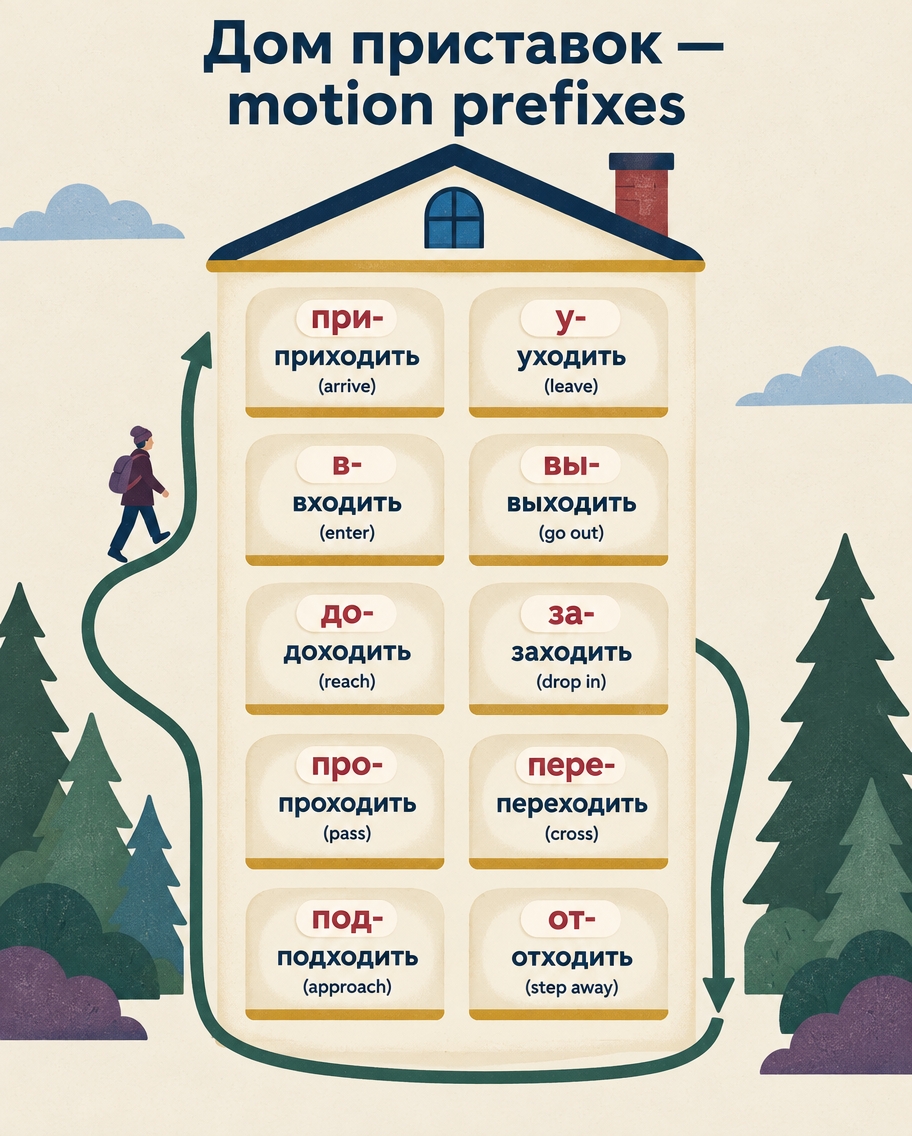
Eleven prefixes and two verbs, and you can arrive, leave, enter, come out, reach, drop in, pass, cross, approach and step away — on foot or by vehicle. This lesson builds the whole prefixed motion system of Russian, gives you the surprising past that comes with it, and teaches you how to ask for and follow a route.
⏱ About 55 minutes24 phrases34 exercises
What you will learn
Read a prefixed motion verb you have never met by splitting it into prefix and base, and say what it means before you look it up
Build the future of any prefixed motion verb as one word — приду́, прие́дешь, дойдёт, дое́дем — and explain why there is no бу́ду in it
Produce the past of the идти́ family from its second stem: пришёл, пришла́, пришло́, пришли́, plus the one exception that вы- creates
Match each prefix to the preposition and case it brings with it: войти́в + accusative, вы́йтииз + genitive, дойти́до + genitive, подойти́к + dative, отойти́от + genitive
Ask how to get somewhere on foot and by transport, and follow a five-step route given to you by a stranger
Use the five direction prepositions ми́мо, че́рез, вдоль, вокру́г and поперёк with the case each one wants, and name the five things a route is made of
Quick review
Say these aloud before you start. They come from earlier lessons.
Я иду́ в парк.I am walking to the park.Listen in Russian:Slow in Russian:Я иду́ в парк.
Она́ е́дет на метро́.She is going by metro.Listen in Russian:Slow in Russian:Она́ е́дет на метро́.
Пойдём в кино́!Let us go to the cinema!Listen in Russian:Slow in Russian:Пойдём в кино́!
Когда́ я приду́, я позвоню́.When I come, I will ring.Listen in Russian:Slow in Russian:Когда́ я приду́, я позвоню́.
Пря́мо и нале́во.Straight ahead and to the left.Listen in Russian:Slow in Russian:Пря́мо и нале́во.
До вокза́ла.As far as the station.Listen in Russian:Slow in Russian:До вокза́ла.
Theory
One prefix, one meaning — and it works on both verbs
Lesson 7 gave you two verbs and one question: are you going on your own two feet, or are you inside a vehicle? That question does not change today. Everything new in this lesson is a prefix, and a prefix does not care which verb it lands on. Put при- in front of идти́ and you get "arrive on foot"; put the same при- in front of е́хать and you get "arrive by vehicle". The prefix carries the direction, the base carries the means, and nothing else moves.
That is the whole system, and it is why this lesson is far less frightening than its reputation suggests. There are eleven prefixes here and each one has a single core meaning, so eleven meanings give you twenty-odd verbs rather than twenty-odd separate things to memorise. Come at it from the prefix column, never from the verb list.
One more thing follows automatically. Every one of these verbs is perfective, and that is no coincidence: a prefix that adds a limit — arrive, reach, cross, leave — is precisely what turns an unfinished action into a finished one. Lesson 13 showed you the deal, and Lesson 14 showed you what it does to the future.
Я приду́ за́втра.I will come tomorrow (on foot).Listen in Russian:Slow in Russian:Я приду́ за́втра.
Я прие́ду за́втра.I will arrive tomorrow (by vehicle).Listen in Russian:Slow in Russian:Я прие́ду за́втра.
Он ушёл.He has left (on foot).Listen in Russian:Slow in Russian:Он ушёл.
Она́ уе́хала.She has left (by vehicle).Listen in Russian:Slow in Russian:Она́ уе́хала.
The future is one word — and the past is a different verb
Because they are perfective, none of these verbs has a present tense at all. Приду́ has exactly the shape of a present and is a future. To say what is happening right now you go back to the unprefixed verbs of Lesson 7 — яиду́, яе́ду — or to the imperfective partner, яприхожу́. The future, on the other hand, costs you nothing: it is simply the conjugation, приду́, придёшь, придёт, придём, придёте, приду́т.
The past of the идти́ family is where Russian genuinely surprises you, and it is worth meeting the surprise head-on. It is not built on the same stem as anything else in the verb. идти́ in the past is шёл, шла, шло, шли, and every prefix simply sits on top of those four forms: пришёл, ушёл, вошёл, дошёл, зашёл, прошёл, перешёл, подошёл, отошёл. Learn four words and eleven verbs come free.
The е́хать family is boring by comparison, and you should enjoy that. It adds -л to the infinitive stem like any regular verb: прие́хал, прие́хала, прие́хало, прие́хали. It also keeps its stress in one place throughout — on the root vowel of -ех- and -ед- — so прие́ду, уе́ду, дое́ду and подъе́ду all rhyme with each other. The one irregularity in the whole family is the imperative, and it is the same for all seven verbs: поезжа́йте.
There is a single exception to every rule above, and it is a useful one to know. The prefix вы- pulls the stress onto itself wherever it appears, in every form, without exception: вы́йти gives вы́йду, вы́йдешь, вы́шел, вы́шла. Because that stress is no longer on the ending, the ending is written е and not ё.
Он пришёл.He arrived (on foot).Listen in Russian:Slow in Russian:Он пришёл.
Она́ пришла́.She arrived (on foot).Listen in Russian:Slow in Russian:Она́ пришла́.
Они́ прие́хали.They arrived (by vehicle).Listen in Russian:Slow in Russian:Они́ прие́хали.
Мы вы́йдем здесь.We will get off here.Listen in Russian:Slow in Russian:Мы вы́йдем здесь.
What each prefix means, and the case it brings with it
The eleven prefixes fall into three groups. The first is arrival and departure: при- "arrive" and у- "leave". They are exact opposites, and each one brings its own preposition — прийти́ wants в or на with the accusative, уйти́ wants из with the genitive. You met both cases in Lessons 5, 6 and 8, so nothing new arrives here except the verbs themselves.
The second group is in and out, up and away: в- "into", вы- "out of", под- "up to", от- "back, away from". Notice that the preposition is hiding inside the prefix, and that the preposition tells you the case. войти́в + accusative; вы́йтииз + genitive; подойти́к + dative, the к of Lesson 9; отойти́от + genitive, the от of Lesson 8. Learn the verb with its preposition glued on and the ending writes itself.
The third group is about the path itself. до- is "as far as" and takes до + genitive. за- is the one English speakers most often get wrong: it is not "into" but "in passing, for a short call", so зайти́ means to drop by, with к + dative for a person and в + accusative for a place. про- is "past, through" — пройти́ми́мо + genitive, or че́рез + accusative. And пере- is "across": перейти́че́рез + accusative.
Войди́те в магази́н.Come into the shop.Listen in Russian:Slow in Russian:Войди́те в магази́н.
Вы́йдите из магази́на.Come out of the shop.Listen in Russian:Slow in Russian:Вы́йдите из магази́на.
Дойди́те до остано́вки.Walk as far as the stop.Listen in Russian:Slow in Russian:Дойди́те до остано́вки.
Зайди́те к нам.Drop in and see us.Listen in Russian:Slow in Russian:Зайди́те к нам.
Asking the way, and understanding the answer
Two questions cover almost everything you will ever need. On foot it is Какпройти́вмузе́й? or Какдойти́доостано́вки? By vehicle it is Какдое́хатьдовокза́ла? The grammar is the same in both: как plus a perfective infinitive. Pick the wrong base and a Russian will still understand you perfectly, but the answer will come back in the wrong mode and you will find yourself walking to a station you should have taken a bus to.
The answer is a chain of short imperatives, and this is where the lesson pays for itself. Иди́тепря́мо. Наперекрёсткеповоро́тнапра́во. Пройди́теми́мопа́рка. Перейди́тече́резу́лицу. Directions to a single stranger use the plural -те form even between people who would otherwise be on ты, because you are addressing someone you do not know.
Five nouns carry the rest of the route, and they are worth learning with the preposition they most often appear in: наперекрёстке (at the crossing), усветофо́ра (by the traffic lights), доостано́вки (as far as the stop), поперехо́ду (by the crossing), поворо́тнапра́во (a turn to the right). All four prepositions in that list — на, у, до and по — are ones you already have.
Как пройти́ в музе́й?How do I get to the museum on foot?Listen in Russian:Slow in Russian:Как пройти́ в музе́й?
Как дое́хать до вокза́ла?How do I get to the station by transport?Listen in Russian:Slow in Russian:Как дое́хать до вокза́ла?
Иди́те пря́мо до перекрёстка.Go straight ahead as far as the crossing.Listen in Russian:Slow in Russian:Иди́те пря́мо до перекрёстка.
Авто́бус подъе́хал к светофо́ру.The bus pulled up at the traffic lights.Listen in Russian:Slow in Russian:Авто́бус подъе́хал к светофо́ру.
This is A2 material, and it is here on purpose
A word about level, because this course has promised not to oversell you. The A1 standard for Russian as a foreign language expects four motion verbs — идти́, ходи́ть, е́хать, е́здить — and exactly two prefixes, по- and при-. You already have both of those from Lesson 7. Everything else on this page is A2, and the official guidance is explicit that the rest of the prefix system belongs beyond the elementary level.
We teach it here anyway, for two reasons. The first is practical: you cannot ask for directions in a Russian city without пройти́, дойти́ and перейти́, and a course that stops at прийти́ leaves you unable to hold the one conversation you most need. The second is structural: the prefix system is far more regular than its reputation, and once Lessons 13 and 14 have installed aspect and the perfective future, the marginal cost of twenty more verbs is genuinely small.
What that means in practice is that you should not try to memorise twenty-two verbs tonight. Memorise eleven prefix meanings and two stems, and build the verb when you need it. The imperfective partners follow the same rule: take the multidirectional base — ходи́ть or е́здить — and put the same prefix on it: уходи́ть, вы́ходить, входи́ть, доходи́ть, заходи́ть, проходи́ть, переходи́ть, подходи́ть and отходи́ть on foot; приезжа́ть, уезжа́ть, доезжа́ть, заезжа́ть, переезжа́ть and подъезжа́ть by vehicle. Same prefix, same meaning, no single-trip limit. One of them, приходи́ть, is in the word list below; the rest you can now form whenever you need them.
Я ухожу́ сейча́с.I am leaving now. (уходи́ть, the imperfective partner of уйти́)Listen in Russian:Slow in Russian:Я ухожу́ сейча́с.
Авто́бус уезжа́ет.The bus is leaving. (уезжа́ть, the imperfective partner of уе́хать)Listen in Russian:Slow in Russian:Авто́бус уезжа́ет.
Она́ прихо́дит ве́чером.She comes in the evening. (приходи́ть, the imperfective partner of прийти́)Listen in Russian:Slow in Russian:Она́ прихо́дит ве́чером.
Мы захо́дим в магази́н.We drop into the shop as a rule. (заходи́ть, the imperfective partner of зайти́)Listen in Russian:Slow in Russian:Мы захо́дим в магази́н.
The prefix × base matrix: eleven prefixes, two verbs
Form
prefix
идти́ — on foot
е́хать — by vehicle
to set off, to start going
по-
пойти́
пое́хать
to arrive
при-
прийти́
прие́хать
to leave, to go away
у-
уйти́
уе́хать
to come in, to enter
в-
войти́
—
to come out; to get off
вы-
вы́йти
—
to reach, to get as far as
до-
дойти́
дое́хать
to drop in on the way
за-
зайти́
зае́хать
to pass, to go past, to go through
про-
пройти́
—
to cross; to move house
пере-
перейти́
перее́хать
to come up to, to pull up
под-
подойти́
подъе́хать
to step back, to move away
от-
отойти́
—
Eleven meanings, not twenty-two verbs. The prefix carries the direction, the base carries the means, and the means question of Lesson 7 — on foot or by vehicle? — never changes its answer here. по- and при- are the only two prefixes the A1 standard asks for; everything else on this page is A2. The dashes mark prefixes whose vehicle partner exists but sits outside the core set: въе́хать and вы́ехать (in and out by vehicle), объе́хать (round) and прое́хать (past) are all real verbs built on exactly the same stem. Read the table down the prefix column, not across it.
The directions kit: what each word governs
Form
meaning
what it governs
in a route
напра́во
to the right
adverb — no case
Пото́мнапра́во.
нале́во
to the left
adverb — no case
Пото́мнале́во.
пря́мо
straight ahead
adverb — no case
Иди́тепря́мо.
наза́д
back, backwards
adverb — no case
Неиди́теназа́д.
ми́мо
past, by
genitive
Пройди́теми́мопа́рка.
че́рез
across, over; through
accusative
Перейди́тече́резу́лицу.
вдоль
along
genitive
Иди́тевдольу́лицы.
вокру́г
around
genitive
Авто́бусе́детвокру́гго́рода.
поперёк
across the width of
genitive
У́лицаидётпоперёкго́рода.
The first four are adverbs and take nothing after them; the last five are prepositions, and each one fixes the case of the noun that follows. Note the two senses of "across": че́рез + accusative is the thing you cross, поперёк + genitive is the width you cut. напра́во, нале́во and пря́мо are the three you already have from Lesson 7.
Perfective motion in the future — and the past that changes stem
Form
прийти́ (on foot)
прие́хать (by vehicle)
future — я
приду́
прие́ду
future — ты
придёшь
прие́дешь
future — он / она́ / оно́
придёт
прие́дет
future — мы
придём
прие́дем
future — вы
придёте
прие́дете
future — они́
приду́т
прие́дут
past — он
пришёл
прие́хал
past — она́
пришла́
прие́хала
past — оно́
пришло́
прие́хало
past — они́
пришли́
прие́хали
Read the two columns against each other and the whole lesson is in one table. Both verbs are perfective, so neither has a present tense: the six "future" forms look like presents and are not. Both build the past with -л. But the come-on-foot column swaps stems to do it — идти́ becomes шёл — while the come-by-vehicle column simply adds -л to -еха-. Learn пришёл, пришла́, пришло́, пришли́ once and every other prefix inherits them: ушёл, вошёл, дошёл, зашёл, прошёл, перешёл, подошёл, отошёл. The single exception is вы-, which takes the stress with it and writes е instead of ё: вы́шел, вы́шла.
The route: five moves, on foot and by vehicle
Form
on foot — the идти́ family
by vehicle — the е́хать family
Asking the way
Какпройти́вмузе́й?
Какдое́хатьдорестора́на?
Setting off
Иди́тепря́мо.
Поезжа́йтепря́мо.
Getting as far as a point
Выдойдётедоперекрёстка.
Выдое́детедоостано́вки.
Dropping in on the way
Язайду́вмагази́н.
Мызае́демвмагази́н.
Arriving
Выпришли́.
Выприе́хали.
The same five moves with a different base, and nothing else changes. Row three is the perfective future of Lesson 14 doing ordinary work: one word, no бу́ду, and the listener hears a completed arrival rather than a journey in progress. Row two is the imperative — but note that the vehicle column cannot use *пое́дь: Russian builds that imperative from an older verb entirely, giving поезжа́йте.
Vocabulary
Learn each word with its stress mark and its pronunciation. Nouns are given with their gender, animacy and their full six-case declension; verbs are given with their aspect and, where one exists, their partner verb.
Russian
English
Gender / aspect
Pronunciation
Audio
приходи́тьimperfective
to come, to arrive (on foot) — as a habit or a process
Full six-case declension of the 5 nouns in this lesson
Each case is listed with the question word that selects it. Find the question you are answering and the ending follows.
Singular
Form
поворо́т (m)
перекрёсток (m)
светофо́р (m)
перехо́д (m)
остано́вка (f)
Nominative · Кто? Что?
поворо́т
перекрёсток
светофо́р
перехо́д
остано́вка
Genitive · Кого? Чего?
поворо́та
перекрёстка
светофо́ра
перехо́да
остано́вки
Dative · Кому? Чему?
поворо́ту
перекрёстку
светофо́ру
перехо́ду
остано́вке
Accusative · Кого? Что?
поворо́т
перекрёсток
светофо́р
перехо́д
остано́вку
Instrumental · Кем? Чем?
поворо́том
перекрёстком
светофо́ром
перехо́дом
остано́вкой
Prepositional · Оком? Очём?
поворо́те
перекрёстке
светофо́ре
перехо́де
остано́вке
Plural
Form
поворо́т (m)
перекрёсток (m)
светофо́р (m)
перехо́д (m)
остано́вка (f)
Nominative · Кто? Что?
поворо́ты
перекрёстки
светофо́ры
перехо́ды
остано́вки
Genitive · Кого? Чего?
поворо́тов
перекрёстков
светофо́ров
перехо́дов
остано́вок
Dative · Кому? Чему?
поворо́там
перекрёсткам
светофо́рам
перехо́дам
остано́вкам
Accusative · Кого? Что?
поворо́ты
перекрёстки
светофо́ры
перехо́ды
остано́вки
Instrumental · Кем? Чем?
поворо́тами
перекрёстками
светофо́рами
перехо́дами
остано́вками
Prepositional · Оком? Очём?
поворо́тах
перекрёстках
светофо́рах
перехо́дах
остано́вках
Ready-to-use phrases
Как пройти́ в музе́й?
How do I get to the museum on foot?
IPA/kak prɐjˈtʲi f mʊˈzʲej/
Say itKAHK pruy-TEE v moo-ZEY?
The question of the lesson. пройти́ is perfective, so the literal reading is "how does one walk as far as the museum", and the answer will be a walking route. Ask it with дое́хать instead and you will be told which bus to take.
traveldirectionsquestionsmotioncity
Listen in Russian:Slow in Russian:Как пройти в музей?
Как дое́хать до вокза́ла?
How do I get to the station by transport?
IPA/kak dɐˈjexətʲ dɐ vɐɡˈzalə/
Say itKAHK duh-YEH-khyut duh vug-ZAH-luh?
до + genitive, as in Lesson 8: довокза́ла. дое́хать is perfective, so its future is one word — дое́ду, дое́дешь — which is why the question needs no auxiliary.
traveldirectionsquestionsmotiontransport
Listen in Russian:Slow in Russian:Как доехать до вокзала?
Иди́те пря́мо, вдоль у́лицы.
Go straight ahead, along the street.
IPA/ɪˈdʲitʲe ˈprʲamə vdolʲ ˈulʲitsɨ/
Say itih-DEE-tyuh PRYAH-muh, vuh-DYOL OO-lih-tsih.
Directions to one stranger take the -те form even between people who would otherwise use ты. вдоль governs the genitive, hence у́лицы.
politedirectionsmotioncity
Listen in Russian:Slow in Russian:Идите прямо, вдоль улицы.
Пройди́те ми́мо па́рка.
Go past the park.
IPA/prɐjˈdʲitʲe ˈmʲimə ˈparkə/
Say itpruy-DEE-tyuh MEE-muh PAHR-kuh.
ми́мо + genitive. This is the standard way to turn a landmark into a milestone: name the thing you leave behind and the listener knows how far to go.
traveldirectionsmotioncity
Listen in Russian:Slow in Russian:Пройдите мимо парка.
Say itpih-riy-DEE-tyuh CHEH-ris OO-lih-tsoo puh pih-rih-KHOH-doo.
One sentence, two cases: че́рез + accusative for what you cross, по + dative for the way you cross it. It is also what a Russian parent says to a child.
traveldirectionsmotioncity
Listen in Russian:Slow in Russian:Перейдите через улицу по переходу.
На перекрёстке — поворо́т напра́во.
At the crossing, it is a turn to the right.
IPA/nə pʲɪrʲɪˈkrʲɵstkʲe pɐvɐˈrot nɐˈpravə/
Say itnuh pih-rih-KRYOHST-kyuh — puh-vuh-ROHT nuh-PRAH-vuh.
на + prepositional for the point on the route, as in Lesson 5. The turn is a noun, поворо́т, not a verb: Russian names the feature of the road rather than the action of the driver. перекрёстке needs no acute because ё is always stressed.
traveldirectionscityplace
Listen in Russian:Slow in Russian:На перекрёстке — поворот направо.
Дойди́те до остано́вки.
Walk as far as the stop.
IPA/dɐjˈdʲitʲe dɐ ɐstɐˈnofkʲɪ/
Say itduy-DEE-tyuh duh uh-stuh-NOH-fkih.
до- and до are the same morpheme wanting the same case. Learn "дойти́до + genitive" as one chunk and the ending follows for free.
traveldirectionsmotiontransport
Listen in Russian:Slow in Russian:Дойдите до остановки.
Авто́бус подъе́хал к светофо́ру.
The bus pulled up at the traffic lights.
IPA/ɐfˈtobʊs pɐdˈjexəl k svʲɪtɐˈforʊ/
Say ituh-FTOH-boos pud-YEH-khul k svih-tuh-FOH-roo.
подъе́хать governs к + dative, the same к of Lesson 9 that подошли́ takes. Note the ъ: it separates the prefix подъ- from the root and is never dropped.
neutraltransportmotioncity
Listen in Russian:Slow in Russian:Автобус подъехал к светофору.
Он прихо́дит на рабо́ту у́тром.
He comes to work in the morning (every day).
IPA/on prʲɪˈxodʲɪt nə rɐˈbotʊ ˈutrom/
Say itOHN prih-KHOH-dit nuh ruh-BOH-too OO-trum.
The one imperfective verb of this lesson, and the contrast that makes aspect click: прихо́дит is what he does as a rule, придёт is what he will do once. у́тром is the instrumental time adverb of Lesson 10.
neutralmotionpresentworktime
Listen in Russian:Slow in Russian:Он приходит на работу утром.
Мы прие́дем на метро́.
We will arrive by metro.
IPA/mɨ prʲɪˈjedʲɪm nɐ mʲɪˈtro/
Say itMIH prih-YEH-dim nuh mih-TROH.
One word for the whole future, because прие́хать is perfective. Compare the imperfective future of Lesson 14: мыбу́демприезжа́ть — two words, and a different meaning, "we will be coming (as a rule)".
neutralmotionfuturetransport
Listen in Russian:Slow in Russian:Мы приедем на метро.
Он уже́ ушёл.
He has already left (on foot).
IPA/on ʊˈʐe ʊˈʂol/
Say itOHN oo-ZHEH oo-SHOHL.
Russian has no perfect tense, so a perfective past plus уже́ does the whole job of "has already gone". ушёл keeps the suppletive ш-stem of идти́ and a stressed ё, which is why there is no acute to place.
neutralmotionpastaspecttime
Listen in Russian:Slow in Russian:Он уже ушёл.
Она́ уе́хала в Москву́.
She has left for Moscow.
IPA/ɐˈna ˈujexələ f mɐˈskvu/
Say ituh-NAH oo-YEH-khuh-luh v muh-SKVOO.
уе́хать takes в + accusative for the destination and из + genitive for the place left: она́уе́халаизМосквы́вПе́тербург. The past is regular here — уе́хала, not a ш-stem — because the base is е́хать, not идти́.
neutralmotionpasttravel
Listen in Russian:Slow in Russian:Она уехала в Москву.
Зайди́те к нам ве́чером.
Drop in and see us this evening.
IPA/zɐjˈdʲitʲe k nam ˈvʲetɕɪrəm/
Say itzuy-DEE-tyuh k NAHM VYEH-chih-rum.
за- is "in passing, for a short call", never simply "into". к + dative for the people you are calling on, the government Lesson 9 gave you with кврачу́.
informalmotionfamilytime
Listen in Russian:Slow in Russian:Зайдите к нам вечером.
Мы зае́дем в магази́н.
We will drop into the shop.
IPA/mɨ zɐˈjedʲɪm v mɐɡɐˈzʲin/
Say itMIH zuh-YEH-dim v muh-guh-ZEEN.
The vehicle twin of зайти́, with the same "on the way" meaning. In the car you заезжа́ете; on foot you заходи́те.
neutralmotionfutureshopping
Listen in Russian:Slow in Russian:Мы заедем в магазин.
Войди́те, пожа́луйста.
Come in, please.
IPA/vɐjˈdʲitʲe pɐˈʐalʊjstə/
Say itvuy-DEE-tyuh, puh-ZHAH-luy-stuh.
The imperative of a prefixed perfective is built on the future stem: войду́ gives войди́, войди́те. It is what you say standing in a doorway — and what you hear from the other side of it.
politemotionpoliteness
Listen in Russian:Slow in Russian:Войдите, пожалуйста.
Вы́йдем здесь.
Let us get off here.
IPA/ˈvɨjdʲɪm zdʲesʲ/
Say itVIY-dim ZDYES.
Of a bus, tram or train вы́йти means "to get off", not "to leave a building". The first person plural of a perfective verb — вы́йдем, пойдём, зайдём — is the standard "let us…", and Russian has no separate word for "let".
neutralmotiontransport
Listen in Russian:Slow in Russian:Выйдем здесь.
Подойди́те к остано́вке.
Come up to the stop.
IPA/pədɐjˈdʲitʲe k ɐstɐˈnofkʲɪ/
Say itpuh-duy-DEE-tyuh k uh-stuh-NOH-fkyuh.
под- + к + dative. The same shape covers every approach: подойти́кврачу́, подойти́кокну́, подойти́квопро́су.
politedirectionsmotiontransport
Listen in Russian:Slow in Russian:Подойдите к остановке.
Отойди́те наза́д.
Step back.
IPA/ɐtɐjˈdʲitʲe nɐˈzat/
Say ituh-tuy-DEE-tyuh nuh-ZAHT.
от- is "away from" and it wants от + genitive when it names what you move away from: отойди́теотокна́. With an adverb instead, as here, no case is involved at all.
neutralmotiondirectionsemergency
Listen in Russian:Slow in Russian:Отойдите назад.
Пое́хали!
Let us go! (by vehicle)
IPA/ˈpojexəlʲɪ/
Say itpuh-YEH-khuh-lih!
The past plural used as an invitation, exactly like пойдём! for walking. Gagarin said it on 12 April 1961 and it is still the first thing a Russian reaches for when the engine starts.
informalmotiontransport
Listen in Russian:Slow in Russian:Поехали!
Они́ перее́хали в но́вый дом.
They have moved to a new house.
IPA/ɐˈnʲi pʲɪrʲɪˈjexəlʲɪ v ˈnovɨj dom/
Say ituh-NEE pih-rih-YEH-khuh-lih v NOH-viy DOHM.
перее́хать means "to move house" with no preposition at all, and "to drive across" with че́рез + accusative. Which one you have is decided by what follows: вно́выйдом is a move, че́резу́лицу is a crossing.
neutralmotionpastfamily
Listen in Russian:Slow in Russian:Они переехали в новый дом.
У́лица идёт поперёк го́рода.
The street runs across the city.
IPA/ˈulʲitsə ɪˈdʲot pəpʲɪˈrʲɵk ˈɡorədə/
Say itOO-lih-tsih ih-DYOHT puh-pih-RYOHK GOH-ruh-duh.
поперёк + genitive, the partner of вдоль. Notice too that a street in Russian идёт — it "goes" — where English says it "runs".
neutralcitydirectionsplace
Listen in Russian:Slow in Russian:Улица идёт поперёк города.
Авто́бус е́дет вокру́г го́рода.
The bus goes around the city.
IPA/ɐfˈtobʊs ˈjedʲɪt vɐˈkruk ˈɡorədə/
Say ituh-FTOH-boos YEH-dit vuh-KROOKH GOH-ruh-duh.
вокру́г + genitive. The unprefixed е́дет of Lesson 7 does the moving here; the preposition, not a prefix, supplies the circular path.
neutraltransportdirectionscity
Listen in Russian:Slow in Russian:Автобус едет вокруг города.
До остано́вки бли́зко.
It is close to the stop.
IPA/dɐ ɐstɐˈnofkʲɪ ˈblʲiskə/
Say itduh uh-stuh-NOH-fkih BLEE-skuh.
A verbless sentence: до + genitive plus the adverb, no copula, exactly the Lesson 1 pattern. The opposite is доостано́вкидалеко́.
neutraldirectionsplacetransport
Listen in Russian:Slow in Russian:До остановки близко.
Я приду́ за́втра.
I will come tomorrow (on foot).
IPA/ja prʲɪˈdu ˈzavtrə/
Say itYAH prih-DOO ZAHF-truh.
приду́ has the shape of a present and is a future, because прийти́ is perfective. This is the form Lesson 14 taught for сде́лаю; motion verbs behave the same way, and there is no бу́ду anywhere in the sentence.
neutralmotionfuturetime
Listen in Russian:Slow in Russian:Я приду завтра.
Dialogues
Asking the way on foot
Tom stops a passer-by, Marina, in the centre of town. They are strangers, so they use вы.
Tom
Здравствуйте! Скажите, пожалуйста, как пройти в музей?
Hello! Could you tell me, how do I get to the museum on foot?
Listen in Russian:Slow in Russian:Здравствуйте! Скажите, пожалуйста, как пройти в музей?
Marina
Идите прямо, вдоль улицы.
Go straight ahead, along the street.
Listen in Russian:Slow in Russian:Идите прямо, вдоль улицы.
Tom
А потом?
And then?
Listen in Russian:Slow in Russian:А потом?
Marina
На перекрёстке поворот направо. Пройдите мимо парка.
At the crossing there is a turn to the right. Go past the park.
Listen in Russian:Slow in Russian:На перекрёстке поворот направо. Пройдите мимо парка.
Tom
Музей там?
Is the museum there?
Listen in Russian:Slow in Russian:Музей там?
Marina
Нет. Перейдите через улицу по переходу. Музей — вот там, у светофора.
No. Cross the street by the pedestrian crossing. The museum is right there, by the traffic lights.
Listen in Russian:Slow in Russian:Нет. Перейдите через улицу по переходу. Музей — вот там, у светофора.
Tom
Большое спасибо! А до музея далеко?
Thank you very much! And is the museum far?
Listen in Russian:Slow in Russian:Большое спасибо! А до музея далеко?
Marina
Нет, близко. Вы дойдёте быстро.
No, it is close. You will get there quickly.
Listen in Russian:Slow in Russian:Нет, близко. Вы дойдёте быстро.
At the bus stop
Tom asks Ivan, whom he has never met, how to reach the station. Two strangers, so вы throughout.
Tom
Скажите, пожалуйста, как доехать до вокзала?
Could you tell me, how do I get to the station by transport?
Listen in Russian:Slow in Russian:Скажите, пожалуйста, как доехать до вокзала?
Ivan
На автобусе. Остановка — через улицу.
By bus. The stop is across the street.
Listen in Russian:Slow in Russian:На автобусе. Остановка — через улицу.
Tom
Автобус едет прямо?
Does the bus go straight ahead?
Listen in Russian:Slow in Russian:Автобус едет прямо?
Ivan
Нет, автобус едет вокруг города. Но до вокзала — три остановки.
No, the bus goes around the city. But it is only three stops to the station.
Listen in Russian:Slow in Russian:Нет, автобус едет вокруг города. Но до вокзала — три остановки.
Tom
А такси здесь есть?
And is there a taxi here?
Listen in Russian:Slow in Russian:А такси здесь есть?
Ivan
Такси подъедет быстро. А вот и ваш автобус, он уже подъехал.
A taxi will pull up quickly. And here is your bus — it has already arrived.
Listen in Russian:Slow in Russian:Такси подъедет быстро. А вот и ваш автобус, он уже подъехал.
Tom
Спасибо! А где я выйду?
Thank you! And where do I get off?
Listen in Russian:Slow in Russian:Спасибо! А где я выйду?
Ivan
Выйдете на третьей остановке. Вокзал — прямо там.
You get off at the third stop. The station is right there.
Listen in Russian:Slow in Russian:Выйдете на третьей остановке. Вокзал — прямо там.
In a taxi
Tom gets into a taxi. Driver and passenger are strangers and use вы, but Russian taxi drivers speak in the first person plural — кудаедем? — and that is normal, not rude.
Driver
Здравствуйте! Куда едем?
Hello! Where are we going?
Listen in Russian:Slow in Russian:Здравствуйте! Куда едем?
Tom
На вокзал, пожалуйста.
To the station, please.
Listen in Russian:Slow in Russian:На вокзал, пожалуйста.
Driver
Поехали. Прямо, потом направо?
Here we go. Straight ahead, then to the right?
Listen in Russian:Slow in Russian:Поехали. Прямо, потом направо?
Tom
Да, и ещё через два перекрёстка.
Yes, and then through two more crossings.
Listen in Russian:Slow in Russian:Да, и ещё через два перекрёстка.
Driver
Хорошо. Доедем до остановки и направо, мимо парка.
Right. We will get as far as the stop and then turn right, past the park.
Listen in Russian:Slow in Russian:Хорошо. Доедем до остановки и направо, мимо парка.
Tom
А сколько это стоит?
And how much is that?
Listen in Russian:Slow in Russian:А сколько это стоит?
Driver
Триста рублей. Мы уже приехали. Вокзал — вот там.
Three hundred roubles. Here we are. The station is right there.
Listen in Russian:Slow in Russian:Триста рублей. Мы уже приехали. Вокзал — вот там.
Tom
Хорошо! Спасибо большое.
Good! Thank you very much.
Listen in Russian:Slow in Russian:Хорошо! Спасибо большое.
Exercises
Answer actively — try to recall the Russian before you look at any hint.
ConjugationExercise 1
Give the future form for "я".
прие́хать — я (future)
ConjugationExercise 2
Give the future form for "они́".
уйти́ — они́ (future)
ConjugationExercise 3
Give the polite imperative.
прийти́ — imperative, вы
ConjugationExercise 4
Give the future form for "ты".
дойти́ — ты (future)
ConjugationExercise 5
Give the past tense form for a female subject.
вы́йти — past, a woman speaking
ConjugationExercise 6
Give the future form for "мы".
подъе́хать — мы (future)
ConjugationExercise 7
Give the present tense form for "я".
приходи́ть — я (present)
ConjugationExercise 8
Give the future form for "они́".
перейти́ — они́ (future)
Translate into RussianExercise 9
Translate into Russian.
I will come tomorrow (on foot).
Translate into RussianExercise 10
Translate into Russian, addressing one person politely.
Go straight ahead.
Translate into RussianExercise 11
Translate into Russian.
How do I get to the museum on foot?
Translate into RussianExercise 12
Translate into Russian.
He has already left (on foot).
Translate into RussianExercise 13
Translate into Russian, addressing one person politely.
Cross the street.
Translate into RussianExercise 14
Translate into Russian.
We will drop into the shop (by car).
Translate into EnglishExercise 15
Translate into English.
Войди́те, пожа́луйста.
Translate into EnglishExercise 16
Translate into English.
Она́уе́халавМоскву́.
Translate into EnglishExercise 17
Translate into English.
Дойди́тедоостано́вки.
Translate into EnglishExercise 18
Translate into English.
Авто́бусподъе́халксветофо́ру.
Multiple choiceExercise 19
Choose the correct prefix.
Which prefix means "arrive"?
Multiple choiceExercise 20
Choose the correct verb.
Which verb means "to drop in" on foot?
Multiple choiceExercise 21
Choose the correct form.
What is the past tense of прийти́ for "she"?
Fill the gapExercise 22
Fill the gap: "Go past the park."
Пройди́те ___ па́рка.
Fill the gapExercise 23
Fill the gap with the past tense of дойти́.
Вчера́он ___ доостано́вки. (дойти́)
Listen and typeExercise 24
Play the audio and type what you hear.
Listen and type the sentence.
True or falseExercise 25
Answer true or false.
Приду́ is a present-tense form.
True or falseExercise 26
Answer true or false.
Every prefixed motion verb in this lesson is perfective.
Match the pairsExercise 27
Pair the prefixes with their meanings.
Match each prefix with the meaning it adds to a motion verb.
Choose the caseExercise 28
Choose the correct phrase.
Дойди́те ___ . (перекрёсток)
Choose the caseExercise 29
Choose the correct phrase.
Отойди́те ___ . (окно́)
Choose the endingExercise 30
Choose the ending.
Future of перейти́ for «мы»: перейд___
Choose the aspectExercise 31
Choose the verb that fits: a single visit, tomorrow.
За́втрая ___ квам.
Choose the stressExercise 32
Choose the correctly stressed form.
Where does the stress fall in «доехать»?
Word orderExercise 33
Put the words in order.
Build the sentence: "I will come tomorrow (on foot)."
Transform the sentenceExercise 34
Rewrite it with по-.
Add the prefix and put this into the future: «Яе́дувМоскву́.»
Speak now
Say each sentence aloud three times: slowly, at normal speed, then from memory. Then change the prefix and run the same sentence through the whole family — приду́, уйду́, дойду́, зайду́, перейду́ — without stopping. The drill that matters here is not remembering twenty verbs; it is hearing that they are one verb with eleven hats on.
Я приду́ за́втра.I will come tomorrow (on foot).Listen in Russian:Slow in Russian:Я приду́ за́втра.
Мы прие́дем на метро́.We will arrive by metro.Listen in Russian:Slow in Russian:Мы прие́дем на метро́.
Как пройти́ в музе́й?How do I get to the museum on foot?Listen in Russian:Slow in Russian:Как пройти́ в музе́й?
Иди́те пря́мо до перекрёстка.Go straight ahead as far as the crossing.Listen in Russian:Slow in Russian:Иди́те пря́мо до перекрёстка.
Он уже́ ушёл, она́ уе́хала.He has already left on foot, she has left by vehicle.Listen in Russian:Slow in Russian:Он уже́ ушёл, она́ уе́хала.
Зайди́те к нам ве́чером.Drop in and see us this evening.Listen in Russian:Slow in Russian:Зайди́те к нам ве́чером.
Lesson checkpoint
Before you move on, make sure you can do all of this without looking:
Say the whole future of прийти́ from memory, all six forms, then do the same for прие́хать
Give the four past forms of прийти́ and of прие́хать side by side, and say out loud where the two stems differ
Build a verb from each of the prefixes у-, в-, вы-, до-, за-, про-, пере-, под- and от- on both bases, and say what each one means without looking
Ask a stranger how to get to the museum on foot, then how to get to the station by transport, and give yourself the answer to both
Describe a five-step route from where you are sitting, using иди́те, дойди́те, пройди́те and перейди́те plus at least three of ми́мо, че́рез, вдоль, вокру́г and поперёк
Put the correct case after each of the five direction prepositions, saying a full noun phrase with every one of them
Remember this
The prefix carries the direction, the base carries the means. при- + идти́ is to arrive on foot, при- + е́хать is to arrive by vehicle, and the prefix means the same thing whichever verb it sits on.
Every prefixed motion verb here is perfective, so none of them has a present tense. приду́ is a future, and the future is a single word — the perfective future of Lesson 14, with no бу́ду anywhere in it.
The past of the идти́ family is built on a completely different stem: пришёл, пришла́, пришло́, пришли́. Learn those four once and every prefix inherits them. The е́хать family is regular — прие́хал, прие́хала.
вы- is the single exception: it drags the stress onto itself in every form, so вы́йду, вы́йдешь, вы́шел and вы́шла all stress the prefix, and the ending is written е rather than ё.
Each prefix brings its own preposition and its own case: войти́в + accusative, вы́йтииз + genitive, дойти́до + genitive, подойти́к + dative, отойти́от + genitive, перейти́че́рез + accusative.
зайти́ and зае́хать mean "to drop by", not "to go in" — Зайди́текнамве́чером. And most of this lesson is A2, not A1: learn eleven prefix meanings and two stems, and build the verbs when you need them.