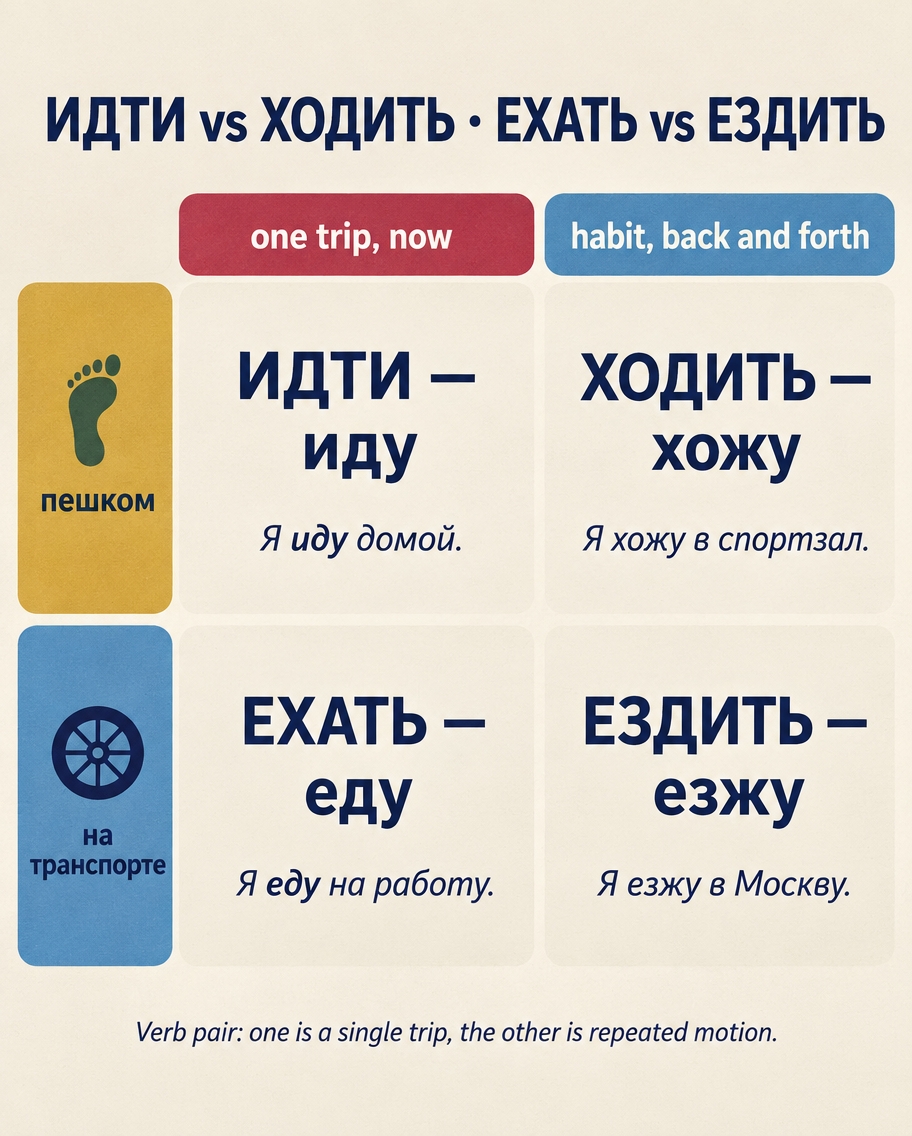
Russian asks what English never does: are you going on foot or by vehicle, and is this one journey or a habit? Lesson 7 installs идти, ходить, ехать and ездить, the на + transport chunks, and the only two motion prefixes you need at this level.
⏱ About 55 minutes26 phrases34 exercises
What you will learn
Choose between идти and ехать according to whether you go on foot or by vehicle
Choose between the one-way verbs (идти, ехать) and the return-or-habit verbs (ходить, ездить)
Conjugate идти and ехать in the present and produce the irregular past шёл, шла, шло, шли
Say how you travel with the на + transport chunks: наавтобусе, намашине, наметро, пешком
Ask and answer «Кудатыидёшь?», «Кактыедешь?» and «Вокзалдалеко?»
Use the only two A1 motion prefixes, пойти and прийти, and know that the rest of the grid waits until Lesson 15
Quick review
Say these aloud before you start. They come from earlier lessons.
Я живу́ в Москве́.I live in Moscow.Listen in Russian:Slow in Russian:Я живу́ в Москве́.
Где метро́?Where is the metro?Listen in Russian:Slow in Russian:Где метро́?
У меня́ есть кни́га.I have a book.Listen in Russian:Slow in Russian:У меня́ есть кни́га.
Вчера́ я рабо́тал.Yesterday I worked.Listen in Russian:Slow in Russian:Вчера́ я рабо́тал.
Она́ чита́ет кни́гу.She is reading a book.Listen in Russian:Slow in Russian:Она́ чита́ет кни́гу.
Мы хоти́м отдыха́ть.We want to rest.Listen in Russian:Slow in Russian:Мы хоти́м отдыха́ть.
Theory
One verb becomes two: on foot or by vehicle
English has one verb for leaving a place and getting somewhere else: "to go". Russian asks a question English never asks, and it asks it every single time. Are you going on your own two feet, or are you inside a vehicle? On foot is идти. By vehicle is ехать. There is no neutral option and no way to dodge the choice.
The split is about the means, not the distance. Walking two kilometres to the park takes идти, while driving two streets to the shop takes ехать. If a journey has several legs — you walk to the stop, ride the bus, walk again — Russian names the main leg, and the main leg is almost always the vehicle, so the whole trip takes ехать.
The good news is that this is a two-word decision, not a grammar system. Learn the pair, and every journey you describe for the rest of the course slots into one column or the other. Everything else in this lesson builds on it.
Я иду́ в парк.I am walking to the park.Listen in Russian:Slow in Russian:Я иду́ в парк.
Я е́ду в парк.I am going to the park (by transport).Listen in Russian:Slow in Russian:Я е́ду в парк.
Мы идём в кино́.We are walking to the cinema.Listen in Russian:Slow in Russian:Мы идём в кино́.
Она́ е́дет на метро́.She is going by metro.Listen in Russian:Slow in Russian:Она́ е́дет на метро́.
One trip or many: идти against ходить, ехать against ездить
Each of the two verbs has a partner, and the second split is just as important as the first. идти and ехать describe one journey in one direction, happening now. ходить and ездить describe either a round trip — there and back, with the return already implied — or a journey you make repeatedly, as a habit.
This is not aspect. All four verbs are imperfective, and the formal treatment of aspect waits until Lesson 13. What you have here is a separate opposition that Russian grammar books call determinacy, and it is best learnt as vocabulary: four verbs, two pairs, one question each. "Am I on my way?" takes идти or ехать. "Do I go there, or did I go and come back?" takes ходить or ездить.
The consequence is the single most useful discovery in this lesson: the Russian present of a one-way motion verb can only mean the English progressive. Яидувмагазин is "I am walking to the shop right now", never "I go to the shop most days". For the habit you must switch verb: Яхожувмагазин.
Я иду́ в магази́н.I am on my way to the shop (now, one direction).Listen in Russian:Slow in Russian:Я иду́ в магази́н.
Я хожу́ в магази́н.I go to the shop (regularly, or I go and come back).Listen in Russian:Slow in Russian:Я хожу́ в магази́н.
Вчера́ я ходи́л в кино́.Yesterday I went to the cinema (and came home again).Listen in Russian:Slow in Russian:Вчера́ я ходи́л в кино́.
Мы е́здим в Москву́.We go to Moscow (from time to time, by transport).Listen in Russian:Slow in Russian:Мы е́здим в Москву́.
Conjugating идти and ехать: two small irregulars
Both verbs look frightening and are actually short. идти takes the ordinary first-conjugation endings on the stem ид-: иду, идёшь, идёт, идём, идёте, идут. ехать does the same on ед-: еду, едешь, едет, едем, едете, едут. Two stems, twelve forms, and the stress never moves in ехать at all.
The surprise is in the past. ехать is perfectly regular — ехал, ехала, ехало, ехали — but идти changes stem entirely: шёл, шла, шло, шли. There is no way to predict it from the present, so learn the four forms as a block. Note that all four are one syllable long, which is why none of them carries a stress mark in this course.
The imperative has one more trap. иди and идите are regular, but ехать has no imperative of its own in the standard language: the form you use is поезжай and поезжайте, built from the prefixed verb. Forms such as ехай and езжай are non-standard, however often you hear them. And wherever a ё appears — идёшь, идёт, идём, идёте — print it; ё is always stressed, so those four forms need no acute.
идти́ → иду́, идёшь, иду́тto go on foot → I go, you go, they goListen in Russian:Slow in Russian:идти́ → иду́, идёшь, иду́т
е́хать → е́ду, е́дешь, е́дутto go by vehicle → I go, you go, they goListen in Russian:Slow in Russian:е́хать → е́ду, е́дешь, е́дут
Он шёл домо́й.He was walking home.Listen in Russian:Slow in Russian:Он шёл домо́й.
Иди́те пря́мо.Go straight ahead. (polite or plural)Listen in Russian:Slow in Russian:Иди́те пря́мо.
How you get there: the на + transport chunks
Russian answers "how?" with на plus the Prepositional case — the same case and the same ending you met in Lesson 5 for где?. наавтобусе, натрамвае, напоезде, насамолёте, навелосипеде. Because the feminine Prepositional also ends in -е, намашине looks different but is built the same way, and the two indeclinables simply do not change: наметро, натакси. There is nothing to work out, so learn each chunk whole.
One word stands apart: пешком, "on foot". It is a plain adverb, with no preposition and no ending, and it is the only means of travel in this lesson that needs neither.
Watch the в / на switch, because it is the one place learners trip. наметро means "by metro"; вметро means "inside the underground". The noun is indeclinable and identical in both, so the preposition and the question are all you have to go on: как? or где? The same contrast runs through every vehicle — яедувмашину (I am getting into the car) against яедунамашине (I am going by car).
Я е́ду на авто́бусе.I am going by bus.Listen in Russian:Slow in Russian:Я е́ду на авто́бусе.
Она́ е́дет на маши́не.She is going by car.Listen in Russian:Slow in Russian:Она́ е́дет на маши́не.
Мы идём пешко́м.We are going on foot.Listen in Russian:Slow in Russian:Мы идём пешко́м.
Я чита́ю в метро́.I am reading in the metro. (в = where, not how)Listen in Russian:Slow in Russian:Я чита́ю в метро́.
Two prefixes and no more: пойти and прийти
Russian builds a whole grid of motion verbs with prefixes — уйти, войти, выйти, дойти, зайти, перейти, подъехать — and it is genuinely useful. It is also A2. At this level you need exactly two, and the course deliberately stops there: пойти and прийти.
по- adds the idea of setting off. пойти is perfective, which means it has no present tense at all: пойду, пойдёшь, пойдёт look like present forms and are really future ones. Япойдудомой is "I shall set off home", and it is also the polite way to leave a room or a party. при- adds arrival: прийти means to arrive on foot, and again its "present" is future — яприду, "I shall arrive".
Both keep the odd past stem of идти: пошёл, пошла, пошло, пошли and пришёл, пришла, пришло, пришли. Everything else in the prefix grid waits for Lesson 15, where it is labelled A2 on purpose. Do not try to run ahead of this: two prefixes used correctly are worth more than twelve used badly.
Пойдём!Let's go! (on foot)Listen in Russian:Slow in Russian:Пойдём!
За́втра я пойду́ в парк.Tomorrow I shall go to the park.Listen in Russian:Slow in Russian:За́втра я пойду́ в парк.
Когда́ ты придёшь?When will you arrive? (on foot)Listen in Russian:Slow in Russian:Когда́ ты придёшь?
Она́ пришла́ домо́й.She came home. (feminine past of прийти)Listen in Russian:Slow in Russian:Она́ пришла́ домо́й.
The four motion verbs in the present tense
Form
идти́
ходи́ть
е́хать
е́здить
я
иду́
хожу́
е́ду
е́зжу
ты
идёшь
хо́дишь
е́дешь
е́здишь
он / она / оно
идёт
хо́дит
е́дет
е́здит
мы
идём
хо́дим
е́дем
е́здим
вы
идёте
хо́дите
е́дете
е́здите
они
иду́т
хо́дят
е́дут
е́здят
Two axes, not one. The first split is on foot (идти, ходить) against by vehicle (ехать, ездить); the second is one journey now (идти, ехать) against a round trip or a habit (ходить, ездить). All four are imperfective — this is not aspect, which is Lesson 13. Watch the stress in the first row: яхожу́ pulls it onto the ending, and every other form of ходить puts it straight back on the stem, while е́зжу never moves at all.
One way, or there and back?
Form
идти́ / ходи́ть — on foot
е́хать / е́здить — by transport
One journey, in progress now
Яиду́вмагази́н.
Яе́дувМоскву́.
There and back, one round trip
Вчера́яходи́лвмагази́н.
Вчера́яе́здилвМоскву́.
Repeatedly, as a habit
Яхожу́вмагази́нпешко́м.
Яе́зжувМоскву́напо́езде.
The present of a one-way verb can only mean right now. Яидувмагазин is never "I go to the shop most days" — that is Яхожувмагазин. English packs three meanings into one verb; Russian makes you choose before you open your mouth. In the past the same choice survives: яшёл means "I was on my way", яходил means "I went and came back".
Как? — the transport chunks with на
Form
авто́бус (m)
по́езд (m)
маши́на (f)
метро́ (indecl.)
на + Prepositional — "by …" (как?)
наавто́бусе
напо́езде
намаши́не
наметро́
в + Accusative — "into …" (куда?)
вавто́бус
впо́езд
вмаши́ну
вметро́
в + Prepositional — "inside …" (где?)
вавто́бусе
впо́езде
вмаши́не
вметро́
Every vehicle means "by …" with на plus the Prepositional: наавтобусе, напоезде, намашине, наметро. The masculine -е of Lesson 5 and the feminine -е of машина look identical here, so there is nothing to decide — learn the chunk whole. Switch to в and Lesson 6's где? / куда? contrast comes back unchanged: вавтобус is where you are going, вавтобусе is where you already are. пешком sits outside this table entirely — it is an adverb and takes no preposition.
The only two prefixes you need today: по- and при-
Form
идти́ (imperfective)
пойти́ (perfective)
прийти́ (perfective)
present / future, я
иду́
пойду́
приду́
present / future, они
иду́т
пойду́т
приду́т
past, он / она
шёл / шла
пошёл / пошла́
пришёл / пришла́
imperative, ты / вы
иди́, иди́те
пойди́, пойди́те
приди́, приди́те
по- adds "set off", при- adds "arrive". Both prefixed verbs are perfective, so the forms in the first two rows look like presents and are really futures: япойду means "I shall set off", яприду means "I shall arrive". All three pasts come from the ш-stem, not from the infinitive. Everything beyond these two prefixes is A2 and is deliberately saved for Lesson 15.
Vocabulary
Learn each word with its stress mark and its pronunciation. Nouns are given with their gender, animacy and their full six-case declension; verbs are given with their aspect and, where one exists, their partner verb.
Full six-case declension of the 14 nouns in this lesson
Each case is listed with the question word that selects it. Find the question you are answering and the ending follows.
Singular
Form
авто́бус (m)
трамва́й (m)
по́езд (m)
самолёт (m)
такси́ (n)
велосипе́д (m)
маши́на (f)
Москва́ (f)
метро́ (n)
вокза́л (m)
аэропо́рт (m)
парк (m)
магази́н (m)
кино́ (n)
Nominative · Кто? Что?
авто́бус
трамва́й
по́езд
самолёт
такси́
велосипе́д
маши́на
Москва́
метро
вокзал
аэропорт
парк
магазин
кино
Genitive · Кого? Чего?
авто́буса
трамва́я
по́езда
самолёта
такси́
велосипе́да
маши́ны
Москвы́
метро
вокзала
аэропорта
па́рка
магазина
кино
Dative · Кому? Чему?
авто́бусу
трамва́ю
по́езду
самолёту
такси́
велосипе́ду
маши́не
Москве́
метро
вокзалу
аэропорту
па́рку
магазину
кино
Accusative · Кого? Что?
авто́бус
трамва́й
по́езд
самолёт
такси́
велосипе́д
маши́ну
Москву́
метро
вокзал
аэропорт
парк
магазин
кино
Instrumental · Кем? Чем?
авто́бусом
трамва́ем
по́ездом
самолётом
такси́
велосипе́дом
маши́ной
Москво́й
метро
вокзалом
аэропортом
па́рком
магазином
кино
Prepositional · Оком? Очём?
авто́бусе
трамва́е
по́езде
самолёте
такси́
велосипе́де
маши́не
Москве́
метро
вокзале
аэропорте
па́рке
магазине
кино
Plural
Form
авто́бус (m)
трамва́й (m)
по́езд (m)
самолёт (m)
такси́ (n)
велосипе́д (m)
маши́на (f)
Москва́ (f)
метро́ (n)
вокза́л (m)
аэропо́рт (m)
парк (m)
магази́н (m)
кино́ (n)
Nominative · Кто? Что?
авто́бусы
трамва́и
поезда́
самолёты
—
велосипе́ды
маши́ны
—
—
вокзалы
аэропорты
па́рки
магазины
—
Genitive · Кого? Чего?
авто́бусов
трамва́ев
поездо́в
самолётов
—
велосипе́дов
маши́н
—
—
вокзалов
аэропортов
па́рков
магазинов
—
Dative · Кому? Чему?
авто́бусам
трамва́ям
поезда́м
самолётам
—
велосипе́дам
маши́нам
—
—
вокзалам
аэропортам
па́рким
магазинам
—
Accusative · Кого? Что?
авто́бусы
трамва́и
поезда́
самолёты
—
велосипе́ды
маши́ны
—
—
вокзалы
аэропорты
па́рки
магазины
—
Instrumental · Кем? Чем?
авто́бусами
трамва́ями
поезда́ми
самолётами
—
велосипе́дами
маши́нами
—
—
вокзалами
аэропортами
па́ркими
магазинами
—
Prepositional · Оком? Очём?
авто́бусах
трамва́ях
поезда́х
самолётах
—
велосипе́дах
маши́нах
—
—
вокзалах
аэропортах
па́рких
магазинах
—
A dash means the form does not exist. Plural-only nouns such as де́ньги and су́тки have no singular, and indeclinable nouns such as ко́фе and метро́ keep one form in all six cases.
Ready-to-use phrases
Куда́ ты идёшь?
Where are you going (on foot)?
IPA/kʊˈda tɨ ɪˈdʲoʂ/
Say itkoo-DAH TIH ih-DYOHSH?
идёшь is the one-way verb, so this asks about the journey in progress right now. Note the ё: идёшь, идёт, идём, идёте — all four print it, and because ё is always stressed none of them needs an acute.
informalquestionsmotion
Listen in Russian:Slow in Russian:Куда ты идёшь?
Я иду́ в магази́н.
I am walking to the shop.
IPA/ja ɪˈdu f mɐɡɐˈzʲin/
Say itYAH ih-DOO v muh-guh-ZEEN.
в + the Accusative answers куда? — the destination, exactly as in Lesson 6. The verb itself tells you that you are on foot.
neutralmotioncity
Listen in Russian:Slow in Russian:Я иду в магазин.
Я иду́ домо́й.
I am walking home.
IPA/ja ɪˈdu dɐˈmoj/
Say itYAH ih-DOO duh-MOY.
домой is the directional adverb, "homewards". Its locative partner дома (Lesson 5) answers где?, and the two never swap.
neutralmotionplace
Listen in Russian:Slow in Russian:Я иду домой.
Мы идём в кино́.
We are walking to the cinema.
IPA/mɨ ɪˈdʲom f kʲɪˈno/
Say itMIH ih-DYOHM f kih-NOH.
идём means "we are on our way", this minute. The в is pronounced [ф] before the voiceless к.
neutralmotioncity
Listen in Russian:Slow in Russian:Мы идём в кино.
Ты е́дешь и́ли идёшь?
Are you going by transport or on foot?
IPA/tɨ ˈjedʲɪʂ ˈilʲɪ ɪˈdʲoʂ/
Say itTIH YEH-dish EE-lih ih-DYOHSH?
The most important question in this lesson, because the two answers are not interchangeable. или is the "or" of an open choice, as opposed to а, which contrasts.
informalquestionsmotiontransport
Listen in Russian:Slow in Russian:Ты едешь или идёшь?
Как ты е́дешь?
How are you getting there?
IPA/kak tɨ ˈjedʲɪʂ/
Say itKAHK TIH YEH-dish?
The question that earns you the answer: наавтобусе, наметро, намашине or пешком. To somebody you address as вы it is Каквыедете?
informalquestionsmotiontransport
Listen in Russian:Slow in Russian:Как ты едешь?
Я е́ду в Москву́.
I am travelling to Moscow.
IPA/ja ˈjedʊ v mɐˈskvu/
Say itYAH YEH-doo v muh-SKVOO.
ехать covers every vehicle at once — bus, tram, car, train, plane, bicycle. Only your own two feet are excluded.
neutralmotiontravel
Listen in Russian:Slow in Russian:Я еду в Москву.
Она́ е́дет на метро́.
She is going by metro.
IPA/ɐˈna ˈjedʲɪt nɐ mʲɪˈtro/
Say ituh-NAH YEH-dit nuh mih-TROH.
на + the Prepositional is the fixed way to name the means of transport. метро is indeclinable, so this chunk is the easiest one in the set.
neutralmotiontransport
Listen in Russian:Slow in Russian:Она едет на метро.
Мы е́дем на авто́бусе.
We are going by bus.
IPA/mɨ ˈjedʲɪm nɐ ɐfˈtobʊsʲɪ/
Say itMIH YEH-dim nuh uh-FTOH-boo-syuh.
Two reductions in one word: the в of автобус devoices to [ф] before the т, and the first о collapses to [ɐ].
neutralmotiontransport
Listen in Russian:Slow in Russian:Мы едем на автобусе.
Он е́дет на маши́не.
He is going by car.
IPA/on ˈjedʲɪt nɐ mɐˈʂɨnʲɪ/
Say itOHN YEH-dit nuh muh-SHIH-nyuh.
This is the Prepositional of машина, the same case as наавтобусе, not the Instrumental. The и after the always-hard ш is really [ɨ].
neutralmotiontransport
Listen in Russian:Slow in Russian:Он едет на машине.
Я е́ду на по́езде.
I am travelling by train.
IPA/ja ˈjedʊ nɐ ˈpoɪstʲɪ/
Say itYAH YEH-doo nuh POH-yih-zdyuh.
по́езд moves its stress onto the ending in the plural — поезда́ — but this Prepositional form keeps it on the first syllable.
neutralmotiontransporttravel
Listen in Russian:Slow in Russian:Я еду на поезде.
Ты е́здишь в Москву́?
Do you go to Moscow (from time to time)?
IPA/tɨ ˈjezdʲɪʂ v mɐˈskvu/
Say itTIH YEH-zdish v muh-SKVOO?
ездить, not ехать: the question is about your life, not about the trip you are on this minute. Compare ТыедешьвМоскву?, asked of somebody with a suitcase in their hand.
informalquestionsmotiontravel
Listen in Russian:Slow in Russian:Ты ездишь в Москву?
Я хожу́ в парк пешко́м.
I walk to the park (regularly, or there and back).
IPA/ja xɐˈʐu f park pʲɪʂˈkom/
Say itYAH khuh-ZHOO f PAHRK pih-SHKOHM.
хожу́ is the only present-tense form of ходить with the stress on the ending — хо́дишь, хо́дит and хо́дят all pull it back to the stem. пешком needs no preposition: it is the one means-of-travel word in this lesson that takes no case.
neutralmotioncity
Listen in Russian:Slow in Russian:Я хожу в парк пешком.
Она́ хо́дит в кино́.
She goes to the cinema (regularly).
IPA/ɐˈna ˈxodʲɪt f kʲɪˈno/
Say ituh-NAH KHOH-dit f kih-NOH.
ходить, so this is a habit or a round trip, never a journey in progress. Contrast Онаидётвкино — she is on her way there now.
neutralmotionhobbies
Listen in Russian:Slow in Russian:Она ходит в кино.
По́езд идёт в Москву́.
The train goes to Moscow.
IPA/ˈpoɪst ɪˈdʲot f mɐˈskvu/
Say itPOH-yist ih-DYOHT v muh-SKVOO.
Vehicles themselves go with идти: поездидёт, автобусидёт, трамвайидёт. This is the standard way to say where a service runs. The final д of поезд devoices to [т].
neutraltransportmotion
Listen in Russian:Slow in Russian:Поезд идёт в Москву.
Куда́ идёт авто́бус?
Where does this bus go?
IPA/kʊˈda ɪˈdʲot ɐfˈtobʊs/
Say itkoo-DAH ih-DYOHT uh-FTOH-boos?
The question to ask at any stop. The same frame works for every vehicle: Кудаидёттрамвай? Кудаидётпоезд?
travelquestionstransport
Listen in Russian:Slow in Russian:Куда идёт автобус?
Вокза́л далеко́?
Is the station far?
IPA/vɐɡˈzal dʲɪlʲɪˈko/
Say itvug-ZAHL duh-lih-KOH?
No verb is needed: далеко is the whole predicate, and the rising intonation of Lesson 1 makes it a question. The к voices to [ɡ] before the з.
travelquestionscitytransport
Listen in Russian:Slow in Russian:Вокзал далеко?
Нет, вокза́л бли́зко.
No, the station is close.
IPA/nʲet vɐɡˈzal ˈblʲiskə/
Say itNYET, vug-ZAHL BLEE-skuh.
близко and далеко are the two answers that make asking worth the effort. Note the opposite stress: бли́зко but далеко́.
travelcitytransport
Listen in Russian:Slow in Russian:Нет, вокзал близко.
Иди́те пря́мо.
Go straight ahead.
IPA/ɪˈdʲitʲɪ ˈprʲamə/
Say itih-DEE-tyuh PRYAH-muh.
The вы imperative, which is what you use with a stranger or with more than one person. To one friend or child it is идипрямо.
politecitymotionimperative
Listen in Russian:Slow in Russian:Идите прямо.
Напра́во и́ли нале́во?
To the right or to the left?
IPA/nɐˈpravə ˈilʲɪ nɐˈlʲevə/
Say itnuh-PRAH-vuh EE-lih nuh-LYEH-vuh?
The natural follow-up once you know it is not far. Both adverbs are stressed on their second syllable: напра́во, нале́во.
travelquestionscity
Listen in Russian:Slow in Russian:Направо или налево?
Пойдём!
Let's go! (on foot)
IPA/pɐjˈdʲom/
Say itpuy-DYOHM!
пойти in the "we" imperative, and the everyday way to say "let's go". It works for a vehicle journey too, because you still walk to the stop. The group or polite version is пойдёмте, and the singular imperative is пойди́.
informalmotion
Listen in Russian:Slow in Russian:Пойдём!
Я пойду́ домо́й.
I'll go home. / I'm off home.
IPA/ja pɐjˈdu dɐˈmoj/
Say itYAH puy-DOO duh-MOY.
пойти is perfective, so this form looks like a present tense and is really a future one: "I shall set off home". It is also the standard polite way to leave.
neutralmotionfuture
Listen in Russian:Slow in Russian:Я пойду домой.
Когда́ ты придёшь?
When will you arrive?
IPA/kɐɡˈda tɨ prʲɪˈdʲoʂ/
Say itkug-DAH TIH prih-DYOHSH?
прийти is perfective, so придёшь is future. It covers arrival on foot; arriving by vehicle is приехать, which is Lesson 15.
informalquestionsmotionfuture
Listen in Russian:Slow in Russian:Когда ты придёшь?
За́втра я приду́ в парк.
Tomorrow I'll come to the park.
IPA/ˈzavtrə ja prʲɪˈdu f park/
Say itZAHF-truh YAH prih-DOO f PAHRK.
The perfective future needs no auxiliary: приду already means "I shall arrive". Compare the imperfective future of Lesson 2, ябудуидти, which is grammatical but sounds marked.
neutralmotionfuturetime
Listen in Russian:Slow in Russian:Завтра я приду в парк.
Вчера́ мы ходи́ли в кино́.
Yesterday we went to the cinema (and came back).
IPA/fˈtɕorə mɨ xɐˈdʲilʲɪ f kʲɪˈno/
Say itfuh-chih-RAH MIH khuh-DEE-lih f kih-NOH.
ходили, not шли: the round trip is finished and you are home again. «Вчерамышливкино» would mean you were on your way there at some point yesterday.
neutralpastmotion
Listen in Russian:Slow in Russian:Вчера мы ходили в кино.
Я е́зжу на велосипе́де.
I ride a bicycle.
IPA/ja ˈjeʐʐʊ nɐ vʲɪlɐsʲɪˈpʲedʲɪ/
Say itYAH YEH-zhoo nuh vih-luh-sih-PYEH-dyuh.
The з and the ж of езжу merge into a single long [ʐː]. ездить keeps its stress on the first syllable all the way through the paradigm: е́зжу, е́здишь, е́здит, е́здят.
neutraltransporthobbies
Listen in Russian:Slow in Russian:Я езжу на велосипеде.
Dialogues
Two friends on the same street
Tom meets Anna in the street. Both are on foot, so both use идти.
Tom
Привет, Анна! Куда ты идёшь?
Hi, Anna! Where are you going?
Listen in Russian:Slow in Russian:Привет, Анна! Куда ты идёшь?
Anna
Я иду в магазин. А ты?
I am walking to the shop. And you?
Listen in Russian:Slow in Russian:Я иду в магазин. А ты?
Tom
Я иду в парк. Это далеко?
I am walking to the park. Is it far?
Listen in Russian:Slow in Russian:Я иду в парк. Это далеко?
Anna
Нет, парк близко. Иди прямо.
No, the park is close. Go straight ahead.
Listen in Russian:Slow in Russian:Нет, парк близко. Иди прямо.
Tom
Спасибо! А магазин далеко?
Thank you! And is the shop far?
Listen in Russian:Slow in Russian:Спасибо! А магазин далеко?
Anna
Нет, магазин тоже близко.
No, the shop is close too.
Listen in Russian:Slow in Russian:Нет, магазин тоже близко.
Tom
Пойдём!
Let's go!
Listen in Russian:Slow in Russian:Пойдём!
Anna
Пойдём! Вот магазин, а вот парк.
Let's go! There is the shop, and there is the park.
Listen in Russian:Slow in Russian:Пойдём! Вот магазин, а вот парк.
Asking a stranger for the station
Anna stops a man in the street. They are strangers, so she uses вы.
Anna
Здравствуйте! Скажите, пожалуйста, вокзал далеко?
Hello! Could you tell me, is the station far?
Listen in Russian:Slow in Russian:Здравствуйте! Скажите, пожалуйста, вокзал далеко?
Man
Нет, вокзал близко.
No, the station is close.
Listen in Russian:Slow in Russian:Нет, вокзал близко.
Anna
Идти пешком?
Do I walk there?
Listen in Russian:Slow in Russian:Идти пешком?
Man
Да, идите прямо. Вот вокзал.
Yes, go straight ahead. There is the station.
Listen in Russian:Slow in Russian:Да, идите прямо. Вот вокзал.
Anna
Прямо и направо?
Straight ahead and to the right?
Listen in Russian:Slow in Russian:Прямо и направо?
Man
Нет, прямо и налево.
No, straight ahead and to the left.
Listen in Russian:Slow in Russian:Нет, прямо и налево.
Anna
Спасибо!
Thank you!
Listen in Russian:Slow in Russian:Спасибо!
Man
Пожалуйста!
You are welcome!
Listen in Russian:Slow in Russian:Пожалуйста!
How do we get to the cinema?
Ivan and Olga are planning the trip. Olga takes the metro; Ivan usually cycles.
Ivan
Ольга, мы идём в кино или едем?
Olga, are we walking to the cinema or going by transport?
Listen in Russian:Slow in Russian:Ольга, мы идём в кино или едем?
Olga
Кино далеко. Мы едем.
The cinema is far. We are going by transport.
Listen in Russian:Slow in Russian:Кино далеко. Мы едем.
Ivan
На автобусе или на метро?
By bus or by metro?
Listen in Russian:Slow in Russian:На автобусе или на метро?
Olga
На метро. Я езжу на метро. А ты?
By metro. I go by metro. And you?
Listen in Russian:Slow in Russian:На метро. Я езжу на метро. А ты?
Ivan
Я езжу на велосипеде. Но сегодня холодно.
I ride a bicycle. But today it is cold.
Listen in Russian:Slow in Russian:Я езжу на велосипеде. Но сегодня холодно.
Olga
И ты едешь на автобусе?
So you are going by bus?
Listen in Russian:Slow in Russian:И ты едешь на автобусе?
Ivan
Нет, сегодня я еду на метро. Пойдём!
No, today I am going by metro. Let's go!
Listen in Russian:Slow in Russian:Нет, сегодня я еду на метро. Пойдём!
Olga
Пойдём!
Let's go!
Listen in Russian:Slow in Russian:Пойдём!
Exercises
Answer actively — try to recall the Russian before you look at any hint.
ConjugationExercise 1
Give the present tense form for "ты".
идти — ты
ConjugationExercise 2
Give the present tense form for "мы".
ехать — мы
ConjugationExercise 3
Give the present tense form for "я".
ходить — я
ConjugationExercise 4
Give the future tense form for "я".
пойти — я (future)
ConjugationExercise 5
Give the past tense form for a female speaker.
идти — past, feminine
Translate into RussianExercise 6
Translate into Russian.
I am walking to the shop.
Translate into RussianExercise 7
Translate into Russian.
We are going to Moscow by train.
Translate into RussianExercise 8
Translate into Russian.
She is going to the park on foot.
Translate into RussianExercise 9
Translate into Russian.
Do you go to Moscow (from time to time)?
Translate into RussianExercise 10
Translate into Russian.
Go straight ahead. (to one person, politely)
Translate into RussianExercise 11
Translate into Russian.
Tomorrow I will set off for the park on foot.
Translate into EnglishExercise 12
Translate into English.
Яиду́домо́й.
Translate into EnglishExercise 13
Translate into English.
Она́е́детнаметро́.
Translate into EnglishExercise 14
Translate into English.
Вчера́мыходи́ливкино́.
Fill the gapExercise 15
Fill the gap: "I am walking to the park (now)."
Я ___ впарк.
Fill the gapExercise 16
Fill the gap: "We are going by bus."
Мы ___ наавтобусе.
Fill the gapExercise 17
Fill the gap: "Go straight ahead!" (polite, to one person)
___ прямо!
Fill the gapExercise 18
Fill the gap: "Do you go to Moscow (from time to time)?"
Ты ___ вМоскву?
Choose the caseExercise 19
Choose the right form: "I am travelling to Moscow."
Яеду ___ .
Choose the caseExercise 20
Choose the right form: "We are walking to the park."
Мыидём ___ .
Choose the caseExercise 21
Choose the right form: "She lives in Moscow."
Онаживёт ___ .
Choose the caseExercise 22
Choose the right form: "I am reading in the metro."
Ячитаю ___ .
Choose the caseExercise 23
Choose the right form: "She is going by car."
Онаедет ___ .
Choose the endingExercise 24
Choose the right ending.
Яедунаавтобус___ .
Choose the endingExercise 25
Choose the right ending.
Онаедетнамашин___ .
Choose the endingExercise 26
Choose the right ending.
МыедемвМоск___ .
Multiple choiceExercise 27
Choose the correct form.
You are on your way to the shop right now, on foot. Which form do you use?
Choose the aspectExercise 28
Choose the right verb: a single journey tomorrow, on foot.
За́втрая ___ впарк.
True or falseExercise 29
Answer true or false.
«Яидувмагазин» can mean "I go to the shop most days."
Match the pairsExercise 30
Pair the words.
Match each vehicle with the chunk that means "by …".
Word orderExercise 31
Put the words in order.
Build the sentence: "I am walking to the shop on foot."
Transform the sentenceExercise 32
Rewrite the sentence.
Rewrite this so that it means a habit rather than a journey in progress: «Яидувпарк.»
Choose the stressExercise 33
Choose the correctly stressed form.
Where does the stress fall in «велосипед»?
Listen and typeExercise 34
Play the audio and type what you hear.
Listen and type the sentence.
Speak now
Say each sentence aloud three times: slowly, at normal speed, then from memory. Then swap the destination or the vehicle for your own and say the new version out loud. Before you speak, decide which of the four verbs you need — on foot or by vehicle, one journey or a habit.
Я иду́ в магази́н.I am walking to the shop.Listen in Russian:Slow in Russian:Я иду́ в магази́н.
Я е́ду в Москву́ на по́езде.I am travelling to Moscow by train.Listen in Russian:Slow in Russian:Я е́ду в Москву́ на по́езде.
Мы идём в кино́ пешко́м.We are walking to the cinema.Listen in Russian:Slow in Russian:Мы идём в кино́ пешко́м.
Ты е́здишь на метро́?Do you travel by metro?Listen in Russian:Slow in Russian:Ты е́здишь на метро́?
За́втра я пойду́ в парк.Tomorrow I will go to the park.Listen in Russian:Slow in Russian:За́втра я пойду́ в парк.
Иди́те пря́мо. Вот вокза́л.Go straight ahead. There is the station.Listen in Russian:Slow in Russian:Иди́те пря́мо. Вот вокза́л.
Lesson checkpoint
Before you move on, make sure you can do all of this without looking:
Recite the present tense of идти and of ехать from memory, all six forms of each
Say aloud, in Russian, how you get to work or to study today — use на + the vehicle, or пешком if you walk
Explain to yourself the difference between «яиду» and «яхожу», then give one true example of each from your own week
Conjugate пойти and прийти in the future, all six forms of each, without looking
Give the four past-tense forms of идти and say why they surprise an English speaker
Ask a stranger the way to the station using вы, then answer the same question as if you were the stranger
Remember this
идти is going on foot and ехать is going by vehicle. Russian asks the question English never asks, and it asks it on every journey.
идти and ехать are one journey in one direction, in progress now; ходить and ездить are the round trip or the habit. All four are imperfective — this is not aspect.
The present of a one-way motion verb can only mean "am going now": «яидувмагазин» is never "I go to the shop most days".
идти is irregular in the past — шёл, шла, шло, шли — while ехать is regular there: ехал, ехала, ехало, ехали. ехать has no unprefixed imperative; the norm is поезжай.
The means of transport is на + the Prepositional: наавтобусе, напоезде, намашине, наметро. пешком is an adverb and takes no preposition at all.
Two prefixes only: пойти "to set off" and прийти "to arrive". Both are perfective, so their "present" forms are really future: япойду, яприду.