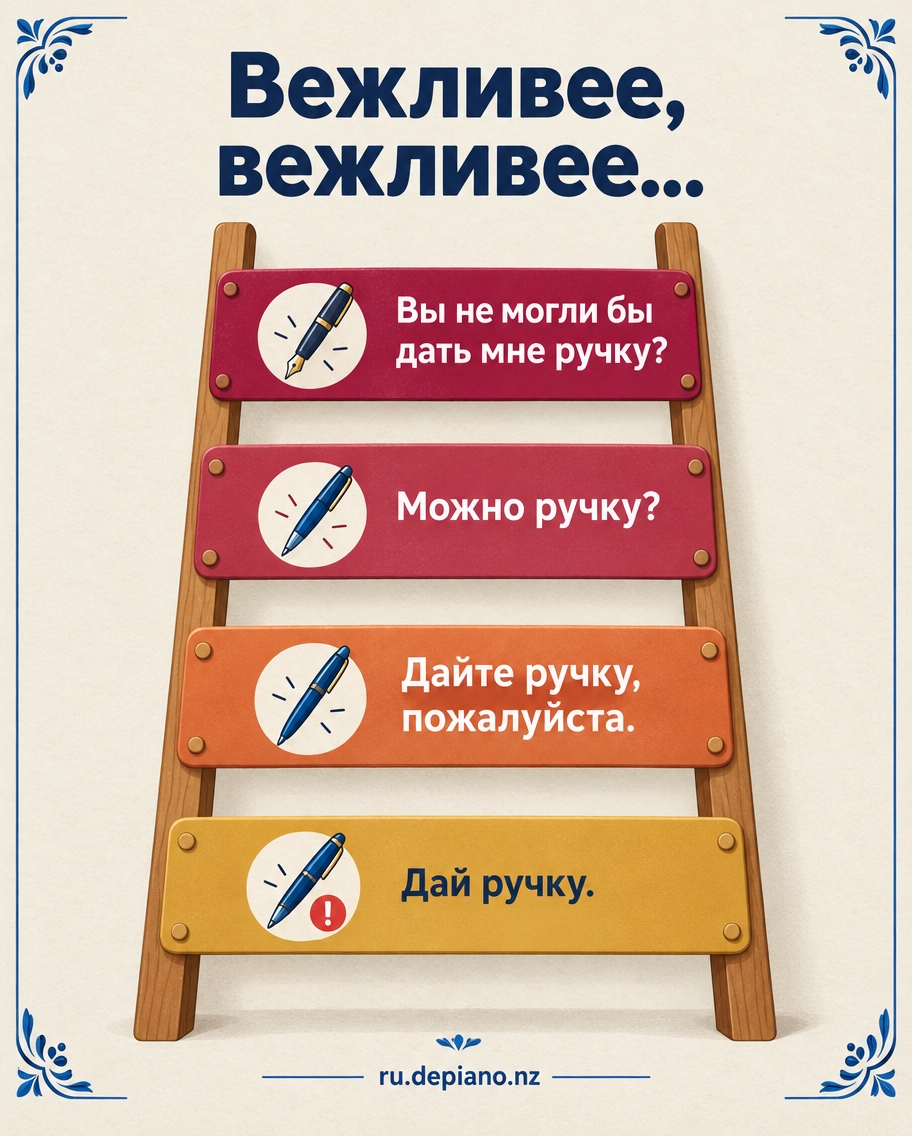
How to ask for anything in Russian without sounding blunt: the four-rung politeness ladder, the particle бы that makes the conditional, the complete ты/вы switch, извините against простите, and the four frames that report a problem and get it fixed.
⏱ About 55 minutes24 phrases32 exercises
What you will learn
Climb the four-rung politeness ladder — imperative plus пожалуйста, можно, яхотелбы, немоглибывы — and pick the rung that fits the person in front of you
Use the particle бы to build a conditional: say where it sits, what it can never do, and why «яхочубы» does not exist
Switch a whole sentence between ты and вы — pronoun, verb, imperative, possessive, apology and request — without mixing the two registers
Apologise at the right weight: извини and извините for social friction, прости and простите for a real offence, and «за» plus the accusative for what you are sorry about
Report a problem in four frames — этонеработает, уменяпроблемас, япотерял, мненужнапомощь — and get the case government right in each of them
Open, run and close a telephone call and a short written message in Russian
Quick review
Say these aloud before you start. They come from earlier lessons.
Скажите ещё раз, пожалуйста.Say that once more, please.Listen in Russian:Slow in Russian:Скажите ещё раз, пожалуйста.
Можно?May I? / Is it allowed?Listen in Russian:Slow in Russian:Можно?
У меня нет времени.I haven't got any time.Listen in Russian:Slow in Russian:У меня нет времени.
Мне нужно к врачу.I need to get to a doctor.Listen in Russian:Slow in Russian:Мне нужно к врачу.
У меня проблема.I have a problem.Listen in Russian:Slow in Russian:У меня проблема.
Помогите мне, пожалуйста.Please help me.Listen in Russian:Slow in Russian:Помогите мне, пожалуйста.
Theory
The politeness ladder: four ways to ask for something
Russian has no verb form for "could". There is no auxiliary to reach for and no subjunctive to memorise, so politeness is built out of four separate levers instead — the вы register, the particle бы, the negative question, and пожалуйста in the right place. You can pull one of them or all four at once, and the rung you choose tells the listener exactly how big the favour is and how well you know them.
From most direct to softest, the four rungs are these. (1) An imperative plus пожалуйста: «Скажите, пожалуйста, гдеаптека.» This is not rude — it is the ordinary way to ask a stranger for something small and quick, and the пожалуйста is doing all the softening. (2) «Можно» plus an infinitive: «Можновойти?» You are asking permission rather than requesting an action, which is why this is the default in shops, offices and doorways, anywhere you might be intruding. (3) «Яхотелбы» or «Яхотелабы»: you state a wish instead of giving an order, and the verb agrees with you, the speaker, not with the listener. This is the rung for cafés, ticket desks and anything formal. (4) «Немоглибывы» plus an infinitive: a negative question about the other person's ability, in the conditional. It is the softest thing Russian has, and it is what you use for a real favour.
One warning about пожалуйста, because English speakers put it in the wrong place every time. In Russian it goes after the verb or at the very end of the request — «Помогитемне, пожалуйста» — and it never opens the sentence the way English "Please," does. «Пожалуйста, помогитемне» is perfectly understandable and sounds translated. On its own, of course, пожалуйста means "you're welcome" or "here you are", which you have known since Lesson 1.
Скажите, пожалуйста, где аптека.Tell me please, where is the pharmacy?Listen in Russian:Slow in Russian:Скажите, пожалуйста, где аптека.
Можно войти?May I come in?Listen in Russian:Slow in Russian:Можно войти?
Я хотела бы чашку кофе.I'd like a cup of coffee.Listen in Russian:Slow in Russian:Я хотела бы чашку кофе.
Не могли бы вы мне помочь?Could you help me?Listen in Russian:Slow in Russian:Не могли бы вы мне помочь?
бы — the one-syllable conditional
бы is a single syllable and it does the whole job of English "would". It attaches to a PAST tense form and never to a present one, and that is the only rule you really need: яхотелбы, якупилбы, немоглибывы. There is no such thing as «яхочубы», and no amount of wanting will get бы next to a present-tense verb. The past form here has lost its pastness — хотелбы is not "wanted" but "would like" — which is the same trick the conditional plays in English.
Its position is fixed, and this is where learners go wrong constantly. бы is a clitic: an unstressed word with no stress of its own, so it has to lean on the word in front of it. It sits immediately after the finite verb and can never open a clause. In «Яхотелбыкофе», «Немоглибывыпомочь?» and «Вынемоглибысказатьещёраз?» it is glued to хотел and могли every time. Notice what you ARE free to move: the pronoun. «Немоглибывы…» and «Вынемоглибы…» mean the same thing, the first a shade more formal. What you cannot do is pull бы away from the verb.
Two more facts and you have the whole particle. Only one бы per clause — Russian never doubles it. And the conditional is really half of a bigger construction whose other half is "if": to say "if I had time, I would help" you need a Russian word for "if", and that word arrives with the whole connector kit in Lesson 20, which is where the full counterfactual sentence is built. Until then, use бы only inside the two formulas you have just met — the wish, «яхотелбы», and the request, «немоглибывы». Between them they cover very nearly everything a visitor has to ask for. One honest label: the conditional with бы sits a step past the A1 minimum, and Lessons 17 to 24 are where this course goes past it. It is worth the climb early, because these two formulas are the difference between sounding like a phrasebook and sounding like a person making a request.
Я хотел бы кофе, пожалуйста.I'd like a coffee, please. (a man speaking)Listen in Russian:Slow in Russian:Я хотел бы кофе, пожалуйста.
Я хотела бы кофе, пожалуйста.I'd like a coffee, please. (a woman speaking)Listen in Russian:Slow in Russian:Я хотела бы кофе, пожалуйста.
Не могли бы вы мне помочь?Could you help me?Listen in Russian:Slow in Russian:Не могли бы вы мне помочь?
Вы не могли бы сказать ещё раз?Could you say that once more?Listen in Russian:Slow in Russian:Вы не могли бы сказать ещё раз?
ты and вы all the way down
Lesson 3 introduced вы as the polite singular and Lesson 16 drilled the -те imperative. This lesson closes the topic, because politeness is where the two registers actually meet — and the point worth making is that the switch is never one word. It runs through the whole sentence: the pronoun, the verb ending, the imperative, the possessive, the apology and the request. Change one of them and you have to change all of them.
The first matrix below is the whole system on one page. Read it across rather than down: «Скажимнетвойномер» and «Скажитемневашномер» are the same sentence in two registers, and so are «Прости, янезнал» and «Простите, янезнал». Mixing them — «Скажите, гдетвойдом?» — is the most revealing foreigner mistake there is, far more than a wrong case ending, because it happens in the first five words of the conversation and it is impossible to hear as anything but a mistake.
Two rules of use. вы is the default with any adult you do not know well, with anyone noticeably older than you, and with anyone providing you a service — shop assistants, drivers, doctors, officials. ты is for friends, family, children, students of the same age, and anyone who has offered it. That offer, «Давайтенаты», always comes from the older or more senior of the two; making it upwards is a social blunder. And вы carries one more job that has nothing to do with politeness: it is also the ordinary plural "you". So «выхотитекофе» can be one person addressed formally or four people addressed casually, and only the situation tells you which.
Скажи мне твой номер.Tell me your number. (one friend)Listen in Russian:Slow in Russian:Скажи мне твой номер.
Скажите мне ваш номер.Tell me your number. (one stranger, or several people)Listen in Russian:Slow in Russian:Скажите мне ваш номер.
Прости, я не знал.Sorry, I didn't know. (ты)Listen in Russian:Slow in Russian:Прости, я не знал.
Не могли бы вы сказать ещё раз?Could you say that once more? (вы)Listen in Russian:Slow in Russian:Не могли бы вы сказать ещё раз?
Apologising: извините, простите, and what they govern
Four words do almost all of the work, and all four are imperatives. Извини and извините come from the perfective verb извинить; прости and простите come from the perfective простить. The -те is the вы ending you built in Lesson 16, so извините is polite and plural at the same time. The fact that Russians apologise in the imperative — literally "excuse me!" — is worth noticing once and then not thinking about again.
The two verbs are not interchangeable, and the difference is one of weight. Извините is light and social: you brush past someone on the metro, you interrupt, you catch a stranger's attention in the street — «Извините, гдеметро?» is "excuse me" rather than "I'm sorry". Простите is heavier and personal: you have actually done something to this person and you are asking them to forgive you. One step above it again is «Прошупрощения», literally "I ask forgiveness", formal and a little old-fashioned, and exactly right when you have made a real mistake in front of someone you do not know. Add пожалуйста to any of them and the apology gets warmer rather than more urgent.
The grammar is easy and worth getting right. Both verbs take «за» plus the accusative for the thing you are sorry about: «Извинитезаошибку», «Проститезазвонок». Russian then needs no "that"-clause to give the reason — a comma and a plain statement is the natural shape, «Простите, янепонял», and the «…, что …» construction is Lesson 20. The imperfective partners exist too. Извинять is rare, because apologising is a single completed act, but прощать is common: you will hear «Ятебяпрощаю», and «Прощайте!» survives as a farewell that implies you may not meet again.
Извините, пожалуйста.I'm so sorry. / Excuse me, please.Listen in Russian:Slow in Russian:Извините, пожалуйста.
Простите, я не понял.Sorry, I didn't understand.Listen in Russian:Slow in Russian:Простите, я не понял.
Извините за ошибку.Sorry about the mistake.Listen in Russian:Slow in Russian:Извините за ошибку.
Прошу прощения.I beg your pardon.Listen in Russian:Slow in Russian:Прошу прощения.
Reporting a problem: four frames that get you help
When something goes wrong, Russian reaches for four frames, and between them they cover very nearly everything. «Этонеработает» — it does not work; работать is Lesson 2 and the negative is the ordinary не in front of the verb. «Уменяпроблемас…» — I have a problem with something, where с is the preposition from Lesson 10 and it demands the instrumental ending: стелефоном, скомпьютером, скартой. «Япотерял…» or «Япотеряла…» — I have lost something, accusative. And «Мненужнапомощь» — I need help.
Of the four, «Уменянеработаеттелефон» is the most idiomatic, and it is worth seeing why it is built the way it is. The уменя frame from Lesson 4 means "at my place, in my possession"; the thing that has broken stays in the nominative because it is the grammatical subject; and неработает is simply said about it. The sentence means, very literally, "at my place the phone is not working". You can say «Мойтелефоннеработает» and be perfectly grammatical, but you will sound like a textbook. Say «Уменянеработаеттелефон» and you sound Russian.
«Мненужнапомощь» needs one new form. Нужна is the short form of нужный, and short adjectives agree with the thing that is needed, never with the person who needs it: нужен (masculine), нужна (feminine), нужно (neuter), нужны (plural). The person goes in the dative — мне, нам, вам — and the thing stays in the nominative: «Мненуженврач», «Мненужнавода», «Намнужновремя». Lesson 20 takes short adjectives much further; this one set is enough to ask for anything. On the telephone a whole call is three moves: say who you are («Здравствуйте, этоМарина»), give the frame, and close («Спасибозапомощь»). In writing it is the same three, and the polite acknowledgement that a message has arrived is «Яполучилвашеписьмо».
Телефон не работает.The phone isn't working.Listen in Russian:Slow in Russian:Телефон не работает.
У меня проблема с компьютером.I have a problem with the computer.Listen in Russian:Slow in Russian:У меня проблема с компьютером.
У меня не работает телефон.My phone isn't working. (literally: at my place the phone is not working)Listen in Russian:Slow in Russian:У меня не работает телефон.
Мне нужна помощь.I need help.Listen in Russian:Slow in Russian:Мне нужна помощь.
ты / вывовсехформах — the register switch, one row at a time
Form
ты — one person you know well
вы — one stranger, or any number of people
местоимение — the pronoun
ты
вы
настоящеевремя — the present tense
тыхо́чешь · тымо́жешь · тызна́ешь
выхоти́те · вымо́жете · вызна́ете
повелительное — the imperative
скажи́ · помоги́ · дай · извини́
скажи́те · помоги́те · да́йте · извини́те
притяжательное — the possessive
твойно́мер · твоя́кни́га · твоёписьмо́
вашно́мер · ва́шакни́га · ва́шеписьмо́
просьбасбы — a request with бы
немогбыты … · немогла́быты …
немогли́бывы …
желание — a wish
яхоте́лбы · яхоте́лабы
яхоте́лбы · яхоте́лабы
несколькочеловек — more than one person
— ты is never plural in modern Russian
вы — always, whoever they are and however well you know them
Read the matrix across, not down. Скажимнетвойномер and Скажитемневашномер are one sentence in two registers, and so are Извини, янезнал and Извините, янезнал. The switch is never a single word: pronoun, verb ending, imperative, possessive and request all move together, and mixing them is the fastest way to be heard as a foreigner, because it happens in the first five words of the conversation. Two rows are traps. The wish row does not change at all — яхотелбы is the same whoever you are talking to, because the past tense agrees with the speaker, and a woman says яхотелабы. And the last row is not about politeness: вы is also the ordinary plural "you", so выхотитекофе can be one person addressed formally or four people addressed casually, and only the situation says which.
Четыреступенивежливости — the four rungs of a request
Form
1 · повели́тельное + пожа́луйста
2 · мо́жно + инфинити́в
3 · яхоте́лбы + …
4 · немогли́бывы + инфинити́в
пример — an example
Скажи́те, пожа́луйста, гдеапте́ка.
Мо́жновойти́?
Яхоте́лабыча́шкуко́фе.
Немогли́бывымнепомо́чь?
чтовынасамомделепросите — what you are really asking for
an action, directly, softened only by пожа́луйста
permission — may this happen at all?
you state a wish and leave the decision open
about the other person's ability, in the conditional, in the negative
комуикогда — who and when
everyday and small: directions, a shop counter, a quick favour
shops, offices, doorways, anywhere you might be intruding
cafés, ticket desks, travel, anything formal; it agrees with the speaker, never with the listener
a genuine favour from a person — a stranger, a colleague, someone senior
меняетсялисты / вы? — does the register change it?
скажи́ · скажи́те
neither — мо́жно is impersonal, so there is no person in it to change
neither — хоте́лбы agrees with the speaker, not with the listener
немогбыты · немогли́бывы
Climb only as high as the favour needs. Rung 1 with пожалуйста is perfectly polite for a small thing and is what Russians say most of the time; rung 4 is for a real favour, and using it to ask for a coffee would sound like a proposal of marriage. Rung 2 asks permission rather than action, which is why it is the one you use before you walk through a door. Rung 3 is the one English speakers reach for too early: it is formal, and in a café it can sound stiff, but at a desk, on the telephone, or with a surname it is exactly right. Only rungs 1 and 4 change between ты and вы; rungs 2 and 3 have no person in them to change. The rungs stack, and stacking is normal: «Извините, пожалуйста, немоглибывы…» uses three of them at once and is not over-polite, only Russian.
Сообщитьопроблеме — the case government of a problem report
Form
форму́ла — the frame
паде́ж — what it governs
приме́р — an example
frame 1 — it is broken
Э́тонерабо́тает.
nothing — the broken thing is the subject, so nominative
Компью́тернерабо́тает.
frame 2 — I have a problem with …
Уменя́пробле́мас …
с + instrumental
Уменя́пробле́маскомпью́тером.
frame 2, the idiomatic version
Уменя́нерабо́тает …
nominative — and the thing is still the subject, not the object
Уменя́нерабо́таеттелефо́н.
frame 3 — I have lost …
Япотеря́л · потеря́ла …
accusative
Япотеря́лкошелёк.
frame 4 — I need …
Мнену́жен · нужна́ · ну́жно · ну́жны …
nominative — the short adjective agrees with the thing needed, and the person is dative
Мненужна́по́мощь.
the apology
Извини́теза … · Прости́теза …
за + accusative
Извини́тезаоши́бку.
the thanks
Спаси́боза …
за + accusative
Спаси́бозапо́мощь.
Four of the seven rows are accusative, and they all answer the same question — зачто? — because за in this sense means "for" and governs the accusative, exactly as it does for motion into a place in Lesson 6. The two nominative rows are the ones English speakers get wrong. In «Уменянеработаеттелефон» the phone is the subject, not the object, so it stays in the nominative even though it is yours; the sentence means, literally, "at my place the phone is not working", and it is far more idiomatic than «Мойтелефоннеработает», which is grammatical but sounds translated. In «Мненужнапомощь» the help is the subject and the person who needs it goes in the dative. The instrumental after «проблемас» is the с of Lesson 10 — скем? счем? — and it is why the ending changes: стелефоном, скомпьютером, скартой.
Vocabulary
Learn each word with its stress mark and its pronunciation. Nouns are given with their gender, animacy and their full six-case declension; verbs are given with their aspect and, where one exists, their partner verb.
Full six-case declension of the 11 nouns in this lesson
Each case is listed with the question word that selects it. Find the question you are answering and the ending follows.
Singular
Form
проще́ние (n)
поло́мка (f)
жа́лоба (f)
звоно́к (m)
сообще́ние (n)
пробле́ма (f)
оши́бка (f)
телефо́н (m)
письмо́ (n)
но́мер (m)
по́мощь (f)
nom · Кто? Что?
проще́ние
поло́мка
жа́лоба
звоно́к
сообще́ние
пробле́ма
оши́бка
телефо́н
письмо́
но́мер
по́мощь
gen · Кого? Чего?
проще́ния
поло́мки
жа́лобы
звонка́
сообще́ния
пробле́мы
оши́бки
телефо́на
письма́
но́мера
по́мощи
dat · Кому? Чему?
проще́нию
поло́мке
жа́лобе
звонку́
сообще́нию
пробле́ме
оши́бке
телефо́ну
письму́
но́меру
по́мощи
acc · Кого? Что?
проще́ние
поло́мку
жа́лобу
звоно́к
сообще́ние
пробле́му
оши́бку
телефо́н
письмо́
но́мер
по́мощь
instr · Кем? Чем?
проще́нием
поло́мкой
жа́лобой
звонко́м
сообще́нием
пробле́мой
оши́бкой
телефо́ном
письмо́м
но́мером
по́мощью
prep · Оком? Очём?
проще́нии
поло́мке
жа́лобе
звонке́
сообще́нии
пробле́ме
оши́бке
телефо́не
письме́
но́мере
по́мощи
Plural
Form
проще́ние (n)
поло́мка (f)
жа́лоба (f)
звоно́к (m)
сообще́ние (n)
пробле́ма (f)
оши́бка (f)
телефо́н (m)
письмо́ (n)
но́мер (m)
по́мощь (f)
nom · Кто? Что?
—
поло́мки
жа́лобы
звонки́
сообще́ния
пробле́мы
оши́бки
телефо́ны
пи́сьма
номера́
по́мощи
gen · Кого? Чего?
—
поло́мок
жа́лоб
звонко́в
сообще́ний
пробле́м
оши́бок
телефо́нов
пи́сем
номеро́в
по́мощей
dat · Кому? Чему?
—
поло́мкам
жа́лобам
звонка́м
сообще́ниям
пробле́мам
оши́бкам
телефо́нам
пи́сьмам
номера́м
по́мощам
acc · Кого? Что?
—
поло́мки
жа́лобы
звонки́
сообще́ния
пробле́мы
оши́бки
телефо́ны
пи́сьма
номера́
по́мощи
instr · Кем? Чем?
—
поло́мками
жа́лобами
звонка́ми
сообще́ниями
пробле́мами
оши́бками
телефо́нами
пи́сьмами
номера́ми
по́мощами
prep · Оком? Очём?
—
поло́мках
жа́лобах
звонка́х
сообще́ниях
пробле́мах
оши́бках
телефо́нах
пи́сьмах
номера́х
по́мощах
Ready-to-use phrases
Извини́те, пожа́луйста.
I'm so sorry. / Excuse me, please.
IPA/ɪzvʲɪˈnʲitʲə pɐˈʐalujstə/
Say itih-zvih-NEE-tyuh, puh-ZHAH-luy-stuh.
The standard "I'm so sorry", and also the standard way to stop a stranger in the street before you ask anything of them. The пожалуйста here does not mean "please" — it warms the apology. To one person you know well, the same sentence is «Извини, пожалуйста».
politepolitenessregistercore
Listen in Russian:Slow in Russian:Извините, пожалуйста.
Не могли́ бы вы мне помо́чь?
Could you help me?
IPA/nʲɪ mɐˈɡlʲi bɨ vɨ mnʲe pɐˈmotɕ/
Say itNYEH muh-GLEE BIH VIH muh-NYEH puh-MOHCH?
The softest rung of the ladder: a negative question about the other person's ability, in the conditional. помочь governs the DATIVE, so "me" is мне and never меня. бы stays glued to могли; what you may move is the pronoun — «Вынемоглибымнепомочь?» means exactly the same thing.
politepolitenessregisteremergencygovernment
Listen in Russian:Slow in Russian:Не могли бы вы мне помочь?
Вы не могли́ бы сказа́ть ещё раз?
Could you say that once more?
IPA/vɨ nʲɪ mɐˈɡlʲi bɨ skɐˈzatʲ ɪˈʂːo ras/
Say itVIH NYEH muh-GLEE BIH skuh-ZYAT yih-SHCHOH RAHS?
The same rung with the pronoun in front, which is the order you will hear most often and is a shade less formal. ещё carries ё, and ё is always stressed, so it never takes an extra mark. сказать is the perfective partner of говорить (Lesson 13) and is the right one here: you want the sentence said again once, not talked at continuously.
politepolitenessregisterquestionscommunication
Listen in Russian:Slow in Russian:Вы не могли бы сказать ещё раз?
Я хоте́л бы ча́шку ко́фе, пожа́луйста.
I'd like a cup of coffee, please.
IPA/ja xɐˈtʲel bɨ ˈtɕaʂkʊ ˈkofʲe pɐˈʐalujstə/
Say itYAH khuh-TYEL BIH CHAH-shkoo KOH-fyuh, puh-ZHAH-luy-stuh.
Rung three, said by a man. A woman says «Яхотелабы»; the past tense agrees with the speaker, not with the person being asked, which is why this rung does not change between ты and вы. чашку is the accusative of чашка (Lesson 10) and кофе is indeclinable, so it stays кофе in every case (Lesson 1).
politepolitenessregisterfoodrestaurant
Listen in Russian:Slow in Russian:Я хотел бы чашку кофе, пожалуйста.
Я хоте́ла бы купи́ть телефо́н.
I'd like to buy a phone.
IPA/ja xɐˈtʲelə bɨ kʊˈpʲitʲ tʲɪlʲɪˈfon/
Say itYAH khuh-TYEH-luh BIH koo-PEET tih-lih-FOHN.
The same rung said by a woman, and followed by an infinitive rather than a noun: «яхотелабы» takes either. купить is perfective (Lesson 13), which is what a purchase is — one completed act. The imperfective покупать would be about shopping as a habit.
politepolitenessregistershopping
Listen in Russian:Slow in Russian:Я хотела бы купить телефон.
Мо́жно войти́?
May I come in?
IPA/ˈmoʐnə vɐjˈtʲi/
Say itMOHZH-nuh vuy-TEE?
Rung two: an impersonal construction with no subject and no person to conjugate, asking whether something is permitted at all. The perfective войти (Lesson 15) asks about this one act of coming in; the imperfective входить would ask whether entering is allowed here as a rule. «Можноявойду?» is equally good Russian and a little more personal.
politepolitenessregisterplacemotion
Listen in Russian:Slow in Russian:Можно войти?
Мо́жно мне посмотре́ть?
May I have a look?
IPA/ˈmoʐnə mnʲe pəsmɐˈtrʲetʲ/
Say itMOHZH-nuh muh-NYEH puh-smuh-TRYET?
The same rung with the person who wants it added in the dative: можномне. посмотреть is the perfective partner of смотреть (Lesson 13), and it is what you ask for in a shop when you want to handle the thing before you decide.
politepolitenessregistershopping
Listen in Russian:Slow in Russian:Можно мне посмотреть?
Мо́жно ваш но́мер телефо́на?
May I have your phone number?
IPA/ˈmoʐnə vaʂ ˈnomʲɪr tʲɪlʲɪˈfonə/
Say itMOHZH-nuh VAHSH NOH-mihr tih-lih-FOH-nuh?
A noun phrase with no verb in it at all, which Russian does happily once можно has set up the permission frame. номер takes the genitive of the thing it is the number OF — номертелефона — exactly like «чашкакофе». The possessive is ваш rather than твой, because можно is being used with someone you address as вы.
politepolitenessregistercommunication
Listen in Russian:Slow in Russian:Можно ваш номер телефона?
Бу́дьте добры́, скажи́те, где апте́ка.
Would you be so kind as to tell me where the pharmacy is.
IPA/ˈbudʲtʲə dɐˈbrɨ skɐˈʐɨtʲə ɡdʲe ɐˈptʲekə/
Say itBOO-tyuh duh-BRIH, skuh-ZHIH-tyuh, guh-DYEH up-TYEH-kuh.
The formal opener plus an ordinary imperative: «будьтедобры» is not itself the request, it is the cushion in front of it, and what follows is the same скажите you have been using since Lesson 5. The indirect question keeps statement word order — «гдеаптека», never *«гдеестьаптека», because the present-tense copula is zero.
formalpolitenessregistercityplace
Listen in Russian:Slow in Russian:Будьте добры, скажите, где аптека.
Бу́дьте любе́зны, помоги́те мне.
Would you be so kind as to help me.
IPA/ˈbudʲtʲə lʲʉˈbʲeznə pəmɐˈɡʲitʲe mnʲe/
Say itBOO-tyuh lyoo-BYEH-znih, puh-muh-GEE-tyuh muh-NYEH.
The interchangeable partner of «будьтедобры», a touch more official. Notice what follows: an ordinary imperative, помогите, not an infinitive — these openers change the temperature of a request, never its grammar. помогать and помочь both govern the dative, so "me" is мне.
formalpolitenessregisteremergency
Listen in Russian:Slow in Russian:Будьте любезны, помогите мне.
Прости́те, я не по́нял.
I'm sorry, I didn't understand.
IPA/prɐˈsʲtʲitʲə ja nʲe ˈponʲɪl/
Say itpruh-STEE-tyuh, YAH NYEH POH-nyul.
простите is the heavier of the two apologies, and here it is doing the work a British speaker does with "sorry" before admitting they have not followed. понять is perfective (Lesson 13) and its past is mobile: понял, but поняла, поняло, поняли. A woman says «янепоняла».
politepolitenessregistercommunicationstudy
Listen in Russian:Slow in Russian:Простите, я не понял.
Прости́, я не зна́ла.
Sorry, I didn't know.
IPA/prɐˈsʲtʲi ja nʲe ˈznalə/
Say itpruh-STEE, YAH NYEH ZNAH-luh.
The ты form, and a woman speaking: the Russian past marks gender and number, not person, so знала rather than знал. Between friends this is the whole apology. Простите here would put back the distance the two of you have already agreed to drop.
informalpolitenessregisterfamily
Listen in Russian:Slow in Russian:Прости, я не знала.
Извини́те за оши́бку.
Sorry about the mistake.
IPA/ɪzvʲɪˈnʲitʲə zɐ ɐˈʂɨpkʊ/
Say itih-zvih-NEE-tyuh zuh uh-SHIHP-koo.
The apology plus «за» with the accusative is how Russian names what it is sorry for. за in this sense means "for" and takes the accusative — the same preposition and case as «спасибозапомощь». The б of ошибка devoices to [п] before the к.
politepolitenessregisterproblems
Listen in Russian:Slow in Russian:Извините за ошибку.
Извини́те за звоно́к.
Sorry to ring you.
IPA/ɪzvʲɪˈnʲitʲə zə zvɐˈnok/
Say itih-zvih-NEE-tyuh zuh zvuh-NOHK.
How you open a call the other person was not expecting, or one you are making outside working hours. Literally "forgive me for the call". звонок loses its о in every other form, but here it keeps it: the accusative of an inanimate masculine noun equals the nominative.
politepolitenessregistercommunication
Listen in Russian:Slow in Russian:Извините за звонок.
Прошу́ проще́ния.
I beg your pardon.
IPA/prɐˈʂu prɐˈɕːenʲɪjə/
Say itpruh-SHOO pruh-SHCHEH-nih-yuh.
The most formal apology Russian has, literally "I ask forgiveness", and the right one when извините would be too light — you have trodden on somebody's foot, interrupted a meeting, got a name badly wrong. прошу takes the GENITIVE here, not the accusative: прощения.
formalpolitenessregister
Listen in Russian:Slow in Russian:Прошу прощения.
Телефо́н не рабо́тает.
The phone isn't working.
IPA/tʲɪlʲɪˈfon nʲe rɐˈbotəɪt/
Say ittih-lih-FOHN NYEH ruh-BOH-tuh-yit.
Frame one, and the shortest useful sentence in this lesson. не goes straight in front of the verb and nothing else moves. The broken thing is the subject, so it is in the nominative: компьютернеработает, лифтнеработает. Swap in any noun you know and the frame still works.
neutralproblemsnegationobjects
Listen in Russian:Slow in Russian:Телефон не работает.
У меня́ пробле́ма с компью́тером.
I have a problem with the computer.
IPA/ʊ mʲɪˈna prɐˈblʲemə s kəmˈpʲjutʲɪrəm/
Say itoo mih-NYAH pruh-BLYEH-muh s kum-PYOO-tih-rum.
Frame two: the уменя possession frame from Lesson 4, then проблема, then «с» with the instrumental — the с of Lesson 10, скем? счем? That is why the ending is -ом: скомпьютером, стелефоном, скартой. Get this case right and the whole sentence sounds native; get it wrong and correct grammar everywhere else will not save it.
neutralproblemscasesinstrumentalobjects
Listen in Russian:Slow in Russian:У меня проблема с компьютером.
У меня́ не рабо́тает телефо́н.
My phone isn't working.
IPA/ʊ mʲɪˈna nʲe rɐˈbotəɪt tʲɪlʲɪˈfon/
Say itoo mih-NYAH NYEH ruh-BOH-tuh-yit tih-lih-FOHN.
The most idiomatic of the four frames, and worth learning whole. телефон is in the NOMINATIVE because it is the grammatical subject: the sentence means "at my place the phone is not working". «Мойтелефоннеработает» is grammatical but sounds translated.
neutralproblemsnominativeobjects
Listen in Russian:Slow in Russian:У меня не работает телефон.
Я потеря́л кошелёк.
I've lost my wallet.
IPA/jə pətʲɪˈrʲal kəʂɨˈlʲok/
Say itYAH puh-tih-RYAHL kuh-shih-LYOHK.
Frame three, and the verb governs the accusative. кошелёк is inanimate, so the accusative equals the nominative and nothing changes. A woman says «япотеряла». The о of кошелёк is fleeting — it disappears in every other form, where the stress takes its place: кошелька, кошельку (Lesson 11).
emergencyproblemsaccusativeshoppingemergency
Listen in Russian:Slow in Russian:Я потерял кошелёк.
Мне нужна́ по́мощь.
I need help.
IPA/mnʲe nʊʐˈna ˈpoməɕː/
Say itmuh-NYEH noozh-NAH POH-mushch.
Frame four. The person who needs goes in the dative (мне) and the thing needed is the subject in the nominative (помощь), so the short adjective agrees with the THING: нужна, feminine. A man asking for a doctor says «мненуженврач»; for time, «мненужновремя»; for money, «намнужныденьги». Only the feminine short form moves its stress onto the ending.
emergencyproblemsimpersonalemergencyagreement
Listen in Russian:Slow in Russian:Мне нужна помощь.
Спаси́бо за по́мощь.
Thank you for the help.
IPA/spɐˈsʲibə zə ˈpoməɕː/
Say itspuh-SEE-buh zuh POH-mushch.
«За» with the accusative does duty for English "for" after thanks as well as after an apology: спасибозаписьмо, спасибозазвонок, спасибозапомощь. The case is the same in both, and it is the one English speakers most often replace with the genitive, which is wrong here.
politepolitenessaccusativeemergency
Listen in Russian:Slow in Russian:Спасибо за помощь.
Я получи́л ва́ше письмо́.
I got your letter.
IPA/ja pəlʊˈtɕil ˈvaʂə pʲɪsˈmo/
Say itYAH puh-loo-CHIHL VAH-shih pih-SMOH.
The opening line of a written reply, and the polite way to acknowledge that a message has arrived. получить is perfective (Lesson 13): the letter is in your hands, so the result is what matters. ваше, not твоё, unless you are writing to a friend. Note the mobile stress of письмо — письмо here, but письма in the plural (Lesson 6).
neutralcommunicationpolitenesswriting
Listen in Russian:Slow in Russian:Я получил ваше письмо.
Спаси́бо за сообще́ние.
Thank you for the message.
IPA/spɐˈsʲibə zə səɐˈpɕːenʲɪjə/
Say itspuh-SEE-buh zuh suh-up-SHCHEH-nih-yuh.
The closing line of the same exchange. сообщение is any message — a text, a post, a notification — and it is a neuter noun in -ие, which keeps its -и- in the oblique cases: сообщения, сообщению, осообщении. The accusative here equals the nominative, so the word does not change.
politepolitenesscommunicationwriting
Listen in Russian:Slow in Russian:Спасибо за сообщение.
Алло́! Здра́вствуйте, э́то Мари́на.
Hello! This is Marina.
IPA/ɐˈlo ˈzdrastvʲɪtʲə ˈɛtə mɐˈrʲinə/
Say ituh-LOH! ZDRAH-stvuy-tyuh, EH-tuh muh-REE-nuh.
How a caller opens a telephone conversation in Russian. алло is for the person making the call, or for an informal answer; a shop or an office picking up a work phone says «Слушаю» or «Слушаювас» instead. You identify yourself with «это» plus the nominative, not with «я» — «этоМарина» is the fixed formula for "this is Marina".
neutralpolitenesscommunicationgreetingssurvival
Listen in Russian:Slow in Russian:Алло! Здравствуйте, это Марина.
Dialogues
A call about a problem
Marina rings the service desk about her phone. She has never spoken to Viktor before, so both of them use вы from start to finish — and the call runs in three moves: identify yourself, give the frame, close.
Marina
Алло! Здравствуйте, это Марина.
Hello! This is Marina.
Listen in Russian:Slow in Russian:Алло! Здравствуйте, это Марина.
Viktor
Здравствуйте, Марина. Я вас слушаю.
Hello, Marina. I'm listening.
Listen in Russian:Slow in Russian:Здравствуйте, Марина. Я вас слушаю.
Marina
У меня проблема с телефоном. Он не работает.
I have a problem with the phone. It doesn't work.
Listen in Russian:Slow in Russian:У меня проблема с телефоном. Он не работает.
Viktor
Извините. Скажите, пожалуйста, ваш номер.
I am sorry. Tell me your number, please.
Listen in Russian:Slow in Russian:Извините. Скажите, пожалуйста, ваш номер.
Marina
Мой номер пять-два-три.
My number is five-two-three.
Listen in Russian:Slow in Russian:Мой номер пять-два-три.
Viktor
Спасибо. Я вижу проблему. Это не поломка, это ошибка в номере.
Thank you. I can see the problem. It isn't a breakdown, it's a mistake in the number.
Listen in Russian:Slow in Russian:Спасибо. Я вижу проблему. Это не поломка, это ошибка в номере.
Marina
Очень хорошо. Спасибо за помощь!
Very good. Thank you for the help!
Listen in Russian:Slow in Russian:Очень хорошо. Спасибо за помощь!
Viktor
Пожалуйста. Я вам напишу сегодня.
You're welcome. I'll write to you today.
Listen in Russian:Slow in Russian:Пожалуйста. Я вам напишу сегодня.
Marina
Спасибо! До свидания.
Thank you! Goodbye.
Listen in Russian:Slow in Russian:Спасибо! До свидания.
A favour at work
Thomas has a problem with his computer. He and Nina work in the same office but are not friends, so they use вы — and watch how the request climbs the politeness ladder as it goes.
Thomas
Нина, извините, пожалуйста.
Nina, excuse me please.
Listen in Russian:Slow in Russian:Нина, извините, пожалуйста.
Nina
Да, я вас слушаю.
Yes, I'm listening.
Listen in Russian:Slow in Russian:Да, я вас слушаю.
Thomas
Будьте добры, помогите мне. У меня не работает компьютер.
Would you be so kind as to help me. My computer is not working.
Listen in Russian:Slow in Russian:Будьте добры, помогите мне. У меня не работает компьютер.
Nina
Давайте посмотрим.
Let's have a look.
Listen in Russian:Slow in Russian:Давайте посмотрим.
Thomas
Вот, смотрите.
Here, look.
Listen in Russian:Slow in Russian:Вот, смотрите.
Nina
Я вижу проблему. Это не поломка, это ошибка.
I can see the problem. It isn't a breakdown, it's a mistake.
Listen in Russian:Slow in Russian:Я вижу проблему. Это не поломка, это ошибка.
Thomas
Простите, я не понял. Вы не могли бы сказать ещё раз?
Sorry, I don't follow. Could you say that once more?
Listen in Russian:Slow in Russian:Простите, я не понял. Вы не могли бы сказать ещё раз?
Nina
Вот ваш компьютер. Смотрите, он работает.
Here's your computer. Look, it's working.
Listen in Russian:Slow in Russian:Вот ваш компьютер. Смотрите, он работает.
Thomas
Спасибо за помощь!
Thank you for the help!
Listen in Russian:Slow in Russian:Спасибо за помощь!
Switching to ты
Anya and Marco have worked in the same office for a month and still say вы to each other. Anya is the senior of the two, so the offer to switch is hers to make and not his.
Anya
Марко, извините, можно спросить?
Marco, excuse me, may I ask?
Listen in Russian:Slow in Russian:Марко, извините, можно спросить?
Marco
Да, спрашивайте.
Yes, go ahead.
Listen in Russian:Slow in Russian:Да, спрашивайте.
Anya
Вы работаете со мной уже месяц. Давайте на ты?
You've been working with me for a month now. Shall we switch to ты?
Listen in Russian:Slow in Russian:Вы работаете со мной уже месяц. Давайте на ты?
Marco
Спасибо, давайте.
Thank you, let's.
Listen in Russian:Slow in Russian:Спасибо, давайте.
Anya
Очень хорошо. Прости, Марко, я не знала твой номер телефона.
Very good. Sorry, Marco, I didn't know your phone number.
Listen in Russian:Slow in Russian:Очень хорошо. Прости, Марко, я не знала твой номер телефона.
Marco
Ничего. Вот мой номер.
It's nothing. Here's my number.
Listen in Russian:Slow in Russian:Ничего. Вот мой номер.
Anya
Спасибо. А это твой компьютер?
Thanks. And is this your computer?
Listen in Russian:Slow in Russian:Спасибо. А это твой компьютер?
Marco
Нет, не мой. Мой там.
No, not mine. Mine is over there.
Listen in Russian:Slow in Russian:Нет, не мой. Мой там.
Anya
Спасибо ещё раз!
Thanks again!
Listen in Russian:Slow in Russian:Спасибо ещё раз!
Exercises
Answer actively — try to recall the Russian before you look at any hint.
Multiple ChoiceExercise 1
Choose the correct form.
You stop a stranger in the street to ask where the metro is. What do you say?
Fill GapExercise 2
Fill the gap with the conditional particle.
Немогли ___ вымнепомочь?
Translate To RussianExercise 3
Translate into Russian.
Could you help me?
Stress ChoiceExercise 4
Choose the correctly stressed form.
Where does the stress fall in «извините»?
Stress ChoiceExercise 5
Choose the correctly stressed form.
Where does the stress fall in «жалоба»?
ConjugationExercise 6
Give the informal imperative.
простить — ты (imperative)
ConjugationExercise 7
Give the "они" form of the perfective future.
извинить — они (future)
True FalseExercise 8
Answer true or false.
«Извините» and «простите» mean the same thing and can be swapped freely.
Case ChoiceExercise 9
Choose the correct form of телефон.
Уменяпроблема ___ . (телефон)
Ending ChoiceExercise 10
Choose the ending.
Извинитезаошиб___ .
Pronoun ChoiceExercise 11
Choose the correct form of я.
Вынемоглибысказать ___ ещёраз?
Word OrderExercise 12
Put the words in order.
Build the request: "Could you say that once more?"
Translate To RussianExercise 13
Translate into Russian.
I have a problem with the computer.
Translate To RussianExercise 14
Translate into Russian.
Excuse me, please.
Multiple ChoiceExercise 15
Choose the correct sentence.
A woman orders a coffee. What does she say?
True FalseExercise 16
Answer true or false.
«бы» can stand at the beginning of a sentence.
Fill GapExercise 17
Fill the gap: "Would you be so kind, say that once more."
Будьте ___, скажитеещёраз.
Sentence TransformExercise 18
Rewrite using «немоглибывы».
Make it a rung-4 request: «Скажите, гдеаптека.»
Sentence TransformExercise 19
Change the register.
Put this into the вы register: «Прости, янезнал.»
ConjugationExercise 20
Give the four past-tense forms, separated by commas.
помочь — past tense (он / она / оно / они)
Aspect ChoiceExercise 21
Choose the right aspect.
Немоглибывы ___ мне? (one favour, right now)
Match PairsExercise 22
Pair the words.
Match each ты form with its вы partner.
Listen And TypeExercise 23
Play the audio and type what you hear.
Listen and type the sentence.
Listen And ChooseExercise 24
Play the audio and pick the match.
Listen and choose the sentence you hear.
Flashcard Self RatingExercise 25
Recall the English meaning, then rate how well you knew it.
звонок
Flashcard Self RatingExercise 26
Recall the English meaning, then rate how well you knew it.
поломка
Translate To EnglishExercise 27
Translate into English.
Проститезаошибку.
Multiple ChoiceExercise 28
Choose the correct sentence.
How do you ask "May I come in?"
Case ChoiceExercise 29
Choose the correct form of карта.
Япотерял ___ . (карта)
Ending ChoiceExercise 30
Choose the ending.
Спасибозапомощ___ .
Translate To RussianExercise 31
Translate into Russian.
Would you be so kind as to tell me where the pharmacy is?
Sentence TransformExercise 32
Change the register, keeping the conditional.
Rewrite for one person you address as вы: «Немогбытысказатьмнетвойномер?»
Speak now
Say each request aloud three times: slowly, at normal speed, then from memory. Then take one request of your own and climb the whole ladder with it — first as a bare imperative with пожалуйста, then with можно, then with «яхотелбы», then with «немоглибывы» — and notice what each rung changes about what you are asking for. Change хотел to хотела if that is you, and say every one of them twice more: once to a friend with ты, once to a stranger with вы. If you can switch register without stopping to think, the lesson has done its job.
Извините, пожалуйста, вы не могли бы мне помочь?Excuse me, could you possibly help me?Listen in Russian:Slow in Russian:Извините, пожалуйста, вы не могли бы мне помочь?
Я хотел бы чашку кофе, пожалуйста.I'd like a cup of coffee, please.Listen in Russian:Slow in Russian:Я хотел бы чашку кофе, пожалуйста.
Можно войти?May I come in?Listen in Russian:Slow in Russian:Можно войти?
Будьте добры, скажите, где аптека.Would you be so kind, tell me where the pharmacy is.Listen in Russian:Slow in Russian:Будьте добры, скажите, где аптека.
У меня не работает телефон. Мне нужна помощь.My phone is not working. I need help.Listen in Russian:Slow in Russian:У меня не работает телефон. Мне нужна помощь.
Спасибо за помощь. До свидания!Thank you for the help. Goodbye!Listen in Russian:Slow in Russian:Спасибо за помощь. До свидания!
Lesson checkpoint
Before you move on, make sure you can do all of this without looking:
Say the same request four ways — imperative with пожалуйста, можно, яхотелбы, немоглибывы — and say out loud what each rung changes about what you are asking for
Take five sentences you use every day and rewrite each of them from ты into вы: pronoun, verb, imperative, possessive and request, all five at once
Apologise three times at three different weights: to a stranger you have bumped on the metro, to a colleague you have kept waiting, and formally to somebody whose name you have got wrong
Report a problem four ways — «этонеработает», «уменяпроблемас…», «япотерял…», «мненужнапомощь» — and name the case each frame demands
Make one telephone call out loud, from «алло» to «досвидания»: identify yourself, give the frame, ask the question, close
Explain to yourself, in English, why «яхочубы» is impossible and where бы is allowed to sit in a sentence
Remember this
Russian has no verb form for "could". It builds politeness out of four separate levers instead, and you may stack them: the вы register, the particle бы, a negative question, and пожалуйста placed after the verb or at the end of the request — never at the front, where it sounds translated.
бы is a clitic that carries the whole of English "would". It attaches to a past tense form and never to a present one, it sits immediately after the finite verb, it can never open a clause, and there is only ever one per clause. «Яхотелбы», «яхотелабы» and «немоглибывы» are the three formulas that between them cover almost everything a visitor has to ask for.
The ты/вы switch is never one word. Pronoun, verb ending, imperative, possessive and request all move together: ты → вы, хочешь → хотите, скажи → скажите, твой → ваш, немогбыты → немоглибывы. Mixing them is the most revealing foreigner mistake there is, because it happens in the first five words of a conversation.
Извините is light and social — a bump, an interruption, an "excuse me" before a question to a stranger. Простите is heavier and personal and asks for forgiveness. «Прошупрощения» is the formal step above both. All three govern «за» with the accusative for what you are sorry about: извинитезаошибку, проститезазвонок.
A problem is reported in four frames: «этонеработает», «уменяпроблемас» plus the instrumental, «япотерял» plus the accusative, and «мненужнапомощь». The most idiomatic of them is «уменянеработаеттелефон», where the broken thing stays in the nominative because it is the subject, not the object.
The short adjective agrees with the thing needed, never with the person who needs it: нужен, нужна, нужно, нужны, with the person in the dative. «Мненуженврач», «мненужнапомощь», «намнужновремя». Only the feminine moves its stress onto the ending.