
Lo vedo.
I can see him.
IPA /lo ˈvedo/
Say it loh VEH-doh
Lo replaces a masculine noun and stands before the verb.
Listen in Italian:
Slow in Italian:
Lo vedo.
Unlock all three regular verb families in the present tense, master spelling changes like gioco and giochi, replace nouns with lo, la, li and le, say ages with avere and count up to one thousand.
Say these aloud before you start. They come from earlier lessons.
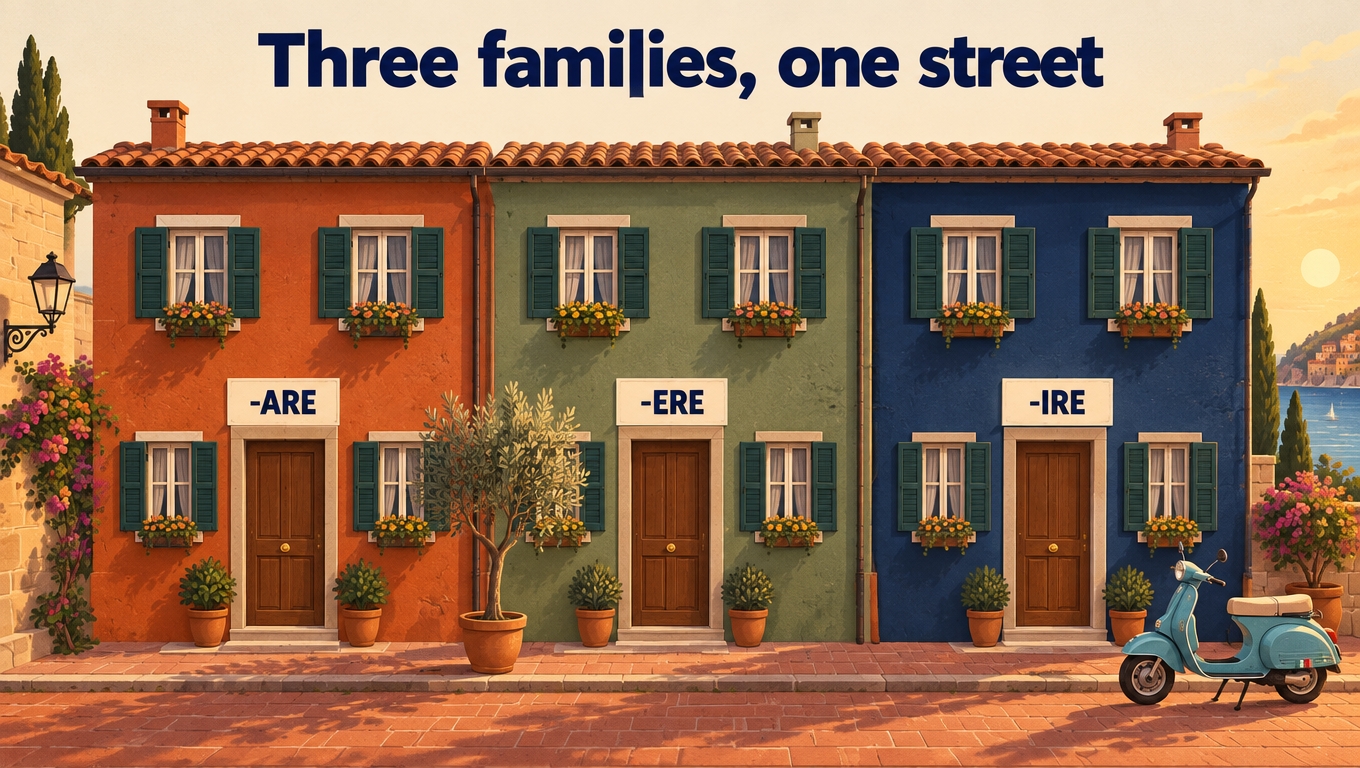
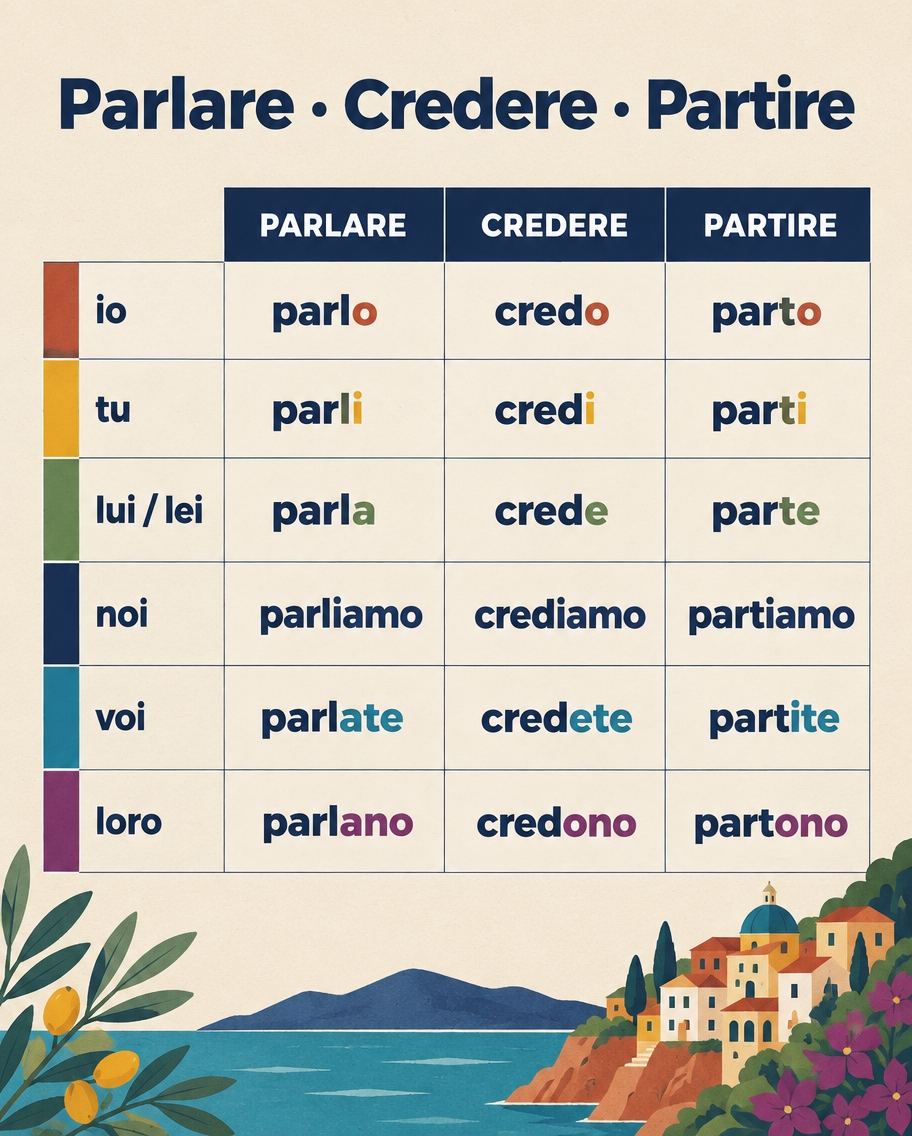
You already know the -are family: parlo, parli, parla, parliamo, parlate, parlano. The other two regular families, -ere and -ire, share most of those endings. All three keep -o for io and -iamo for noi.
The -ere family (vedere): vedo, vedi, vede, vediamo, vedete, vedono. The -ire family (dormire): dormo, dormi, dorme, dormiamo, dormite, dormono. The only visible difference between -ere and -ire in the present tense is the voi form: -ete versus -ite.
The stress pattern is also identical in all three families: the stress falls on the stem for io, tu, lui/lei and loro (VÈ-do, DÒR-mo) and on the ending for noi and voi (ve-DIA-mo, dor-MI-te).
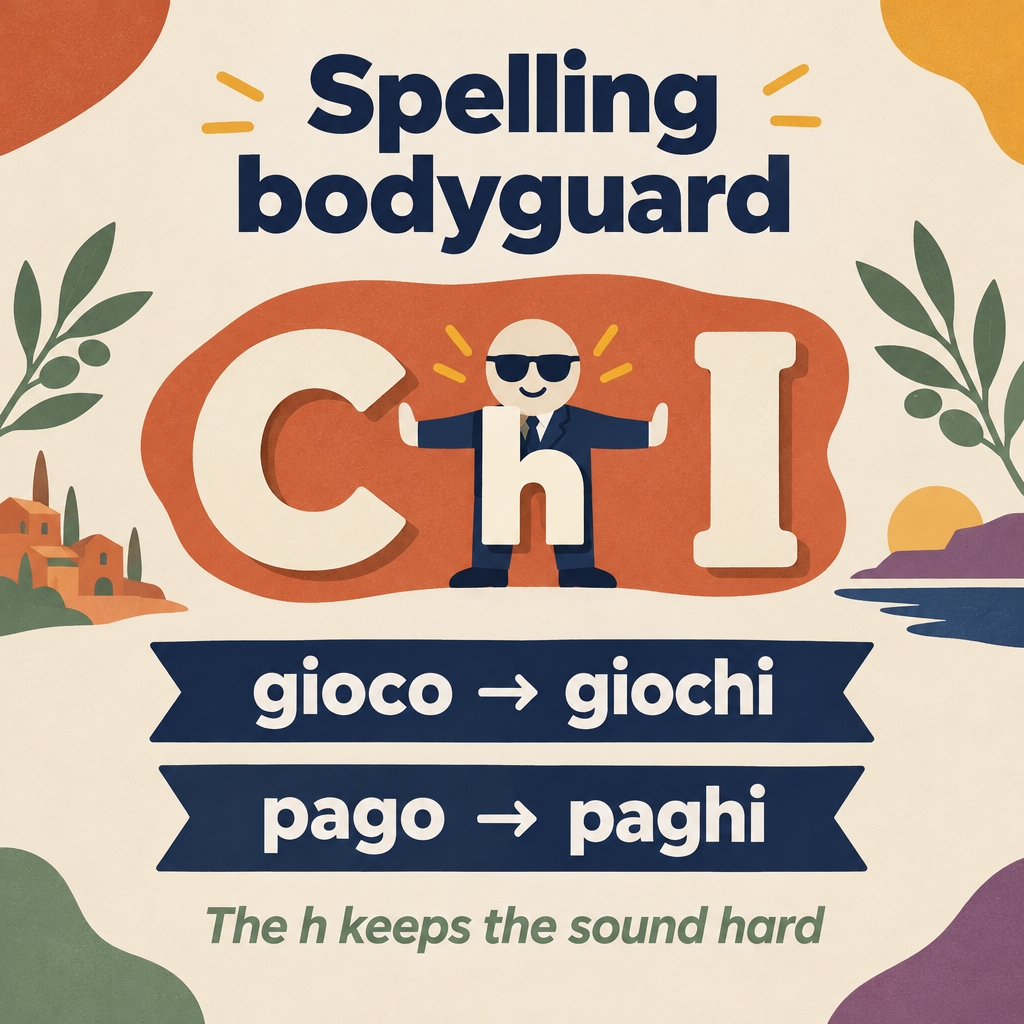
Verbs like giocare and pagare end in -care and -gare, where c and g are hard sounds. Before the letter i, Italian adds a silent h to keep that hard sound: tu giochi, noi giochiamo, tu paghi, noi paghiamo. The h changes nothing you say — it only fixes the spelling.
Verbs like mangiare and cominciare end in -giare and -ciare. Here the g and c are already soft, so the extra i is not written: tu mangi (never mangii), io mangio, tu cominci. The sound stays the same; only one i survives.
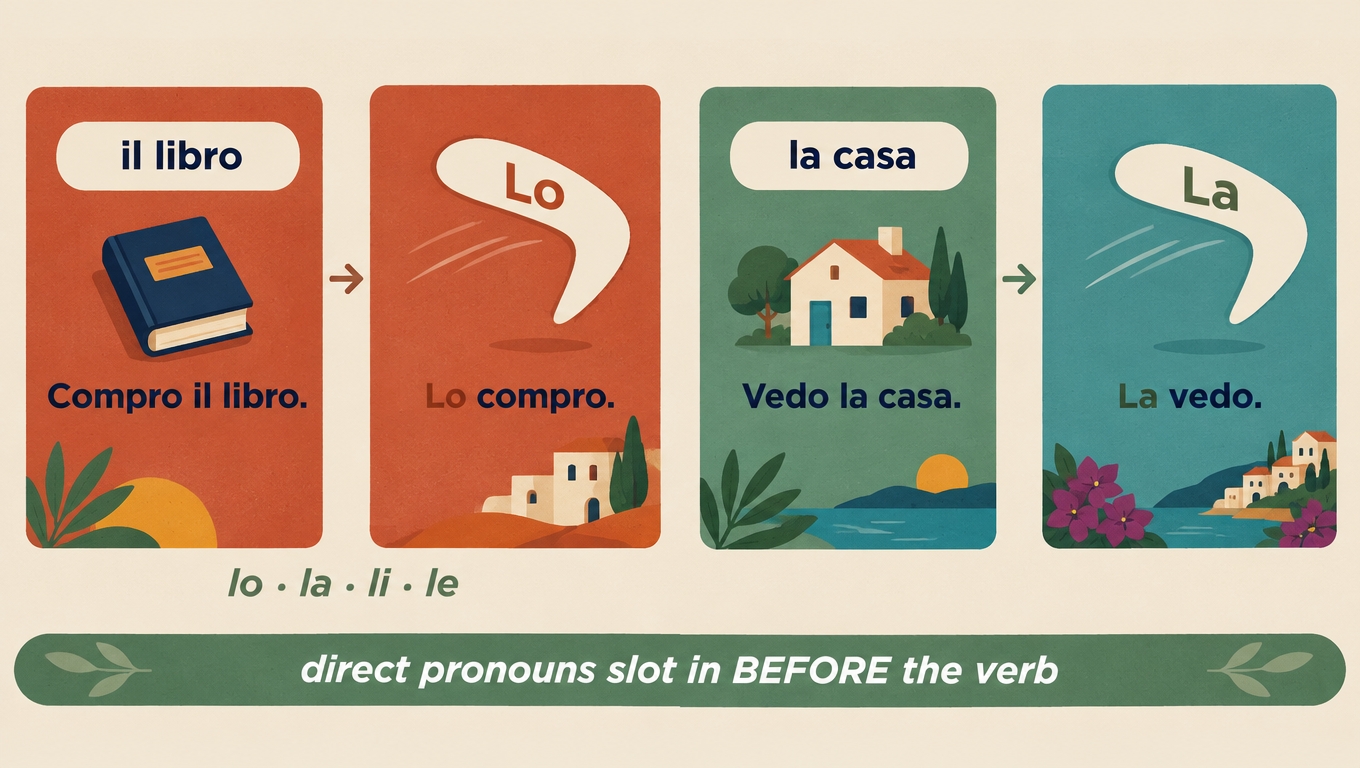
When you do not want to repeat a noun, Italian replaces it with a small pronoun: mi (me), ti (you), lo (him, it — masculine), la (her, it — feminine), ci (us), vi (you, plural), li (them — masculine), le (them — feminine).
The pronoun goes directly before the conjugated verb: Vedo Marco becomes Lo vedo. In a negative sentence, non still comes first: Non lo vedo.
Choose lo or li for masculine nouns and la or le for feminine nouns — the pronoun keeps the gender and number of the noun it replaces. Before a vowel, lo and la shrink to l': L'hai visto?
In Lesson 1 you built the past with ho + parlato. Regular verbs form the participle mechanically: -are becomes -ato, -ere becomes -uto, -ire becomes -ito (dormire → dormito). But some of the most useful verbs are irregular, and you simply learn their participles as words in their own right.
fare → fatto, dire → detto, scrivere → scritto, leggere → letto, aprire → aperto, chiudere → chiuso, prendere → preso, vedere → visto. Put them after ho, hai, ha and the sentence is done: Ho fatto. Hai letto? Abbiamo preso il treno.
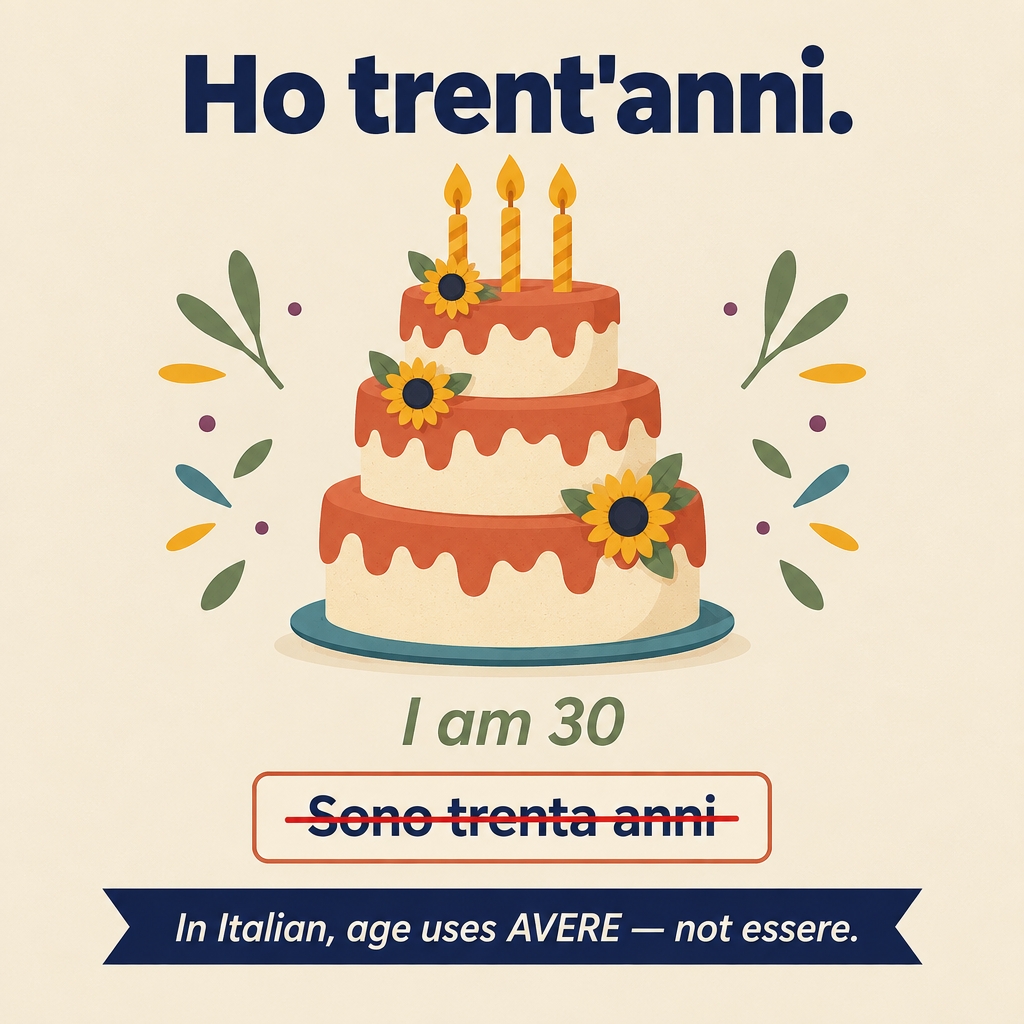
English says I am thirty; Italian says I have thirty years: Ho trent'anni. Always use avere plus anni for age. To ask, say Quanti anni hai? (informal) or Quanti anni ha? (formal).
You already know numbers up to one hundred. The hundreds are regular: cento, duecento, trecento, quattrocento, cinquecento, seicento, settecento, ottocento, novecento — then mille (one thousand). Cento never changes its form; just attach the rest of the number and write it as one word: centodieci (110), trecentoquarantadue (342), novecentonovantanove (999).
| Form | parlare (-are) | vedere (-ere) | dormire (-ire) |
|---|---|---|---|
| io | parlo | vedo | dormo |
| tu | parli | vedi | dormi |
| lui / lei | parla | vede | dorme |
| noi | parliamo | vediamo | dormiamo |
| voi | parlate | vedete | dormite |
| loro | parlano | vedono | dormono |
The voi row is the only difference between -ere and -ire: vedete versus dormite.
| Form | giocare | pagare | mangiare |
|---|---|---|---|
| io | gioco | pago | mangio |
| tu | giochi | paghi | mangi |
| lui / lei | gioca | paga | mangia |
| noi | giochiamo | paghiamo | mangiamo |
-care and -gare add a silent h before i; -giare and -ciare simply drop the extra i.
| Form | English | Italian | example |
|---|---|---|---|
| me | me | mi | Marco mi vede. |
| you (singular) | you | ti | Ti chiamo domani. |
| him / it (masculine) | him, it | lo | Lo vedo. |
| her / it (feminine) | her, it | la | La vedo. |
| us | us | ci | Ci vedono. |
| you (plural) | you | vi | Vi sentiamo. |
| them (masculine) | them | li | Li prendo. |
| them (feminine) | them | le | Le chiudo. |
The pronoun stands before the conjugated verb; lo and la become l' before a vowel.
| Form | infinitive | past participle | example |
|---|---|---|---|
| to do, to make | fare | fatto | Ho fatto. |
| to say | dire | detto | Ha detto no. |
| to write | scrivere | scritto | Ho scritto. |
| to read | leggere | letto | Hai letto? |
| to open | aprire | aperto | Hanno aperto. |
| to close | chiudere | chiuso | Ho chiuso. |
| to take | prendere | preso | Abbiamo preso. |
| to see | vedere | visto | Hai visto? |
No rule produces these — learn each one as a single word.
| Form | number | Italian |
|---|---|---|
| 100 | 100 | cento |
| 200 | 200 | duecento |
| 300 | 300 | trecento |
| 500 | 500 | cinquecento |
| 900 | 900 | novecento |
| 1,000 | 1.000 | mille |
Cento never changes; build any number by attaching the rest: duecentocinquanta (250).
| Italian | English | Pronunciation | Audio |
|---|---|---|---|
| vedere | to see | /veˈdere/ veh-DEH-reh | Listen in Italian: Slow in Italian: vedere |
| rispondere | to answer, to reply | /riˈspondere/ ree-SPOHN-deh-reh | Listen in Italian: Slow in Italian: rispondere |
| chiedere | to ask | /ˈkjɛdere/ KYEH-deh-reh | Listen in Italian: Slow in Italian: chiedere |
| aprire | to open | /aˈprire/ ah-PREE-reh | Listen in Italian: Slow in Italian: aprire |
| chiudere | to close | /ˈkjudere/ KYOO-deh-reh | Listen in Italian: Slow in Italian: chiudere |
| sentire | to hear, to feel | /senˈtire/ sehn-TEE-reh | Listen in Italian: Slow in Italian: sentire |
| prendere | to take, to have (food and drink) | /ˈprɛndere/ PREHN-deh-reh | Listen in Italian: Slow in Italian: prendere |
| chiamare | to call | /kjaˈmare/ kyah-MAH-reh | Listen in Italian: Slow in Italian: chiamare |
| vendere | to sell | /ˈvendere/ VEHN-deh-reh | Listen in Italian: Slow in Italian: vendere |
| dormire | to sleep | /dorˈmire/ dor-MEE-reh | Listen in Italian: Slow in Italian: dormire |
| leggere | to read | /ˈlɛddʒere/ LEHJ-jeh-reh | Listen in Italian: Slow in Italian: leggere |
| scrivere | to write | /ˈskrivere/ SKREE-veh-reh | Listen in Italian: Slow in Italian: scrivere |
| mi | me (direct object) | /ˈmi/ MEE | Listen in Italian: Slow in Italian: mi |
| ti | you (direct object, informal singular) | /ˈti/ TEE | Listen in Italian: Slow in Italian: ti |
| lo | him, it (masculine direct object) | /ˈlo/ LOH | Listen in Italian: Slow in Italian: lo |
| la | her, it (feminine direct object) | /ˈla/ LAH | Listen in Italian: Slow in Italian: la |
| ci | us (direct object) | /ˈtʃi/ CHEE | Listen in Italian: Slow in Italian: ci |
| vi | you (direct object, plural) | /ˈvi/ VEE | Listen in Italian: Slow in Italian: vi |
| li | them (masculine direct object) | /ˈli/ LEE | Listen in Italian: Slow in Italian: li |
| le | them (feminine direct object) | /ˈle/ LEH | Listen in Italian: Slow in Italian: le |
| cento | one hundred | /ˈtʃɛnto/ CHEHN-toh | Listen in Italian: Slow in Italian: cento |
| mille | one thousand | /ˈmille/ MEEL-leh | Listen in Italian: Slow in Italian: mille |
| la porta | the door | /la ˈporta/ lah POHR-tah | Listen in Italian: Slow in Italian: la porta |
| la finestra | the window | /la fiˈnɛstra/ lah fee-NEH-strah | Listen in Italian: Slow in Italian: la finestra |
| il compleanno | the birthday | /il kompleˈanno/ eel kohm-pleh-AHN-noh | Listen in Italian: Slow in Italian: il compleanno |
Lo vedo.
I can see him.
IPA /lo ˈvedo/
Say it loh VEH-doh
Lo replaces a masculine noun and stands before the verb.
La vedo ogni giorno.
I see her every day.
IPA /la ˈvedo ˈoɲɲi ˈdʒorno/
Say it lah VEH-doh OHN-yee JOHR-noh
Non li sento.
I cannot hear them.
IPA /non li ˈsento/
Say it nohn lee SEHN-toh
Order in a negative sentence: non + pronoun + verb.
Le chiamo domani.
I will call them tomorrow.
IPA /le ˈkjamo doˈmani/
Say it leh KYAH-moh doh-MAH-nee
Le replaces a feminine plural noun, for example le ragazze.
Cosa vedi?
What can you see?
IPA /ˈkɔza ˈvedi/
Say it KOH-zah VEH-dee
Vedo il mare.
I can see the sea.
IPA /ˈvedo il ˈmare/
Say it VEH-doh eel MAH-reh
Perché non rispondi?
Why do you not answer?
IPA /perˈke non riˈspondi/
Say it pehr-KEH nohn ree-SPOHN-dee
Ti faccio una domanda.
Let me ask you a question.
IPA /ti ˈfattʃo ˈuna doˈmanda/
Say it tee FAHT-choh OO-nah doh-MAHN-dah
Literally: I make you a question. Faccio is the io form of fare.
Apro la finestra.
I am opening the window.
IPA /ˈapro la fiˈnɛstra/
Say it AH-proh lah fee-NEH-strah
Chiudi la porta, per favore.
Close the door, please.
IPA /ˈkjudi la ˈporta per faˈvore/
Say it KYOO-dee lah POHR-tah pehr fah-VOH-reh
Il negozio chiude alle otto.
The shop closes at eight.
IPA /il neˈɡɔttsjo ˈkjude ˈalle ˈɔtto/
Say it eel neh-GOHT-syoh KYOO-deh AHL-leh OHT-toh
Alle is a + le, used before a plural hour.
Prendo un caffè.
I will have a coffee.
IPA /ˈprɛndo um kafˈfɛ/
Say it PREHN-doh oon kahf-FEH
Italians use prendere when ordering food and drink.
Cosa prendi?
What are you having?
IPA /ˈkɔza ˈprɛndi/
Say it KOH-zah PREHN-dee
Come ti chiami?
What is your name?
IPA /ˈkome ti ˈkjami/
Say it KOH-meh tee KYAH-mee
Literally: how do you call yourself?
Mi chiamo Sofia.
My name is Sofia.
IPA /mi ˈkjamo soˈfia/
Say it mee KYAH-moh soh-FEE-ah
Qui vendono frutta fresca.
They sell fresh fruit here.
IPA /kwi ˈvendono ˈfrutta ˈfreska/
Say it kwee VEHN-doh-noh FROOT-tah FREH-skah
Dormo otto ore.
I sleep eight hours.
IPA /ˈdormo ˈɔtto ˈore/
Say it DOHR-moh OHT-toh OH-reh
Il bambino dorme.
The baby is sleeping.
IPA /il bamˈbino ˈdorme/
Say it eel bahm-BEE-noh DOHR-meh
Ho trent'anni.
I am thirty years old.
IPA /o ˌtrentˈanni/
Say it oh trehn-TAHN-nee
Age uses avere, not essere: in Italian you have years.
Quanti anni hai?
How old are you?
IPA /ˈkwanti ˈanni ai/
Say it KWAHN-tee AHN-nee eye
Formal: Quanti anni ha?
Mia nonna ha novant'anni.
My grandmother is ninety.
IPA /ˈmia ˈnonna a noˌvantˈanni/
Say it MEE-ah NOHN-nah ah noh-vahn-TAHN-nee
Ho visto un bel film.
I saw a great film.
IPA /o ˈvisto um bɛl ˈfilm/
Say it oh VEE-stoh oon behl FEELM
Bel is the form of bello used before a masculine singular noun.
Hai letto il libro?
Have you read the book?
IPA /ai ˈletto il ˈlibro/
Say it eye LEHT-toh eel LEE-broh
Abbiamo preso il treno.
We took the train.
IPA /abˈbjamo ˈpreso il ˈtreno/
Say it ahb-BYAH-moh PREH-zoh eel TREH-noh
L'hai visto?
Did you see it?
IPA /lai ˈvisto/
Say it lie VEE-stoh
Lo shrinks to l' before a vowel: lo hai becomes l'hai.
Giulia buys fruit at a market stall in Bologna; the vendor, Marco, serves her politely.
Buongiorno! Cosa vende oggi?
Good morning! What are you selling today?
Listen in Italian: Slow in Italian: Buongiorno! Cosa vende oggi?Vendo frutta e verdura fresca, signora.
I sell fresh fruit and vegetables, madam.
Listen in Italian: Slow in Italian: Vendo frutta e verdura fresca, signora.Quanto costano le mele?
How much are the apples?
Listen in Italian: Slow in Italian: Quanto costano le mele?Due euro al chilo. Le prende?
Two euros a kilo. Will you take them?
Listen in Italian: Slow in Italian: Due euro al chilo. Le prende?Sì, le prendo. E anche due arance.
Yes, I will take them. And two oranges as well.
Listen in Italian: Slow in Italian: Sì, le prendo. E anche due arance.Altro?
Anything else?
Listen in Italian: Slow in Italian: Altro?No, grazie. Ecco dieci euro.
No, thank you. Here is ten euros.
Listen in Italian: Slow in Italian: No, grazie. Ecco dieci euro.Grazie a Lei, arrivederci!
Thank you, goodbye!
Listen in Italian: Slow in Italian: Grazie a Lei, arrivederci!Sara and Paolo are working in a small office on a hot afternoon.
Apro la finestra?
Shall I open the window?
Listen in Italian: Slow in Italian: Apro la finestra?Sì, apri la finestra, per favore.
Yes, open the window, please.
Listen in Italian: Slow in Italian: Sì, apri la finestra, per favore.E la porta? La chiudo?
And the door? Shall I close it?
Listen in Italian: Slow in Italian: E la porta? La chiudo?No, la chiudo io dopo.
No, I will close it later.
Listen in Italian: Slow in Italian: No, la chiudo io dopo.Senti le macchine in strada?
Can you hear the cars in the street?
Listen in Italian: Slow in Italian: Senti le macchine in strada?Sì, le sento, ma non le vedo.
Yes, I can hear them, but I cannot see them.
Listen in Italian: Slow in Italian: Sì, le sento, ma non le vedo.Guarda! Vedo il treno!
Look! I can see the train!
Listen in Italian: Slow in Italian: Guarda! Vedo il treno!Lo vedo anch'io.
I can see it too.
Listen in Italian: Slow in Italian: Lo vedo anch'io.Emma and Luca look at old family photographs during a break.
Quanti anni hai, Luca?
How old are you, Luca?
Listen in Italian: Slow in Italian: Quanti anni hai, Luca?Ho ventotto anni. E tu?
I am twenty-eight. And you?
Listen in Italian: Slow in Italian: Ho ventotto anni. E tu?Ho trentun anni.
I am thirty-one.
Listen in Italian: Slow in Italian: Ho trentun anni.E tuo fratello? Quanti anni ha?
And your brother? How old is he?
Listen in Italian: Slow in Italian: E tuo fratello? Quanti anni ha?Lui ha trentacinque anni.
He is thirty-five.
Listen in Italian: Slow in Italian: Lui ha trentacinque anni.E la signora in questa foto? Chi è?
And the lady in this photo? Who is she?
Listen in Italian: Slow in Italian: E la signora in questa foto? Chi è?È mia nonna. Ha novantadue anni!
She is my grandmother. She is ninety-two!
Listen in Italian: Slow in Italian: È mia nonna. Ha novantadue anni!Novantadue! Non li dimostra.
Ninety-two! She does not look it.
Listen in Italian: Slow in Italian: Novantadue! Non li dimostra.Choose the correct form of vedere.
Choose the correct form of rispondere.
Choose the correct form of chiudere.
Choose the correct form of dormire.
Choose the correctly spelt form.
Choose the correctly spelt form.
Choose the pronoun that replaces Marco.
Choose the pronoun that replaces Anna e Sara.
Choose the correct direct object pronoun.
Choose the correct direct object pronoun.
Write the correct form.
Write the correct form.
Write the correct form.
Write the correct form.
Write the correct form.
Write the correctly spelt form.
Fill the gap with the past participle.
Fill the gap with the past participle.
Fill the gap to say I am thirty.
Fill the gap with the question word.
Fill the gap with the past participle.
Translate into Italian.
Translate into Italian.
Translate into Italian.
Translate into Italian.
Translate into Italian.
Translate into English.
Translate into English.
Tap the words in the correct order.
Tap the words in the correct order.
Tap an Italian pronoun, then tap its meaning.
Tap an infinitive, then tap its participle.
True or false?
True or false?
True or false?
Play the audio, then type exactly what you hear.
Play the audio, then tap the matching sentence.
Rewrite the sentence with a direct object pronoun.
Rewrite the sentence with a direct object pronoun.
Choose the correct word.
Say the sentence aloud, then show the meaning and rate yourself.
Say each sentence aloud three times: once slowly, once at normal speed, once from memory. Then change one word and say your own version.
Before you move on, make sure you can do all of this without looking:
Go deeper: -are verbs · -ere verbs · -ire verbs · Direct object pronouns · avere · Numbers