
Ciao!
Hi! / Bye!
IPA /ˈtʃao/
Say it CHOW
One syllable: Ciao sounds like CHOW. Works for hello and goodbye, with people you use tu with.
Listen in Italian:
Slow in Italian:
Ciao!
Master the verbs essere, fare and stare, and handle your first real conversations: greetings, introductions, names, nationalities and jobs.
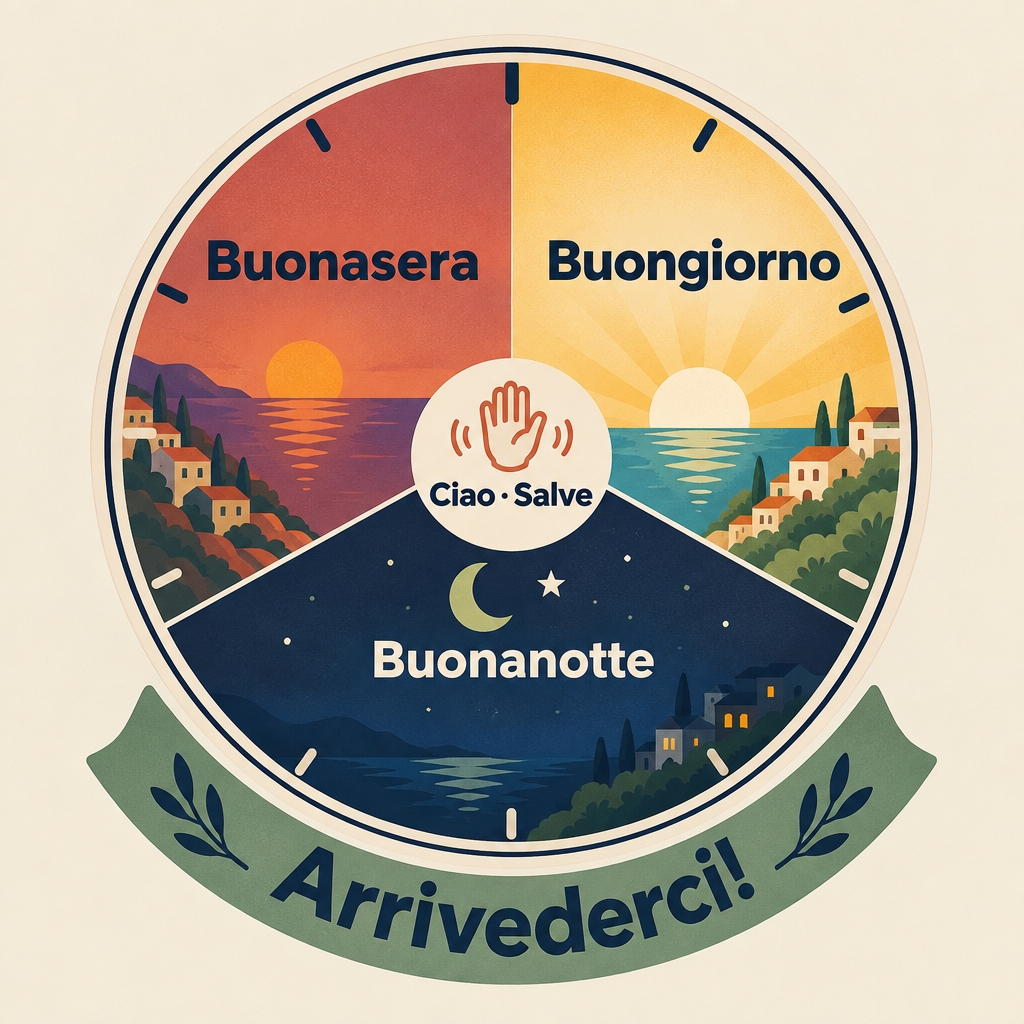
Say these aloud before you start. They come from earlier lessons.
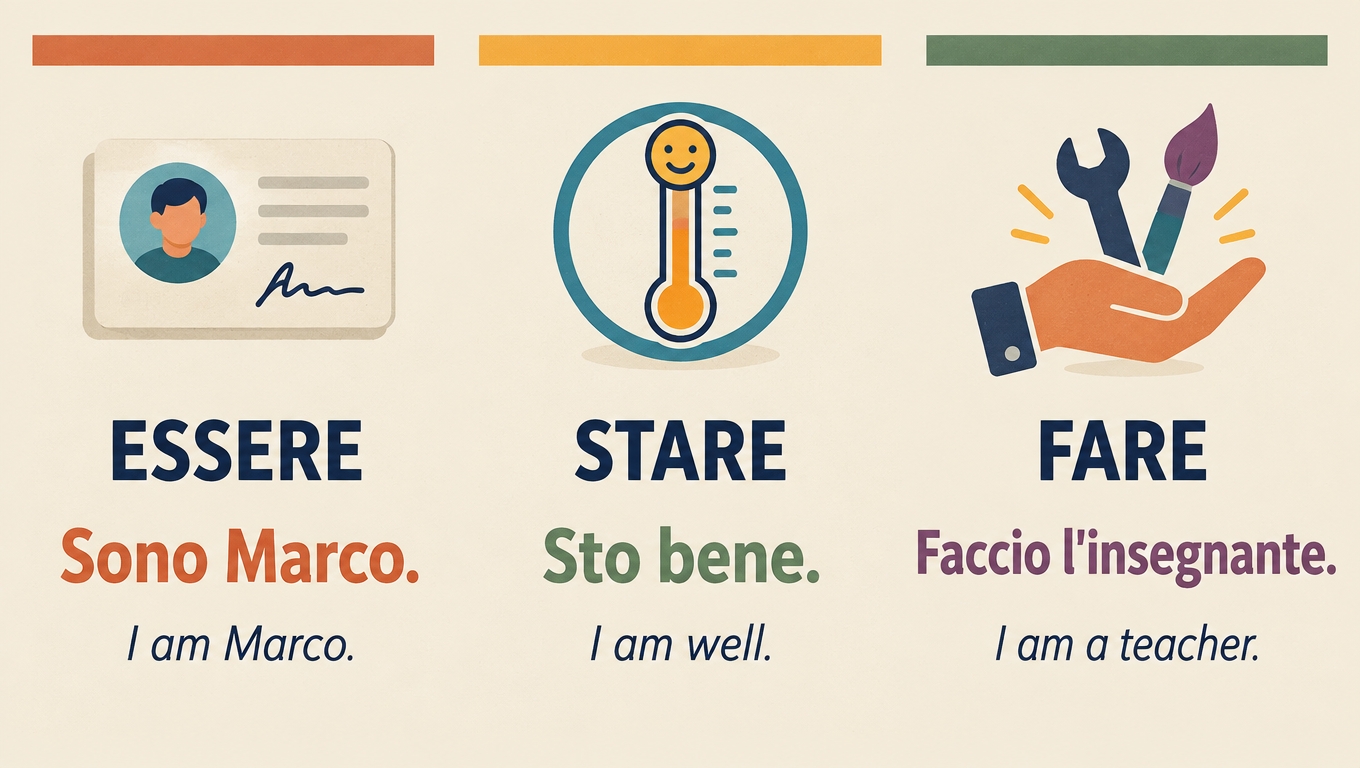
Essere (to be), fare (to do/make) and stare (to stay/be doing) appear in almost every first meeting. essere and fare are irregular, so learn them as sets — but note that stare is regular: sto, stai, sta, stiamo, state, stanno.
stare appears in greetings: Come stai? literally means 'How are you staying?' — but Italians ask it as 'How are you?'. At beginner level: use stare for how someone is doing or feeling, and essere for who or what someone is.
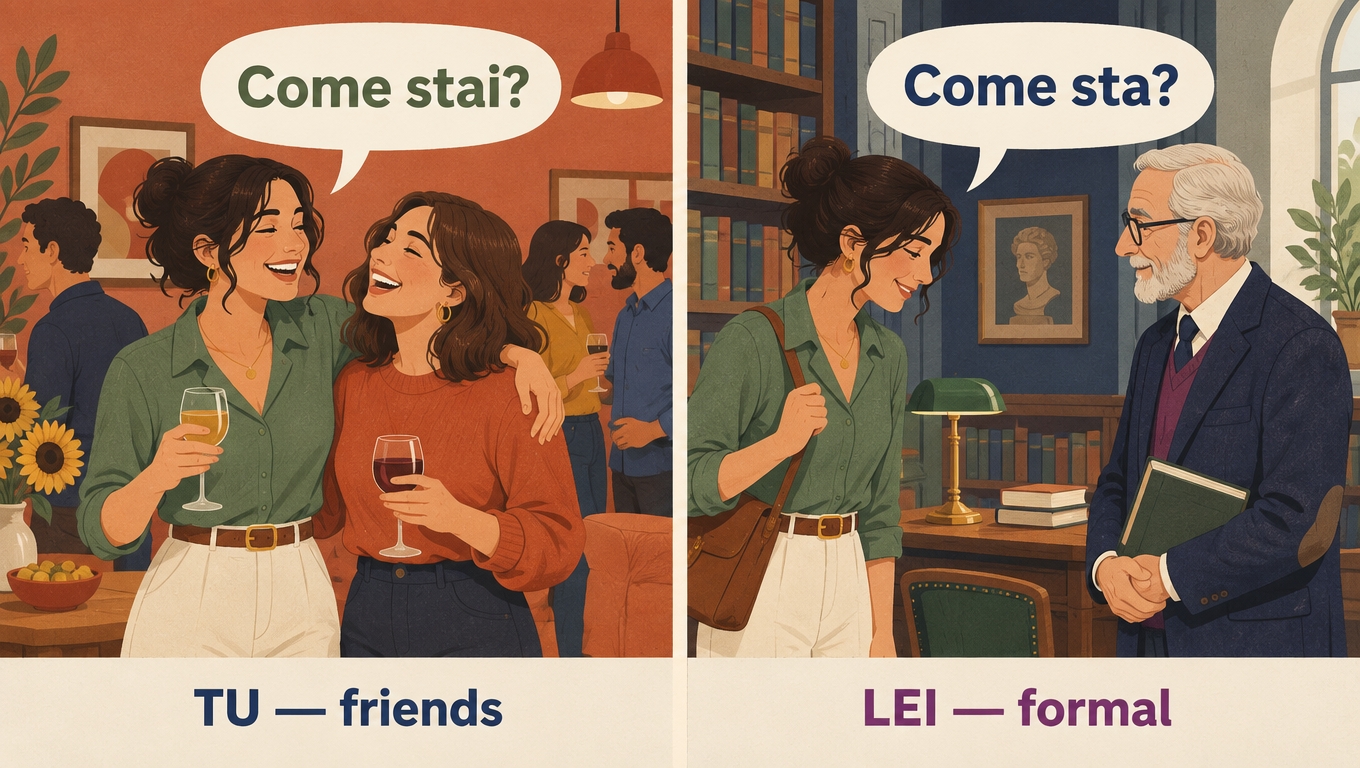
Italian has two ways to say 'you'. Use tu with friends, family and young people. Use Lei (with a capital L) with strangers, older people and in professional situations.
The verb form changes too: Come stai? (informal) becomes Come sta? (formal). When in doubt in Italy, start formal — Italians will invite you to switch to tu.
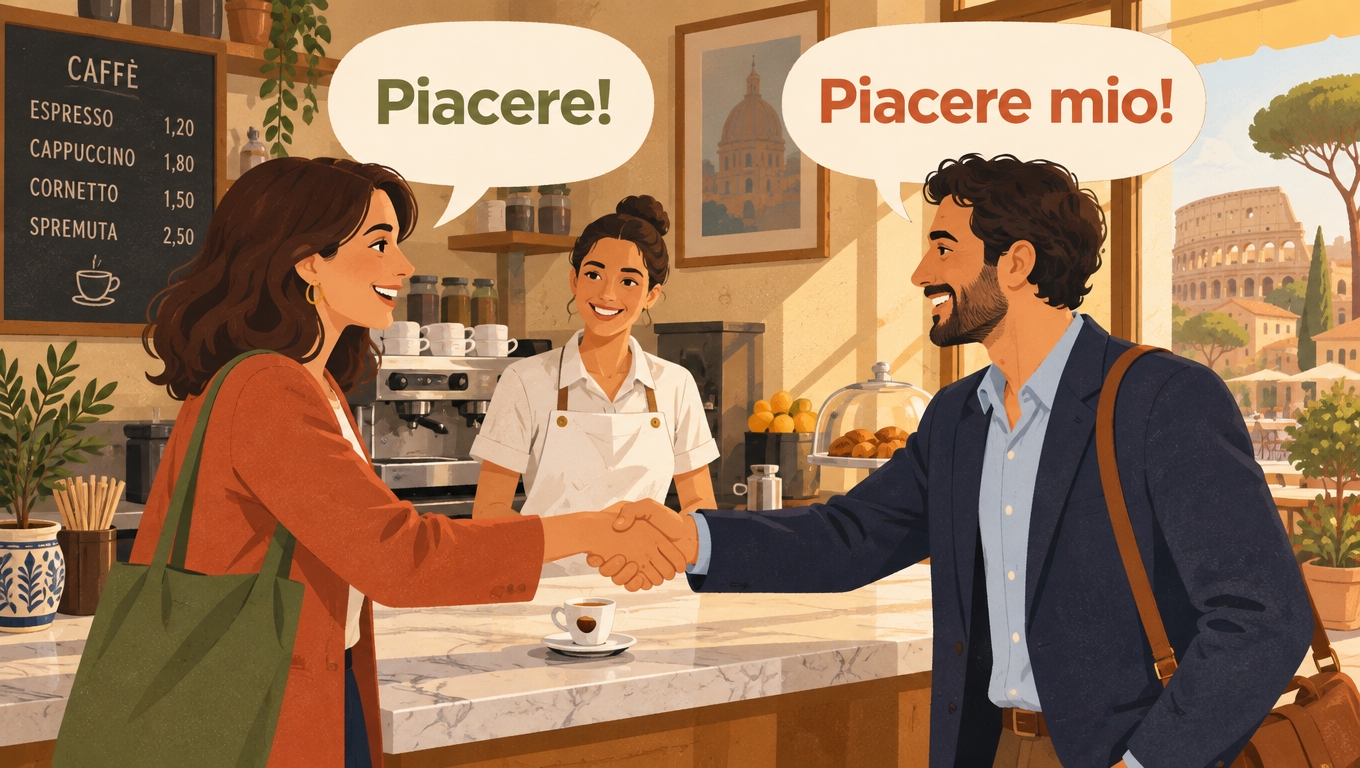
Mi chiamo... is the standard way to give your name — it literally means 'I call myself...'. Piacere means 'pleasure' and is the all-purpose reply when you meet someone: Piacere! — 'Nice to meet you!'.
To say where you are from, use Di dove sei? (informal) or Di dov'è? (formal), and answer with Sono di + city or Sono + nationality.
Three tiny conjunctions connect your sentences: e (and), ma (but), o (or). Put them between two complete sentences or two items: Sono di Roma, ma abito a Milano.
Learn the greeting pairs as units: buongiorno/buonasera for meeting, arrivederci/a presto for leaving, and remember grazie and prego always travel together.
| Form | essere | fare | stare |
|---|---|---|---|
| io | sono | faccio | sto |
| tu | sei | fai | stai |
| lui / lei | è | fa | sta |
| noi | siamo | facciamo | stiamo |
| voi | siete | fate | state |
| loro | sono | fanno | stanno |
essere and stare both give sono in the io form — a common trap. Sono inglese (I am English) but Sto bene (I am well).
| Form | Meeting | Leaving |
|---|---|---|
| any time | Ciao! | Ciao! / A presto! |
| morning | Buongiorno! | Buona giornata! |
| afternoon/evening | Buonasera! | Buonasera! / Arrivederci! |
| night | Buonanotte! | Buonanotte! |
Ciao works for both hello and goodbye, but only with people you use tu with.
| Italian | English | Pronunciation | Audio |
|---|---|---|---|
| essere | to be | /ˈessere/ EHS-seh-reh | Listen in Italian: Slow in Italian: essere |
| fare | to do, to make | /ˈfare/ FAH-reh | Listen in Italian: Slow in Italian: fare |
| stare | to stay, to be (how one is) | /ˈstare/ STAH-reh | Listen in Italian: Slow in Italian: stare |
| chiamarsi | to be called | /kjaˈmarsi/ kyah-MAHR-see | Listen in Italian: Slow in Italian: chiamarsi |
| ciao | hi, bye | /ˈtʃao/ CHOW | Listen in Italian: Slow in Italian: ciao |
| buongiorno | good morning, good day | /bwonˈdʒorno/ bwohn-JOR-noh | Listen in Italian: Slow in Italian: buongiorno |
| buonasera | good evening | /bwonaˈsera/ bwoh-nah-SEH-rah | Listen in Italian: Slow in Italian: buonasera |
| arrivederci | goodbye (formal) | /arriveˈdertʃi/ ah-ree-veh-DEHR-chee | Listen in Italian: Slow in Italian: arrivederci |
| grazie | thank you | /ˈɡrattsje/ GRAHT-syeh | Listen in Italian: Slow in Italian: grazie |
| prego | you are welcome, please | /ˈpreɡo/ PREH-goh | Listen in Italian: Slow in Italian: prego |
| scusa | sorry, excuse me (informal) | /ˈskuza/ SKOO-zah | Listen in Italian: Slow in Italian: scusa |
| male | badly, bad | /ˈmale/ MAH-leh | Listen in Italian: Slow in Italian: male |
| così così | so-so | /koˈzi koˈzi/ koh-ZEE koh-ZEE | Listen in Italian: Slow in Italian: così così |
| il piacere | pleasure; nice to meet you | /pjaˈtʃere/ pyah-CHEH-reh | Listen in Italian: Slow in Italian: il piacere |
| il nome | name | /ˈnome/ NOH-meh | Listen in Italian: Slow in Italian: il nome |
| italiano | Italian (person/language) | /itaˈljano/ ee-tah-LYAH-noh | Listen in Italian: Slow in Italian: italiano |
| inglese | English (person/language) | /iŋˈɡleze/ een-GLEH-zeh | Listen in Italian: Slow in Italian: inglese |
| lo studente | student | /stuˈdente/ stoo-DEHN-teh | Listen in Italian: Slow in Italian: lo studente |
| il professore | teacher (male) | /profesˈsore/ proh-fehs-SOH-reh | Listen in Italian: Slow in Italian: il professore |
| il medico | doctor | /ˈmɛdiko/ MEH-dee-koh | Listen in Italian: Slow in Italian: il medico |
| l'insegnante | teacher | /inseɲˈɲante/ een-sehn-YAHN-teh | Listen in Italian: Slow in Italian: l'insegnante |
| l'ingegnere | engineer | /indʒeɲˈɲere/ een-jehn-YEH-reh | Listen in Italian: Slow in Italian: l'ingegnere |
| l'avvocato | lawyer | /avvoˈkato/ ahv-voh-KAH-toh | Listen in Italian: Slow in Italian: l'avvocato |
| il lavoro | job, work | /laˈvoro/ lah-VOH-roh | Listen in Italian: Slow in Italian: il lavoro |
| oggi | today | /ˈɔddʒi/ OH-jee | Listen in Italian: Slow in Italian: oggi |
| il marito | husband | /maˈrito/ mah-REE-toh | Listen in Italian: Slow in Italian: il marito |
| la moglie | wife | /ˈmɔʎʎe/ MOH-lyeh | Listen in Italian: Slow in Italian: la moglie |
Ciao!
Hi! / Bye!
IPA /ˈtʃao/
Say it CHOW
One syllable: Ciao sounds like CHOW. Works for hello and goodbye, with people you use tu with.
Buongiorno!
Good morning! / Good day!
IPA /bwonˈdʒorno/
Say it bwohn-JOR-noh
Buonasera!
Good evening!
IPA /bwonaˈsera/
Say it bwoh-nah-SEH-rah
Used from late afternoon.
Come stai?
How are you? (informal)
IPA /ˈkome ˈstai/
Say it KOH-meh STY
Come sta?
How are you? (formal)
IPA /ˈkome ˈsta/
Say it KOH-meh STAH
Use Lei forms with people you do not know.
Sto bene, grazie. E tu?
I am well, thanks. And you?
IPA /sto ˈbɛne ˈɡrattsje e ˈtu/
Say it stoh BEH-neh GRAHT-syeh eh TOO
Mi chiamo Marco.
My name is Marco.
IPA /mi ˈkjamo ˈmarko/
Say it mee KYAH-moh MAR-koh
Piacere!
Nice to meet you!
IPA /pjaˈtʃere/
Say it pyah-CHEH-reh
The standard reply when names are exchanged.
Come ti chiami?
What is your name? (informal)
IPA /ˈkome ti ˈkjami/
Say it KOH-meh tee KYAH-mee
Come si chiama?
What is your name? (formal)
IPA /ˈkome si ˈkjama/
Say it KOH-meh see KYAH-mah
Di dove sei?
Where are you from? (informal)
IPA /di ˈdove ˈsɛi/
Say it dee DOH-veh SAY
Sono inglese, di Londra.
I am English, from London.
IPA /ˈsono iŋˈɡleze di ˈlondra/
Say it SOH-noh een-GLEH-zeh dee LOHN-drah
Che lavoro fai?
What do you do for a living? (informal)
IPA /ke laˈvoro ˈfai/
Say it keh lah-VOH-roh FY
Faccio il medico.
I am a doctor.
IPA /ˈfattʃo il ˈmɛdiko/
Say it FAH-choh eel MEH-dee-koh
Fare + il + profession: Faccio il medico. Sono studente (no article).
Sono studente.
I am a student.
IPA /ˈsono stuˈdente/
Say it SOH-noh stoo-DEHN-teh
Questo è mio marito.
This is my husband.
IPA /ˈkwesto ɛ mi o maˈrito/
Say it KWEH-stoh eh MEE-oh mah-REE-toh
Questa è mia moglie.
This is my wife.
IPA /ˈkwesta ɛ ˈmia ˈmɔʎʎe/
Say it KWEH-stah eh MEE-ah MOH-lyeh
Grazie mille!
Thanks a lot!
IPA /ˈɡrattsje ˈmille/
Say it GRAHT-syeh MEEL-leh
Prego.
You are welcome.
IPA /ˈpreɡo/
Say it PREH-goh
Prego also means 'please go ahead' and 'can I help you?'.
Arrivederci e a presto!
Goodbye and see you soon!
IPA /arriveˈdertʃi e a ˈprɛsto/
Say it ah-ree-veh-DEHR-chee eh ah PREHS-toh
Buona giornata!
Have a nice day!
IPA /ˈbwɔna dʒorˈnata/
Say it BWOH-nah jor-NAH-tah
Said when parting in the morning/afternoon.
Mi dispiace.
I am sorry.
IPA /mi disˈpjatʃe/
Say it mee dees-PYAH-cheh
Also 'I am sorry to hear that'.
Giulia introduces herself to Emma at a friend's birthday party.
Ciao! Mi chiamo Giulia. E tu?
Hi! My name is Giulia. And you?
Listen in Italian: Slow in Italian: Ciao! Mi chiamo Giulia. E tu?Ciao! Io sono Emma. Piacere!
Hi! I am Emma. Nice to meet you!
Listen in Italian: Slow in Italian: Ciao! Io sono Emma. Piacere!Piacere! Di dove sei?
Nice to meet you! Where are you from?
Listen in Italian: Slow in Italian: Piacere! Di dove sei?Sono inglese, di Londra. E tu?
I am English, from London. And you?
Listen in Italian: Slow in Italian: Sono inglese, di Londra. E tu?Sono di Roma, ma adesso abito a Milano.
I am from Rome, but now I live in Milan.
Listen in Italian: Slow in Italian: Sono di Roma, ma adesso abito a Milano.Che lavoro fai?
What do you do for a living?
Listen in Italian: Slow in Italian: Che lavoro fai?Faccio l'avvocato. E tu?
I am a lawyer. And you?
Listen in Italian: Slow in Italian: Faccio l'avvocato. E tu?Sono studentessa di italiano!
I am an Italian-language student!
Listen in Italian: Slow in Italian: Sono studentessa di italiano!A new colleague meets the director for the first time — everything stays formal.
Buongiorno, come sta?
Good morning, how are you?
Listen in Italian: Slow in Italian: Buongiorno, come sta?Buongiorno, sto bene, grazie. E lei?
Good morning, I am well, thank you. And you?
Listen in Italian: Slow in Italian: Buongiorno, sto bene, grazie. E lei?Bene, grazie. Come si chiama?
Well, thanks. What is your name?
Listen in Italian: Slow in Italian: Bene, grazie. Come si chiama?Mi chiamo Luca Bianchi.
My name is Luca Bianchi.
Listen in Italian: Slow in Italian: Mi chiamo Luca Bianchi.Piacere. Che lavoro fa?
Nice to meet you. What do you do?
Listen in Italian: Slow in Italian: Piacere. Che lavoro fa?Faccio l'ingegnere da cinque anni.
I have worked as an engineer for five years.
Listen in Italian: Slow in Italian: Faccio l'ingegnere da cinque anni.Perfetto. Arrivederci e buona giornata!
Perfect. Goodbye and have a nice day!
Listen in Italian: Slow in Italian: Perfetto. Arrivederci e buona giornata!Choose the correct form of essere.
Choose the correct form of fare.
Choose the correct form of stare.
Write the correct form.
Write the correct form.
Write the full form.
Write the full form.
Fill the gap with the correct question word.
Fill the gap with the missing adverb.
Translate into Italian.
Translate into Italian.
Translate into Italian.
Translate into Italian.
Translate into Italian.
Translate into English.
Translate into English.
Choose the correct form for the formal you.
Tap the words in the correct order.
Tap a greeting, then its situation.
True or false?
True or false?
Play the audio, then type exactly what you hear.
Choose the correct article for professions after fare.
Say the greeting aloud, then reveal the meaning and rate yourself.
Say it aloud with your own name, then reveal and rate yourself.
Do a one-minute self-introduction aloud: greet, give your name, nationality, city and job. Then switch to formal and do it again as if meeting a stranger.
Before you move on, make sure you can do all of this without looking:
Go deeper: essere · fare · Present tense · Questions · Negation