Theory
Fare : six irregular forms , dozens of everyday expressions Fare (to do , to make ) is one of the most frequent verbs in Italian , and it is irregular : faccio , fai , fa , facciamo , fate , fanno . Learn the six forms as a set .
Fare teams up with nouns to build expressions that English renders with 'have ' or 'go ': fare colazione (to have breakfast ), fare la spesa (to do the food shopping ), fare una passeggiata (to go for a walk ). Do not translate word by word — learn each expression as a single block .
Faccio colazione alle otto.
I have breakfast at eight o'clock.
Listen in Italian:
Slow in Italian:
Faccio colazione alle otto.
Listen in Italian:
Slow in Italian:
Facciamo una passeggiata dopo cena.
We go for a walk after dinner.
Listen in Italian:
Slow in Italian:
Facciamo una passeggiata dopo cena.
Listen in Italian:
Slow in Italian:
Fanno la spesa il sabato.
They do the food shopping on Saturdays.
Listen in Italian:
Slow in Italian:
Fanno la spesa il sabato.
Listen in Italian:
Slow in Italian:
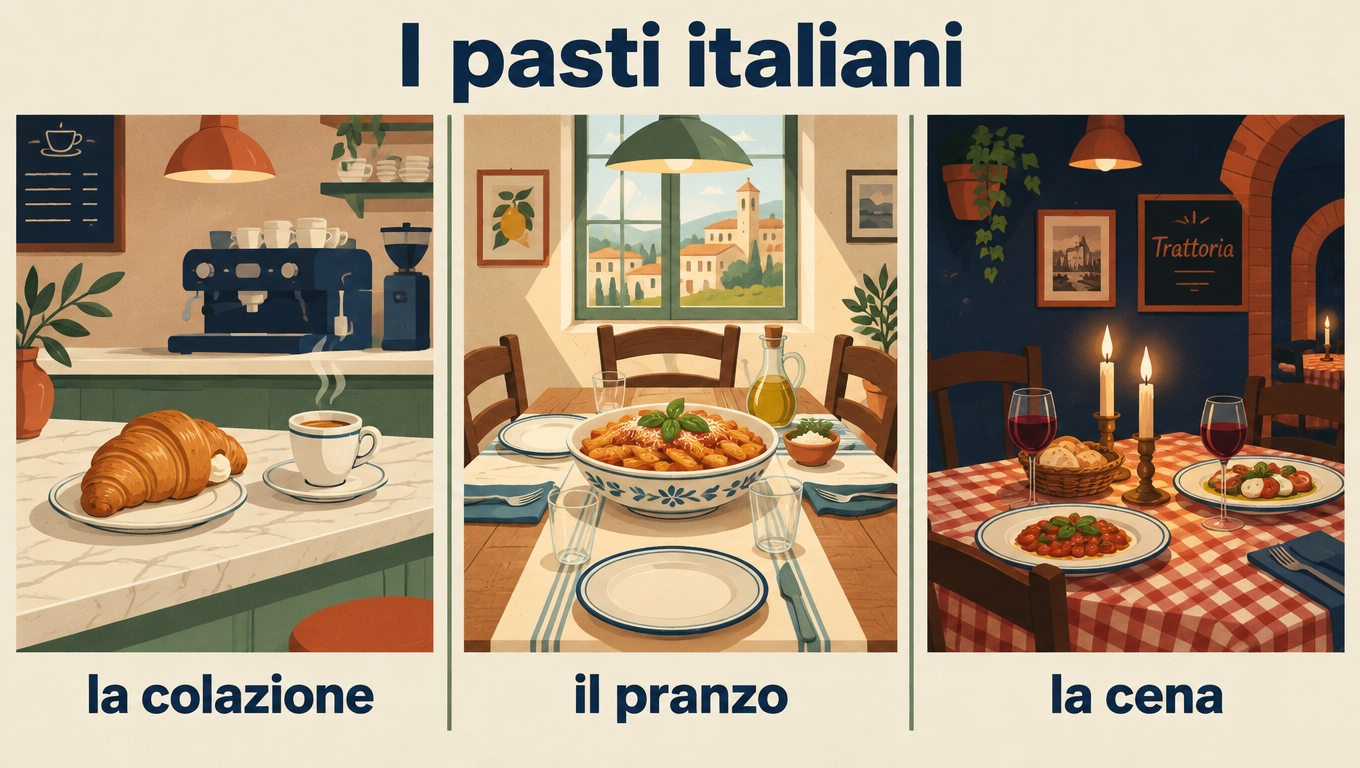
Meals : fare colazione , pranzare , cenare For breakfast , Italians say fare colazione : Faccio colazione alle sette . For lunch and dinner the language gives you a choice : the dedicated verbs pranzare (to have lunch ) and cenare (to have dinner ), or fare pranzo and fare cena .
Pranzare and cenare are completely regular -are verbs , so you already know all their endings . Both patterns are standard ; the single verbs are simply shorter .
Pranzo all'una.
I have lunch at one o'clock.
Listen in Italian:
Slow in Italian:
Pranzo all'una.
Listen in Italian:
Slow in Italian:
Ceniamo fuori stasera.
We are eating out tonight.
Listen in Italian:
Slow in Italian:
Ceniamo fuori stasera.
Listen in Italian:
Slow in Italian:
Vuoi fare pranzo con noi?
Do you want to have lunch with us?
Listen in Italian:
Slow in Italian:
Vuoi fare pranzo con noi?
Listen in Italian:
Slow in Italian:
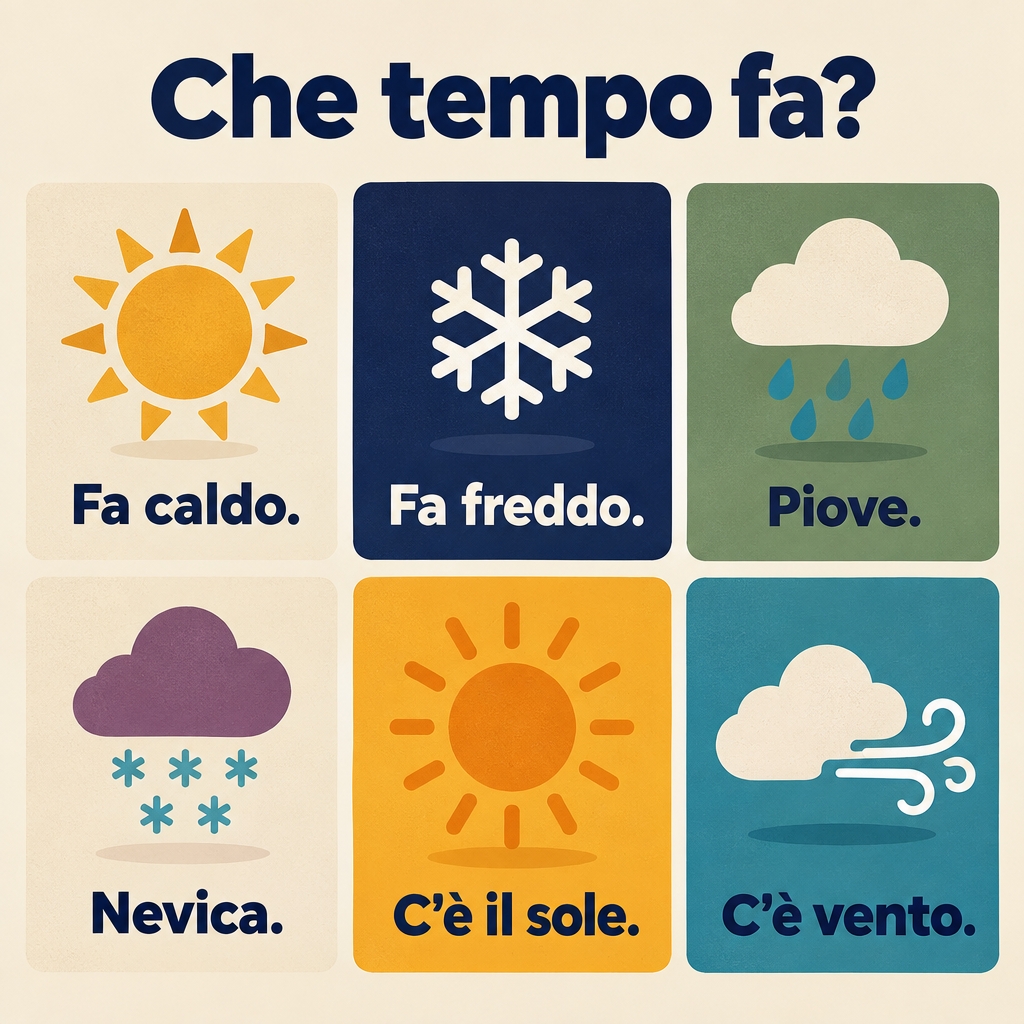
Weather : fare for the sky , avere for people To describe the weather , Italian uses fare impersonally : Fa caldo (it is hot ), Fa freddo (it is cold ), Fa bel tempo (the weather is nice ). Weather verbs appear in the third person : Piove (it is raining ), Nevica (it is snowing ). For sunshine , say C 'è il sole — literally 'there is the sun '.
Careful : when a person feels hot or cold , Italian switches to avere : Ho caldo (I am hot ), Ho freddo (I am cold ). Caldo and freddo are nouns here , so they never change ending : Maria ha caldo , i ragazzi hanno freddo .
Fa molto freddo oggi.
It is very cold today.
Listen in Italian:
Slow in Italian:
Fa molto freddo oggi.
Listen in Italian:
Slow in Italian:
Nevica in montagna.
It is snowing in the mountains.
Listen in Italian:
Slow in Italian:
Nevica in montagna.
Listen in Italian:
Slow in Italian:
Ho caldo: apro la finestra.
I am hot: I am opening the window.
Listen in Italian:
Slow in Italian:
Ho caldo: apro la finestra.
Listen in Italian:
Slow in Italian:
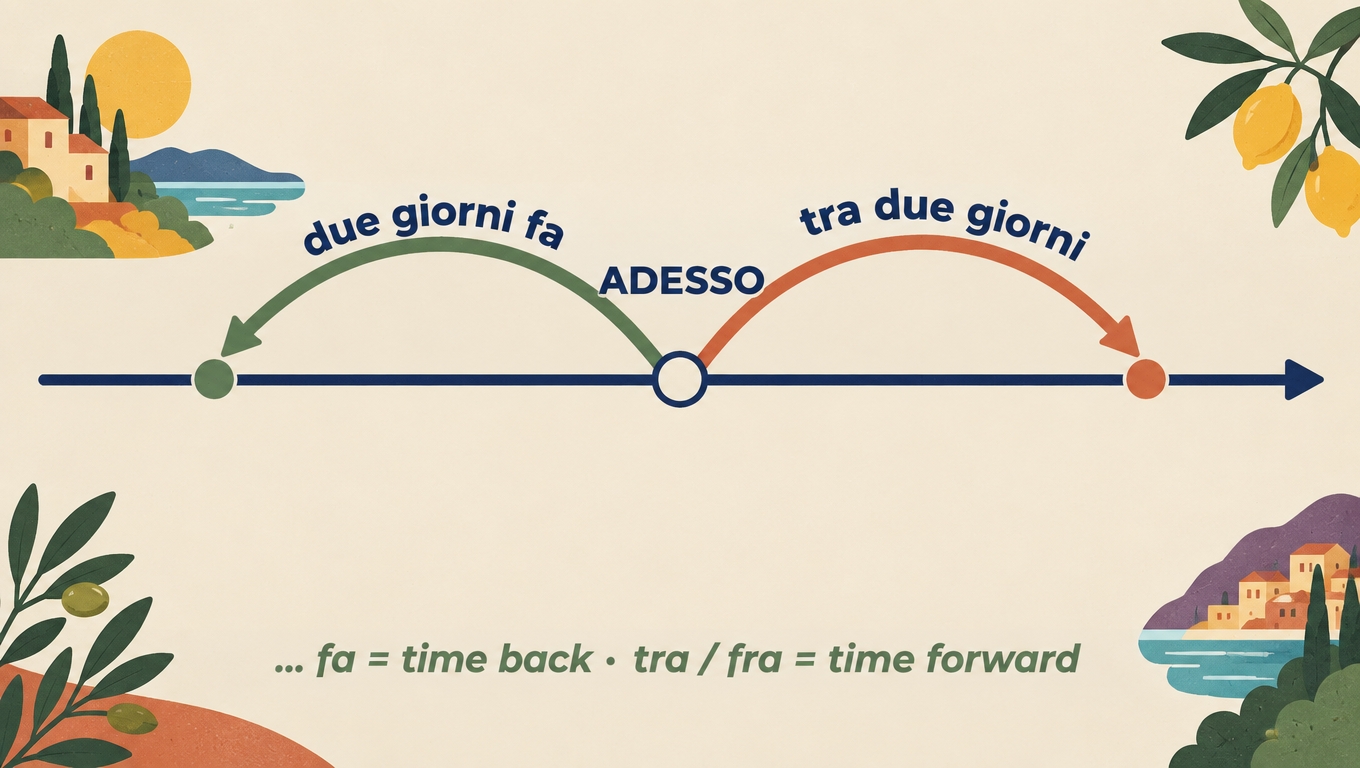
Looking back and looking forward : fa , tra /fra and the present tense Put fa after a length of time and it means 'ago ': due giorni fa (two days ago ), una settimana fa (a week ago ). Combine it with the passato prossimo you already know : Ho parlato con Anna due giorni fa .
For the future , tra and fra both mean 'in ' a period of time and are fully interchangeable : tra una settimana , fra due mesi (in a week , in two months ). And notice something liberating : with a future time word like domani , the plain present tense already points to the future : Domani parto (Tomorrow I am leaving ).
Ho mangiato qui una settimana fa.
I ate here a week ago.
Listen in Italian:
Slow in Italian:
Ho mangiato qui una settimana fa.
Listen in Italian:
Slow in Italian:
Ci vediamo tra una settimana!
See you in a week!
Listen in Italian:
Slow in Italian:
Ci vediamo tra una settimana!
Listen in Italian:
Slow in Italian:
Domani parto per Roma.
Tomorrow I am leaving for Rome.
Listen in Italian:
Slow in Italian:
Domani parto per Roma.
Listen in Italian:
Slow in Italian:
fare — to do , to make (present tense , irregular )Watch the io and loro forms : faccio and fanno . The past participle is fatto .
Talking about meals Breakfast has no dedicated verb : always fare colazione . Pranzare and cenare are regular -are verbs .
Weather : the sky and the person The weather 'does ' with fare or a weather verb ; people feel hot and cold with avere : ho caldo , hai freddo .
Ago and in : fa vs tra /fra Fa follows the time expression and looks back ; tra and fra come before it and look forward .
Exercises
Choose the correct form of fare .
Io ___ colazione alle otto .
Show answer and explanation
Choose from: faccio fai fa facciamo
faccio
Hint: The io form of fare has a double c .
Fare is irregular : with io the form is faccio .
Choose the correct word to describe the weather .
___ caldo oggi .
Show answer and explanation
Choose from: Fa Ho È Hai
Fa
Hint: The sky 'does ' heat — which verb ?
The weather is described impersonally with fare : Fa caldo (it is hot ). Ho caldo would mean that a person feels hot .
Choose the correct form of fare .
I miei amici ___ una passeggiata dopo cena .
Show answer and explanation
Choose from: fanno facciamo fate fa
fanno
Hint: Third person plural of fare .
I miei amici is 'they ', so use the loro form : fanno .
Choose the word that means 'ago '.
Ho parlato con Luca due giorni ___.
Show answer and explanation
Choose from: fa tra dopo fra
fa
Hint: This word comes after the time expression .
Fa after a time expression means 'ago ': due giorni fa (two days ago ). Tra and fra look forward : tra due giorni (in two days ).
Choose the correct form of partire for a future plan .
Domani ___ per Roma .
Show answer and explanation
Choose from: parto parte partono partiamo
parto
Hint: First person singular of partire .
With domani , the present tense already talks about the future . The subject is io : Domani parto (Tomorrow I am leaving ).
Write the correct form .
fare — tu (present tense )
Show answer and explanation
fai
Hint: Three letters , ends in -ai .
Fare is irregular : tu fai .
Write the correct form .
fare — noi (present tense )
Show answer and explanation
facciamo
Hint: The noi form keeps the double c : fa-cci-amo .
Fare is irregular : noi facciamo . Note the cci .
Write the correct form .
pranzare — io (present tense )
Show answer and explanation
pranzo
Hint: Regular -are io ending : -o .
Pranzare is a regular -are verb : io pranzo .
Write the correct form .
nevicare — lui (present tense )
Show answer and explanation
nevica
Hint: Regular -are lui /lei ending : -a .
With lui /lei , -are verbs end in -a : nevica . Weather verbs like nevicare are used mostly in this impersonal third-person form .
Fill the gap with the Italian word .
Dopo pranzo facciamo una ___. (a walk )
Show answer and explanation
passeggiata
Hint: pahs-sehd-JAH-tah
Fare una passeggiata means to go for a walk .
Fill the gap with the Italian word .
Apriamo la finestra : ho ___! (hot , as a person feels it )
Show answer and explanation
caldo
Hint: KAHL-doh
A person feels heat with avere + the noun caldo : ho caldo . Fa caldo describes the weather , not the person .
Fill the gap with the Italian preposition .
___ una settimana partiamo per l 'Italia . (in )
Show answer and explanation
Tra
Hint: Two possible answers — both start with a consonant cluster tr -/fr -.
Tra and fra both mean 'in ' a period of time : tra una settimana (in a week ). They are fully interchangeable .
Fill the gap .
___ il sole : andiamo al mare ! (there is )
Show answer and explanation
C 'è
Hint: Ci + è contracts to one short word .
C 'è il sole — literally 'there is the sun ' — is how Italian says it is sunny .
Choose the correct article for spesa .
Faccio ___ spesa al mercato .
Show answer and explanation
Choose from: la il lo le
la
Hint: Spesa is feminine .
Spesa is a feminine singular noun : la spesa . Fare la spesa means to do the food shopping .
Choose the pronoun that completes this goodbye .
___ vediamo tra una settimana !
Show answer and explanation
Choose from: Ci Ti Vi Mi
Ci
Hint: The pronoun means 'each other ' for noi .
Ci vediamo means 'we will see each other ' — the standard way to say see you . Ci vediamo tra una settimana : See you in a week !
Translate into Italian .
It is cold today .
Show answer and explanation
Fa freddo oggi
Hint: fare (lui /lei form ) + freddo
Weather uses fare impersonally : Fa freddo (it is cold ).
Translate into Italian .
Are you cold ? (informal )
Show answer and explanation
Hai freddo ?
Hint: avere (tu ) + freddo
People feel cold with avere : hai freddo ? — literally 'do you have cold ?'
Translate into Italian .
We ate here a week ago .
Show answer and explanation
Abbiamo mangiato qui una settimana fa
Hint: abbiamo mangiato + una settimana + one small word
Passato prossimo (abbiamo mangiato ) + time expression + fa : una settimana fa (a week ago ).
Translate into Italian .
See you in a week !
Show answer and explanation
Ci vediamo tra una settimana !
Hint: Ci vediamo + tra + una settimana
Ci vediamo (see you ) + tra /fra + time : tra una settimana (in a week ). Tra and fra are interchangeable .
Translate into English .
Faccio la spesa il sabato .
Show answer and explanation
I do the food shopping on Saturdays .
Hint: La spesa is the shopping you do for food .
Fare la spesa is the everyday expression for food shopping ; il sabato here means every Saturday .
Translate into English .
Nevica in montagna .
Show answer and explanation
It is snowing in the mountains .
Hint: A weather verb in the third person .
Nevica is the impersonal third person of nevicare : it is snowing .
Tap the words in the correct order .
Build the sentence : I spoke two days ago .
Show answer and explanation
Ho parlato due giorni fa
Hint: End with the word for 'ago '.
The time expression and fa go together at the end : due giorni fa (two days ago ). Ieri is the distractor — it cannot combine with fa .
Tap the words in the correct order .
Build the sentence : It is very hot today .
Show answer and explanation
Fa molto caldo oggi
Hint: Start with the impersonal form of fare .
Fa + molto + caldo describes the weather ; oggi can go at the end . Freddo would reverse the meaning .
Tap an Italian expression , then tap its English meaning .
Match each fare expression to its meaning .
Show answer and explanation
fare colazione = to have breakfast , fare la spesa = to do the food shopping , fare una passeggiata = to go for a walk , fare cena = to make dinner
Hint: Think about which noun belongs to which part of the day .
Fare + noun builds fixed everyday expressions ; learn each one as a block rather than translating word by word .
Tap an Italian sentence , then tap its English meaning .
Match each weather sentence to its meaning .
Show answer and explanation
Fa caldo = It is hot , Piove = It is raining , Nevica = It is snowing , C 'è il sole = It is sunny
Hint: Two of these use verbs , two use nouns .
Three weather patterns : fare + noun (fa caldo ), a weather verb (piove , nevica ), and c 'è + noun (c 'è il sole ).
True or false ?
To say that a person feels hot , an Italian says fa caldo .
Show answer and explanation
false
Hint: Which verb do people use for how they feel ?
False . Fa caldo describes the weather . A person who feels hot says ho caldo — avere , not fare .
True or false ?
Tra and fra both mean 'in ' a period of time and are interchangeable .
Show answer and explanation
true
Hint: Think of Ci vediamo tra una settimana / fra una settimana .
True . Tra una settimana and fra una settimana are identical in meaning ; choose whichever sounds better to you .
Rewrite the sentence in the past with fa .
Parlo con Anna oggi . → Say it happened two days ago .
Show answer and explanation
Ho parlato con Anna due giorni fa
Hint: ho + participle of parlare + due giorni fa
Present parlo becomes passato prossimo ho parlato , and oggi becomes due giorni fa (two days ago ).
Play the audio , then type exactly what you hear .
Listen and write the Italian sentence .
Show answer and explanation
Fa freddo oggi .
Hint: Three words : the weather , the cold , the day .
Fa freddo oggi — It is cold today . Weather with fare , third person .
Play the audio , then tap the matching sentence .
Listen and choose the sentence you hear .
Show answer and explanation
Choose from: Che tempo fa oggi ?Che tempo fa domani ?Che fai oggi ?Quanto tempo hai oggi ?
Che tempo fa oggi ?
Hint: It is a question about the weather .
Che tempo fa oggi ? — What is the weather like today ? Listen for tempo after che .
Say the sentence aloud , then show the meaning and rate yourself .
Ho caldo !
Show answer and explanation
I am hot !
Hint: oh KAHL-doh
Ho caldo — avere + the noun caldo expresses how a person feels . Contrast : Fa caldo describes the weather .