Theory
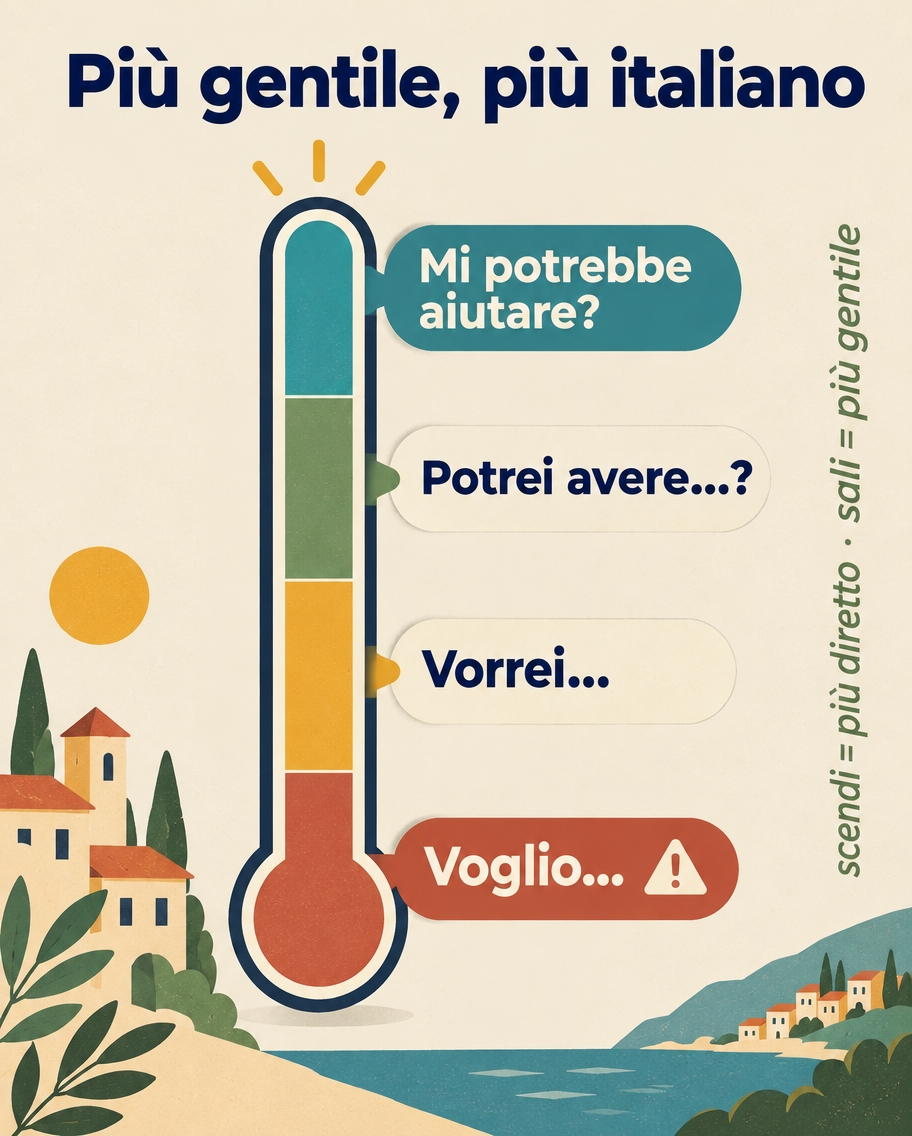
Vorrei , potrei , dovrei : the polite conditional The conditional is the tense of politeness . It uses the same stem as the future (Lesson 14) plus the endings -ei , -esti , -ebbe , -emmo , -este , -ebbero . So volere becomes vorrei (I would like ), potere becomes potrei (I could ) and dovere becomes dovrei (I should ).
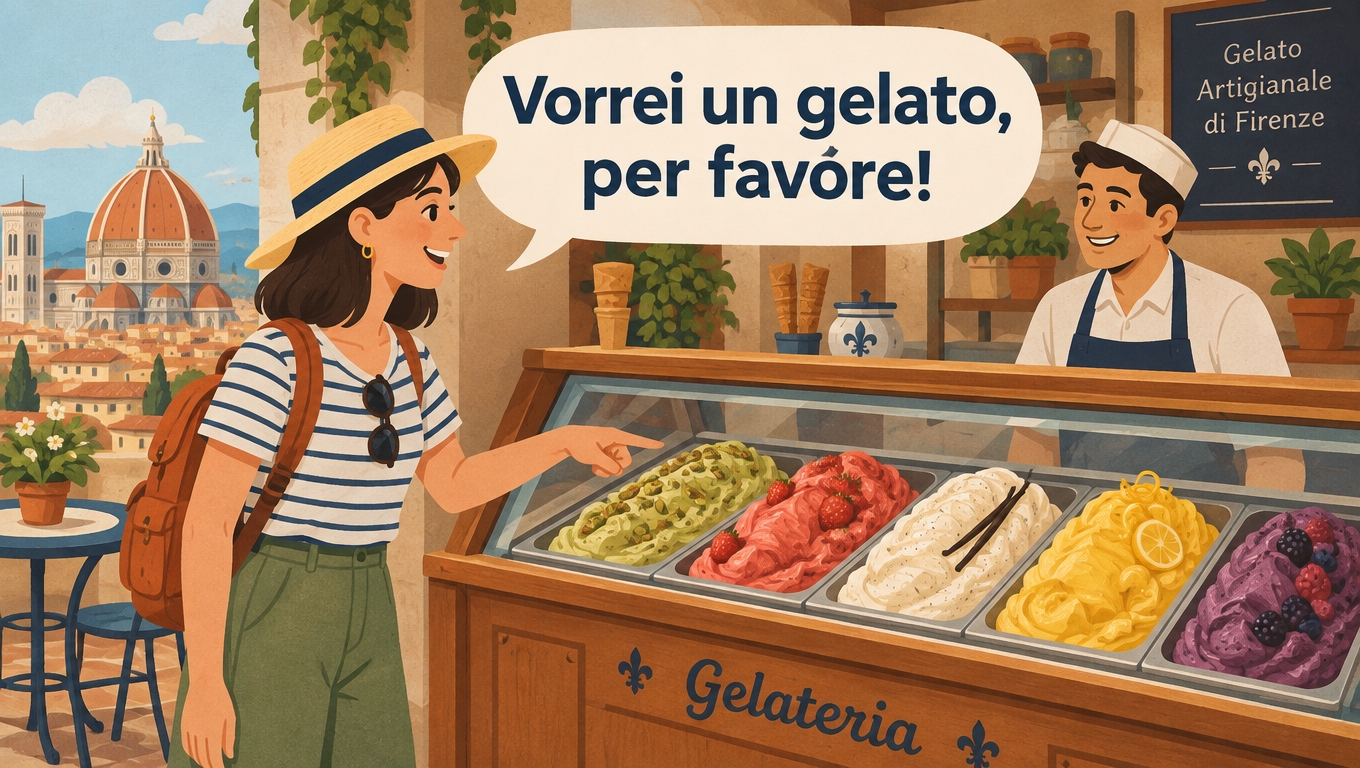
One change transforms how people hear you . Voglio un caffè (I want a coffee ) can sound demanding with strangers ; Vorrei un caffè is warm and polite . Use vorrei whenever you order , book or ask for something , and add per favore to finish the job .
Vorrei un caffè, per favore.
I would like a coffee, please.
Listen in Italian:
Slow in Italian:
Vorrei un caffè, per favore.
Listen in Italian:
Slow in Italian:
Potrei pagare con la carta?
Could I pay by card?
Listen in Italian:
Slow in Italian:
Potrei pagare con la carta?
Listen in Italian:
Slow in Italian:
Dovrei prenotare il treno.
I should book the train.
Listen in Italian:
Slow in Italian:
Dovrei prenotare il treno.
Listen in Italian:
Slow in Italian:
Mi piacerebbe : how to say what you would love Piacere works backwards from English : the thing you like is the subject , so the verb agrees with it , not with you . Mi piace Roma means literally Rome is pleasing to me .
In the conditional this gives you a gentle way to talk about wishes : mi piacerebbe + infinitive means I would like to ... Use mi piacerebbero when the thing is plural : mi piacerebbero due biglietti (I would like two tickets ). To ask a friend , say ti piacerebbe ...?
Mi piacerebbe visitare il centro storico.
I would like to visit the historic centre.
Listen in Italian:
Slow in Italian:
Mi piacerebbe visitare il centro storico.
Listen in Italian:
Slow in Italian:
Ti piacerebbe un caffè?
Would you like a coffee?
Listen in Italian:
Slow in Italian:
Ti piacerebbe un caffè?
Listen in Italian:
Slow in Italian:
Mi piacerebbero due biglietti per Roma.
I would like two tickets to Rome.
Listen in Italian:
Slow in Italian:
Mi piacerebbero due biglietti per Roma.
Listen in Italian:
Slow in Italian:
Two ways to ask : tu and Lei With strangers , in shops and at reception desks , Italian uses the formal Lei — grammatically the third person . Potrebbe aiutarmi ? (Could you help me ?) is the most useful formal question you will ever learn : potrebbe plus any infinitive , with mi attached to the end of that infinitive . Informally , to a friend : Potresti aiutarmi ?
Imperatives follow the same split . To a friend : scusami (excuse me ), dimmi (tell me ), dammi (give me ) — the pronoun glues itself to the end . To a stranger : mi scusi , mi dica , mi dia — the pronoun comes before the verb . Same meaning , different door .
Potrebbe ripetere, per favore?
Could you repeat that, please?
Listen in Italian:
Slow in Italian:
Potrebbe ripetere, per favore?
Listen in Italian:
Slow in Italian:
Mi scusi, dov'è il binario sei?
Excuse me, where is platform six?
Listen in Italian:
Slow in Italian:
Mi scusi, dov'è il binario sei?
Listen in Italian:
Slow in Italian:
Scusami, sono in ritardo.
Sorry, I am late.
Listen in Italian:
Slow in Italian:
Scusami, sono in ritardo.
Listen in Italian:
Slow in Italian:
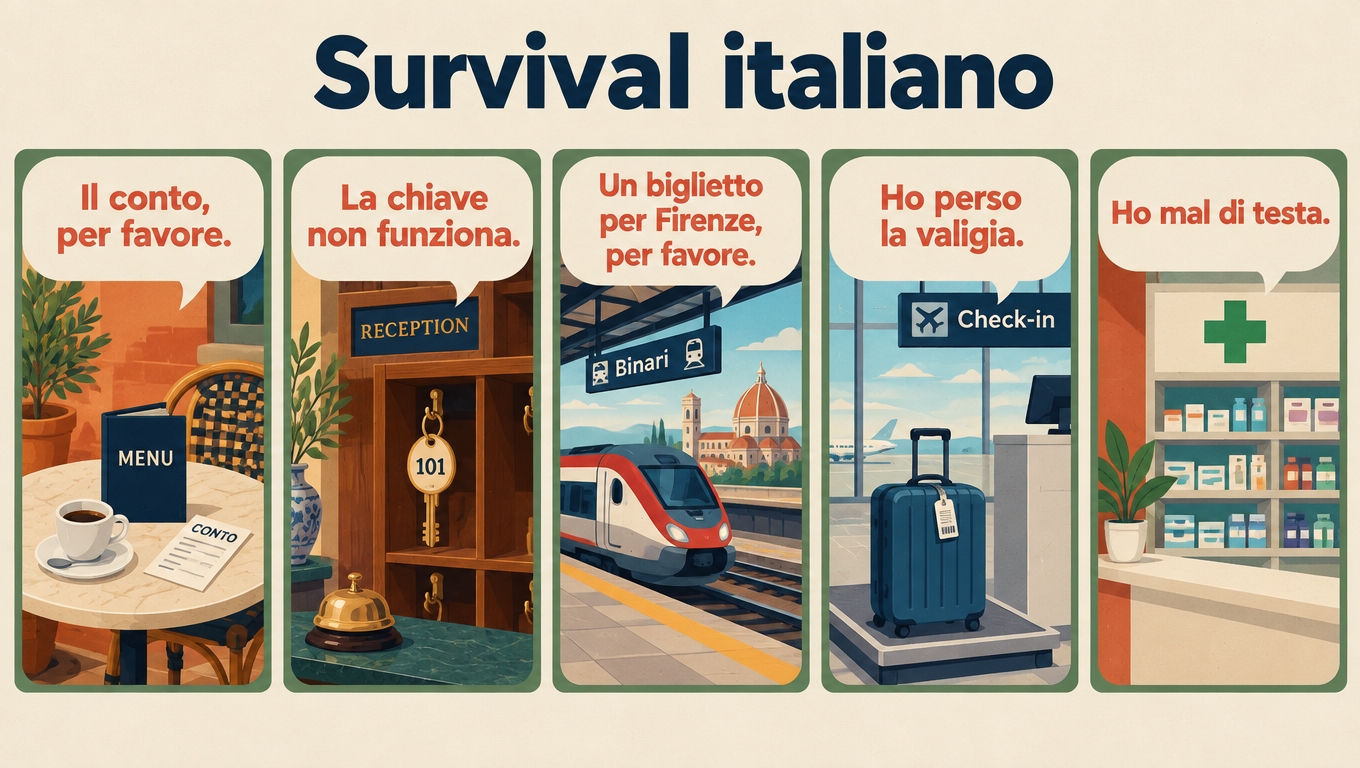
When something goes wrong Two patterns solve most everyday problems . First : Non funziona + the thing , for anything that does not work — remember the verb agrees , so non funzionano le luci for plurals . Second : C 'è un problema con + the thing , for everything else .
Then say what you need with vorrei or mi serve (I need ), and listen for the common replies : Subito (right away ), Mi dispiace (I am sorry ), Un momento (one moment ). Calm , polite and clear wins every time .
Non funziona la doccia.
The shower is not working.
Listen in Italian:
Slow in Italian:
Non funziona la doccia.
Listen in Italian:
Slow in Italian:
C'è un problema con la prenotazione.
There is a problem with the booking.
Listen in Italian:
Slow in Italian:
C'è un problema con la prenotazione.
Listen in Italian:
Slow in Italian:
Non ho ordinato questo.
I did not order this.
Listen in Italian:
Slow in Italian:
Non ho ordinato questo.
Listen in Italian:
Slow in Italian:
The polite conditional : volere , potere , dovere Future stem + -ei , -esti , -ebbe , -emmo , -este , -ebbero . Vorrei is the polite replacement for voglio ; potrebbe is the formal could you .
piacere in the conditional : what you would like The thing liked is the subject : mi piacerebbe un caffè , but mi piacerebbero due biglietti .
Getting attention : tu and Lei imperatives With tu the pronoun attaches to the end of the verb ; with Lei it stands before the verb . Choose the column before you speak .
Exercises
Choose the polite way to order .
___ un caffè , per favore .
Show answer and explanation
Choose from: Vorrei Voglio Voglia Vorrebbe
Vorrei
Hint: You need the io form of the conditional .
Vorrei is the io conditional of volere — I would like . Voglio (I want ) sounds too direct with strangers .
Choose the correct formal request .
___ aiutarmi , per favore ?
Show answer and explanation
Choose from: Potrebbe Potresti Puoi Posso
Potrebbe
Hint: Formal requests use the third-person conditional .
Potrebbe is the formal (Lei ) conditional of potere — could you . Potresti is informal ; puoi and posso are present tense .
Choose the correct form of piacere .
Mi ___ visitare Venezia . (I would like to visit Venice .)
Show answer and explanation
Choose from: piacerebbe piace piacciono piaci
piacerebbe
Hint: A wish needs the conditional .
Mi piacerebbe + infinitive means I would like to ... The action is treated as one thing , so the verb is singular .
Choose the formal way to say excuse me .
___, signora ! Dov 'è la stazione ?
Show answer and explanation
Choose from: Mi scusi Scusami Scusa Scusatemi
Mi scusi
Hint: Signora tells you the register .
With a stranger you address as Lei : mi scusi . Scusami and scusa are for friends ; scusatemi addresses a group .
Write the correct form .
volere — io (conditional )
Show answer and explanation
vorrei
Hint: Same stem as the future : vorrò → vorrei .
The conditional uses the future stem vorr - plus -ei : io vorrei .
Write the correct form .
potere — Lei , formal you (conditional )
Show answer and explanation
potrebbe
Hint: Future stem potr - plus -ebbe .
The formal Lei takes the third-person form : potrebbe — could you .
Write the correct form .
dovere — io (conditional )
Show answer and explanation
dovrei
Hint: Like the future dovrò , but with -ei .
Dovere drops its first e : stem dovr - plus -ei gives dovrei — I should .
Fill the gap with the polite form of volere .
___ prenotare un tavolo per due . (I would like )
Show answer and explanation
Vorrei
Hint: Conditional of volere , io form .
Vorrei + infinitive is the standard polite request : I would like to book .
Fill the gap with the correct form .
Non ___ il riscaldamento . (funzionare )
Show answer and explanation
funziona
Hint: Third person singular .
Il riscaldamento is singular and masculine , so the verb is funziona : the heating is not working .
Fill the gap with the correct preposition .
C 'è un problema ___ la camera . (with )
Show answer and explanation
con
Hint: It means with .
The pattern is c 'è un problema con + noun : there is a problem with ...
Translate into Italian .
Could you help me , please ? (formal )
Show answer and explanation
Potrebbe aiutarmi , per favore ?
Hint: Potrebbe + aiutar + mi .
Potrebbe (formal could you ) + aiutare + mi attached to the infinitive : aiutarmi .
Translate into Italian .
I would like a ticket to Rome .
Show answer and explanation
Vorrei un biglietto per Roma
Hint: Vorrei + un biglietto + per .
Vorrei + article + noun ; the destination takes per : per Roma .
Translate into Italian .
The key does not work .
Show answer and explanation
La chiave non funziona
Hint: la chiave + non + funzionare .
Both orders are natural : la chiave non funziona or non funziona la chiave .
Translate into Italian .
Excuse me , where is the station ? (formal )
Show answer and explanation
Mi scusi , dov 'è la stazione ?
Hint: mi scusi + dov 'è .
Formal excuse me is mi scusi ; dov 'è is dove + è contracted .
Translate into Italian .
I did not order this .
Show answer and explanation
Non ho ordinato questo
Hint: non + ho + the -ato participle of ordinare .
Negative passato prossimo : non + ho + ordinato (regular -are participle ).
Translate into English .
Mi piacerebbe visitare il centro storico .
Show answer and explanation
I would like to visit the historic centre
Hint: Piacerebbe is the conditional .
Mi piacerebbe + infinitive expresses a wish : I would like to ...
Translate into English .
C 'è un problema con la prenotazione .
Show answer and explanation
There is a problem with the booking
Hint: C 'è = there is .
C 'è un problema con — there is a problem with . La prenotazione is the booking or reservation .
Translate into English .
Dovrei confermare il volo .
Show answer and explanation
I should confirm the flight
Hint: Conditional of dovere .
Dovrei is the conditional of dovere : I should / I ought to .
Tap the words in the correct order .
Build the sentence : I would like a coffee , please .
Show answer and explanation
Vorrei un caffè per favore
Hint: Start with the polite verb .
Vorrei + un caffè + per favore . Voglio is the distractor — too direct for polite ordering .
Tap the words in the correct order .
Build the question : Could you help me , please ? (formal )
Show answer and explanation
Potrebbe aiutarmi per favore ?
Hint: The conditional comes first .
Potrebbe first , then the infinitive with mi attached : aiutarmi , then per favore .
Tap a formal phrase , then tap the informal equivalent .
Match each formal imperative to its informal twin .
Show answer and explanation
mi scusi — scusami , mi dica — dimmi , mi dia — dammi , mi aiuti — aiutami
Hint: Formal : mi + verb . Informal : verb + mi .
Formal Lei imperatives put mi before the verb ; informal tu imperatives glue the pronoun to the end .
Tap a sentence , then tap its place .
Match each problem to the place where you would say it .
Show answer and explanation
Non funziona la doccia . — hotel , Il volo è in ritardo . — airport , Non ho ordinato questo . — restaurant , Mi serve una medicina . — pharmacy
Hint: Think about what a doccia and a volo are .
Each situation has its place : doccia → hotel , volo → airport , ordinare → restaurant , medicina → pharmacy .
Play the audio , then type exactly what you hear .
Listen and write the Italian sentence .
Show answer and explanation
Non funziona la doccia .
Hint: A hotel problem with funzionare .
Non funziona la doccia — the shower is not working .
Play the audio , then choose what the speaker is asking for .
Listen . What does the speaker want ?
Show answer and explanation
Choose from: A ticket to Rome A hotel in Rome A table for two A taxi to the airport
A ticket to Rome
Hint: Listen for biglietto .
Vorrei un biglietto per Roma — I would like a ticket to Rome .
Choose the correct article .
___ stazione è qui vicino .
Show answer and explanation
Choose from: La Il Lo L '
La
Hint: Stazione ends in -e but is feminine .
Stazione is a feminine noun , so it takes la .
Choose the correct article .
___ albergo è in centro .
Show answer and explanation
Choose from: L 'Il La Lo
L '
Hint: Masculine noun , vowel start .
Albergo is masculine and starts with a vowel , so il becomes l ': l 'albergo .
Choose the correct pronoun .
___ piacerebbe un caffè . (I would like a coffee .)
Show answer and explanation
Choose from: Mi Ti Lo Io
Mi
Hint: To me — the indirect pronoun .
Piacere needs an indirect object pronoun : mi piacerebbe — it would be pleasing to me .
Rewrite the sentence using the conditional .
Make it polite : Voglio un caffè .
Show answer and explanation
Vorrei un caffè
Hint: Change only the verb .
Swap voglio for the conditional vorrei — the sentence instantly becomes polite .
Rewrite for a stranger you address as Lei .
Make it formal : Scusami , sono in ritardo .
Show answer and explanation
Mi scusi , sono in ritardo
Hint: Move mi before the formal imperative .
Scusami is the tu form ; with Lei the pronoun moves before the verb : mi scusi .
True or false ?
Voglio un caffè is the most polite way to order in a bar .
Show answer and explanation
false
Hint: Which is softer : I want or I would like ?
False . Voglio (I want ) sounds demanding ; the polite choice is vorrei — I would like .
True or false ?
Mi dica is used with people you address as Lei .
Show answer and explanation
true
Hint: Think about who says mi dica to you in a shop .
True . Mi dica is the formal imperative of dire ; with friends you say dimmi .
Say the sentence aloud , then show the meaning and rate yourself .
Potrebbe aiutarmi , per favore ?
Show answer and explanation
Could you help me , please ?
Hint: poh-TREHB-beh ah-yoo-TAR-mee
Your master key for formal requests : potrebbe + infinitive + mi .