
Vado a Firenze in treno.
I am going to Florence by train.
IPA /ˈvado a fiˈrɛntse in ˈtrɛno/
Say it VAH-doh ah fee-REHN-tseh in TREH-noh
a + city, in + transport.
Listen in Italian:
Slow in Italian:
Vado a Firenze in treno.
Move around with a, in, da, di, con, senza and per, talk about people with tonic pronouns, and make requests with dare, dire and dimmi, dammi.
Say these aloud before you start. They come from earlier lessons.
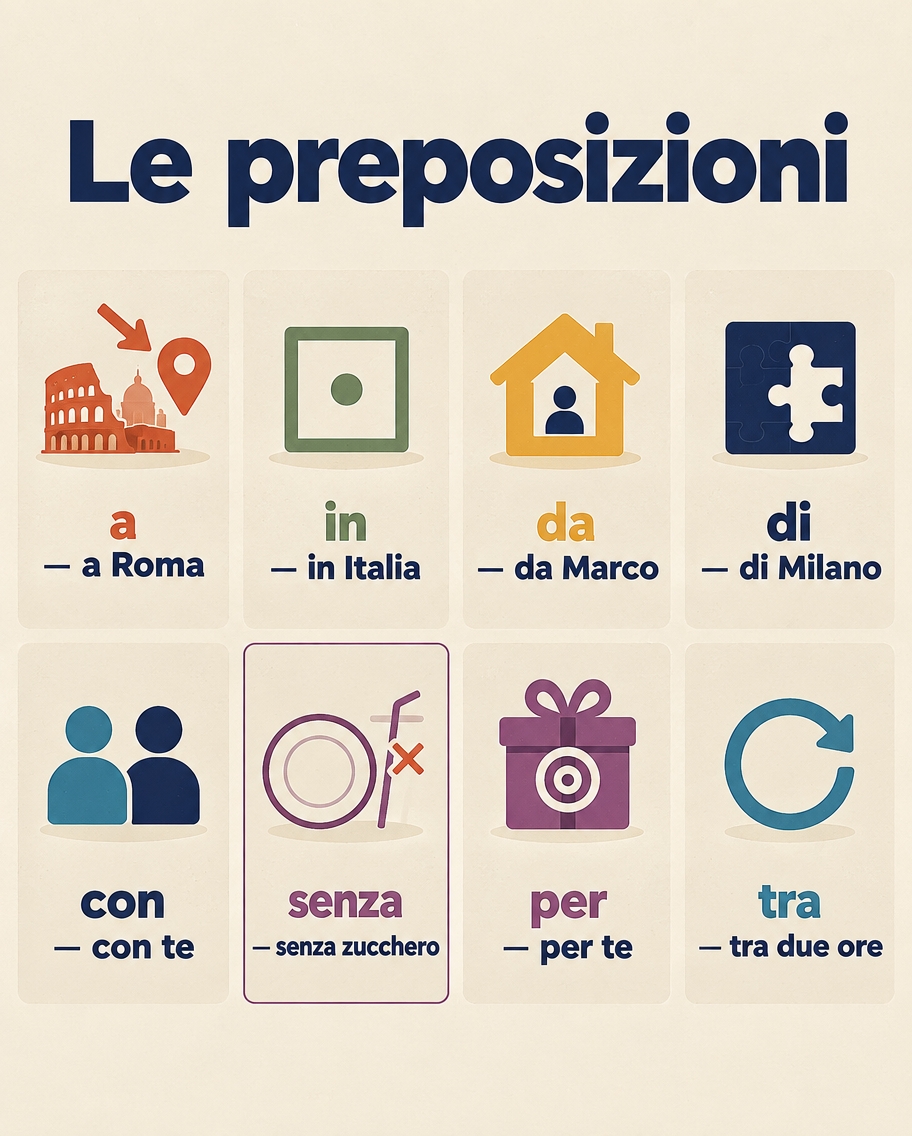
Italian movement and relationships run through a small set of prepositions: a (to/at), in (in/into), da (from/at someone's place), di (of/from), con (with), senza (without), per (for/through).
Note the patterns: vado a Roma, vado in Italia, vengo da Milano, sono di Venezia, lavoro con Luca, un caffè senza zucchero, un regalo per te. Learn them in fixed chunks, not as isolated words.
When a preposition meets the definite article, they usually fuse: a + il = al, a + la = alla, in + il = nel, in + la = nella, da + il = dal, da + la = dalla, di + il = del.
You have already used them without noticing: vado al cinema (a + il), la casa del professore (di + il). Learn the most common ones as vocabulary: al, alla, nel, nella, dal, dalla, del, della.
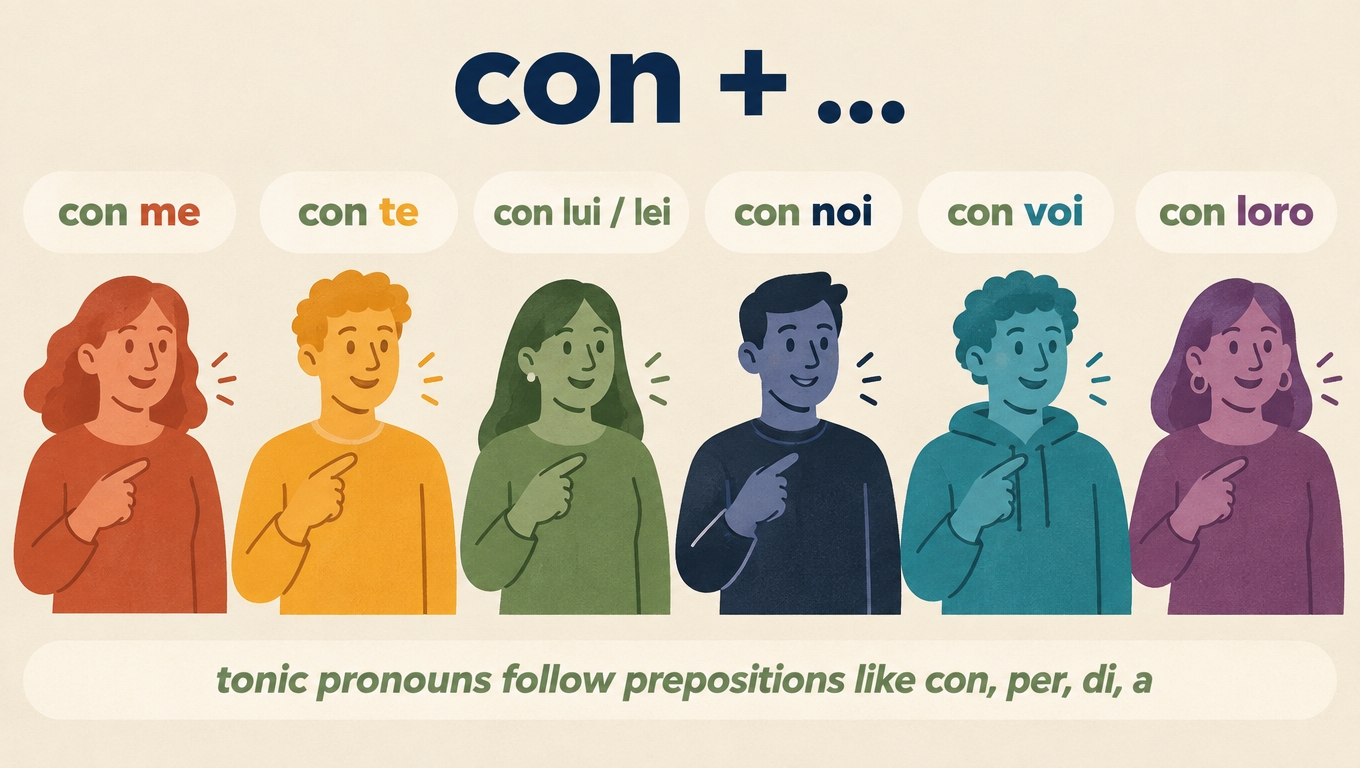
After a preposition, Italian uses the strong pronoun forms: me, te, lui, lei, noi, voi, loro — not mi, ti, lo, la. Vieni con me? (Are you coming with me?), Questo regalo è per te (This gift is for you).
They are easy because you mostly need me, te, lui, lei: con me, per te, con lui, da lei.
dare (to give) and dire (to say) are irregular but short: dare — do, dai, dà, diamo, date, danno; dire — dico, dici, dice, diciamo, dite, dicono.
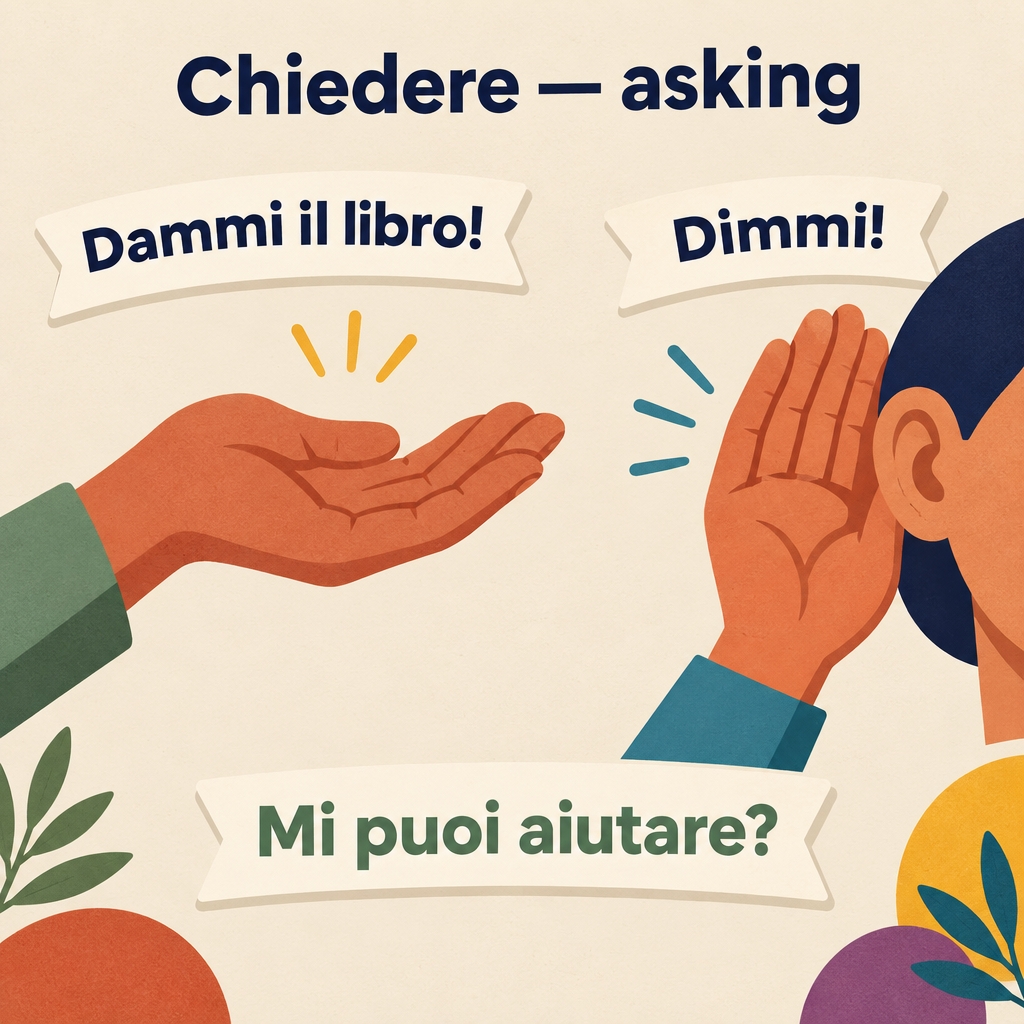
For quick requests, Italian uses the imperative: dimmi (tell me), dammi (give me), and the polite mi dica (tell me, formal). The -mi and -ci stick to the verb: aiutami (help me), parlami (talk to me).
| Form | il | la | lo |
|---|---|---|---|
| a | al | alla | allo |
| in | nel | nella | nello |
| da | dal | dalla | dallo |
| di | del | della | dello |
a + il → al, in + il → nel, da + il → dal, di + il → del. Learn the chunks, not the rule tables.
| Form | dare | dire |
|---|---|---|
| io | do | dico |
| tu | dai | dici |
| lui / lei | dà | dice |
| noi | diamo | diciamo |
| voi | date | dite |
| loro | danno | dicono |
Both are irregular in the io form. dà carries an accent to distinguish it from da (from).
| Italian | English | Pronunciation | Audio |
|---|---|---|---|
| la preposizione | preposition | /prepoziˈtsjone/ preh-poh-zee-TSYOH-neh | Listen in Italian: Slow in Italian: la preposizione |
| dare | to give | /ˈdare/ DAH-reh | Listen in Italian: Slow in Italian: dare |
| dire | to say, to tell | /ˈdire/ DEE-reh | Listen in Italian: Slow in Italian: dire |
| il regalo | gift, present | /reˈɡalo/ reh-GAH-loh | Listen in Italian: Slow in Italian: il regalo |
| la chiave | key | /ˈkjave/ KYAH-veh | Listen in Italian: Slow in Italian: la chiave |
| la borsa | bag; handbag | /ˈbɔrsa/ BOR-sah | Listen in Italian: Slow in Italian: la borsa |
| il sale | salt | /ˈsale/ SAH-leh | Listen in Italian: Slow in Italian: il sale |
| lo zucchero | sugar | /ˈtsukkero/ TSOOK-keh-roh | Listen in Italian: Slow in Italian: lo zucchero |
| il mare | the sea, the seaside | /il ˈmare/ eel MAH-reh | Listen in Italian: Slow in Italian: il mare |
| la stazione | the station | /la statˈtsjone/ lah staht-TSYOH-neh | Listen in Italian: Slow in Italian: la stazione |
| il treno | the train | /il ˈtrɛno/ eel TREH-noh | Listen in Italian: Slow in Italian: il treno |
| aiutare | to help | /ajuˈtare/ ah-yoo-TAH-reh | Listen in Italian: Slow in Italian: aiutare |
| rispondere | to answer, to reply | /riˈspondere/ ree-SPOHN-deh-reh | Listen in Italian: Slow in Italian: rispondere |
| chiedere | to ask | /ˈkjɛdere/ KYEH-deh-reh | Listen in Italian: Slow in Italian: chiedere |
| vicino | near, close | /viˈtʃino/ vee-CHEE-noh | Listen in Italian: Slow in Italian: vicino |
| lontano | far | /lonˈtano/ lohn-TAH-noh | Listen in Italian: Slow in Italian: lontano |
| sopra | above, on top | /ˈsopra/ SOH-prah | Listen in Italian: Slow in Italian: sopra |
| sotto | under, below | /ˈsotto/ SOHT-toh | Listen in Italian: Slow in Italian: sotto |
| dentro | inside | /ˈdentro/ DEHN-troh | Listen in Italian: Slow in Italian: dentro |
| fuori | outside | /ˈfwɔri/ FWOH-ree | Listen in Italian: Slow in Italian: fuori |
| insieme | together | /inˈsjɛme/ een-SYEH-meh | Listen in Italian: Slow in Italian: insieme |
| mia | mine (feminine) | /ˈmia/ MEE-ah | Listen in Italian: Slow in Italian: mia |
| la cosa | thing | /ˈkɔza/ KOH-zah | Listen in Italian: Slow in Italian: la cosa |
| l'amico | friend (male) | /aˈmiko/ ah-MEE-koh | Listen in Italian: Slow in Italian: l'amico |
| l'amica | friend (female) | /aˈmika/ ah-MEE-kah | Listen in Italian: Slow in Italian: l'amica |
| la festa | party, celebration | /la ˈfɛsta/ lah FEH-stah | Listen in Italian: Slow in Italian: la festa |
Vado a Firenze in treno.
I am going to Florence by train.
IPA /ˈvado a fiˈrɛntse in ˈtrɛno/
Say it VAH-doh ah fee-REHN-tseh in TREH-noh
a + city, in + transport.
Vengo da Milano.
I come from Milan.
IPA /ˈveŋɡo da miˈlano/
Say it VEHN-goh dah mee-LAH-noh
Sono di Venezia.
I am from Venice.
IPA /ˈsono di veˈnɛttsja/
Say it SOH-noh dee veh-NEHT-syah
di for origin.
Un caffè senza zucchero, per favore.
A coffee without sugar, please.
IPA /um kafˈfɛ ˈsɛntsa ˈtsukkero per faˈvore/
Say it oon kahf-FEH SEHN-tsah TSOOK-keh-roh pehr fah-VOH-reh
Questo è per te.
This is for you.
IPA /ˈkwesto ɛ per ˈte/
Say it KWEH-stoh eh pehr TEH
Vieni con me?
Are you coming with me?
IPA /ˈvjɛni kon ˈme/
Say it VYEH-nee kohn MEH
con + me, not con + mi.
Parlo con lui domani.
I will talk with him tomorrow.
IPA /ˈparlo kon ˈlui doˈmani/
Say it PAR-loh kohn LOO-ee doh-MAH-nee
Vado al mare d'estate.
I go to the seaside in summer.
IPA /ˈvado al ˈmare deˈstate/
Say it VAH-doh ahl MAH-reh dehs-TAH-teh
al = a + il.
La chiave è nella borsa.
The key is in the bag.
IPA /la ˈkjave ɛ ˈnella ˈbɔrsa/
Say it lah KYAH-veh eh NEHL-lah BOR-sah
nella = in + la.
Esco dalla stazione alle sei.
I leave the station at six.
IPA /ˈɛsko ˈdalla statˈtsjone ˈalle ˈsɛi/
Say it EHS-koh DAHL-lah stah-TSYOH-neh AL-leh SAY
dalla = da + la.
Dimmi come stai.
Tell me how you are.
IPA /ˈdimmi ˈkome ˈstai/
Say it DEEM-mee KOH-meh STY
dimmi = di' + mi.
Dammi il sale, per favore.
Give me the salt, please.
IPA /ˈdammi il ˈsale per faˈvore/
Say it DAHM-mee eel SAH-leh pehr fah-VOH-reh
dammi = da' + mi.
Mi dica, per favore.
Tell me, please. (formal)
IPA /mi ˈdika per faˈvore/
Say it mee DEE-kah pehr fah-VOH-reh
Puoi aiutarmi?
Can you help me?
IPA /ˈpwɔi ajuˈtarmi/
Say it PWOY ah-yoo-TAHR-mee
aiutarmi = aiutare + mi.
Mi può aiutare?
Can you help me? (formal)
IPA /mi ˈpwɔ ajuˈtare/
Say it mee PWO ah-yoo-TAH-reh
Ti do un regalo.
I give you a gift.
IPA /ti do um reˈɡalo/
Say it tee doh oon reh-GAH-loh
ti = to you (indirect).
Mi dai una mano?
Will you give me a hand?
IPA /mi ˈdai ˈuna ˈmano/
Say it mee DY OO-nah MAH-noh
la mano is feminine despite -o.
Ti ho detto la verità.
I told you the truth.
IPA /ti o ˈdetto la veriˈta/
Say it tee oh DEHT-toh lah veh-ree-TAH
dire → detto.
Cosa mi consigli?
What do you recommend to me?
IPA /ˈkɔza mi konˈsiʎʎi/
Say it KOH-zah mee kohn-SEE-lyee
Andiamo insieme al cinema.
Let's go to the cinema together.
IPA /anˈdjamo inˈsjɛme al ˈtʃinema/
Say it ahn-DYAH-moh een-SYEH-meh ahl CHEE-neh-mah
insieme = together.
Il regalo è per mia madre.
The gift is for my mother.
IPA /il reˈɡalo ɛ per ˈmia ˈmadre/
Say it eel reh-GAH-loh eh pehr MEE-ah MAH-dreh
Non posso uscire senza chiavi.
I cannot go out without the keys.
IPA /non ˈpɔsso uʃˈʃire ˈsɛntsa ˈkjavi/
Say it nohn POHS-soh oo-SHEE-reh SEHN-tsah KYAH-vee
A traveller asks how to get to the centre.
Mi scusi, come arrivo al centro?
Excuse me, how do I get to the centre?
Listen in Italian: Slow in Italian: Mi scusi, come arrivo al centro?Prenda il treno per Firenze e scenda a Santa Maria Novella.
Take the train to Florence and get off at Santa Maria Novella.
Listen in Italian: Slow in Italian: Prenda il treno per Firenze e scenda a Santa Maria Novella.La stazione è lontana da qui?
Is the station far from here?
Listen in Italian: Slow in Italian: La stazione è lontana da qui?No, è vicina. Dieci minuti a piedi.
No, it is close. Ten minutes on foot.
Listen in Italian: Slow in Italian: No, è vicina. Dieci minuti a piedi.Perfetto, grazie mille!
Perfect, thanks a lot!
Listen in Italian: Slow in Italian: Perfetto, grazie mille!Di niente, buon viaggio!
You are welcome, have a good trip!
Listen in Italian: Slow in Italian: Di niente, buon viaggio!Leo asks a friend to help him move.
Ciao! Puoi aiutarmi domani?
Hi! Can you help me tomorrow?
Listen in Italian: Slow in Italian: Ciao! Puoi aiutarmi domani?Certo! Cosa devo fare?
Of course! What do I need to do?
Listen in Italian: Slow in Italian: Certo! Cosa devo fare?Devo portare questa borsa a casa mia.
I need to carry this bag to my home.
Listen in Italian: Slow in Italian: Devo portare questa borsa a casa mia.Dammi un momento, arrivo subito.
Give me a moment, I will be right there.
Listen in Italian: Slow in Italian: Dammi un momento, arrivo subito.Grazie! Vieni con me in macchina?
Thanks! Are you coming with me by car?
Listen in Italian: Slow in Italian: Grazie! Vieni con me in macchina?Sì, volentieri!
Yes, gladly!
Listen in Italian: Slow in Italian: Sì, volentieri!Choose the correct preposition for cities.
Choose the correct preposition for countries.
Choose the correct preposition for origin.
Choose the correct pronoun.
Fill the gap with the tonic pronoun.
Write the correct form.
Write the correct form.
Write the past participle.
Translate into Italian.
Translate into Italian (informal).
Translate into Italian.
Translate into Italian.
Translate into English.
Translate into English.
Choose the articulated preposition.
Choose the articulated preposition.
Tap the words in the correct order.
Tap a preposition, then its meaning.
Tap a form, then its parts.
True or false?
True or false?
Play the audio, then type exactly what you hear.
Play the audio, then pick the sentence.
Say the request aloud, then reveal and rate yourself.
Say the request aloud, then reveal and rate yourself.
Ask a partner aloud: come with me, give me a hand, tell me how you are — in both informal and formal. Then say where you go in summer and who you talk to tomorrow.
Before you move on, make sure you can do all of this without looking:
Go deeper: Prepositions · Articulated prepositions · Indirect object pronouns · Direct object pronouns